Do it for science – not for tenure

Career advice from a Nobel Laureate

By Judith Reichel

I recently had the pleasure of joining the 67th Lindau Nobel Laureate meeting at Lake Constance in the south of Germany. The weeklong meeting alternates its main focus between chemistry, physics, and medicine & physiology each year — the three categories of natural sciences the Nobel Prizes are awarded for. This year the focus was back on chemistry, and I was lucky enough to be invited by the organisers to cover the event on their blog.

Throughout the week I met handpicked junior researchers, talented fellow science communicators and journalists, and — above all — sat down with Nobel Laureates for one-on-one interviews.

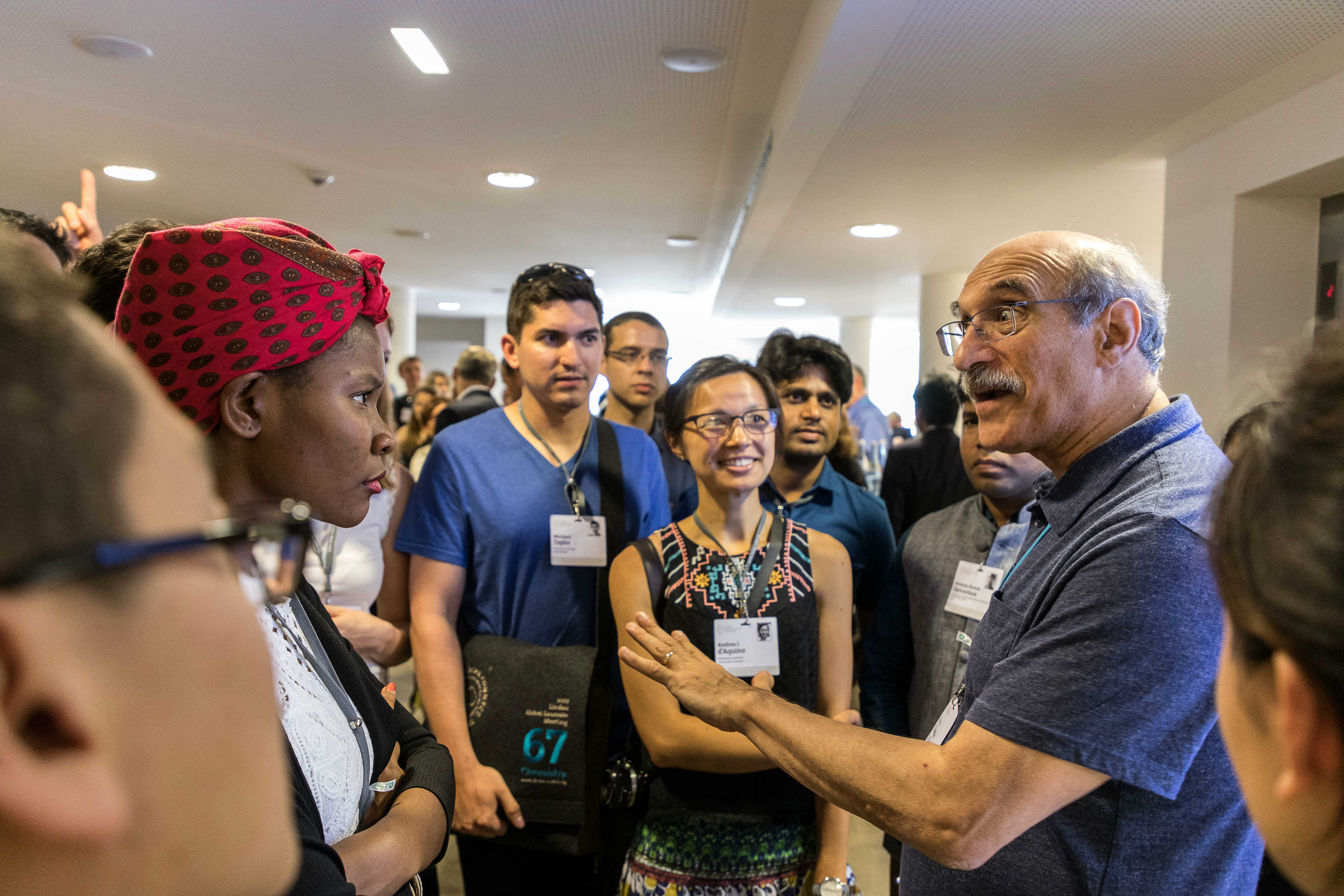
One of them was Martin Chalfie, who won the 2008 prize in Chemistry with Osamu Shimomura and Roger Y. Tsien for their development of the now widely used Green Fluorescent Protein (GFP) tag. Inserting the gene sequence for GFP into a host organism produces the protein within a cell, which allows for the visualization of intricate biological processes.

Chalfie talking to students at Lindau 2017

Chalfie talking to students at Lindau 2017{credit}Christian Flemming/Lindau Nobel Laureate Meetings Young Scientists in conversation with Martin Chalfie{/credit}

Continue reading

A look out to a dark Universe: Three young scientists share their thoughts

Young scientists from Nature’s Outlook on the dark Universe share their views on dark matter, gravitational waves, and dark energy.

You can find the full Outlook, covering the Lindau conference, Nobel prize winners, and Q&As with George Smoot and Brian Schmidt, here.

WEB_Astronomy-sky_65870

Continue reading

No such animal

Nobel Laureate Dan Shechtman describes the structure of quasi-crystals, the discovery of which won him the scorn of colleagues in the 1980’s and then the Nobel Prize in chemistry in 2011.


Suggested posts

Tick tock cold cold clock

Big box small box light-filled box

Aint no stopping them now

The precious, precious networking platinum that is Lindau

Alaina G. Levine is live from the Lindau Conference

Lindau is a special conference. Here, under the banner of Educate-Inspire-Connect, and above cobblestone streets, next to a city hall dating back to the 1400s, networking is very much encouraged, supported, facilitated and emphasised. And the networking here is precious, precious platinum.

marketing-man-person-communication (1)

Continue reading

A science masterclass

Young researchers discuss science and careers with Nobel laureates at the 2015 Lindau Nobel meeting.

Image credit: Sam Falconer

Every year, Nobel laureates and young researchers come together in Lindau, Germany. It’s a unique opportunity to glean some advice for a successful career in science. The 2015 meeting cast a spotlight on super-resolution microscopy, as discussed in depth in the Nature Outlook: Science Masterclass, as well as fields as diverse as memory formation and the Higgs boson.

The first meeting was held in 1951, just two years before Francis Crick and James Watson revealed their structure of DNA. Since then, Nobel laureates from all walks of science have graced the small island with their presence, and 2015 was no different.

Elizabeth Blackburn, who shared the 2009 Nobel Prize in Physiology or Medicine with Carol Greider and Jack Szostak for their work on telomeres, was one of only three female laureates to attend the meeting. Other attendees included Richard Roberts (shared the 1993 Nobel Prize in Physiology or Medicine with Phillip Sharp for their discoveries of split genes), Francois Englert (shared the 2013 Nobel Prize in Physics with Peter Higgs for the theoretical discovery of a mechanism that gives mass to subatomic particles), Bruce Beutler (shared one half of the 2011 Nobel Prize in Physiology or Medicine with Jules Hoffmann for their work on the activation of innate immunity) and Susumu Tonegawa (winner of the Nobel Prize in Physiology or Medicine in 1987 for unlocking the genetic secrets behind antibodies’ diverse structures).

This particular Nature Outlook was supplemented with a series of videos highlighting some of the scientists’ work. On the blog, we’ve shown Saul Perlmutter’s work on the expanding universe, Stefan Hell’s work on breaking the diffraction barrier, Robert Wilson’s work on the cosmic microwave background and an insight into Elizabeth Blackburns interest in telomeres.

But of particular interest to the Naturejobs blog are three short videos that discuss certain elements of careers in science. Equal opportunities: Women in science, explores laureate Ada Yonath’s career, and why the gender gap in science persists. Young scientists also came together to discuss whose responsibility it is to disseminate science and finally, what does an early career scientist’s future look like, given the uncertainty in the job market?

Further reading/listening from the Naturejobs blog:

Podcast with Martin Chalfie, Venki Ramakrishnan and Arieh Warshel, on what it takes to be hired into their labs.

Podcast: Academia to industry, and back again, with Eric Betzig

Mentoring: A perspective from Nobel laureates

Mentoring: Before they were laureates

Mentoring: Where do laureates go for advice?

Lessons from a laureate

Academia to industry and back again

Eric Betzig, one of three chemistry Nobel laureates from 2014, shares what he learned from working in both academia and industry, and how he applies it to his career now.


Naturejobs-podcast
It’s often said that being a science graduate is a great thing: it opens so many doors and gives you the chance to take on any career. Although this might be true, it also makes deciding what career to focus on, and train for, very difficult.

This month, Nature Careers published a great piece based on the 2015 Nature Graduate Student Survey, where Nature tried to uncover what careers early career researchers were hoping to get, and how they were preparing themselves. In this podcast I was joined by Monya Baker, one of the Nature Careers editors, to give us some further insight into the survey.

The second part of the podcast is an interview I did with Eric Betzig, one of the three chemistry Nobel prize winners in 2014. In our chat we talk about his work in breaking the diffraction limit, what it’s like to see living cells move and his transitions from academia to industry and back again.