Good science & good journalism: what’s the link?

In journalism, the more you write about a particular issue, the more chances you have of being heard by people who matter and of impacting public policy — that’s an obvious thing.

In science, the more you publish, the more you influence your peers and, in effect, people who matter. Now, that too is pretty obvious.

In many ways — especially when the issues are of immediate importance to you and me (such as the environment or health) — journalism and scientific publishing have a lot in common. They help create the buzz, bring matters to the fore and, if done well, could influence national policies. In many cases, a glaring scientific observation lends seamlessly to a brilliant work of high-impact journalism and vice-versa.

The latest IPCC working group report (fifth assessment report or AR5), as always and with reason, got a lot of media attention when it was released last month. There have been studies and more studies showing how media coverage of climate change issues peaks during IPCC negotiations and before and after the release of such ARs. However, there’s also much disappointment among negotiators and climate change communicators that effective coverage does not happen where it matters most.

During a south Asian climate change communicators’ meet last year, the issue of journalism versus activism was discussed at length as a section of journalists seemed to be gleefully crossing the line, created by modern journalism, to “do their bit for the society”. Some debated that we live in times when journalism is no longer considered a vocation, it is a profession guided mostly by advertising revenue, circulation/viewership and space/time crunch. However, most agreed that environment journalism is still that niche area where these lines often blur effortlessly.

Award winning environmental journalist Mark Schapiro says science lends itself seamlessly to great investigative stories.

Award winning environmental journalist Mark Schapiro says science lends itself effortlessly to great investigative stories.

The sentiments were echoed this month when a meet of global investigative journalists discussed how environmental journalism could be made more scientific and high-impact. The session discussed at length the many layers of environmental coverage, the use of scientific methodology and new age tools (satellite images, scientific literature and geotagged maps) to make sense of it all.

Taking this discussion to the next level — that is to ask ‘how environment journalists can make a difference’ — David Dodman of London-based International Institute of Environment and Development recently outlined what journalists in their role as communicators can do towards “strengthening the resilience of vulnerable citizens and infrastructure.”  They could advocate wise use of funds to improve living conditions and build resilience.

Dodman says urban populations in Africa and Asia live in places exposed to hazards, such as floods and tropical storms, which will become more frequent and intense in the coming decades. Many towns and cities lack the necessary basic infrastructure and resources to reduce the risk that such hazards pose,” he wrote in his blog. Urban residents are not always aware of the range of funds that their cities could use. Journalists can inform vulnerable citizens about them, so that citizens can in turn make the right demands from their authorities at different scales, he says.

A couple of months ago, an article in Nature Reviews Climate Change made a direct connection between pollution in a particular country/region to the number of scientific papers published in that country/region. The article accompanied by a beautiful map  concluded that the more the number of scientific papers produced from a country, the lesser are its pollution levels. “Good scientific research is necessary to provide the basis for the implementation of policies that aim to control harmful environmental agents, helping society to decide a course of action,” write Lais Fajersztain and colleagues in the paper.

They also infer from their study that governments that spend more on health care have more stringent air quality standards, probably because of greater governmental awareness of the adverse health effects of air pollution and the consequent establishment of air pollution control measures to avoid increased health costs. The researchers found that scientific research on the impact of air pollution on health is concentrated mainly in North America and Europe, China, Australia, Brazil and Japan. Such research is practically nonexistent in Africa, India and other South American countries — developing countries were found to contribute only 5% of the total research.

The map depicted a comparative panel of the number of papers produced from 1983 to date on malaria, water quality and air pollution, using the Web of Science database. “There was a marked imbalance between levels of air pollution and local scientific production: a more balanced scenario emerges when waterborne diseases and malaria are considered,” the scientists wrote.

Now that is something to pick on. And it brings to fore another question: are countries traditionally doing well in science also producing the best journalistic works? The question, in turn, merits another scientific study.

Good science and good journalism will never cease to give-and-take.
Aerosols contributing to climate change in India, China

Our freelance writer Biplab Das dug out an interesting research paper from Geophysical Research Letters this week. Though the authors are from Argonne National Laboratory, Illinois; NASA Goddard Institute for Space Studies and Columbia Earth Institute, Columbia University, New York; they have been working on the contribution of aerosols  to climate change in India and China.

It is worth pointing out here that there has been very little study of the contribution of aerosol emissions from India and China to radiative forcing. Radiative forcing is the process through which about 30 per cent of sunlight reaching the Earth’s surface is reflected back into space as invisible infrared light.  Aerosols generated by human activities reflect infrared light generated by reflected sunlight, thereby trapping it in the atmosphere. This alters radiative forcing, resulting in climate change. Recent studies have identified aerosol emission, particularly black carbon emission from industrializing countries like India and China, as emission control targets for mitigating climate change.

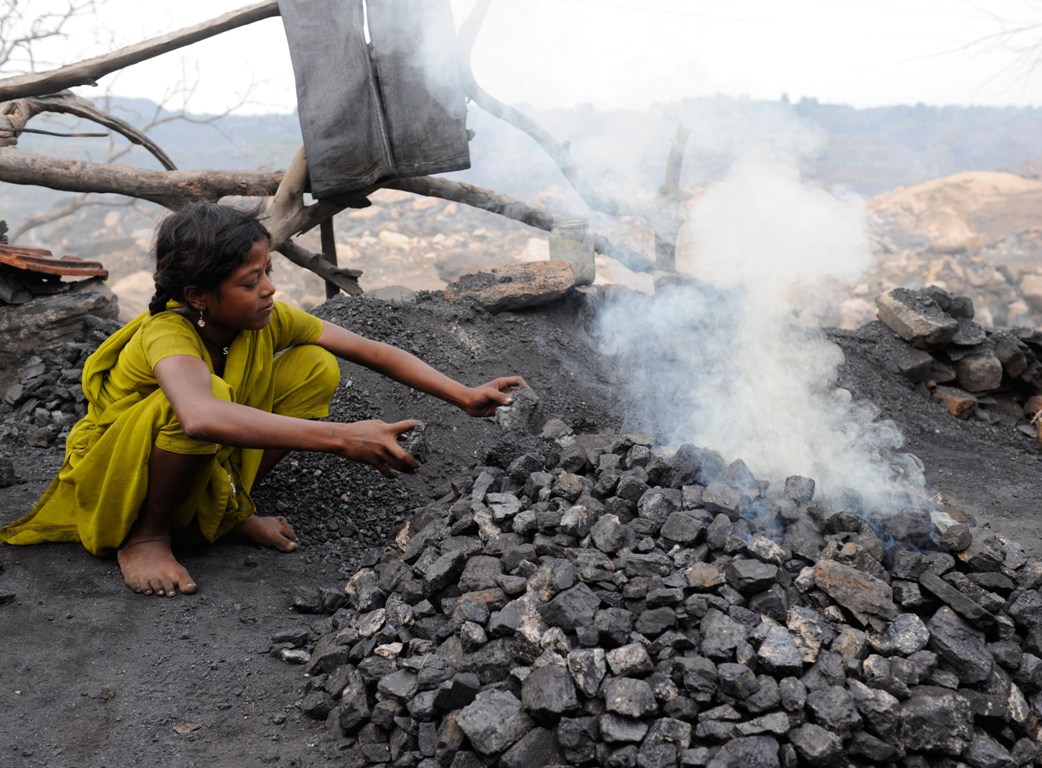
Coal burning is one of the key contributors to aerosol emissions.

Coal burning is one of the key contributors to aerosol emissions.{credit}Joerg Boethling / Alamy{/credit}

So the researchers have found that these small airborne particles called aerosols (for example, black carbon particles in diesel exhaust and sulfate particles produced by coal burning) in India and China may indirectly contribute to climate change. Higher black carbon levels in the atmosphere lead to warming, whereas increased sulfate levels cause cooling.

To find out the situation in India and China, the researchers examined emissions from the most important aerosol sources in the two neighbouring countries and estimated the net radiative forcing from each source, both locally and globally. In this analysis, they used models developed by the NASA Goddard Institute for Space Studies.

Major emission sources of black carbon are diesel truck and bus exhaust and residential biofuel and fossil-fuel combustion. For organic carbon, residential biofuel and fossil-fuel combustion are important sources. The study found that fossil-fuel combustion in the power sector accounts for 52.3 per cent of sulphur dioxide emission in India.

The researchers reveal that residential biofuel combustion in both India and China gave rise to significant positive direct radiative forcing through black carbon emission. They say that aerosol emission from diesel trucks and buses also makes a positive contribution to radiative forcing in India.

References

1. Streets, D. G. et al. Radiative forcing due to major aerosol emitting sectors in China and India. Geophys. Res. Lett. (2013) doi: 10.1002/grl.50805

India’s no to dolphinarium

Here’s some more news on India’s national aquatic animal, the Gangetic dolphin.

Last week, India’s ministry of environment and forests banned creation of any dolphinarium across the country that might attract tourists with dolphin shows or similar such commercial use of the friendly mammal, elevated to the status of national aquatic animal less than four years back.

The ministry’s Central Zoo Authority said in a circular that various state governments and tourism development corporations had been receiving proposals to develop such dolphinarium in recent years. But since India’s Wild Life (Protection) Act, 1972 says that captive animals can be kept for exhibition only in ‘zoos’ (that includes circus and rescue centres), the dolphinarium will fall under the definition of ‘zoo’.

The ministry also observed that since the endangered Gangetic dolphin is India’s national aquatic animal and a highly intelligent and sensitive species, it is morally unacceptable to keep it captive for entertainment purpose. The ministry has advised state governments to reject any such proposal for dolphinarium by organizations or agencies.

A fisherman with a Gangetic Dolphin.

A fisherman with a Gangetic dolphin.{credit}CAPGD 2010{/credit}

The Gangetic dolphin was accorded the national aquatic animal status in 2009 when the 100 million year old species was found to face the danger of extinction within the next decade if not protected ferociously.

Poaching,  accidental killing, dolphin-fisherman competition for fish, use of dolphin products, construction of dams and barrages  and pollution of the river are named as some of the biggest threats to the dolphin population.

At last count, India had around 2,300 Gangetic dolphins. The World Wide Fund for Nature had said in 2009 before any large-scaled national intervention that its population was declining at a rate of 10 per cent annually.

India then launched a decadal programme (The Conservation Action Plan for the Gangetic Dolphin 2010-2020) which noted: “Just as the tiger represents the health of the forest and the snow leopard represents the health of the mountainous regions, the presence of the Dolphin in a river system signals its good health and biodiversity.”

Here’s hoping that all the action bears fruit and makes life somewhat better for the Gangetic dolphin by 2020.

Heat warning system for India’s harsh summer

I found it quite interesting that an Indian city should have a proper ‘action plan’ to tackle the effects of changing climate patterns that have resulted in some severe summer temperatures in the last decade. Living in India, the action plans by city or state administrations we have mostly seen are: close schools and colleges,  close offices and at best issue a “do not venture out between 11 a.m. to 4 p.m” notice. There have been sporadic public interest advertisements in newspapers on how to beat the heat.

So, this week when the U.S. based environmental action group NRDC said it would be releasing South Asia’s first ‘heat action plan’ for the city of Ahmedabad in Gujarat, India, it struck as a novel, much-needed concept.

viewimage

Some key people behind the action plan: (clockwise) Kim Knowlton, Dileep Mavalankar, Gulrez Azhar and Anjali Jaiswal (inset).

The plan has been finalised in collaboration with the Indian Institute of Public Health (IIPH), Gandhinagar; Mount Sinai School of Medicine, Rollins School of Public Health at Emory University, Georgia, USA; and Ahmedabad Municipal Corporation (AMC). NRDC said in a release that with this plan to protect residents from extreme heat events, Ahmedabad will be able to ‘comprehensively address the threat of extreme heat caused by climate change.’ (NRDC’s Anjali Jaiswal and Kim Knowlton have elaborated on the action plan in their blogs earlier. Dileep Mavalankar and Gulrez Shah Azhar from IIPH, Gandhinagar were partners in the project. )

The action plan includes initiatives to educate communities on the health risks of extreme heat, implement an early warning system, and train medical officials to treat heat-related illnesses. The plan is being officially released on Arpil 16, 2013.  It includes plans on how to equip government agencies, healthcare providers and other stakeholders to respond to extreme heat events as India’s heat season progresses.

NRDC says the action plan is based on scientific studies conducted in the city over two years. The plan also suggests policy measures to address projected future health risks related to extreme heat. A key area of the plan that would be useful for the local administration are suggestions on creating emergency response and management; and involving health agencies as well as meteorological services in the bigger scheme of things.

The idea is to have an innovative set of strategies, including an early heat-health warning system, to protect the city’s seven million residents (especially the vulnerable ones) from extreme heat.

If the Ahmedabad project turns out to be successful, Gujarat apparently plans to implement it across the state.

Sounds like a good plan!

Of pesticides and fertilisers

This week saw a lot of talk on safe food, clean environment, pesticides and fertilisers emanating from two events — a conference on food safety and environmental toxins and the release of the United Nations Environment Programme (UNEP) global report “Our Nutrient World”.

The conference — organised by New Delhi based Centre for Science and Environment (CSE) — noted that bio-safety of pesticides was a serious issue for India. It called for policy level intervention to give regulatory powers to either the health or the environment ministries (not the agriculture ministry, which presently regulates).“There is a need to review all registered pesticides taking into account comparative risk assessment and deregister toxic and obsolete pesticides,” said Chandra Bhushan, head of CSE’s food safety programme, in a press release. Organic and non-pesticide farming has been showing encouraging results across the country and the government should encourage them, he noted.

The conference called for publication of an annual report on the status of pesticide contamination in the country.

The UNEP report

The UNEP global Report “Our Nutrient World” co-authored by eminent Indian biotechnologist N. Raghuram took note of India’s constraints in phosphorous mining and urged for a mechanism to recycle human wastes for agriculture through innovative steps like urine-separating toilets.

Raghuram, also the Director of New Delhi-based South Asian Nitrogen Centre, said most of the phosphorous in India is mined from sedimentary rocks with the country accounting  for only 0.19 per cent of the world’s resources. It is mostly low-grade phosphorous not suitable for fertilizer manufacture. That makes India heavily dependent on imports.

Also, large tracts of croplands in India suffer from physico-chemical and nutrient imbalances resulting in low efficiency of applied fertilizer phosphorous. An estimated 4-15 per cent of phosphorous consumed by livestock becomes available for human consumption in the end.

With a population of close to 1.3 billion, India is estimated to release between 0.38-1.02 Tg of phosphorous per annum. Raghuram says the country needs an effective mechanism to recycle human wastes to plough back this phosphorous into agriculture use. It would ensure two things, he says — capturing nutrients and returning them to the soil as well as improved sanitation in the developing world.

Sane thinking all. Hope advocacy like this finds its way into the country’s policy documents.

Himalayas get climate funds

Some respite for the people of the Hindu Kush-Himalayas (HKH) grappling with the effects of climate change.
A new grant of 11 million euros announced today will go into livelihood development and mitigation of climate change impacts for people in the region. The European Union (EU) and the International Centre for Integrated Mountain Development (ICIMOD) signed an agreement on this today.

{credit}photodisc/imagesource{/credit}

The programme will start in 2013 and envisages using natural resources in a more sustainable, efficient way to protect the environment. According to a release by the organisations, the programme will try to do this by enhancing the knowledge base on Himalayan ecosystems and ecosystem services, raising awareness on the effects of environmental degradation, climate change and adaptation; strengthening collaborative action research in the region. It will also build capacity in higher education and train institutions and civil society across the region to scale up best practice for improved resilience to climate change.

The HKH region spans over 8 countries: Afghanistan, Bangladesh, Bhutan, China, India, Myanmar, Pakistan, and Nepal with interconnected mountain ranges and plateaus, extending for more than 3,500 km.  Glaciers alone cover an area of 60,000 square km.  The region is called the world’s ‘roof’ and ‘water tower’.
According to ICIMOD, changing climate patterns have negatively impacted the lives of people in this region. Glaciers are receding, permafrost retreats, snow melt induces changed river flows, and ecosystems are altering.
There is an increased frequency and duration of extreme climatic events, causing more frequent and severe natural disasters.  These factors aggravate erosion, land degradation, decline in soil fertility and crop yields.  The capacity of mountain people to deal with these growing stresses is limited, and the incidence of poverty is growing.
The funds should see some reversals in the lives of the HKH people, who are in the direct line of fire of the climate change phenomenon.

Green films for the masses

Films on environment and wildlife have come a long way in India in the last decade. Celluloid seems to be quite a medium of choice to take the message across. The film making format has also seen a change with many film makers changing over to new ways of storytelling.

However, documentary films screened at environment and wildlife film festivals, viewed by select audiences most of whom are already aware of  the issues, do not somehow seem to go beyond that mandate. Yes, the challenges to cross over to the other side, the mainstream, and be seen by the masses are many — no one goes to a movie theatre to be preached, they go there for entertainment.

Is there a middle path for environment & wildlife film makers? A still from 'Life of Pi'.{credit}Life of Pi movie/Flickr{/credit}

At the other end of the spectrum are big budget movies such as ‘Life of Pi’, which every middle class and upper class household in India worth its salt went to check out last weekend. The movie taught children a thing or two about animal behaviour and survival strategies (though many could scientifically challenge some of the films contents, specially the dream-like carnivorous island). Agreed that it takes one Ang Lee and truckloads of money to make such movies but the take home message here is the art of storytelling.

Is their a way of telling a story, beyond the documentary mode, that could perhaps make a movie much more ‘mainstream’? Why don’t more environment and wildlife film makers use innovative ways of telling stories? That, in no way, is intended to belittle the classic documentary format, which will forever continue to charm the more intellectually-oriented — the classes, as cinema lingo labels them. As for the masses, these festivals will perhaps need to reinvent themselves in form and tenor for people to sit up and take note.

The organisers of environment and wildlife film festivals seem to realise this and are struggling hard to reach their message across to more people every year.

One of the biggest film festivals in this genre in India — the multi-city traveling festival CMS Vatavaran that began in 2002 — boasted of 300 entries from 27 countries last year. It is still travelling this year with the theme ‘biodiversity conservation’ and is scheduled to screen films in the West Bengal capital Kolkata next week (December 3-8, 2012). Their theme was a good fit for Hyderabad’s COP-11 to the Convention on Biological Diversity, where they hosted the ‘International Biodiversity Film Festival’ with more than 50 Indian and international films on biodiversity issues.

The organisers say,”Ideals are abstract, but they are necessary, too. They can be transformed into a felt experience, but can get only as febrile as the passion that pushes it. The questions that provoked us a decade ago remain.”

Being screened in New Delhi next week is ‘Quotes from the Earth‘ (December 6-7, 2012), an environment film festival organised by advocacy group Toxics Link and India International Centre, Delhi. It will have about 25 films from across the world, some of which are currently on show at the more mainstream film event ‘International Film Festival of India (IFFI 2012) in Goa (November 20-30, 2012).

That brings us to films with overt or covert environment/wildlife themes being screened at the more talked about and attended IFFI, 2012. Of these films, just about a couple adopt the documentary-style story telling technique. While the Greek film ‘Boy eating Bird’s Food’ is the story of a boy and a canary bird with insights into the bird’s life, the Hebrew-Russian ‘Igor and the Crane’s Journey’ is the story of a father and son tracing the journey of migratory birds from Russia to Africa. English film ‘Salmon Fishing in the Yemen’ is a visionary sheikh’s passion for a peaceful pastime of salmon fishing and the ‘Last dogs of Winter’ tells the story of wild bears peacefully sharing a barren strip of coastal land with a large number of chained dogs during polar bear season in Manitoba, Canada. ‘Fogo’, featuring a small community in the Fogo island that is forced to leave as the tundras take over their habitats and ‘More than Honey’, a personal perspective of a beekeeper’s grandson in Switzerland, are a couple of others to mention.

Adopting the documentary style are Elemental (by Gayatri Roshan and Emmanuel Voughan-Lee) which narrates the journey of three people connected by their deep bond with nature and driven to confront some of the most pressing ecological challenges of our times, the Vidarbha farmer suicides story ‘Cotton for my Shroud’, and the self explanatory ‘Himachal’s Avian Paradise: Pong Dam Wildlife Sanctuary’ and ‘Mangroves: Guardian of the Coast’.

‘Tiger Dynasty’, a popular film in wildlife film circuit by director-producer-cinematographer S. Nallamuthu shows the life of a young tigress taken from her home in Ranthambore National Park and released in Sariska with the hope that she will raise a new dynasty there. The film maker has been filming the tigress ever since she was a cub and he reveals what challenges such displaced animals feel in their new environments. ‘Char: the No Man’s Land’, is an account of environment refugees from India and Bangladesh.

Girish Kasaravalli’s national award winning film from 2002 ‘Dweepa’ is also a refreshing entry — it deals with the issues of building dams and displacement of natives — with some master storytelling and camera.

I’m sure the issue has been debated in umpteen panel discussions, perhaps in these very film festivals, but it would be good to know what film makers in this genre think about marrying entertainment with hard-core information-packed story telling techniques?  Is there a middle path for environment and wildlife messages? Infotainment, without dumbing down the message? What are the cult movies in this genre, according to you?

Leopard woes

Two every week – that’s the least number of leopards poached or illegally traded in India, according to a new study by the World Wide Fund for Nature (WWF). And if one considers unreported incidents, this figure could go up to four every week, the report says. Like similar reports on other big cats, this one also rues that poaching and illegal trade are shamefully becoming the biggest threat to the survival of the ‘Prince of Cats’.

{credit}Samir Sinha{/credit}

Most of our conservation is tiger-centric. So, the very fact that a decadal study (2001-2010) has been dedicated to its poor but no less majestic cousin leopard,  is in itself something to sit up and take note. More often than not, the leopard is in the news in the Indian subcontinent for being on the ‘prowl’ in suburban human habitats (1, 2, 3) or if the animal is trapped by forest officials and released back into its habitat (1, 2). Like the elephant, the leopard has been at the centre of nasty human-animal conflicts that make for unhappy reading in newspapers.

WWF’s wildlife trade monitoring network TRAFFIC now says, the results in its new report are more than double of all reported leopard-related statistics on illegal trade. That is alarming.

No reliable population estimate of the leopard Panthera pardus exists in this country. This is primarily because of the animal’s elusive nature and its widespread geographical distribution. A vague estimate puts the number at less than 5 animals per 100 square km and so the total number of leopards in the country is anybody’s guess.

Entry from August 1933 issue of Nature{credit}NPG{/credit}

With that blind spot as a backdrop, the TRAFFIC report throws up some unnerving data: at least 1127 leopards were either poached or illegally traded during 2001-2010. The authors say if one adds the unreported incidents, this number could go up to 2294. The report is based on data from 420 incidents of reported seizures of leopard body parts from 35 territories in India.

The authors of the report – Rashid Raza, Devendar Chauhan, M. K. S. Pasha and Samir Sinha – say leopard skin seems to be the most lucrative body part in the illegal trade market. About 88 per cent of the seizures involved only skins and the rest were primarily claws, bones and skulls. The national capital Delhi was found to be the most important hub of illegal trade, according to the report, followed by four northern states – Uttar Pradesh, Uttarakhand, Himachal Pradesh and Haryana.

Among the usual suspects that they recommend – understanding leopard trade better and strengthening law enforcement – is something noteworthy: improving scientific knowledge on leopards. Though there have been sporadic studies recently on the snow leopard, knowledge of leopard ecology and biology is still scarce. Adding to the woes of the leopard is the fact that there are no reliable national population statistics.

This takes me back to a small entry I noticed in an archival issue of Nature from August 1933, while researching leopard science sometime back. The entry (picture right) was about a pair of leopards from Hyderabad being added to the London zoo. It suggested that the genus was not studied enough, scientifically speaking, and needed ‘intensive’ attention.

Nearly 80 years down the line, aren’t we still saying the very same things?

Climate perceptions

OK, so who do you trust most when it comes to news about climate change? Scientists, media, environment organisations, the government, religious leaders or your own family and friends?

{credit}YPCCC{/credit}

Looks like Indians make a clear choice in the matter, and a very scientific one at that — 73% of the 4031 Indians surveyed in a Yale University project have reposed their trust on scientists. The study called the ‘Yale project on climate change communication’ investigated the state of awareness of Indians, their beliefs, attitudes, policy support, and behaviors vis-a-vis climate change. It also studied public observations of changes in local weather and climate patterns and people’s sense of vulnerability to extreme weather events. The survey has an urban bias though, with three quarters of the respondents from cities and the rest from villages.

Coming back to the trust factor — followed by scientists, the survey found that news media (69%), environmental organizations (68%), family and friends (67%); governments and religious leaders (about 50%) were the ones chosen by people to believe climate change related information.

There are strong messages for climate change communicators and policy makers in this representative survey — for instance, 80% of those surveyed watch or listen to serial dramas on radio or television. This was followed (nowhere closely) by hearing/watching news on sports, movie stars, world affairs, local politics, environmental issues, national politics, local weather forecast and business and financial news. So that, sort of, makes a case for where to plug your climate change messages.

Recently, a course correction evaluation of India’s national climate change policies found inconsistencies in what the government wants to do and what it can achieve through its various missions. About 41% of respondents in the Yale project felt the government of India should be doing more to address global warming. Some (38%) also thought India should reduce its own emissions of the gases that cause global warming immediately, without waiting for other countries.

A lot of interpretation is made by climate change policy makers based on local knowledge. Scientists are often pointed to incidents of regional climate change through local people. Local perceptions are considered an important link in the debate on ‘whether it is happening or not’. In the Yale survey, a whopping 80% people said that the amount of rainfall in their local area had changed in the past 10 years – it had either decreased (46%) or increased (34%). More than half the people said that hot days in their local areas were more in number, 21% said that severe storms and droughts had become more frequent and 15% said so had floods. 38% said the monsoon has become more unpredictable in their local area compared to the past. These are significant pointers, both for scientists studying the phenomena and mitigation and adaptation organisations.

What is triggering climate change? More than half the people surveyed thought it is caused mostly by human activities, while 31 percent said it is caused by natural changes in the environment. Again, half the respondents said they had already personally experienced the effects of global warming, while 43 percent said that global warming is already harming or will harm people in India within the next 10 years.

Along with the review of the National Action Plan on Climate Change, this survey make for some interesting background material for the powers that direct policy in this country.

Two degrees of concern

At a recent meet of climate change communicators in Kathmandu, a documentary film called ‘A Degree of Concern’ by Syed Fayaz got the attendees talking animatedly. The film made in the last decade, projected a scenario in a distant future when one degree rise in temperature would play havoc with the glaciers, make agriculture unsustainable and, in short, impact every aspect of our life. It ended with an ominous and alarming warning: “Just one degree”. Though cinema-wise sound, the foremost criticism for the film was its poor scientific assumption — it relied on a baseline data of just three years, in which the temperatures in the freeze zones of upper Himalayas was found to be fluctuating increasing by two degrees every year. That was the basic flaw — a poor baseline.

N H Ravindranath{credit}IISc{/credit}

Today, a media report quoting an upcoming paper in the Indian science journal Current Science says the temperature rise scenario isn’t far away. It is just around the corner — by 2030 — and the predicted rise in temperature, primarily due to green house gas emissions,  is not one degree but somewhere between 1.7 to 2 degrees! Now that comes as a real alarm. The scientists, including lead author R K Chaturvedi say they have arrived at the conclusion through an average of 18 climate models with a smaller margin of error. This kind of rise will actually be quite severe — N H Ravindranath, a professor at the Centre for Sustainable Technologies and Centre for Ecological Science at IISc and co-author is quoted as saying.

Such temperature rise will make Northern India unbearably hot — as of now the heat wave in peak summers kills many and pushes groundwater levels further down. In northeast India, Arunachal Pradesh will be the worst hit, according to the report.

S K Dash, head of the department of Centre for Atmospheric Sciences at IIT Delhi, quoted in the same report, has been studying regional temperature rises for a long time now. He said in a phone chat that there are a number of open source models predicting temperature rise scenarios across the world and it is possible to collate them and arrive at a figure. He is, however, willing to wait till the scientific paper is out to make a comment one way or the other on the veracity of these findings.

On its own, IIT Delhi is currently undertaking what it calls regional climate modelling (RegCM) to be able to project a future scenario till 2100. “We have studied the temperature rise scene up to the year 2003 and found that in the 100 years preceding it, the rise has been about 1.2 degrees,” he said.

Dash is cautious in making any further remark — and he makes the right scientific query: what is the baseline for this new study? Since when has the data been measured?

Like him, we shall wait for the Current Science paper. It would be interesting to see the climate models used for this study.