
At a ‘Career Day’ meet in Bangalore last week, I was asked by a young scientist from the National Centre for Biological Sciences (NCBS) why there were not enough people communicating science in India’s national language Hindi. I had a ready answer for that (I get that question a lot of times from well meaning souls). And the answer is: it makes sense when you ask the same question in the context of Chinese or Japanese or for countries where science is done in regional languages. In India, the language of science happens to be English, for historic reasons. And even if you passed out of a Hindi medium school (or for that matter in any other regional language) and wanted to pursue science, nine out of ten chances you would have to switch to English.
So the question that follows is: who would be the takers, the audience of such communication then? Without a significant audience (and thus commerce) why would a publishing house think of a Hindi science communication venture that runs the risk of being in the red from the word go? [Having said that, here‘s a more optimistic piece that goes beyond the commerce of regional science communication and weighs its merit.]
Someone from the audience had the expected sequel question ready, “What about radio?” Yes, that’s a tried and tested medium — put to very good use by the All India Radio and BBC Hindi Radio to popularise science, primarily agricultural science in rural India. I have loved doing regional language radio trying to relate tough scientific terms to a Hindi audience [though I must admit I have fumbled to find the Hindi equivalent for terms like “cross-pollination” at times].
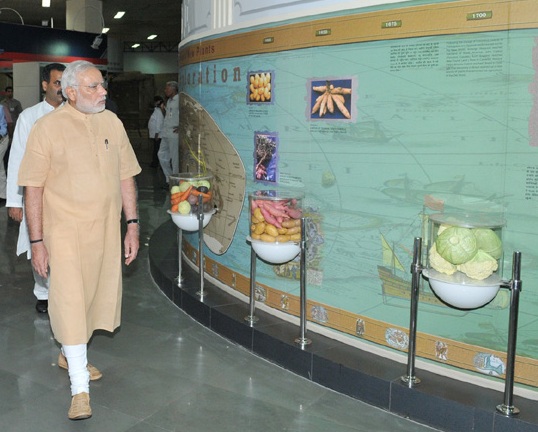
Prime Minister Narendra Modi says agriculture scientists must take to the radio to reach out to farmers.{credit}PIB{/credit}
Therefore, today when Prime Minister Narendra Modi urged hundreds of agricultural scientists at the 86th Foundation Day celebration of the Indian Council of Agricultural Research (ICAR) to make use of good, old radio to take science from ‘lab to land’, it rang a bell. Modi said agricultural colleges should start their own radio stations. Farmers listen to radio a lot and young agricultural scientists in these colleges kicking off new radio programmes would benefit the farmers immensely, the Prime Minister suggested.
Science-savvy Modi, who began his stint in the high chair a couple of months back flagging off a satellite launch vehicle and consulting scientists of all hues from day one, also called for creation of a digitized database of agricultural research in the country. He sought to link the young, educated and progressive farmers of India with agricultural research scholars saying they could form a powerful talent pool.
Farming in India is mostly inherited across generations and so it is difficult to change agricultural practices overnight. Modi said something science communicators often say — that it would be useful for scientists to explain the efficacy of a particular practice or initiative in language the farmer can understand. Agricultural scientists could play a big role in conveying the impact of changes in climate, water and soil to farmers.
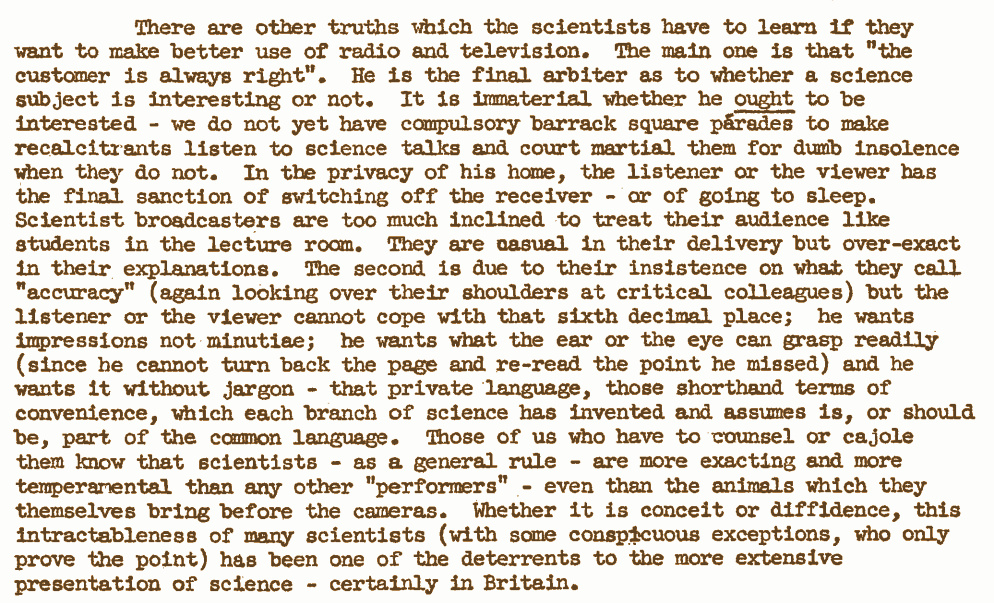
While we are at it, I am taken back to a 1955 communication by British science writer Ritchie Calder, Member of the Council of the British Association for the Advancement of Science. In the article written for UNESCO, Calder summarises the role of a scientist in popularising science through radio thus:
{credit}UNESCO{/credit}
We might well be heralding an era of a structured science communication and outreach programme in this country, with scientists and the radio at the heart of it all.
