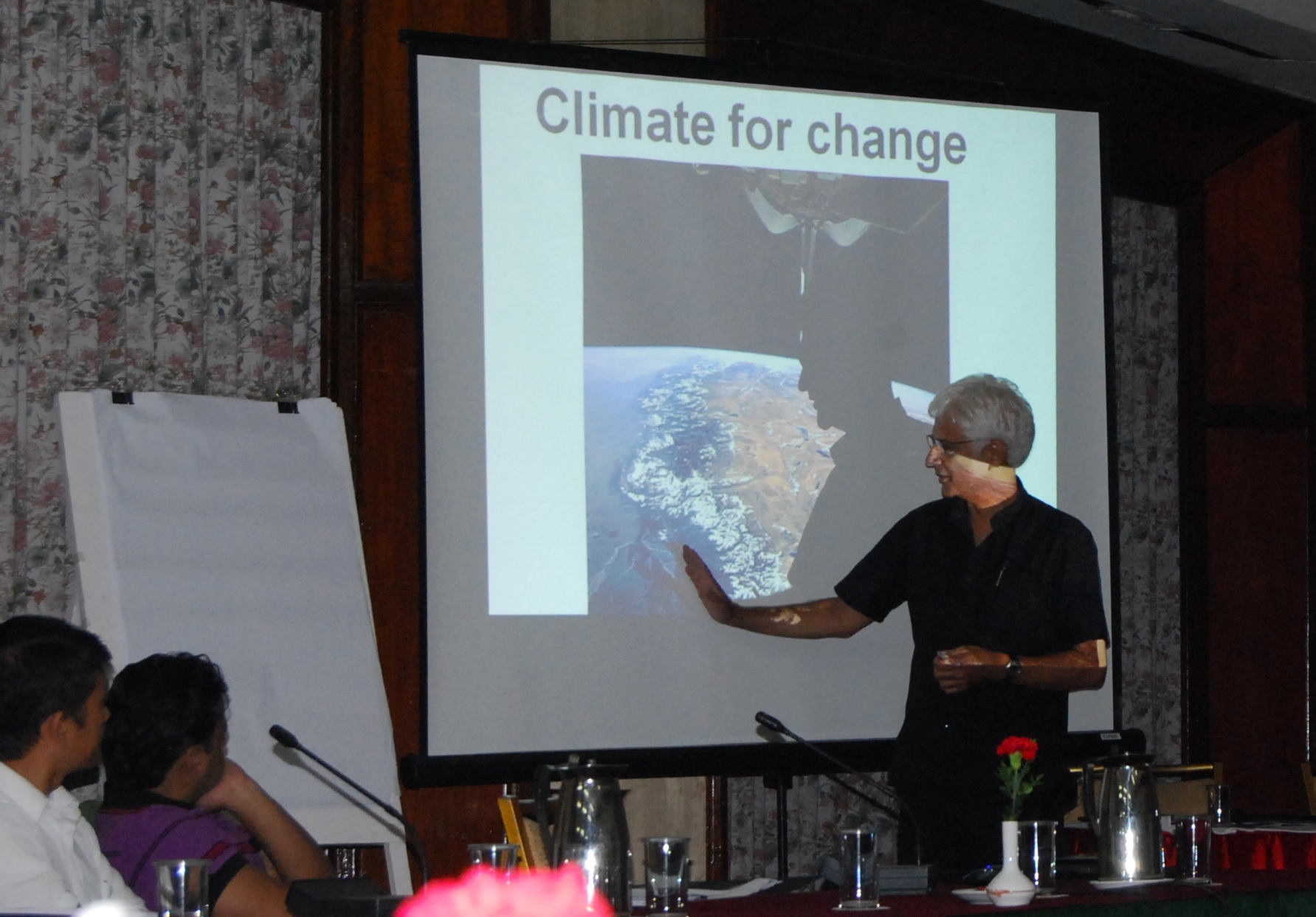
At a workshop discussing what the take homes for Asian countries might be from the latest assessment report of the Intergovernmental Panel on Climate Change (IPCC) — AR5 — it was pointed out that there wasn’t enough science coming out of developing countries to feed the database on emissions or warming in the larger climate change debate. Local scientists need to conduct more climate change related experiments, write more scientific papers and bolster regional science in order to make a case for these developing countries in the international discourse on climate change.
“We also need more authors from the developing world to participate in writing the chapters for the IPCC reports,” says Jonathan Lynn, Head of Communication at the IPCC. Lynn says though there is substantial science emanating from India now, some other small Asian countries such as Indonesia lag far behind. The IPCC collates scientific data from across the world to make predictions for future scenarios with the help of scientists, economists, policy makers and government representatives. Most of the work done by scientists in this process is voluntary and not paid for. Developing country scientists, who also do consultancy work for a living, would expect such work to pay off for their time — this could be one of the reasons why not many developing country scientists are interested in the job, Lynn says.
The IPCC assessment reports try to turn all available scientific evidence into something that would make sense to policy makers and businesses — therefore, the authors have explained the science at hand this time in terms of “risk management” parameters. “And since there are questions of ethics and equity involved in this highly political debate, we now have philosophers in the IPCC team to make sure those aspects are taken care of,” Lynn says.
Joyashree Roy, an economist from the Jadavpur University in Kolkata is the lead author of the industry chapter in IPCC’s assessment report five. She says Asia needs to urgently decouple the high energy sector from emissions. “Almost 44 per cent of the global emissions are from the energy and industry sectors of China and India — there lies an opportunity for south Asia. Can we think of a low emission-high energy scenario?”
Roy says population and economic growth are responsible for the surge in energy demand as well as emissions in south Asia.
Another IPCC author Navroz Dubash from New Delhi-based thinktank Centre for Policy Research points to an inherent dichotomy in the report — the number of countries which have adopted mitigation strategies or have a national action plan for climate change has gone up many times, especially in Asia post-2005. Simultaneously, the emission rates of Asia have zoomed and the world as a whole is hurtling at great speed into a carbon-based future. How is that possible, you wonder. “Well, there have been a slew of national policies in the last few years but they will take around 3-4 years to bear fruit. The more optimistic outlook would be to review the scenario in a couple of years and see if these policies have led to significant action,” he says.
Dubash says India will also benefit from the new stand of IPCC where ‘co-benefits’ of climate-friendly policies are being seen in new light. Earlier, IPCC talked of climate change mitigation plans as the main goal with parameters such as development or health as co-benefits. “The idea now is that the concept of co-benefits could work both ways, meaning if a development project brings in climate change mitigation as a spin-off, it should be totally acceptable. This concept is at the core of India’s national plan and now IPCC has sanctified it — so there’s a huge opportunity.”
According to A R Paneerselvan, advisor to the executive director of Panos South Asia, an organisation informing public and policy debates on environment issues, there are talks of a south Asian intiative for climate related insurance. The insurance would cover farmers against any vulnerability stemming from climate change. The initiative is still at a nascent stage and there’s pressure from the cash crop sector in south Asian countries to make a case for climate-related insurance, he says.
As for IPCC’s fifth assessment report and what’s in it South Asia, London-based Climate and Development Network brought out a good primer that explains just this. The Intergovernmental Panel on Climate Change (IPCC) chairperson Rajendra Kumar Pachauri also spoke about what it means for India at an outreach programme in New Delhi today.