Dan Cressey, a reporter at Nature, speaks about getting a job as a science journalist at the Naturejobs Career Expo, London, 2016.
https://www.youtube.com/watch?v=iilmmDHxgPY

https://www.youtube.com/watch?v=iilmmDHxgPY
Guest contributor Catherine Seed

Left to right: Robert Dawson, Catherine Ball, Anke Sparmann and Belinda Quick{credit}Image credit: Catherine Seed{/credit}
Science communication is rapidly becoming a core requirement for scientists, and has long been a highly sought-after career in its own right.
There is a huge breadth and diversity in the field of science communication, agreed the panel members, yet the use of ‘science communication’ as an umbrella term often obscures this variety. Panellists agreed that the key to developing a successful science communication career is in finding how you prefer to communicate, and determining which avenues of communication match your style. With options ranging from news reporting to working for academic institutions or societies, or in simply starting your own blog, the options are countless. The process, they said, requires much experimentation; test different forms of communication to discover what works best for you.
The objectives of organisations shape the form of communication that they use, said Robert Dawson, head of news at the BBSRC. He stressed the importance of familiarising yourself with different media outlets, universities, research institutions, and companies and their communication style. In his own role, he communicates to scientists, journalists and other members of the media. “Science PR is about balancing the need to encourage the public to be enthusiastic about your organisation and about science, with the need to produce accurate and balanced coverage,” he said. Continue reading
Guest contributor Gaia Donati.

Dream jobs might not always be what you expect.
Planning a career path is a bit like committing to a relationship – you go through phases. First comes the infatuation, leading you to enthusiastically catch any opportunity to establish contacts and gain experience in your chosen sector. As you discover previously unsuspected facets of your ‘dream job’, a few doubts arise: you may find out that the competition is fiercer than you expected, that permanent positions are scarce or that it will take years for you to earn a decent salary. All of a sudden you question your choice altogether, and you are left with a menacingly dark cloud over your head.
Having defended my PhD thesis in experimental quantum optics at the end of July, the idea of my ‘dream career path’ must now become real – it’s time to find that job. I decided I would look into a career in science publishing and journalism, but as I moved the first steps in this direction I found myself surrounded by doubts and unknowns: do I wish to leave academia? What if I keep hopping from one internship to another?
After a few years in the laboratory and a stint at cutting-edge research for my PhD project, I ruled out the postdoc option. My future occupation should combine my love for science with my passion for communicating scientific advances to wider audiences; as a journalist, Continue reading
Following the success of the Boston Naturejobs Career Expo journalism competition (you can read all the articles from the competition in the #NJCEBoston category), we have decided to repeat it for the London Expo, which takes place on 19th September 2014 at the Business Design Centre in Islington.
We are looking for five budding science writers to help us with our coverage of the Naturejobs Career Expo conference sessions and workshops. The conference will explore career paths in industry, academia and science communication, entrepreneurship, structuring a CV and transferable skills, amongst other things. The five winners will have the opportunity to attend the Expo and write up at least two of the sessions or workshops for our readers, sharing the advice and expertise of the speakers with those who cannot attend in person. Winners will work closely with our editors, and their articles will be published on the Naturejobs blog.
Contributor Saheli Sadanand
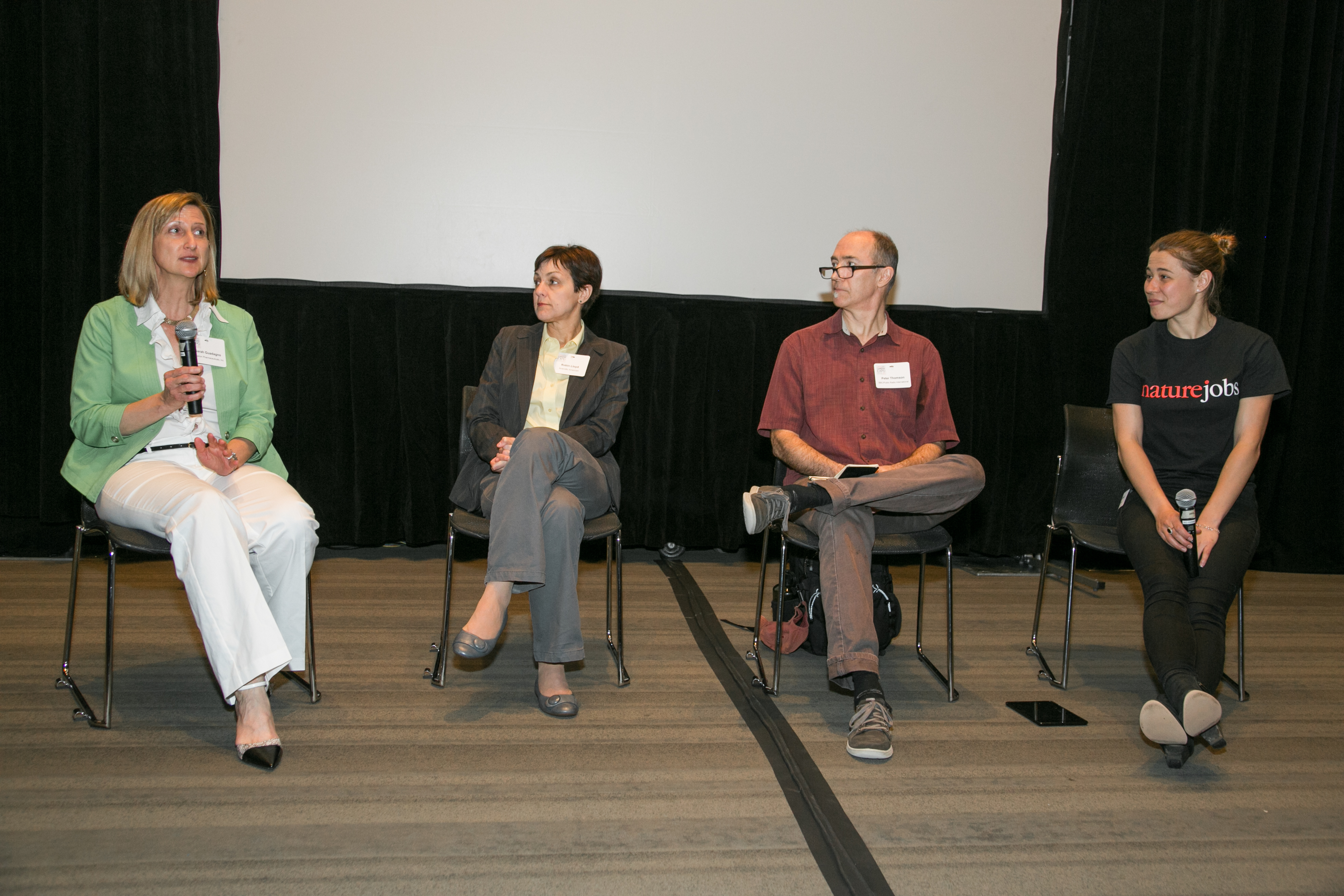
Sarah Guadagno, Robin Lloyd, Peter Thomson, Julie Gould
What is science communication? Turns out that it can be a number of things, as revealed by an afternoon panel at the Naturejobs Career Expo. Peter Thomson, Robin Lloyd and Sarah Guadagno — all of whom have made careers in different forms of science communications – described the paths that brought them to their current positions, and held forth on the challenges and rewarding features of their work.
Peter Thomson is the founding producer of “Living on Earth,” an award-winning environmental news program that has aired on the US public radio network (NPR) since 1991. He now serves as the environment editor for the Public Radio International program, “The World.” “There is something about the human voice that is so elemental. It’s the way we’ve always told stories,” Mr. Thomson said in describing the appeal of radio communication. “Radio is the most intimate medium.” Mr. Thomson pointed out that environment reporting involves more than just a science component; he and his team of journalists must address other perspectives in their pieces.
Robin Lloyd came to her position as online news editor for Scientific American via a circuitous route. She got her Ph.D. in sociology at the University of California, Santa Barbara and after a few years in a tenure-track position, she realised research was not her passion. She then worked in a variety of different jobs (including a stint as a barista!) before becoming a locum editor at Scientific American. Her appointment ultimately evolved into a permanent position at the journal. Her job, as she puts it, is “to take the material that comes in from the writer and turn it into something compelling that the audience really wants to read.” In addition to planning and editing stories for publication, she manages the Scientific American home page. She emphasised that her job involves more than just presenting new and trendy scientific discoveries. Continue reading