Achieving a Bose–Einstein Condensate from my living room during lockdown

During the COVID-19 lockdown which led to the closure of many labs around the world, Amruta Gadge, a postdoctoral researcher in the Quantum Systems and Devices group at the University of Sussex*, made headlines for remotely setting up a Bose–Einstein condensate from her living room. Gadge, an alumna of the University of Pune, tells us how she achieved that.
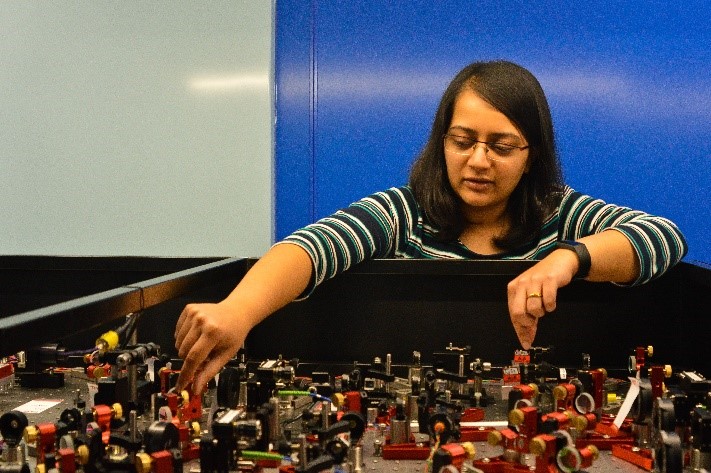
Amruta Gadge adjusting a laser before the lockdown in the apparatus put together to produce the Bose-Einstein condensates.{credit}Rebecca Bond{/credit}

When the UK government announced a national lockdown on 23 March 2020, my lab at the University of Sussex was forced to temporarily close its doors.  We had a strong inkling this was coming, and rushed to get ourselves in order before the lockdown. We were determined to keep our laboratory experiments going as best we could although we had never run them remotely before. Bar a few essential maintenance visits to the lab, the only way to continue our experiments was to use remote control and monitoring technology.

Pre-lockdown, our team was building an apparatus to produce Bose-Einstein condensates (BECs).  A BEC consists of a cloud of hundreds of thousands of rubidium atoms cooled down to nanokelvin temperatures using lasers and magnetic fields.  At such temperatures the cloud suddenly takes on different characteristics, with all atoms behaving together as a single quantum object. This object has such low energy that it can be used to sense very low magnetic fields, a property we are using to probe novel materials such as silver nanowires, silicon nitride nano membranes or to probe ion channels in biological cells.

Already a few months into assembling this system, we were looking forward to a big milestone – producing our first BEC. To run such an experiment from home was no easy feat — the large and complex laser and optics set-ups in state-of-the-art labs couldn’t just be transported. In the days leading up to lockdown, equipment, chairs, and computers were being ferried to various homes, deliveries of equipment were diverted and protocols for remote access and online control were put in place.

Ultra-cold atom experiments are very complex. Obtaining a BEC involves a large amount of debugging and optimising the experimental sequence. When not in the lab, at times it felt almost impossible to debug. We set up software control for the equipment, such as oscilloscopes, vacuum pumps, and others. However, the tool that played the most important role was our environmental monitoring system. Trapped cold atoms are extremely sensitive to variations in the environmental conditions. Changes in the ambient temperature of the lab, humidity, residual magnetic fields, vacuum pressure, and so on, result in laser instability, polarisation fluctuations or changes in the trapping fields. All of these effects lead to fluctuations of the number of trapped atoms, as well as their position and temperature.

Debugging the system is a long process, but this can be greatly helped by monitoring the environmental conditions at all times. This may sound elaborate, however with the rising popularity of time series databases and data visualisation software, it is possible to develop a convenient monitoring system. We made use of cheap and easily programmable microcontrollers for data collection, and two popular open source platforms, InfluxDB and Grafana, for storing and visualising the data, respectively. We set up a large network of sensors throughout the labs, aimed at monitoring all the parameters relevant to the operation of the experiments. If atom numbers fluctuated, or something wasn’t performing well, we could quickly narrow down the problem by looking at our Grafana dashboards. This meant that our experimental control sequence could be quickly tweaked from home for compensating the environmental fluctuations, and the monitoring system proved to be an extremely useful tool in achieving BECs remotely.

We were installing a new 2D magneto-optical trap atom source in the lab, and managed to see a signal from it just the day before the lockdown. I remember being worried that the lockdown was going to delay the progress of our experiment significantly. However, thankfully we could keep operating remotely, and managed to achieve our long-awaited first BEC from my home.

I was very excited when I saw the image of our first BEC. I had spent the whole day optimising the evaporation cooling stage. It was past 10pm, and I was about to stop for the day and suddenly the numbers started looking promising. I continued tweaking the parameters and in just few attempts, I saw the bimodal distribution of the atoms — a signature of a BEC. It was strange to have no one there to celebrate with in person, but we got together for a virtual celebration — something we are all getting used to now. I was really hoping to get the first BEC of our experiment before moving to my next post-doc, and having it obtained remotely turned out to be even more gratifying.

(*Amruta Gadge is now a post-doctoral researcher in the cold atoms and laser physics group at the Weizmann Institute of Science, Israel.)

(Lightly edited and cross-posted from Nature’s onyourwavelength blog.)
How coronavirus data from history is helping fight COVID-19

When a bunch of database experts peered through archival information on coronaviruses, they saw substantial data that could aid the world’s fight against the novel coronavirus pandemic.

Satyavati Kharde and Poulomi Thakurdesai describe how a Springer Nature Experiments team quickly turned this data into a valuable resource for life science and biomedical researchers working on COVID-19.

Many of us had heard the term ‘coronavirus’ for the first time at the office lunch table. Our team lunches are unusual, discussing topics that range from evolution, to bodily functions to Bollywood. The scientific experts in the team were trying to explain how the coronavirus works, its relation to respiration and the conspiracy theories associated with it.

When we read about the first outbreaks, our natural reaction was – not yet again!  Another epidemic! We thought it would not cross the China borders and so we continued planning our upcoming travels.

Out of curiosity, we checked the Springer Nature experiments database – the largest database for life science protocols and methods – to see what content we had around past coronaviruses. We were pleasantly surprised to find a huge number of experiments such as detection of the virus, drug design, drug delivery, vaccine design and biochemical characterisation of coronaviruses that caused earlier contagions – the Severe Acute Respiratory Syndrome (SARS) of 2002 and the Middle Eastern Respiratory Syndrome (MERS) of 2012.

Soon we realised that mankind was in the middle of a pandemic after centuries. In India, we entered the world’s largest ever lockdown in history, started working from home in this ‘new normal’ while continuing our virtual tea break conversations and getting a virology class where some of us non-scientists learnt for the first time that viruses are not exactly living beings!

At the same time, we began watching life science researchers and healthcare professionals, the traditional end users of our products, emerge as the heroes in the world’s fight against the novel coronavirus. These frontline COVID-19 researchers in India and across the globe were working tirelessly to develop new detection methods, new drugs and vaccines to prevent the spread of the pandemic. Lockdowns and a global emergency situation had added several challenges to the existing workflow for researchers in academia as well as in the industry.

Many of our friends were these scientists trying to look for solutions to halt the pandemic at various Indian and international institutes. In one of our casual discussions, some of these scientists talked about the tardy speed and the many challenges of research during the lockdown.

The inner scientist in some of our team members was itching to help ease out their problems. The question was, how? We started working on a workshop for life scientists (involving questions around the database, engineering, and user experience) to understand if there was anything we could do to decrease the challenges they were facing.

In no time, a large global team chimed in taking the challenge up on priority. In one frenzied week, we designed, tested, and pulled together a collection of more than 160 openly accessible protocols and methods on COVID-19 to help laboratory researchers in their work around the pandemic. The resource brought together content on the detection of coronavirus in various species, protocols on designing the vaccine, and understanding the biochemistry of viruses to design new drugs.

Working remotely – alongside sharing recipes and haircut tips – we create a digital interface to address the challenges around the scarcity of reagents and lack of information to develop detection tests for the novel coronavirus. In this interface, researchers can find detailed procedures on various detection techniques, such as RT-PCR, PCR, virus RNA purification, sequencing, and more. With the help of this information, researchers can compare the materials and methods before implementing them in the laboratory.

As we begin to feel a little fulfilled to have contributed our tiny bit in the global fight against COVID-19, this data explorers’ journey is far from over. We are constantly tweaking and scaling up this resource – for the researchers and by the researchers – as and when newer information emerges in the fast-evolving pandemic.

[Satyavati and Poulomi are part of the Springer Nature Experiments team in Pune, India.]

Frugal innovation: India, France can lead the way

In this guest post, Navi Radjou draws from his experience at a hands-on education and problem-solving school in Mumbai. He points out that France’s strong science and engineering capabilities, combined with the Indian concept of jugaad, or frugal ingenuity, could help solve problems that threaten all of humanity.

Navi Radjou

A recent Gallup International Association poll rates French President Emmanuel Macron and Indian Prime Minister Narendra Modi as the two of the most favoured world leaders. They have a historic opportunity to use their huge popularity and goodwill at home and abroad to heal our fractured world. They can do so by bolstering co-innovation between India and France — through top-down R&D partnerships such as the International Solar Alliance as well as bottom-up collaborative initiatives like the STEAM School.

By bringing together Indian and French engineers, scientists, entrepreneurs, designers, artists and business leaders, the two countries can create solutions to what I call “problems without borders”: social inequality, global warming, chronic diseases, water and food scarcity.
In December 2017, I attended the Indo-French STEAM School in Mumbai — which shows how co-innovation can have a major positive impact worldwide. The 10-day programme was co-organized, like every year, by the French Embassy in India, the Paris-based Center for Research and Interdisciplinarity, and Maker’s Asylum, a community space in Mumbai. The programme enables STEAM (Science, Technology, Engineering, Art, and Math) education through hands-on problem-solving based on the UN’s Sustainable Development Goals (SDGs).

100 participants, mostly from France and India — architects, designers, artists, engineers, academics, and students — formed 19 teams to design a product each to tackle one of five specific SDGs in the Indian context: health, education, water/sanitation, energy, and sustainable cities. Over the course of the programme, the participants developed working prototypes of their products.

Participants at the STEAM School 2017

These four products I liked best harnessed frugal innovation to devise simple and cost-effective solutions to major socio-economic and ecological problems:

  • BAT:  a low-cost wrist-wearable to aid the visually impaired. According to a Lancet study, 36 million people in the world are blind, a number set to increase to 115 million by 2050. In India alone, 8.8 million citizens suffer from blindness and nearly 48 million have moderate and severe vision impairment, the largest number for any country. BAT, fitted with a Six Axis feedback mechanism, can make life easier for such people while they navigate public spaces, by vibrating to alert them of obstacles.
  • The SADA Kit:  A portable solution to prevent water-borne health epidemics caused by open-air defecation in rural India. 2.5 billion in the world still lack access to toilets. 300 million Indian women and girls are affected by it. The kit aims to improve the health, safety, and dignity of these women. It comprises of a lightweight portable toilet with a pop-up privacy shield, a waste disposal bag, a small wearable light and whistle, soap, and sanitary pads for women.
  • BIJLI:  a low-cost energy generation device that can be retrofitted to bicycles. It transforms kinetic energy from the wheels into electric energy that can be stored in a battery pack or can be used to charge small electronic gadgets like mobile phones. The device can be used on the go or while the bicycle is stationary. Distributed energy solutions like BIJLI can be a boon for the 300 million Indians who live with little or no electricity today.
  • WASTED: a smart waste segregation bin that helps spread awareness of how much waste we generate. By turning the process of segregation into a game and connecting sensors in the actual bin to an app, it enables users to track and compare waste statistics with friends and neighbors. The idea is to “nudge” people and societies towards zero waste. India generates over 100,000 metric tons of solid waste each day, higher than any other country. The Ellen MacArthur Foundation estimates that by adopting the circular economy principles—through reuse and recycling of waste and resources—India could reap $624 billion in annual benefits in 2050 and cut greenhouse gas emissions by 44%.

“The goal of STEAM School isn’t to solve the SDGs in 10 days, but to teach how to solve them,” says Vaibhav Chhabra, founder of Maker’s Asylum. “STEAM also teaches empathy and tolerance to participants. They learn to transcend their differences, respect each other, and find unity in a shared purpose. They become globally-conscious problem-solvers.”

Vaibhav is right. I interacted with French students from CRI, EM Lyon Business School, and Institut Mines-Télécom at STEAM School, who had developed greater respect for India and its culture by working together with Indians. A Hindi saying captures the power of such synergies: Ek Aur Ek Gyarah Hote Hain, or One and One Equals Eleven. France’s strong science and engineering capabilities, combined with the Indian concept of jugaad, or frugal ingenuity, could help us solve problems that threaten all of humanity.

As a French-Indian, I am thrilled to be part of this process. I left India in 1989 to study in France. During the 80s and 90s, France and India were relatively closed to the outside world. Cooperation between both countries was also limited. I long dreamed of a day when India and France would team up to create solutions without borders. Now my dream is finally coming true.

The theme of the World Economic Forum Annual Meeting 2018 in Davos was “Creating a Shared Future in a Fractured World.” You can’t fix a fractured and conflict-ridden world with the competitive zero-sum mindset that has long dominated world affairs. Instead, it’s time to adopt the cooperative “1+1=11” formula. Macron and Modi can show the way.

[A longer version of this piece was first published by the World Economic Forum. Navi Radjou is a fellow at Cambridge University’s Judge Business School. He is the coauthor of Jugaad Innovation (2012), From Smart to Wise (2013), and Frugal Innovation (2015).]

Nature India Special Issue on ‘Grand Challenges’

coverAs part of Nature India’s 10th anniversary celebrations, we produced a special issue on ‘Grand Challenges’. (Download your free copy here.)

India is headed towards an astonishing population surge. With 1.34 billion people recorded in early 2018, the country is estimated to add another 100 million by 2024 overtaking China, currently the most populous nation in the world. Therefore, her daunting demographics are integral to any discussion around the challenges faced by India.

The mammoth population coupled with limited resources, and growing urbanization and energy needs are important factors behind many socio-economic issues. Be it poverty, healthcare delivery, literacy, pollution or waste management — each of India’s problems can be directly linked to and are intensified by its teeming millions.

Some of the most pressing challenges raised by a large population are in the public healthcare, energy and sanitation sectors. Successive Indian governments have made tremendous efforts to meet public needs and expectations. However, health concerns such as tuberculosis, maternal and infant mortality, vector- and water borne-diseases, malnutrition, hygiene and sanitation remain major problems.

03The Nature India special issue on Grand Challenges takes a closer look at some of these hazards, which are experienced across the developing world. What are the grand challenges for the country’s 1.3 billion people? Can science help find solutions to some of the public health problems? Can innovation provide long-term answers?

Through in-depth commentaries by subject experts, this special issue looks at the state of affairs in malaria
management, maternal and child health, malnutrition and tuberculosis. It also looks at the science-led innovations and solutions already on offer. In a reprint section, we compile some recent articles from across Nature Research publications that highlight the grand challenges and research-based solutions that India and the rest of the developing world have adopted.

The volume also features a special photo section curated from top entries to the 2017 Nature India photo competition, themed ‘Grand Challenges’. These pictures are compelling visual narratives of some deeply moving and familiar circumstances.

With examples and case studies of evidence-based solutions, the Nature India special issue on Grand Challenges hopes to be an enlightening read for scientists, policy-makers, business leaders, and societies across the developing world.


Nature India Annual Volume 2017 is out

NI Annual Volume 2017Nature India stepped into its 10th year in 2018. To mark the occasion, we gave a face lift to our annual volume with a new international design, very similar to Nature. A global team of editors and art designers worked across time zones to produce this annual volume.

In February 2008, Nature Research (then called Nature Publishing Group) launched Nature India in an attempt to chronicle the region’s rapidly changing scientific scene and efforts to embrace globalization. In the decade since, Nature India has witnessed and reported the distinctly Indian essence of science. Thanks to India’s enviable scientific stock that gets an additional 100,000 science post-doctorates every year and to a culture of frugal innovation, the website has seen a plethora of interesting stories.

Nature India has reported this evolution — the moments of glory as well as the difficulties — through in-depth commentaries, news and feature articles and research highlights from the country’s many laboratories and research and development organizations. From rural, low-resource settings to state-of-the-art space facilities, from well-equipped labs in burgeoning cities to makeshift mobile labs in remote islands, this journey of covering science in the world’s largest democracy has been pioneering and meaningful.

Besides producing award-winning editorial content, Nature India has evolved as a useful resource for India’s science community with listings of relevant jobs and events, discipline-specific special issues and the Nature
India annual compendia. Responding to the need for effective communication of science by researchers, Nature India also devised a series of science communication and career workshops in partnership with the Wellcome Trust–DBT India Alliance.

A much-awaited event in our annual calendar is the Nature India photo contest, which has not only enriched our archives with stunning science pictures from around the world but also resulted in a roving exhibition that sparks thought-leading conversations around the visual narrative of science.

Through these years, Nature India has broken major investigative science news stories — from the visible impacts of climate change as the sea gobbles up entire islands in the Bay of Bengal (10.1038/nindia.2013.60) to the poor genetic diversity threatening to wipe out the few surviving population of the Kashmir red deer (10.1038/nindia.2015.35); from the intriguing story of a diabetes-free desert tribe of Madhya Pradesh (10.1038/nindia.2015.23) to the resurfacing of a forest virus that killed more than 100 people in the Western Ghats of India (10.1038/nindia.2016.139).

Among the many engaging investigations we undertook in 2017 was one that looked at why Indian scientists coming back from stints abroad turn out to be less productive once they reached home (10.1038/nindia.2017.82) and a retrospective look at a quietly performed hybridization experiment in 1964 that created a litigon, a cross between a lion and a tigon, in a Kolkata zoo (10.1038/nindia.2017.46).

Our annual volumes are put together by a group of editors and eminent scientists, who curate the contents from our coverage through the year. The affiliations and research interests of some people may have changed after publication of these articles. These annual volumes are handy reckoners for anyone who wants to keep abreast with the research highlights of the year, newsmakers, trends in research and development, careers and policy issues.

As Nature India enters another decade, it will continue to bring to you the best coverage on Indian science in exciting new formats, such as podcasts and possibly videos.

You will find more on our our archival annual issues here:20152014 and 2007-2013.  And some more on the content and subscription of these issues here.

Nature India Annual Volume 2016 is out

Our much awaited collection of the year — the Nature India Annual Volume 2016 — is out this week.

In the year gone by (2016), India witnessed events that would go down in the country’s science history. The Indian Space Research Organisation (ISRO) launched 20 satellites on board one single vehicle, a warm-up that was only bettered five times over into a record breaking 104-satellite launch in early 2017.

India’s low-cost space-faring brilliance, bolstering her sense of self-sufficiency, has attracted global attention. It has come with caveats though — the European Union (EU) recognises that with such a mature space programme (and big strides in other areas of scientific research), India can no longer be bracketed together with ‘developing countries’. The EU’s funds for Indian researchers have, therefore, shrunk to a trickle with the premise that India is
now capable of pumping in more funds for collaborative projects with the EU.

This annual volume of Nature India takes a look at the changing landscape of science and research funding in India with a series of articles.

The discovery of gravitational waves marked a high point in theoretical physics last year. It sent ripples of joy for India, which is now all set to implement a multi-institutional Rs 1200 crore astronomy project that will see one advanced LIGO detector from Hanford in Washington being shifted to a site in India. There’s a flurry of activity in India around this international project. We capture that excitement in this issue. Alongside this, India’s leading participation in making the world’s largest radio telescope, the Square Kilometre Array (SKA), in the remote Australian outback makes it to our cover.

In another investigation, we look at the mushrooming of genomic service centres in India, the lack of regulation in the country to cope with the new wave and how even now most genetic conditions remain undiagnosed at birth.

We hop on to the biodiverse Western Ghats of India to report on an ‘evolutionary museum’ of bush frogs, a forest virus that resurfaced after a decade to kill over 120 people, and to inspect why the rice genome is under threat in this unique rice growing valley.

For researchers looking to ward off work blues, a couple of articles offer practical advice on how to overcome research rut and how to make most of conferences.

Our annual volumes strive to be an important addition to the science calendar of India — a must have for anyone interested in keeping abreast with the research highlights of the year, newsmakers, trends in R&D, careers and policy issues. These annual chronicles of the “contemporary history of science in India” are put together by a group of editors and eminent scientists, who handpick the contents from our coverage through the year.

Affiliations and research interests of some people might have changed after publication of these articles. We mention the publication date on top of each article so that they make sense.

How haldi and litchi cooked up a storm

[Reproduced with permission from Hindu Business Line, column ‘Science and Sensibility’. Published: 1 March 2017]

Under the lens

Subhra Priyadarshini

Two stories, both involving American and Indian scientists, have renewed discussions on scientific rigour and ethics. The stories veer around two of our beloved things — haldi (turmeric) and litchi.

The substance that gives haldi its bright yellow hue — curcumin — has been a hot favourite of Indian scientists. They have found innumerable virtues of curcumin — anti-inflammatory, anti-malarial, anti-cancer and, most recently, as a piggyback on nanofibres to regenerate bone tissues.

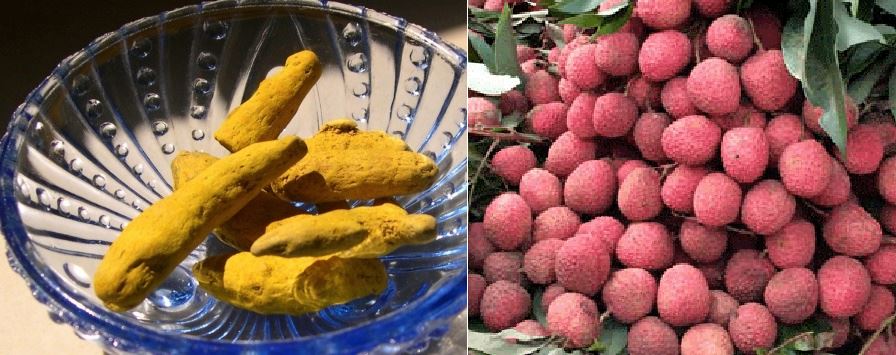
Two of India's favourite things.

Two of India’s favourite things.

When some American scientists debunked the medicinal value of curcumin in a reputed international journal recently, they stirred up a hornet’s nest back home. The article concluded that there was no evidence, whatsoever, of the therapeutic benefits of curcumin and that it wasn’t worth wasting one’s energy and money on researching it to find a new drug.

India’s scientists have taken exception to this, considering that over 10,000 papers have been published and more than 120 clinical trials using curcumin are in various stages of completion. Yes, curcumin may not make for a classical drug going strictly by the tenets of medicinal chemistry, but it certainly qualifies as an ‘adjunct drug’ to treat some infectious diseases. The contention is: summarily dismissing curcumin research as wasteful would be like throwing the baby out with the bath water. And that would bury a lot of remarkable science around the fragrant, yellow spice.

So, even as the dispute over curcumin’s candidature as a good research subject ensues, people across the world will continue to explore the benefits of ‘golden milk’. And Indian homes will continue to take any criticism of haldi with a pinch of salt.

Another controversy erupted around a red-peeled, juicy fruit that instantly transports one to the lazy summer afternoons of our childhoods. Litchis, you could gorge on them all afternoon. And most times, you skipped dinner afterwards brimming over with its sweet richness. Turns out, this innocent fruit-hogging and then not eating an evening meal, could be fatal. It kills a lot of children in Muzaffarpur region of Bihar, the litchi capital of India.

Scientists have been trying to fathom the cause of a mystery seasonal neurological disease outbreak in the region for years now. And some of them recently made a stunning revelation in Lancet: litchi fruits are laden with naturally occurring toxins — hypoglycin A and methylenecyclopropylglycine — that could actually trigger low glucose levels and metabolic derangement among children. Ironic, considering that litchi oozes sugar. The toxins embedded in the fruit apparently reverse all its sugariness.

But where’s the controversy? The dispute began when a set of scientists led by T Jacob John, a virologist earlier with the Christian Medical College Vellore, alleged that the Lancet study did not follow a basic ethical practice in science: acknowledging similar previous findings by his team. John and co-researcher Mukul Das called it ‘scientific misconduct’. Their contention: the Indo-US research group had failed to acknowledge somewhat similar results from 2014 — an act considered grossly unethical in science. True to its reputation, Lancet swung into action to figure out what went wrong in this case.

And that’s how the humble litchi taught our scientists a lesson in ethics.

Nature India partners with ICRISAT for InterDrought-V

Cover InterDrought-VNature India is proud to be associated with the International Crops Research Institute for the Semi-Arid Tropics (ICRISAT) as media partner for the fifth edition of the InterDrought conference being held in Hyderabad (February 21-25, 2017).

The conference brings togther experts from across the world to debate key issues in improving drought and other stress tolerance in crops. Scientists from around 56 countries will come together to explore the possibilities of scientific and technological applications in crop improvement.

ICRISAT Director General David Bergvinson says the conference will bring together the disciplines of plant and crop physiology, genomics, genetics and breeding. It will talk about recent advances in these fields related to plant responses to water deficit and climate change, phenotyping and genetic variability.

According to the conference chair Rajeev Varshney this is the largest conference in the InterDrought series with 850 participants from 56 countries. Earlier conferences in the series habe been held in France, Italy, China and Australia.

Nature India put together this cover for the abstract book depicting the three important elements of the drought story — the starkness of drought, its deep impact on humans and the science-driven solution to meet the challenge — drought-resilient crop varieties.

Here’s Nature India‘s editorial for the conference abstract book:

Looking for a Plan C in water-scarce times

An issue that stirs emotions among scientists, policy makers and the general public alike is ‘water’. Or, in the present times, the lack thereof.

In these water-scarce times, in India, as in many other parts of the world, the issue of groundwater depletion is a subject of concern and serious study. And so, apart from the parched patches that the world inherited from the 20th century, we are looking at times of new aridity triggered by plummeting groundwater tables. It’s actually a vicious circle – news studies are now suggesting that excessive pumping of water for agriculture may not be the reason behind the plunging groundwater levels after all. Long-term changes in monsoon rainfall could instead be influencing this, and that in turn is forcing farmers to dig deeper for water.

Why this preamble on water? Especially when water-scarcity is an issue almost embedded in the DNA of scientists attending InterDrought conferences.

Essentially because it’s nice to take a step back once a while and look at the larger canvas. For scientists and technologists working on a Plan B to counter drought – that is, to still be able to grow nutritionally-rich, drought-resistant crops – these conferences are a wonderful reminder of the big picture. Interestingly, InterDrought-V is hoping to be the largest such congregation in recent times with over 850 scientists from around 56 countries. This provides a canvas bigger than ever before to create new milestones, fortify strategies that have worked so far, and solemnly bury the ones that don’t work so well in the changing climate scenarios.

The Nature Research Group devotes significant energies to the coverage of the “Grand Challenges”, which include our coverage of climate, water and food – issues that resonate well with InterDrought-V. Nature India, a showcase of India’s science, is proud to be associated with the conference as its media partner. We hope that the conference, bringing together the who’s who of the discipline from across the world, will identify issues and concerns to evolve a futuristic Plan C for drought-friendly agriculture.

Nature India partners with British Council for FameLab India

Famelab PosterNature India is parterning with the British Council for the debut of the international FameLab competitions in India. FameLab is one of the biggest science communication competitions in the world, where young researchers compete to explain a scientific concept in just three minutes.

Nature India will support the training of the young researchers in the run up to the final competitions in India, scheduled in January 2017. Along with trainers from the UK and our science communication workshop partners Wellcome Trust/DBT India Alliance, we will train young scientists in presentation and communication skills.

FameLab was started by Cheltenham Festivals, UK in 2005 and British Council got involved with it two years later. The competitions have now expanded into a  global programme taking place in 27 countries with various partners. Nature India is happy to be associated with the competitions in India.

Researchers in India can apply to be part of the competitions here. If shortlisted, they will be invited to attend regional training sessions aimed at grooming them for the national competition. The winner of FameLab India will travel to the Cheltenham Science Festival in the UK to represent India at the FameLab International grand final.

Nature India will be part of all four regional workshops in India training the contestants in science writing and science communication:

South India 27-29 November 2016 University of Kerala
East India 04-06 December 2016 KIIT Bhubaneswar
North India 08-10 December 2016 IIT Delhi
West India 13-15 December 2016 IIT Bombay

In the run up to the competitions, here‘s Nature India‘s guest blog series on the British Council website that hopes to get the attention of all budding science communicators.

So come, join the fun of talking science!

Nature India Annual Volume 2015 is out!

Nature India Annual Volume 3 coverLike every year, we bring you the annual compendium of science as we saw it happen in India last year (2015).

The third issue of the Nature India Annual Volume has been an exercise in introspection, what with India’s science and technology allocation continuing to be lukewarm in 2015. The year brought with it a lot of talk of jugaad (frugal innovation) being the hallmark of India’s science — a term that is met with both pride and disappointment among scientists in the country. Some think the phenomenon epitomises the Indian spirit of excelling even in a resource-poor setting while many feel it is time the country took science funding seriously to be counted among the big science faring nations.

Regardless, the year was buzzing with scientific activity making it tough to choose the events that must get into the annual volume. On the cover, we feature the story of the Indian holy basil, which caught the attention of genomic scientists, opening up the possibility of producing umpteen therapeutic molecules. The draft genomes are expected to facilitate identification of not yet identified genes involved in the synthesis of important secondary metabolites in the plant, heavily used in the Indian and Chinese systems of medicine.

The Indian Council of Medical Research got its second woman Director General in 100 years, making for a happy trend to report. In the art-meets-science genre, we featured Minnesota-based dance company Black Label Movement (BLM), which took Bangalore by a storm explaining science to common people through dance.

We looked at two intriguing tribes of India — the Sahariyas of Madhya Pradesh, who are so socio-politically stressed out that their life expectancy might be going down as a result; and the camel-rearing Raikas of Rajasthan, who baffle immunologists with a near zero incidence of diabetes.

During the year, we reported the anger of senior Indian scientists who joined scores of artists, film directors and authors to protest incidents of assault on freedom of expression. Following the April 2015 Nepal earthquake, which shook the region, Nature India also took note of an appeal by Indian scientists to lift the ban on US geophysicist Roger Bilham, who has largely contributed to the current knowledge of earthquakes in the Himalayan region.
Like its predecessors, this annual volume hopes to be an important addition to the science calendar of India — a must have for anyone interested in keeping abreast with the research highlights of the year, newsmakers, trends in R&D, careers and policy issues.

These annual chronicles of the “contemporary history of science in India” are put together by a group of editors and eminent scientists, who handpick the contents from our coverage through the year. Affiliations and research interests of some people might have changed after publication of these articles. We have mentioned the publication date on top of each article so that they make sense.

Like always, we look forward to your feedback to improve our coverage of science in India.

You will find more on our our archival annual issues here: 2014 and 2007-2013.  And some more on the content and subscription of these issues here.