Commercial break

Science doesn’t happen in a vacuum. Most researchers pursue their career because they not only love science but because they want to have an impact on the world – to help cure cancer, build a better dam, discover new planets, ease hunger. But those findings have to get from the lab to the market before they can become useful.

Ideas-naturejobs-blog

{credit}Topp_Yimgrimm/ThinkStock{/credit}

Continue reading

Why building a start-up is probably your most sensible career path

Your PhD has given you the perfect tool set to start a high-tech company, and it’s nothing to do with your technical skill, says Mark Hammond.

In stark contrast to the proliferation of web based start-ups led by young founders, science based start-ups have typically remained the domain of seasoned professors, spinning out breakthrough technology built on years of research. This is changing rapidly, and it’s now more viable than ever to start a science based company straight out of a PhD. In fact, it might just be one of the most sensible career paths that you can take.

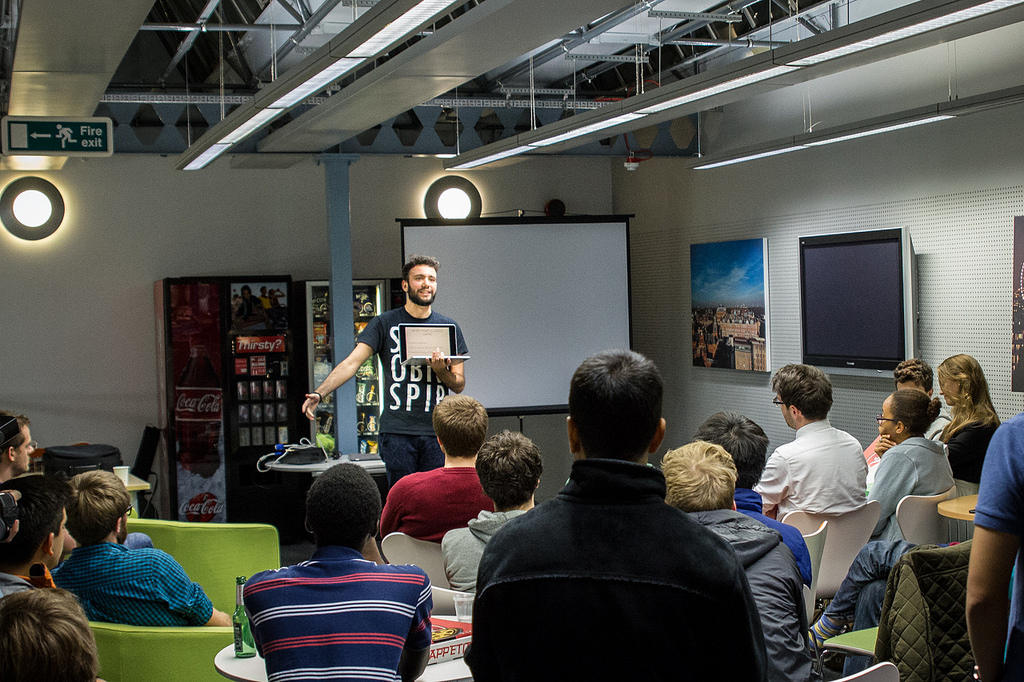
Students at Imperial College’s Marker’s meetup present ideas and get feedback

Continue reading

Entrepreneurship: You’ve got the edge to found

Young scientists have substantial advantages over others when it comes to founding a start-up.

Guest contributor Leonie Mueck

Ideas-naturejobs-blog

{credit}Topp_Yimgrimm/ThinkStock{/credit}

Eoin Hyde has been running from meeting to meeting. His start-up, Innersight, is in a critical phase and he has to convince investors to give him and his co-founder enough funds to get it off the ground. Even with his hectic schedule, he’s full of energy.

“Everything is happening very fast,” he says. Until just a few months ago, Hyde had been working as a postdoc at King’s College London, following a PhD in computational biology at the University of Oxford. He enjoyed his research, but when a former colleague approached him with the request to co-found Innersight, a medical imaging company that constructs 3D images from patients’ scans to help doctors during minimally invasive surgery,  he didn’t think twice. “I had been playing with the idea to found a start-up for a long time,” he explains.

Hyde belongs to a minority. Not many science PhDs choose to found companies, at least not in the UK. According to the UK GRAD programme, only 2% of UK-based physical science and engineering PhD graduates are self-employed; it is unknown how many of those have the goal to found fast-growing technology start-ups with global reach. Alex Crompton, programme director at Entrepreneur First, finds these low numbers regretful because in his opinion, science PhD graduates are perfect founders. Continue reading

Windback Wednesday: Entrepreneurship

Scientists are full of ideas, constantly creating wonderful research, but what can you do when one of these ideas could make you some money? In this Windback Wednesday series we’re digging up some articles from Nature Careers and the Naturejobs blog on entrepreneurship
windbackweds

{credit}Naturejobs{/credit}

The word entrepreneur comes from the 13th century french verb entreprendre, which literally translates to “to do something” or “to undertake”. By the 16th century, the word entrepreneur had developed a meaning of its own: someone who undertakes a business venture. It’s distinguishing features, according to Richard Cantillon (an 18th century economist), are an understanding of risk and being prepared to do business without guaranteed profits. Sounds scary, but it doesn’t need to be.

In a recent interview with Naturejobs (podcast to follow soon!), Steve Blank, a Silicon Valley entrepreneur, described entrepreneurship as a cross between science and art:

“Artists have something inside of them that they want to bring to fruition, and actually see tangible results of: it’s not just thinking about music or listening to music, they want to make music. Making a start-up and making something commercial is exactly that same feeling, and if you don’t have that passion for it, you shouldn’t get engaged. But if you do have that passion for it, you will figure out how to split up some time, take 6 months off or take a sabbatical…. [and] you will find, once in your life, you will experience what it takes to actually do a start-up. But this isn’t a job, this is a passion.”

On that much happier note, we’re going to start this month’s series on entrepreneurship with Neil Savvage’s article on Innovation: Brushing up on business. As well as case-studies, this article gives some insight into practical talks and training courses scientists can do to brush up on their business skills.

Throughout this month, we’ll also be looking at how to find some venture capital to fund ideas, how to become a bio-entrepreneur and how women can find a way in to the entrepreneurial world.

But what we’d like to know is: what does the word entrepreneur mean to you?