How to use your graduate school training to create a successful business without any investors
2

 Every PhD graduate is armed with 10 transferable skills that can help create a successful business without any upfront cash or formal business training, says scientist turned entrepreneur Behrouz Moemeni.
This piece was one of two winners of the Science Innovation Union writing competition, Oxford.
“This is downtown San Francisco, our train’s final stop. Can all passengers please detrain? All detrain please. All detrain.” Perhaps it was the heady fug of jetlag that made this broadcast particularly amusing to my UK-English language sensibilities, but I “detrained” all the same and stepped into the crisp morning air of the Californian rush hour.
I was on the west coast to visit two genetics start-ups as part of a whirlwind three-day tour of the US. With a long postdoc and several first author papers tucked into my belt, I wanted to see if these credentials would pass muster in the tech haven of Silicon Valley. I’ve always found the loneliness of solo work-travel to be highly amenable to strategic thought, and this American adventure was an opportunity to reflect on why I was there and what I wanted.

A placard waved at the anti-Brexit demonstration, held in London on March 25 2017.
“Rule Britannia, Britannia rules the waves, First we’ll kick the Poles out, Then we’ll get the gays.”
Liberal democrat peer Liz Barker reminded a business summit on LGBT rights last week that the above chant was heard in London the day after the EU referendum in June 2016, and that in the three months following there was a 147% increase in reported homophobic crimes.
“Among the very many half-truths bandied about during the [referendum] campaign, the idea that the EU played very little or no parts in gaining rights in this country was most egregious,” she told The Economist’s Pride and Prejudice event, held in London, Hong Kong and New York on 23 March. Continue reading
https://www.youtube.com/watch?v=cKOadartwHs

{credit}Topp_Yimgrimm/ThinkStock{/credit}
In stark contrast to the proliferation of web based start-ups led by young founders, science based start-ups have typically remained the domain of seasoned professors, spinning out breakthrough technology built on years of research. This is changing rapidly, and it’s now more viable than ever to start a science based company straight out of a PhD. In fact, it might just be one of the most sensible career paths that you can take.
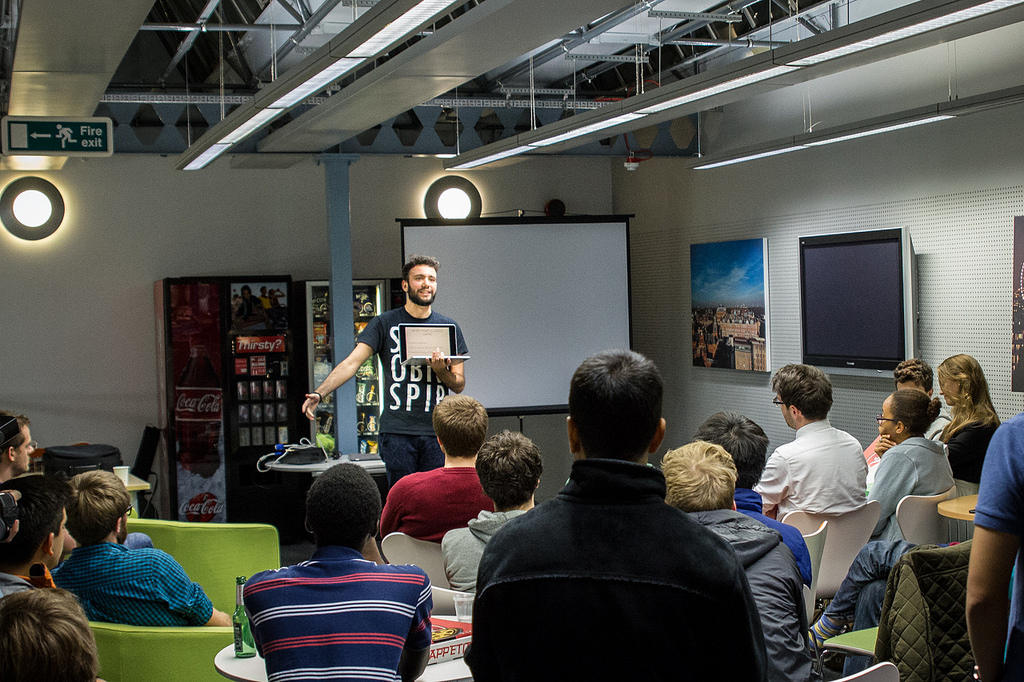
Students at Imperial College’s Marker’s meetup present ideas and get feedback
Naturejobs career expo journalism competition winner Diane N.H. Kim
Confidence is not something we normally associate with science. In this field, grounded in facts and far from emotions, it’s no wonder we have trouble seeing how our attitudes affect our success. A confident attitude is considered much more important for an actress on the red carpet, or a politician delivering a speech. Scientists are still largely portrayed and perceived as solitary individuals with passive personalities, spurred by a media portrayal of a lone scientist in their basement lab. Continue reading
In certain circles, ‘sales’ has become taboo; the word summons memories of double glazing, cleaning supplies, or accidents that weren’t your fault. Despite this, a great salesperson simply believes in their product, and knows how to portray its finer points in an effective way.
Similar knowledge could give you the edge in applying for your next job or promotion. Sure; having the requisite qualifications and soft skills (being personable, confident, organised) is essential, but understanding your own value, and knowing some of the finer skills that salespeople use in their pitch, may help you to better present yourself to an employer.

Contributors Mandë Holford and Ivana Gadjanski

From left to right: Lawrence Krauss, Justine Cassell, Ivana Gadjanski, Mande Holford, Tony Pan and Diva Tommei {credit}World Economic Forum / Faruk Pinjo{/credit}
Scientists may not readily identify themselves as entrepreneurs, but a comparison can indeed be made between the corporate business sector and the scientific enterprise. Are their skills that women in business have that women in science can acquire and benefit from? The intersection of STEM (Science, Tech, Engineering and Math), Innovation, Business and Women were recently addressed on a panel at the World Economic Forum (WEF) Summer Davos meeting in Tianjin China. Together with Justine Cassell, Tony Pan, Diva Tommei, and Lawrence Krauss we discussed ‘why aren’t more women entering careers in science and technology (in academia and industry) given the role of STEM in the future of economic growth?’
The reasons women are lacking in STEM industries and academia are multiple and complex, however one major hurdle we discussed is the lack of business knowledge among the women STEM scientists.
The current knowledge economy calls for educated specialists who can leverage their currency across multiple platforms. Scientists by nature are opportunity driven specialists who can, and should, be thriving in the knowledge economy. Running a successful laboratory is very similar to running a startup or a company. Principal Investigators (PIs) need to be good in fundraising, team- and project management, even marketing (e.g lab twitter accounts). Interestingly, the science-business interface can be a good opportunity for women scientists in STEM academia to get more exposure to these tasks and thrive. Continue reading