Radio and science

At a ‘Career Day’ meet in Bangalore last week, I was asked by a young scientist from the National Centre for Biological Sciences (NCBS) why there were not enough people communicating science in India’s national language Hindi. I had a ready answer for that (I get that question a lot of times from well meaning souls). And the answer is: it makes sense when you ask the same question in the context of Chinese or Japanese or for countries where science is done in regional languages. In India, the language of science happens to be English, for historic reasons. And even if you passed out of a Hindi medium school (or for that matter in any other regional language) and wanted to pursue science, nine out of ten chances you would have to switch to English.

So the question that follows is: who would be the takers, the audience of such communication then? Without a significant audience (and thus commerce) why would a publishing house think of a Hindi science communication venture that runs the risk of being in the red from the word go? [Having said that, here‘s a more optimistic piece that goes beyond the commerce of regional science communication and weighs its merit.]

Someone from the audience had the expected sequel question ready, “What about radio?” Yes, that’s a tried and tested medium — put to very good use by the All India Radio and BBC Hindi Radio to popularise science, primarily agricultural science in rural India. I have loved doing regional language radio trying to relate tough scientific terms to a Hindi audience [though I must admit I have fumbled to find the Hindi equivalent for terms like “cross-pollination” at times].
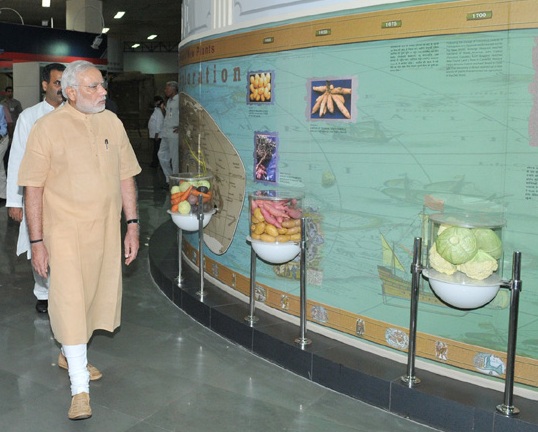
Prime Minister Narendra Modi says agriculture scientists must take to the radio to reach out to farmers.

Prime Minister Narendra Modi says agriculture scientists must take to the radio to reach out to farmers.{credit}PIB{/credit}

Therefore, today when Prime Minister Narendra Modi urged hundreds of agricultural scientists at the 86th Foundation Day celebration of the Indian Council of Agricultural Research (ICAR) to make use of good, old radio to take science from ‘lab to land’, it rang a bell. Modi said agricultural colleges should start their own radio stations. Farmers listen to radio a lot and young agricultural scientists in these colleges kicking off new radio programmes would benefit the farmers immensely, the Prime Minister suggested.

Science-savvy Modi, who began his stint in the high chair a couple of months back flagging off a satellite launch vehicle and consulting scientists of all hues from day one, also called for creation of a digitized database of agricultural research in the country. He sought to link the young, educated and progressive farmers of India with agricultural research scholars saying they could form a powerful talent pool.

Farming in India is mostly inherited across generations and so it is difficult to change agricultural practices overnight. Modi said something science communicators often say — that it would be useful for scientists to explain the efficacy of a particular practice or initiative in language the farmer can understand. Agricultural scientists could play a big role in conveying the impact of changes in climate, water and soil to farmers.

While we are at it, I am taken back to a 1955 communication by British science writer Ritchie Calder, Member of the Council of the British Association for the Advancement of Science. In the article written for UNESCO, Calder summarises the role of a scientist in popularising science through radio thus:

Calder

{credit}UNESCO{/credit}

We might well be heralding an era of a structured science communication and outreach programme in this country, with scientists and the radio at the heart of it all.

Indigenous shrimp brood stock to boost exports

An RGCA brood stock centre. Inset: L. Vannamei

An RGCA brood stock centre. Inset: L. Vannamei{credit}RGCA{/credit}

India released a specific pathogen free variety of shrimp for commercial aquaculture today. This promises to help marginal shrimp farmers and boost seafood exports from India.

The brood stock of  the shrimp in question — Litopenaeus vannamei —  have been developed for the first time in India by the Rajiv Gandhi Centre for Aquaculture (RGCA) in Tamil Nadu. These can now be supplied to hatchery operators at competitive prices, according to a government release. These selectively bred mother shrimps can produce high quality shrimp seed that grow fast and survive well in commercial shrimp farms in India.

Till now Indian shrimp hatcheries imported such brood stock from centres in  USA, Thailand and Singapore incurring high shipping costs and massive transit losses. The average cost of brood stock was estimated at Rs. 5000. This also prompted some hatcheries to source brood stock from shrimp ponds which ultimately resulted in the production of poor quality seeds and subsequent crop loss to farmers.

About 80% of India’s shrimp farmers are estimated to be marginal and small scale and the success of their crop largely depends on the quality of seeds.

India’s export of marine products crossed US$ 3.5 billion for the first time in 2011-12 recording a growth of 6.02%. over the previous year. Frozen shrimps are the major export value item accounting for about half of the total US dollar earnings. One of the major reasons for the increase in production and higher export turnover was due to the introduction of L. vannamei shrimp for aquaculture production. However, one of the major obstacles to higher production was the non-availability of quality brood stock in India in the required quantity.

Government sources said this project will help Indian farmers produce 1.35 lakh metric tonnes of additional shrimp for export worth around Rs. 4000 crore per annum by utilizing about 10,000 hectare water spread area for two crops per every year. It will also deliver quality brood stock to shrimp hatcheries.

RGCA, in collaboration with the Oceanic Institute, Hawaii, USA has produced these selectively bred brood stocks that show good maturation/hatchery performance. Though L.vannamei is native to the Pacific coast of central and south America, it is popular among shrimp farmers worldwide due to the availability of selectively bred fast growing improved quality specific pathogen free (SPF) and specific pathogen resistant (SPR) seeds.

Of pesticides and fertilisers

This week saw a lot of talk on safe food, clean environment, pesticides and fertilisers emanating from two events — a conference on food safety and environmental toxins and the release of the United Nations Environment Programme (UNEP) global report “Our Nutrient World”.

The conference — organised by New Delhi based Centre for Science and Environment (CSE) — noted that bio-safety of pesticides was a serious issue for India. It called for policy level intervention to give regulatory powers to either the health or the environment ministries (not the agriculture ministry, which presently regulates).“There is a need to review all registered pesticides taking into account comparative risk assessment and deregister toxic and obsolete pesticides,” said Chandra Bhushan, head of CSE’s food safety programme, in a press release. Organic and non-pesticide farming has been showing encouraging results across the country and the government should encourage them, he noted.

The conference called for publication of an annual report on the status of pesticide contamination in the country.

The UNEP report

The UNEP global Report “Our Nutrient World” co-authored by eminent Indian biotechnologist N. Raghuram took note of India’s constraints in phosphorous mining and urged for a mechanism to recycle human wastes for agriculture through innovative steps like urine-separating toilets.

Raghuram, also the Director of New Delhi-based South Asian Nitrogen Centre, said most of the phosphorous in India is mined from sedimentary rocks with the country accounting  for only 0.19 per cent of the world’s resources. It is mostly low-grade phosphorous not suitable for fertilizer manufacture. That makes India heavily dependent on imports.

Also, large tracts of croplands in India suffer from physico-chemical and nutrient imbalances resulting in low efficiency of applied fertilizer phosphorous. An estimated 4-15 per cent of phosphorous consumed by livestock becomes available for human consumption in the end.

With a population of close to 1.3 billion, India is estimated to release between 0.38-1.02 Tg of phosphorous per annum. Raghuram says the country needs an effective mechanism to recycle human wastes to plough back this phosphorous into agriculture use. It would ensure two things, he says — capturing nutrients and returning them to the soil as well as improved sanitation in the developing world.

Sane thinking all. Hope advocacy like this finds its way into the country’s policy documents.

Borlaug award

This week saw another alumnus of the Presidency College, fondly called the Oxford of the East, do India proud by bagging Rockefeller Foundation’s first ever Borlaug Field Award, which has been constituted to recognise young researchers helping farmers and hungry people around the world through science. Earlier this month string theorist Ashoke Sen, another Presidency product, wowed the world when he was named one among the eight scientists worldwide to receive the three million dollar Fundamental Physics Prize in its first edition.

Presidency College, now Presidency University, counts among its illustrious alumi the famous scientists Jagadish Chandra Bose,  Satyendra Nath Bose, Meghnad Saha and statistician Prasanta Chandra Mahalanobis. Something in the air at this grand institution that breeds such wonderful science and scientists?

Coming back to the young social scientist who influenced policy through her work , after Presidency College, Aditi Mukherji studied at the Jawaharlal Nehru University, Delhi; and the Indian Institute of Technology, Mumbai; and completed a Ph.D degree in Human Geography at the University of Cambridge, United Kingdom.
Her research on groundwater resources in agriculture has done thousands of farmers in West Bengal a world of good. According to the press release announcing the honour, Mukherji a senior researcher at the International Water Management Institute’s New Delhi office, has surveyed more than 4,000 groundwater users to discover that smallholder farmers in water-abundant eastern India were unable to get water for their irrigation needs due to policy restrictions that actually were made keeping in mind the water scarcity in other parts of the country. She became the voice of the voiceless working closely with farmers and villagers to record their concerns.
Through research and political engagement, she became instrumental in getting two critical policy changes in two years— one to remove a restrictive permit requirement for operating low-power irrigation pumps; and another to reduce the electrification cost to run the pumps. Following these policy changes, the farmers now have easier and more universal access to groundwater for irrigation and will be able to intensify their cropping systems, earn better livelihoods and emerge out of poverty, the award committee noted. Mukherji presented her research to the government convincing them that the situation in water-rich east India was different from other parts of the country facing scarcity and depletion of groundwater.
Mukherji will get the 10,000 dollar award at the World Food Prize international symposium in the US in October.
Here’s raising a toast to the Oxford of the East for nurturing some of the best brains this country has produced!

GM debate

The long-drawn debate over genetically modified (GM) crops in India saw another shocker this week when one of the country’s Parliamentary committees said it was ‘highly disconcerted’ over the pressure being created by the GM industry over the body responsible for approval of GM crops in India (press release). The parliamentary committee smells a ‘collusion of a worst kind’ happening between the approving committee and the industry and has recommended a thorough independent probe into the introduction and subsequent moratorium on Bt. brinjal in India.

In 2008, the Indian Council for Agricultural Research (ICAR) had noted in a report that when lambs were fed with Bt. cotton seeds, the weights of their liver and testicles increased and the WBC in their blood decreased.  The parliamentary committee took note of this and has recommended a professional evaluation of these developments to decide biosafety and health safety aspects of Bt. cotton.

Another interesting observation that the committee makes is that considering India’s rich biodiversity and the irretrievability of transgenic crops released in the environment, any further research and development on transgenics in agricultural crops should only be done in strict containment. Field trials ‘under any garb’ should be a strict no-no. Serious concerns have been raised over the poor policies governing GM crops, absence of a powerful implementing authority, the likely impact of transgenics on agricultural and medicinal crops and labeling of GM products.

The report has met support from independent think tanks and is being seen as a clear indication that the government is waking up to the need for a more broad based debate over introduction of GM crops in India. Sunita Narain, who heads New Delhi-based Centre for Science and Environment says GM technologies need a robust and credible regulatory framework to work in the interest of people and environment. She deposed in front of the Parliamentary committee earlier and believes that this new report paves the way for a more matured debate on GM crops in India.

Hopefully we will have more indigenous R&D and healthier debates to support or trash each move of the government and the industry towards introduction of GM crops in this country.

Farm technology

Climate change has affected farmers in so many ways, it’s difficult to count on your finger tips. The popular view on climate change altering crop patterns, skewing yields and changing regional economies has triggered the interest of most livelihood researchers over the last decade.

Technology will play a key role in ensuring food security.{credit}Photodisc/ImageSource{/credit}

In India, a new grant was announced this week to improve livelihoods and food security of farmers in three states — Punjab, Gujarat and either Bihar or Jharkhand.  These states have a significant stake in India’s overall food security. The U.S. Agency for International Development (USAID) will award a $1.7 million grant to the Centers for International Projects Trust (CIPT).

The Trust will implement what is being called the ‘Water-Agriculture-Livelihood Security in India’ programme. The grant will be used towards public and private sector collaborations and will look at innovations that ensure better agricultural practices.

The programme will support local farmers set up innovative and integrated water and energy saving technologies and practices thereby trying to ensure better yields and incomes for farmers. It will look at  introducing best practices in groundwater management,  improving water and energy policies.

Partners in this programme include state governments, agricultural universities and research institutes, the Indian Council for Agricultural Research, Columbia University in the US, and agri-businesses.

The key to the success of such programmes will be empowering  farmers with technology. As father of India’s Green Revolution M. S. Swaminathan argues in this article in Nature India: “This impending food crisis can be solved to some extent if we can turn the small and marginal farmers, now eligible for institutional credit, to science and technology based farming methods.”

Hope programmes such as these fall back on technology to create sustainable models that last a while and not end with a couple of yields.

Green revolution 2.0

{credit}Photodisc/Photoalto{/credit}

An interesting article published in a review magazine of International Centre for Agricultural Research in the Dry Areas (ICARDA) discusses the feasibility of a second green revolution in India this week. Ram Badan Singh,  president of the country’s National Academy of Agricultural Sciences feels the signs for another big bang in Indian agriculture are encouraging. “Gross capital formation in agriculture, as a percentage of agricultural GDP, increased from 12% in 2004-05 to 22% in 2010-11. Investment in agriculture has increased by 30% in recent years,” he points out.

The first green revolution in the 1960s and ‘70s  catapulted India into becoming the second largest agricultural producer of the world. Though its second version might still be some years away, Singh says most experts feel its only a matter of time.

Of course, it would mean research integration, private investments and policy changes. Singh contends that the first green revolution involved a lot of environmental costs by way of unsustainable groundwater extraction, fertilizer run-off, pesticide residues and salinization. The priority was to resolve food shortages, and environmental issues were poorly understood. “Today we have a clearer understanding of how to monitor, control – even reverse – land and water degradation. We also have technologies that can increase yields without damaging the environment. These technologies are the key to a second Green Revolution,” he writes.

In trying to reach closer to the next big thing in Indian agriculture, technology will play a vital role, says Monkombu Sambasivan Swaminathan, the man credited for bringing about the first green revolution. The challenge would also be to bridge the rich-poor divide in technology, he says in this article in Nature India.

It would be worth watching policy changes and private participation in agriculute in the coming years to find out if the optimism surrounding Green Revolution II is real.