Tyler Prize for Indian environment policy maker

Madhav Gadgil

Madhav Gadgil

Madhav Gadgil, Professor of Interdisciplinary Studies at Goa University and Chair of India’s expert panel on Western Ghats ecology, shares this year’s prestigious Tyler Prize for Environmental Achievement with Jane Lubchenco of Oregon State University, USA. The 2015 Tyler Prize, announced today, recognises their leadership and engagement in the development of conservation and sustainability policies in India, the United States and internationally.

Gadgil’s landmark report on the biodiversity of Western Ghats known as the “Gadgil Committee” report offered guidelines on the protection and development of India’s Western Ghats, a UNESCO World Heritage site and one of the eight most biological diverse areas on earth. His body of work has helped India draft the National Biological Diversity Act. Lubchenco, the former administrator of the federal agency National Oceanic and Atmospheric Administration (NOAA) has for long advocated the importance of the ocean and the need to protect it. The U.S. Department of State named her the first-ever science envoy for the Ocean, to promote this focus on ocean science, marine ecology, climate change and smart policy to a global audience.

“Drs. Lubchenco and Gadgil represent the very best in bringing high-quality science to policy making to protect our environment and ensure the sustainability of natural resources in their respective countries and around the world,” said Tyler Prize Executive Committee Chair Owen T. Lind, Professor of Biology at Baylor University announcing the prize winners. Lubchenco and Gadgil will share the $200,000 cash prize and each receive a gold medallion. The Prize, awarded by the international Tyler Prize Executive Committee with the administrative support of the University of Southern California, honours exceptional foresight and dedication in the environmental sciences and policy.

Gadgil’s career has been dedicated to marrying environmental science with policy making in India and promoting environmental science nationally. Through his public speaking and writing, Gadgil has advanced the field of environmental science and put it on the national radar. “From an early age, my father’s work inspired me to work with people and think about the impact of our collective activities,” Gadgil said in a release. “This first came about in my work in 1975 when traditional basket weavers who depended on bamboo in the Western Ghats approached the government and said the overexploitation of bamboo for paper mills was hurting their livelihood.”

Gadgil’s work began examining the tension between economic development, traditional use of resources among local communities and environmental conservation. This cross-sector approach drove the publication of his first book, This Fissured Land, which is used in environmental education across India, as well as a resource for policy makers.

According to Gadgil, the Western Ghats are central to India’s water supply, genetic diversity, economy and quality of life. “The Indian constitution is about empowering people and our resource management is too top down. Local communities do a better job of balancing economic development and conservation. We must have policies that empower local people to make these choices.”

Working with local forest communities in the central Indian forest belt, Gadgil has seen that that management in the hands of locals is most effective ensuring economic opportunity and sustainable use of natural resources while preserving sacred groves and local cultures. “We must engage local people who are most directly affected by policies if we want to develop policies that promote sustainability and balance the economics, culture and conservation,” Gadgil said in the release. “Empowering people is the key.”

Gadgil is a recipient of India’s highest civilian honours the Padma Shri in 1981 and the Padma Bhushan in 2006. He also received the Shanti Swarun Bhatnagar Award for biological sciences in 1986.

Indian research scholars renew pay hike protests

protest

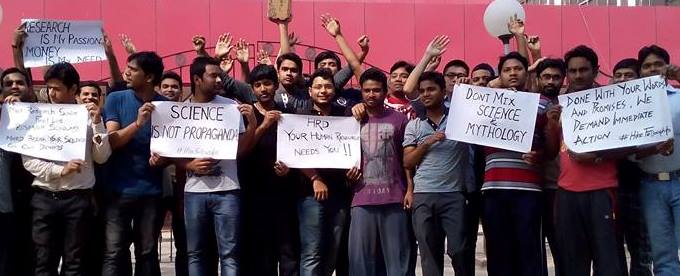
The long-drawn agitation by Indian research scholars demanding a hike in their scholarship stipends made a comeback this week, as research institutions across the country witnessed various forms of protests. At the heart of the protests is the venerable hub of Indian research —  Indian Institution of Science (IISc) in Bangalore — where the scholars are resorting to novel ways of making their point. Sample this street play that shows their disappointment with India’s ministry of human resource development, which has been promising to implement a revised fellowship regime since October last year but hasn’t.

Candlelight vigils, protest marches, human chains, a postcard and cheque campaign (where each research scholar will send a one rupee cheque to the ministries concerned)  and an ‘Open Day’ mark the protests planned across the country this week. The researchers say their patience is being tested by the union government and that these protests are aimed at getting them to issue a new and final notification on when the promised hikes will be implemented. 

IISER research scholar Sivaranjan Uppala withdrawing his hunger strike after promises by the Indian government

IISER research scholar Sivaranjan Uppala withdrawing his hunger strike after promises by the Indian government

Fresh protests erupted last week with Sivaranjan Uppala, a research scholar from Indian Institute of Science Education and Research, Mohali, sitting on a hunger strike in New Delhi. The strike was supported by researchers from Indian Institutes of Technology, All India Institute of Medical Sciences, Jawaharlal Nehru University and the Defence Research and Development Organisation. Uppala’s hunger strike was called off after promises from the ministry to look into the matter by the end of this week.

In October last year, yielding to long standing demands of research scholars,  the Indian government had announced a hike in the fellowships for young scientists working in government laboratories across the country. The union human resource ministry also issued a fresh notice last week saying the same thing again.

The October protests were under the banner of ‘Research Scholars of India’ with scholars from many institutes in Delhi — All India Institute of Medical Sciences, National Institute of Immunology, International Center for Genetic Engineering and Biotechnology (ICGEB), Indian Institute of Technology Delhi, Jawaharlal Nehru University, Jamia Hamdard University, Jamia Milia Islamia, Delhi University and National Institute of Plant Genome Research. Their immediate demands were a hike in fellowship to compensate for the current inflation rate, annual increments linked to inflation, revision of fellowships from April 1, 2014 and streamlining of monthly fellowships.

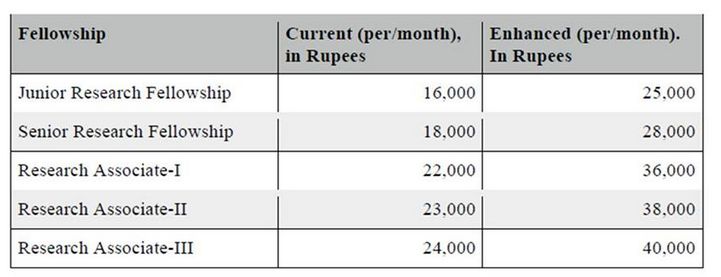
The Indian government agreed to their demands announcing just a couple of days before the festival of lights Diwali that the ‘much awaited hike’ across the board will be at least 50% more than the existing levels and effective 1 October 2014. The hike was affected after India’s finance ministry, after examining the recommendations of an inter-ministerial meeting for its budgetary implications, gave its nod. Here’s how the hike is expected to look like:

fellowship hike

[More details in this official memorandum of India’s Department of Science and Technology.]

The protests do not look like dying down until the Indian government goes beyond promises and follows them up with some action.

India unveils new open access policy

OAPre-Christmas, India’s department of science and technology (DST) and department of biotechnology (DBT) played Santa to the Indian scientific community when they unveiled the country’s new open access policy this month.

The new policy will help researchers working on  funding from either of these two departments under the ministry of science and technology to publish in journals of their choice. The departments hope that researchers will publish in “high quality, peer-reviewed” journals. The authors of such papers will have to deposit copies of the final papers and supporting data in institutional repositories where the information can be accessed by the public.

In essence, it is a big leap for the open access environment in the country. The policy intends to “enhance public exposure of research.” By maximising the distribution of these publications through free online access, the Indian government also wants to ensure percolation of cutting edge research at a rapid pace into higher education curricula, “thereby raising the standard of technical and scientific education in the country”.

The policy notes that “since all funds disbursed by the DBT and DST are public funds, it is important that the information and knowledge generated through the use of these funds are made publicly available as soon as possible, subject to Indian law and IP policies of respective funding agencies and institutions where the research is performed.”

From the funding year 2012-23, authors writing with DST or DBT grants will have to deposit their papers to the institutional repositories within two weeks of acceptance by a journal. They will also have to submit manuscripts of their earlier publications even if they are unrelated to current projects funded by DBT or DST. Journal embargoes will be honoured by these repositories to make the papers openly accessible.

In order to reach the policy to researchers across the country, institutes under DBT and DST will celebrate “Open Access Day” during the International Open Access Week  with sensitising programmes.

India hikes research fellowships

Yielding to long standing demands of research scholars,  the Indian government announced a hike in the fellowships for young scientists working in government laboratories across the country.

The announcement came today, just a couple of days before the festival of lights Diwali and is being seen as a Diwali gift to the research community. India’s Minister of State for Science and Technology (Independent Charge) Jitendra Singh announced in a release that the ‘much awaited hike’ across the board will be at least 50% more than the existing levels and it will be effective from 1 October 2014.

The hike was affected after India’s finance ministry, after examining the recommendations of an inter-ministerial meeting for its budgetary implications, gave its nod. There will also be a regular evaluation of fellowship levels periodically. Here’s how the hike is looking like: fellowship hike More details were released in an official memorandum of the Department of Science and Technology.

Though some of the demands of the research scholars such as revision of fellowships from April 1, 2014 were not met, the protesting scholars were clearly jubilant with the announcement. The key facilitator in the whole discussion  Krishnaswamy VijayRaghavan, secretary to the Department of Science and Technology, was being profusely thanked for his contribution to the effort across social media platforms.

Here’s hoping good days are finally here for India’s research scholars.

Climate change policy: What’s new for Asia?

CDKN-IPCC-Whats-in-it-for-South-Asia-AR5_Page_01At a workshop discussing what the take homes for  Asian countries might be from the latest assessment report of the Intergovernmental Panel on Climate Change (IPCC) — AR5 — it was pointed out that there wasn’t enough science coming out of developing countries to feed the database on emissions or warming in the larger climate change debate. Local scientists need to conduct more climate change related experiments, write more scientific papers and bolster regional science  in order to make a case for these developing countries in the international discourse on climate change.

“We also need more authors from the developing world to participate in writing the chapters for the IPCC reports,” says Jonathan Lynn, Head of Communication at the IPCC. Lynn says though there is substantial science emanating from India now, some other small Asian countries such as Indonesia lag far behind. The IPCC collates scientific data from across the world to make predictions for future scenarios with the help of scientists, economists, policy makers and government representatives. Most of the work done by scientists in this process is voluntary and not paid for. Developing country scientists, who also do consultancy work for a living, would expect such work to pay off for their time — this could be one of the reasons why not many developing country scientists are interested in the job, Lynn says.

The IPCC assessment reports try to turn all available scientific evidence into something that would make sense to policy makers and businesses — therefore, the authors have explained the science at hand this time in terms of “risk management” parameters. “And since there are questions of ethics and equity involved in this highly political debate, we now have philosophers in the IPCC team to make sure those aspects are taken care of,” Lynn says.

Joyashree Roy, an economist from the Jadavpur University in Kolkata is the lead author of the industry chapter in IPCC’s assessment report five. She says Asia needs to urgently decouple the high energy sector from emissions. “Almost 44 per cent of the global emissions are from the energy and industry sectors of China and India — there lies an opportunity for south Asia. Can we think of a low emission-high energy scenario?”

Roy says population and economic growth are responsible for the surge in energy demand as well as emissions in south Asia.

Another IPCC author Navroz Dubash from New Delhi-based thinktank Centre for Policy Research points to an inherent dichotomy in the report — the number of countries which have adopted mitigation strategies or have a national action plan for climate change has gone up many times, especially in Asia post-2005. Simultaneously, the emission rates of Asia have zoomed and the world as a whole is hurtling at great speed into a carbon-based future. How is that possible, you wonder. “Well, there have been a slew of national policies in the last few years but they will take around 3-4 years to bear fruit. The more optimistic outlook would be to review the scenario in a couple of years and see if these policies have led to significant action,” he says.

Dubash says India will also benefit from the new stand of IPCC where ‘co-benefits’ of climate-friendly policies are being seen in new light. Earlier, IPCC talked of climate change mitigation plans as the main goal with parameters such as development or health as co-benefits. “The idea now is that the concept of co-benefits could work both ways, meaning if a development project brings in climate change mitigation as a spin-off, it should be totally acceptable. This concept is at the core of India’s national plan and now IPCC has sanctified it — so there’s a huge opportunity.”

According to A R Paneerselvan, advisor to the executive director of Panos South Asia, an organisation informing public and policy debates on environment issues, there are talks of a south Asian intiative for climate related insurance. The insurance would cover farmers against any vulnerability stemming from climate change. The initiative is still at a nascent stage and there’s pressure from the cash crop sector in south Asian countries to make a case for climate-related insurance, he says.

As for IPCC’s fifth assessment report and what’s in it South Asia, London-based Climate and Development Network brought out a good primer that explains just this. The Intergovernmental Panel on Climate Change (IPCC) chairperson Rajendra Kumar Pachauri also spoke about what it means for India at an outreach programme in New Delhi today.

Antibiotics everywhere — in chicken, pork, fish, mutton

The ‘antibiotics in your chicken’ story was everywhere in the Indian media (1, 2, 3, 4)  today — studies by Delhi-based NGO Centre for Science and Environment (CSE) always manage to generate this level of interest — be it antibiotics in honey, toxic phthalates in toys, polluting car parks or pesticides in cola. These are studies that touch the common man’s  life directly and, many a time, help make policy changes by creating the necessary buzz. The peer review process follows the advocacy drive, I am told, “since publishing scientific findings could take time and the issue at hand might need urgent attention.”

Scientifically speaking, what do we know about the chicken-antibiotic story that we didn’t already? One, this is the biggest study done in India to test residues of antibiotics in chicken — 70 chicken samples from Delhi and the National Capital Region (NCR) were tested, 40 per cent samples tested positive, residues of more than one of six commonly used antibiotics were found in 17 per cent samples. All this “points to a large-scale unregulated use of antibiotics as growth promoters by the poultry industry and could be one of the reasons Indians might be developing antibiotic resistance.”

Antibiotics might creep into your plate from most commercially reared food animals

Antibiotics might creep into your plate from most commercially reared food animals{credit}S. Priyadarshini{/credit}

Getting back to the issue of humans developing antimicrobial resistance through use of antibiotics in food animals, way back in 2002, the World Health Organisation (WHO) raised an alarm over this “fast spreading, serious threat to global public health.” WHO  estimated that half of the antibiotics produced in the world are being used in farms and not to improve human health (WHO, 2002, Use of antimicrobials outside human medicine and resultant antimicrobial resistance in humans).  Antibiotics are administered eight times more for non-therapeutic purposes than for treatment. Antibiotics are given as prophylactics to prevent infections and also to promote growth.

“The prolonged use of low doses of antibiotics in animal feed can create ideal environment for production of antibiotic resistant bacterial strains. The resistant bacteria can be transmitted from animals to humans via contact, food and environment. Infections caused by resistant microorganisms do not respond to the standard drugs, leading to prolonged illness, higher cost of health care and more risk of death.”

So, if you thought your mutton, fish and pork are exempt from the antibiotic-fed category, here’s a rude shocker, by WHO:

antibiotics-WHO

{credit}WHO{/credit}


This year WHO mentioned in its global surveillance report on antimicrobial resistance :

The use of antibiotics in animal husbandry – including  in livestock, poultry and fish farming – are leading to increasing recognition that urgent action is needed to avoid inappropriate use, and to reduce antibiotic usage in animal husbandry and aquaculture, as well as in humans. More data are needed on antibiotic consumption in food-producing animals worldwide, and on the occurrence of antimicrobial resistance in diff‚erent countries and di‚fferent production systems, in order to make comparisons between countries and identify priority areas for intervention.

Food-producing animals are reservoirs of pathogens with the potential to transfer resistance to humans. The magnitude of such transmission from animal reservoirs to humans remains unknown, and will probably vary for di‚fferent bacterial species. The spread of resistance genes from animal bacteria to human pathogens is another potential danger which adds complexity.

The report rang alarm bells saying antibiotic resistance was sweeping the developing world. India also has the dubious distinction of being the hotbed of many drug-defying bugs.

So, earlier this month, at the International Conference on Host Pathogen Interactions (ICHPI) in Hyderabad, the issue of antimicrobial resistance raised some sharp reactions. Scientists attending the meet recognised how microbes are constantly fighting back by gaining new resistance mechanisms against drugs. The need for novel and effective antimicrobial drugs was felt, not only to treat emerging infections but also for the success of medical procedures such as organ transplantation, cancer chemotherapy and major surgeries that are commonly preceded by infections especially in developing nations like India.

Scientists at the meet said it was unfortunate to see ‘lack of data’ for India in the recent WHO report on global surveillance on antimicrobial resistance. A brainstorming, therefore, intended to identify international and national organizations and funding agencies for addressing antimicrobial resistance. The scientists and policy makers participating in the brainstorming were looking at existing Indian policies on antimicrobial resistance and their strengths and weaknesses to spot areas that need immediate amendment.

Some key recommendations that came out of the session (and have been sent to India’s Department of Biotechnology and the Indian Council of Medical Research)  were:  (i) creating awareness about the growing antimicrobial resistance and its impact on animal and human health to the public, doctors and other stakeholders – lobbying with the politicians for this, (ii) regulation of the prescription / sale of antibiotics and standardisation of antibiotic treatment regimen, (iii) collection of epidemiological and surveillance data and maintenance of a nationwide database to monitor and record developing antimicrobial resistance in hospitals, fields and among public, (iv) research to identify novel growth promoters, novel targets to kill microbes, novel combination of approved drugs and alternatives to antibiotics such as probiotics, immunomodulators, anti-virulence drugs, anti-toxins, vaccines and improved sanitary managements, (v) development of community level, rapid, point of care diagnostics/screening tools, (vi) understanding the molecular mechanisms involved in the development of antimicrobial resistance and development of strategies to overcome it, (vii) strict regulation of antibiotic withdrawal period in animal produce and need to monitor food borne illnesses, (viii) development of alternatives to the use of antibiotics in the poultry/aquaculture/veterinary practices, as growth promoters and (ix) as large pharma is not interested in the development of new antibiotics, there is need for enhanced public funding and incentives for small and medium companies.

The scientists have also recommended establishment of a National network for antimicrobial resistance, a coordinating centre for molecular epidemiology, genomics and control of drug resistant pathogens with multiple regional monitoring and surveillance centres. The centre is proposed to give emphasis on hospital and community acquired infections.

Lets hope some of these recommendations get some attention — the near absence of global scientific data in this field means taking the first step would be avant-garde.

The CSE study, therefore, comes at the right time as a pioneering effort to generate public discourse on this very significant threat to public health in India.

Radio and science

At a ‘Career Day’ meet in Bangalore last week, I was asked by a young scientist from the National Centre for Biological Sciences (NCBS) why there were not enough people communicating science in India’s national language Hindi. I had a ready answer for that (I get that question a lot of times from well meaning souls). And the answer is: it makes sense when you ask the same question in the context of Chinese or Japanese or for countries where science is done in regional languages. In India, the language of science happens to be English, for historic reasons. And even if you passed out of a Hindi medium school (or for that matter in any other regional language) and wanted to pursue science, nine out of ten chances you would have to switch to English.

So the question that follows is: who would be the takers, the audience of such communication then? Without a significant audience (and thus commerce) why would a publishing house think of a Hindi science communication venture that runs the risk of being in the red from the word go? [Having said that, here‘s a more optimistic piece that goes beyond the commerce of regional science communication and weighs its merit.]

Someone from the audience had the expected sequel question ready, “What about radio?” Yes, that’s a tried and tested medium — put to very good use by the All India Radio and BBC Hindi Radio to popularise science, primarily agricultural science in rural India. I have loved doing regional language radio trying to relate tough scientific terms to a Hindi audience [though I must admit I have fumbled to find the Hindi equivalent for terms like “cross-pollination” at times].

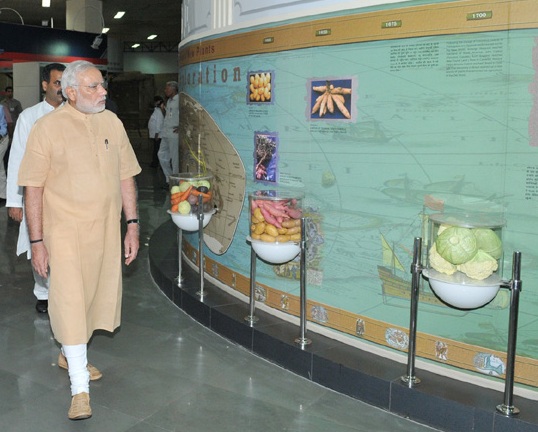
Prime Minister Narendra Modi says agriculture scientists must take to the radio to reach out to farmers.

Prime Minister Narendra Modi says agriculture scientists must take to the radio to reach out to farmers.{credit}PIB{/credit}

Therefore, today when Prime Minister Narendra Modi urged hundreds of agricultural scientists at the 86th Foundation Day celebration of the Indian Council of Agricultural Research (ICAR) to make use of good, old radio to take science from ‘lab to land’, it rang a bell. Modi said agricultural colleges should start their own radio stations. Farmers listen to radio a lot and young agricultural scientists in these colleges kicking off new radio programmes would benefit the farmers immensely, the Prime Minister suggested.

Science-savvy Modi, who began his stint in the high chair a couple of months back flagging off a satellite launch vehicle and consulting scientists of all hues from day one, also called for creation of a digitized database of agricultural research in the country. He sought to link the young, educated and progressive farmers of India with agricultural research scholars saying they could form a powerful talent pool.

Farming in India is mostly inherited across generations and so it is difficult to change agricultural practices overnight. Modi said something science communicators often say — that it would be useful for scientists to explain the efficacy of a particular practice or initiative in language the farmer can understand. Agricultural scientists could play a big role in conveying the impact of changes in climate, water and soil to farmers.

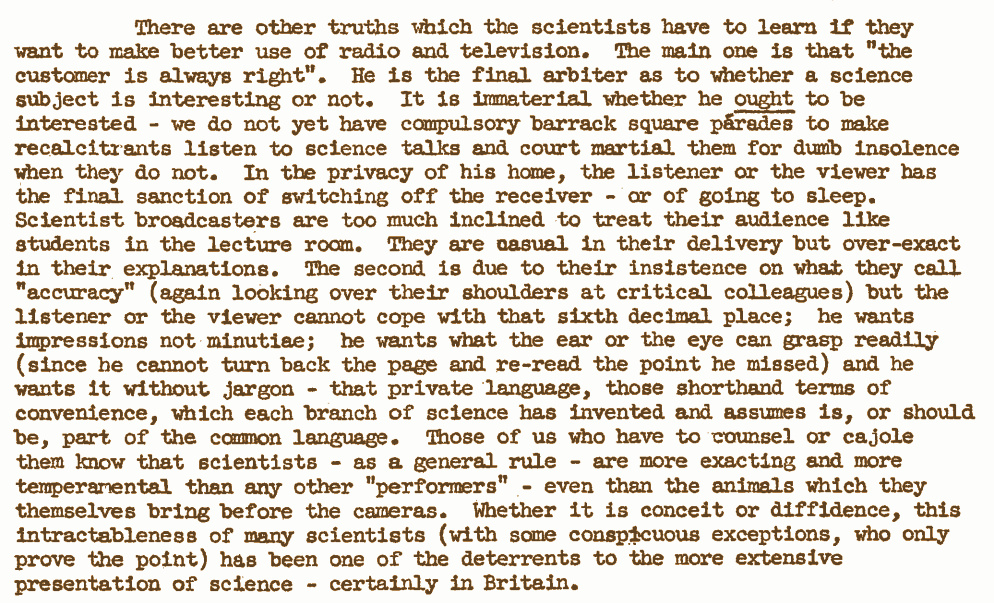
While we are at it, I am taken back to a 1955 communication by British science writer Ritchie Calder, Member of the Council of the British Association for the Advancement of Science. In the article written for UNESCO, Calder summarises the role of a scientist in popularising science through radio thus:

Calder

{credit}UNESCO{/credit}

We might well be heralding an era of a structured science communication and outreach programme in this country, with scientists and the radio at the heart of it all.

India’s research scholars in protest mode

The meagre fellowships that India’s science scholars get has been a contentious issue for long. It raised its head again this week when hundreds of research scholars from various government science and medical institutes of New Delhi staged a silent protest in the corridors of power demanding an immediate hike in fellowships to tackle inflation blues. They were assured by the Indian government yesterday that their long-standing demands will be heard in a meeting next protestweek. And some positive action is expected within the next two weeks.

The researchers under the banner of ‘Research Scholars of India’ were protesting in front of the office of secretary of India’s Department of Science and Technology K. VijayRaghavan. These were scholars from many institutes of Delhi — All India Institute of Medical Sciences, National Institute of Immunology, International Center for Genetic Engineering and Biotechnology (ICGEB), Indian Institute of Technology Delhi, Jawaharlal Nehru University, Jamia Hamdard University, Jamia Milia Islamia, Delhi University and National Institute of Plant Genome Research. Their immediate demands:  a hike in fellowship to compensate for the current inflation rate, annual increments linked to inflation, revision of fellowships from April 1, 2014 and streamlining of monthly fellowships.

Says ICGEB junior research fellow Krishnan Yadav, “Fellowships or stipends provided by the Indian Government to research scholars have, historically, been abysmally low. The amount disbursed is probably enough for one person in his/her twenties to afford a roof over their heads.”

According to a release by the researchers’ body, the cost of living has skyrocketed with inflation soaring over 144% as compared to 2010 level.  A junior research fellow (JRF) gets a stipend of Rs. 16000 per month, increased from Rs. 12000 in 2010 after an indefinite fast by students of Indian Institute of Science, Bengaluru. Senior research  fellows (SRFs) get around Rs. 18,000 per month. Research associates (PhD graduates) get a consolidated fellowship of around Rs. 22,000 per month. “Average age of a research associate is 31 years. With this kind of money, we can’t even support our parents and marriage is a distant dream,” Yadav says.

The protestors are demanding that the pay be revised to 35,000 for JRFs and Rs 38,000 for SRFs.

Quoting a CSIR study, the disgruntled researchers say around 44% of fellows who qualify the prestigious CSIR-UGC JRF/NET examination don’t join Indian institutions for a PhD. More than half of them look at a PhD abroad mainly because of the poor pay.

Anjali Khatri of ICGEB put out an update on the protestors’ Facebook page saying the DST had assured them that new fellowship amounts will be proposed considering inflation rates and guidelines of the Indian Council of Medical Research (ICMR). The protestors  have demanded that their annual increment be linked to two factors — inflation and pay commision. The pay commision recommendations come into force every year but a Phd student’s tenure is not that long. So the researchers have proposed that 1/10th of the hike of pay commision should be included every year in the felllowships along with an inflation-adjusted hike as done for any other government employee.

There have been similar protests in the science hub of the country Bengaluru and in Chandigrah. Some more protests are planned in Mumbai.

Here’s hoping the demands of this country’s young researchers are heard by her policy makers. It will certainly go a long way in retaining talent and attracting more students to science — issues that have plagued the growth of science in the country for long.

Biosecurity laws under scanner

DSC_0674 (2)India tabled an Agriculture Biosecurity Bill in Parliament last year (2013). The government at the Centre has changed since and the Bill is still pending. In the absence of a robust national regulation for biosecurity, the country is still dependent upon an archaic Destructive Insects and Pests Act (DIPA) and the Livestock Importation Act.

In a commentary that discusses the urgent need for a new regulation for the country, our freelance contributor Manupriya writes:

One of the biggest criticisms about the Bill is that it does not include epizootics/zoonoses, disease causing organisms that can hop from one vertebrate to another. Famous examples of such diseases are SARS, Avian flu and Mad Cow disease which can be easily transferred from their primary hosts to humans. While mad cow has not been a cause of concern yet for India, both SARS and avian flu have caused havoc.

India’s ministry of Health and Family Welfare has not made any input to the Bill saying it is the prerogative of the Food safety and Standards authority of India Act. However, international guidelines on biosecurity laid out by FAO clearly say that human health is a key factor that should be considered in every country’s biosecurity framework.

Another criticism for the Bill has been in the area of domestic quarantine. While the bill, does forbid individuals to “possess, move, grow, raise, culture, breed or produce any plant, animal and plant product”, it does not clarify how states should act to contain the spread of disease. India’s past record in imposing domestic quarantine has not been worth mention. Numerous diseases that made a localized appearance earlier have now spread all over the country.

The new Bill hopes to establish an Agricultural Biosecurity Authority of India with headquarters in the national capital region and regional centres all over the country. The authority is expected to be responsible for regulation of the import and export of plants, animals and related products; prevention of entry of quarantine pests; and implementation of post-entry quarantine measures.

Read the commentary here for more on the whys and hows of biosafety in India.

We need some cheeky scientists

As the year drew to a close, I was invited by one of the leading newspaper groups in south India to reflect on the state of India’s science. I have always thought that a crucial factor missing from the country’s science is some cheek, the spirit of adventure, that streak of impertinence which allows researchers to stand up and be counted.

The following piece (reproduced with permission from Hindu Business Line) reflects upon the spirit of constructive irreverence, a key ingredient for scientific research:

India needs a small dose of impertinence in its science

India needs a small dose of impertinence in its science{credit}Federico Rostagno /Alamy{/credit}

Some call it irreverence, some politely couch it as the “questioning spirit”. I call it cheek. That’s what’s missing from Indian science today — the impertinence that made the likes of Raman, Saha and Bose.

Over the years, I have seen students get into undergraduate science streams, bubbling with the passion of becoming biotechnologists, nuclear physicists and electronic engineers. In just about a year, they lose steam, bogged down primarily by the examination system that leaves no room for any other creative pursuit. Halfway into their ‘dream streams’, most of these students are either regretting their decision or are resigned to a no-fun future restricted to earning a living through science. By the end of their courses, many turn away from the subjects they initially thought would be the love of their lives, or just stick around in labs carrying out orders from uninspiring seniors.

What is with this country’s science administration that strips our youngsters of their cheekiness, a crucial factor in the pursuit of science? Why is asking questions of senior scientists seen as a mark of irreverence?

Contrary to the spirit of science, why is it that we see science, scientists and policymakers recoil when faced with uncomfortable questions? What is robbing the happiness of our young researchers — most of whom are encouraged to become androids pushing copycat science?

The lack of cheek has pervaded the science administration so deep that when eminent scientist C. N. R. Rao stood up to question the state of India’s scientific funding after receiving the Bharat Ratna last month, the scientific community was pleasantly surprised. Prime Minister Manmohan Singh’s scientific advisor wasn’t alone in his concern. His public expression of disappointment with the system is the outcome of long years of fighting the system. It is this outrage that many in the science community in India feel but seldom express.

Boom times

These are boom times for Indian science. The national spending on science and technology has gone up in the last few years and is inching towards two per cent of India’s GDP. Though many would still call it peanuts compared to other science-faring nations, it isn’t as bad as the last decade. Hordes of new institutes are coming up, but many feel that simply increasing the number of institutes will not lead to scientific prowess. It is, in fact, a catch-22 situation. The education system needs a complete rethink in order to attract more students to science and produce world class scientists.

India has registered an annual growth rate of more than 12 per cent in scientific publications in Science Citation Indexed journals in the last 5-6 years which compares well to the global average of 4 per cent. India’s global ranking in the number of publications has also seen relative improvement — from 15th position in 2000 to 10th in 2009 and improving.

Given the background, it should look like it is really hunky-dory for scientists working in India. Though good science and research are happening in some brilliant pockets of India, things are not as cheerful in a majority of labs.

Too many bumps

The lion’s share of scientific R&D in India is government-controlled. Scientists complain about the bureaucratic handling of science, poor pay and personal development opportunities, lack of amenities and stifling work environments where new ideas are not allowed to flow freely.

India is also accused of doing ‘copycat science’, duplicating work already done in western countries. The Prime Minister urges scientists to think out of the box and expresses concern over the red tape in science administration at every meeting of the Indian Science Congress. India hasn’t seen a home-grown Nobel Laureate since Sir C. V. Raman who got the prize for physics in 1930, and that is something the government rues time and again.

Also, the ‘publish or perish’ principle of scientific success results in a lot of junior scientists complaining that their seniors take the credit for work they have done and fail to acknowledge them. A lot of angry voices complain about corruption and one-upmanship in Indian labs.

While a handful of such cases have been taken seriously and those found guilty removed from their positions, there is no empirical data to prove that this might be a widespread phenomenon.

However, having said that, it must be conceded that there are labs in this country where the spirit of scientific inquiry is alive. Ideas float around merrily here.

Many of these ideas might be brutally shot down for their sheer craziness by friendly seniors (who prefer to be addressed by their first names). But those that survive are brilliant. That is a democratic and profitable scheme, as against labs that ask for written approval even to ideate!

A scientist friend made a particularly bold statement that I must quote: “Bureaucracy is not something I am bothered about, I can handle that. The sole aim of my lab is to get a Nobel for India soon. That’s what keeps me going.” Good luck, mate!

The spirit is alive. In pockets.