Mobility: Moving within Europe

EURAXESS representatives shared online resources and funding opportunities for those seeking to do science abroad

Contributor Ada Yee

If you’re a student seeking experiences abroad, a newly-minted PhD wanting work in industry-leading countries, or an academic looking to settle in Europe, start by typing “EURAXESS” into your Web browser.  During the Naturejobs Career Expo 2015 in Boston, Massachusetts, we heard from representatives of EURAXESS, a European Commission[https://ec.europa.eu/index_en.htm] initiative designed to encourage researcher mobility and facilitate European research careers. The workshop showcased a range of funding opportunities and resources for researchers of all training levels and—although most attendees were European—all nationalities.

EURAXESS online resource community

For those just starting with their European job search, or for those navigating an overseas transition (including visa paperwork and finding a school for your kids), the session gave a guided tour of EURAXESS’s free-to-use online resource community.

Through the jobs section of the site, job seekers can access an online job portal and upload CVs for organizations’ perusal. So far, the site has collected more than 8,500 job ads, and about 8,000 organizations—including research institutions, universities, and companies—have registered to view CVs, noted Stephanie Jannin, one of EURAXESS’s North America regional representatives.

EURAXESS services also include centers dedicated to helping researchers and their families with the logistics of moving to Europe. Jannin described “a network of over 500 professionals working in over 200 offices across Europe.” Contact information for the centers is found in the services portion of EURAXESS’s site. Continue reading

Job search: Finding your career fit

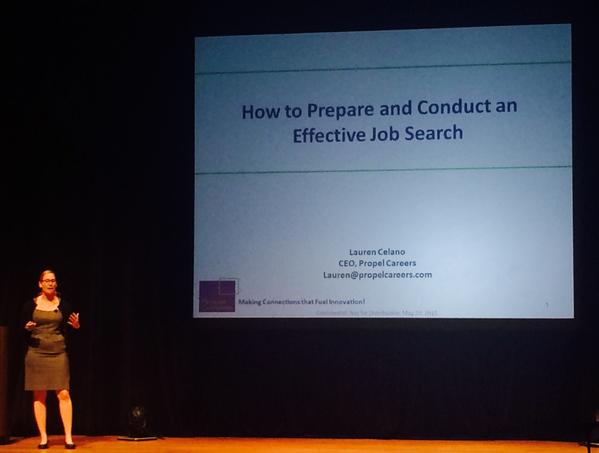
Tips on how to prepare and conduct an effective job search.

Contributor Ada Yee

Lauren-celano-NJCE15

{credit}Image credit: @DrTanyaSmith{/credit}

At the Boston Naturejobs Career Expo on 20 May, Lauren Celano, CEO of the career development firm Propel Careers, surveyed her audience: “How many of you are looking for interesting areas?” Most hands went up. “How many know what you want, and just need someone to hire you?” Just a few hands. Celano went on to coach the audience on the job hunt, starting from ground zero: how do you find a job—and then, an employer—that makes sense for you?

Identify the right career path for you

Celano highlighted growing opportunities across many fields, from industry-oriented positions in academia (core facility director, tech transfer, grant management) to non-profits seeking PhDs to do communications, licensing, or advocacy. With all these options, you should think about what suits you, she advised. “Fit really matters!” stressed Celano. “I see people taking a job because the title sounds cool, but maybe isn’t what they’re looking for, and they’re unhappy.” Continue reading

Career paths: Realize your inner entrepreneur

Scientists are inherently entrepreneurs, as Ada Yee learned when comparing the two during a business school talk.

Contributor Ada Yee

entrepreneur-naturejobsI slipped into a chair at the “Reserved for Latecomers” table, and poured a coffee. I was at a talk by Stanford business school alum Amy Wilkinson on her book “The Creator’s Code”– describing six traits that make entrepreneurs successful. I felt out of place. As a dyed-in-the-wool academic, I’d never counted myself in on the Silicon Valley buzz, but a lab mate had given me his ticket. It was 7am, and I’m a 10am-to-10pm-type grad student—but a grad student nevertheless—and so not one to turn down free eggs and bacon.

My school prides itself on being an innovation incubator, a campus that spawned the founders of Google, Cisco, and Yahoo. Nevertheless, there remains in me a feeling that science and business don’t mix. The majority of academic science still operates on an apprenticeship model, where “losing” students to companies is to lose them from the academic pantheon and kill your own lineage. Growing up in the Silicon Valley, I read headlines on the conflict of interest held by professor-scientists with industry ties in the post Bayh-Dole era (the 1980 decree that paved the way for tech transfer). At a party recently, a student-turned-startup member told me,  “academic scientists like to dig really deep into a problem. That doesn’t work in industry. It’s too slow.” Continue reading