
{credit}JOSS{/credit}
The currency of science is–duh!–publication. You do the work, you write a paper. Acceptance advances a researcher’s career in every way that counts: tenure, promotion, reputation, and funding. Continue reading

{credit}JOSS{/credit}
The currency of science is–duh!–publication. You do the work, you write a paper. Acceptance advances a researcher’s career in every way that counts: tenure, promotion, reputation, and funding. Continue reading
Santiago Perez De Rosso, a PhD student in the Software Design Group at MIT’s Computer Science and Artificial Intelligence Laboratory, talks about Gitless—a kinder, gentler form of version control software.

{credit}Santiago Perez De Rosso // https://dspace.mit.edu/handle/1721.1/106271{/credit}

Adapted from Getty
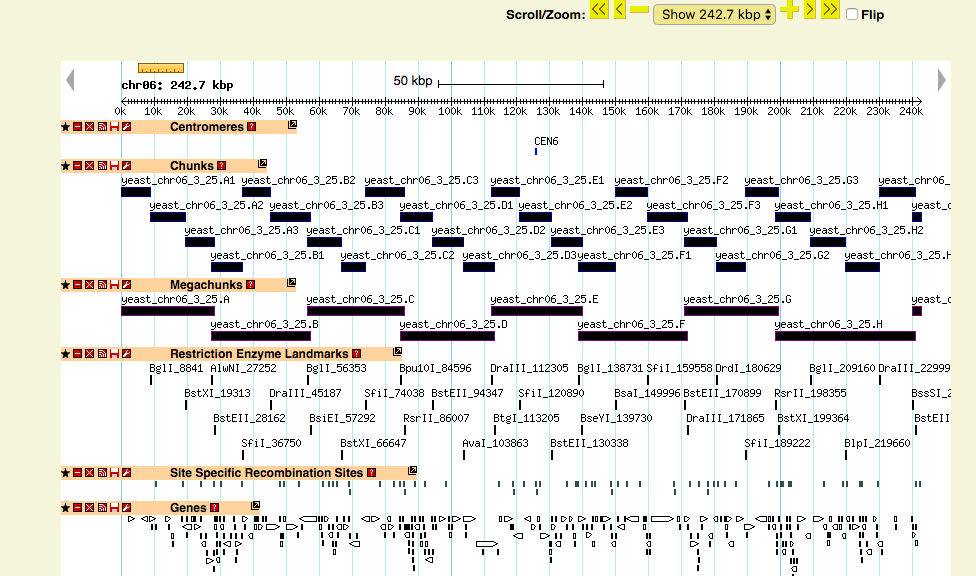
BioStudio screenshot
Consider for a moment the logistics of rewriting a genome from scratch. Starting from a reference genome sequence, you nip and tuck, recode and reorganize. Changes to any one element changes the genetic coordinates of every element downstream, meaning the process requires consider genetic bookkeeping.
Joel Bader, Jef Boeke, and an international team of colleagues faced precisely that problem as they rebuilt five chromosomes from the yeast, Saccharomyces cerevisiae – an effort Amy Maxmen covered yesterday in Nature News. Continue reading
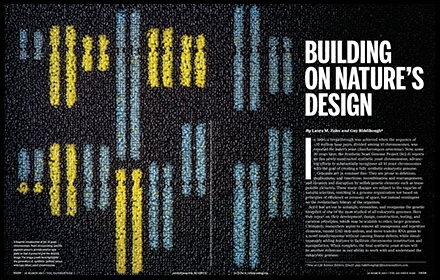
Science magazine
Today, an international research team led by Jef Boeke of New York University Langone Medical Center and Joel Bader at Johns Hopkins University in Baltimore, Maryland, reported in Science a remarkable feat – the complete de novo synthesis and redesign of five yeast chromosomes, a first step towards a completely synthetic model eukaryote. Over at Nature News, Amy Maxmen has done an admirable job covering that achievement, part of a project called Sc2.0. What I’d like to talk about is one of the artistic flourishes used to illustrate it. Continue reading
It’s been nearly a decade since Eric Welsh first noticed some weirdness with Microsoft Excel. A senior staff scientist in the Cancer Informatics Core at the H. Lee Moffitt Cancer Center and Research Institute in Tampa, Florida, Welsh was using Microsoft’s venerable spreadsheet application to view mouse and human gene expression data, the better to sort and understand the numbers. But a quick glance revealed the import hadn’t gone exactly as planned. “Excel would screw them up every time,” he says.
How so? When data are imported into Excel, the program works hard to figure out what kind of value each cell holds. Most of the time, Excel is smart enough to do that correctly, and values like ‘BRCA1’ and ‘12345’ are converted into text and integers, as expected. But “Excel is a little too smart for its own good,” Welsh says. If a cell reads “SEPT7,” the program assumes the author meant to write a date, and converts it automatically. It also sometimes translates what appear be numbers in scientific notation – say, ‘2310009E13’ – into actual scientific notation (‘2.31E+13’). The problem is, those two terms are neither dates nor numbers – they are proper names, scientifically speaking: gene names, sample identifiers or accession numbers. And by autoconverting them, those names are lost, or at least, obscured.

https://bmcbioinformatics.biomedcentral.com/articles/10.1186/1471-2105-5-80
