TechBlog: Building synthetic circuits from RNA

nature23271-f1

{credit}Nature 548, 117–121 (03 August 2017) {/credit}

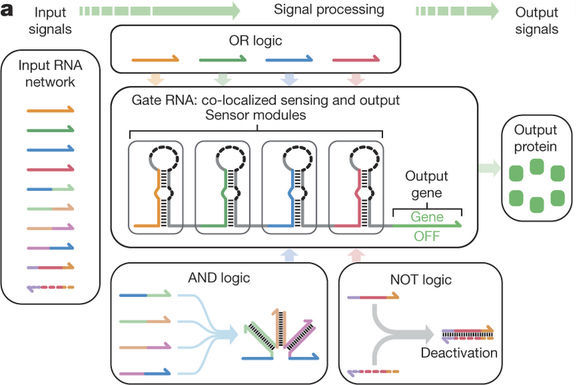
As my recent Technology Feature made clear, the technology to synthesize large genomes is advancing at a remarkable pace. So too are technologies for wiring genetic circuits to endow those genomes with novel properties. In the 3 August issue of Nature, researchers at Arizona State University in Tempe describe a new technology to do just that.

Synthetic biologist Alexander Green of the Biodesign Institute at ASU, and colleagues, describe simple ‘ribocomputing devices‘ that can function as logical AND, OR, and NOT gates — circuit building blocks that control the translation of a reporter gene based on the presence one or more small input RNAs. As those inputs can reflect exposure to different environmental agents or stimuli, the system could serve as a kind of biological sensor.

Continue reading

TechBlog: How to build long DNA

547477a-i1

My most recent Technology Feature, on the technology of genome synthesis, describes advances in the field of large-scale genome hacking. Researchers are rewriting the genomes of organisms from E. coli to yeast, with millions of bases written from scratch. Now, through projects like Genome Project-write, they are turning their attention to even more complex organisms, with concomitantly larger genomes.

How, though, does one actually write a genome? As I note in the article, researchers don’t do that in one step. The molecules are assembled hierarchically, from synthetic oligonucleotides to ever larger pieces, first in a test tube and ultimately in living cells.

That said, it is possible to purchase “gene-sized” pieces of synthetic DNA. But, since DNA today is synthesized mostly using the same error-prone phosphoramidite chemistry researchers have used for decades, the question is: how are those molecules made?

Continue reading

Five rules for starting up in synthetic biology

Building a synthetic biology startup is tough – but stay the course and it’ll be the most rewarding struggle of your life, says James Field.

Since the advent of life 3.6 billion years ago, the survival of all species has depended on rapid innovation at the genetic level. As a consequence, our planet has grown rich with evolved technologies.

Traditionally, the dream of harnessing these evolved technologies has been confined to thought experiments and science fiction. Now, the emerging field of synthetic biology is giving engineers the tools required to tap into evolution’s code-base.

forest-1245951_1280 Continue reading

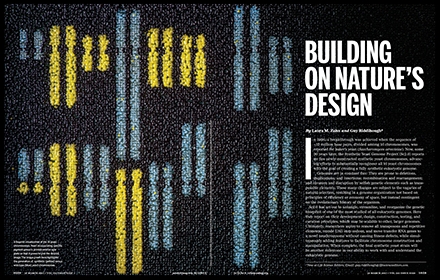
Painting with yeast

Science magazine

Today, an international research team led by Jef Boeke of New York University Langone Medical Center and Joel Bader at Johns Hopkins University in Baltimore, Maryland, reported in Science a remarkable feat – the complete de novo synthesis and redesign of five yeast chromosomes, a first step towards a completely synthetic model eukaryote. Over at Nature News, Amy Maxmen has done an admirable job covering that achievement, part of a project called Sc2.0. What I’d like to talk about is one of the artistic flourishes used to illustrate it. Continue reading

What motivates you as a scientist?

To tie in with the latest Nature Outlook, Lenses on Biology, the Nature Communities team asked five biological scientists at different stages of their education or careers to tell their personal stories in a guest blog post. Each scientist studies, works or has an interest in one of the five research fields featured in Lenses on Biology ― cancer, stem cells, synthetic biology, ocean health and climate change ― and they share what motivates them in their chosen subject. You can read their stories below, and discuss your own motivations here or on the posts in question.