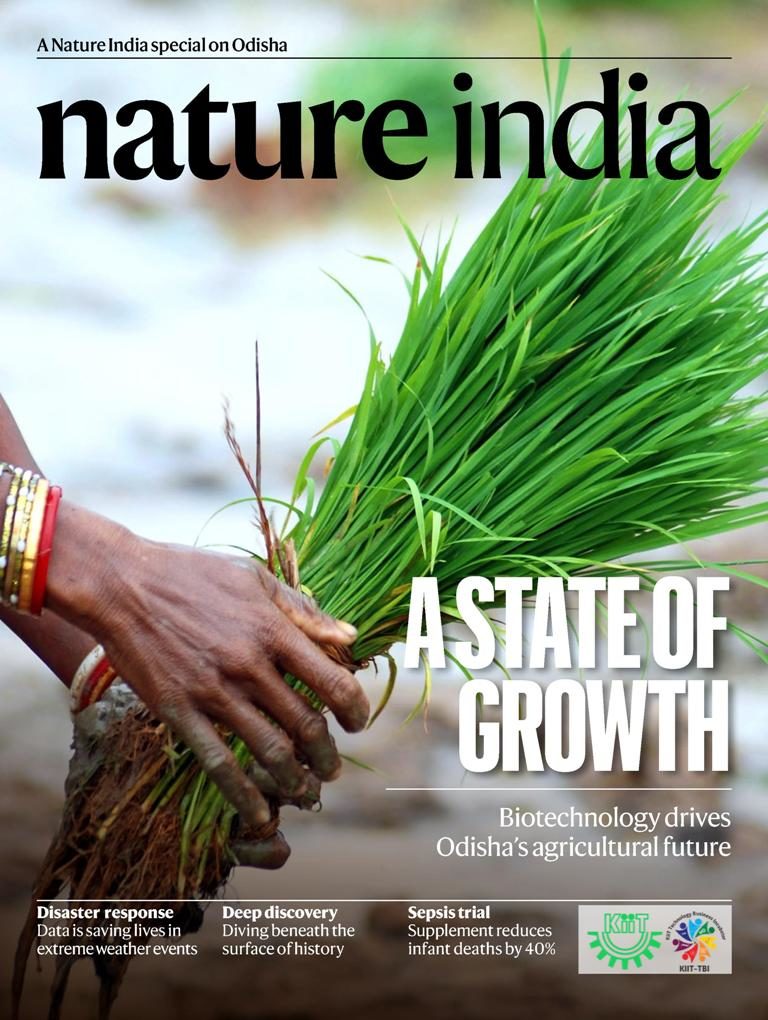
A state known for its heritage, culture and disaster management, and as an emerging hub of scholarship and research, Odisha is making its mark. This special issue captures the aspirations of and challenges for the eastern Indian state in becoming the next national science hub.
Odisha is home to a number of large national institutes and laboratories – the Indian Institute of Technology, the Institute of Life Sciences, the Institute of Minerals and Material Technology, the Regional Medical Research Centre, the National Institute of Science Education and Research, National Rice Research Institute, the Central Institute of Freshwater Aquaculture and the All India Institute of Medical Sciences. The state government-run Utkal University and the Orissa University of Agriculture and Technology in capital Bhubaneswar add to its scholarly might. Private education conglomerates such as the Kalinga Institute of Industrial Technology University and the L V Prasad Eye Institute are helping produce a sizeable scientific workforce.
The entrepreneurship and innovation scene is warming up with a number of technology business incubators setting up shop in the state. A biotechnology cluster is also on the cards. The Odisha special issue takes a close look at this growth of innovation and technology in the state’s science.
Odisha’s 460km coastline and a hot, humid agro-climate, have endowed it with rich fisheries and paddy cultivation resources. The state’s scientific legacy in both aquaculture and rice research have benefitted from these. We examine the results of years of rice and fish breeding that Odisha has gifted to the world. The state’s proximity to the Bay of Bengal and high summer temperatures have also brought severe cyclones, floods and heat waves. We investigate how Odisha is setting an example in using science and technology to cope with such extreme weather phenomena.
Odisha’s rich culture and history draws international attention. Its many temples, monuments, ancient palm leaf manuscripts, paintings, and excavations are keenly researched by archaeologists, leading to innovative conservation methods to preserve Odisha’s past.
We analyse the traditional and modern methods being deployed by scientists, and focus on another rich historical source – shipwrecks – revealing fascinating stories of historic naval wars off the coast of Odisha.
India’s science and technology is well entrenched in metro areas, with institute clusters like those in Bengaluru, Hyderabad, Mumbai, Pune, the national capital region of Delhi, and Kolkata. Smaller, second-tier cities like Bhubaneswar are gearing up to the cluster approach, and are poised to contribute to the research and innovation scene. The Odisha special issue is an attempt to shine a light on one such state. In the near future, Nature India’s regional spotlights will chronicle more such emerging hubs of science in the country.
The Nature India special issue on Odisha is free to download here.
The winners of the Nature India photo contest 2019 have now been chosen after a week of unprecedented activity on the Indigenus blog and our social media channels (Facebook and Twitter ). A global jury, comprising members of the Nature Research editorial and design teams as well as an independent scientist, has given their verdict.
The photographs have been judged for their adherence to this year’s theme ‘Food’, for their creative thinking, quality and print worthiness.
The winner of the Nature India photo contest 2019 is:
for his strong image ‘Dry day catch’, which focuses on the relationship between climate and food and emphasises the importance of water bodies as sources of nutrition.
{credit}Partha Pratim Saha{/credit}
In Partha Pratim’s words: “Shilabati is a rain fed river in Eastern India. Many fishermen depend on this river for their catch in the rainy season. But in summers, the river dries up. Fishermen are then unable to use their boats in the shallow water. In these dry seasons, they go down to the level of the river bed and use hand nets for fishing the traditional way.”
with his picture ‘Empowering meal’, which puts into warm-hearted focus the vital relationship between nutrition and healthy development.
{credit}Avijit Ghosh{/credit}
Avijit says, “In many parts of rural India, school students are given mid-day meals. These free lunches for children in primary and upper primary classes are an innovative scheme to help children get nutrition while also incentivising their school attendance. This scheme exemplifies how food can be used as a means of empowering communities – both through nutrition and education.”
for his image ‘Fishy business’, which highlights the important issue of quality control in raw food products.
{credit}Owais Rashid Hakiem{/credit}
Owais Rashid says, “During the festive season, consumers pay little attention to the quality or freshness of food products as markets are flooded with a variety of options. Just like vegetable buyers, fish and meat eaters can judge the quality of their raw food with some tell-tale signs. This photograph was captured near the Chittaranjan Park fish market in Delhi during the Durga Puja festival.”
Many congratulations to the winners!
The winners of the Nature India photo contest 2019 will get a cash awards ($350, $250 and $200 respectively). They will receive a copy of the Nature India Annual Volume 2018 and a bag of goodies (including Collector’s first issues of Nature and Scientific American and some other keepsakes) from the Nature Research. One of the winning entries also stands a chance of being featured on the cover of a forthcoming print publication.
It’s time to roll out the shortlist of the Nature India Photo Contest 2019.
The 6th edition of our photo contest themed “food” opened in November 2019 and has received some remarkable entries from around the world.
We invited pictures that show food beyond just an instagram-worthy plateful — pictures that demonstrate the link between food and evironment, food and health/nutrition, food security, the processes and techniques of growing food, packaging, cooking or even the politics behind food storage and supply.
Like always, entries came from a mix of amateur and professional photographers, scientists and non-scientists, mobile cameras and high-end DSLRs.
The Nature India editorial and design teams chose ten stunning finalists, that will be rolled out (in no particular order of merit) over the next few days. Nature India’s final decision to chose the winner will be partly influenced by the engagement and reception these pictures receive here at the Indigenus blog, on Twitter and on Facebook. To give all finalists a fair chance, we will consider the social media engagement each picture gets only during the first seven days of its announcement. The final results will be announced sometime in early February 2020.
So here’s finalist number one in the Nature India photo contest 2019:
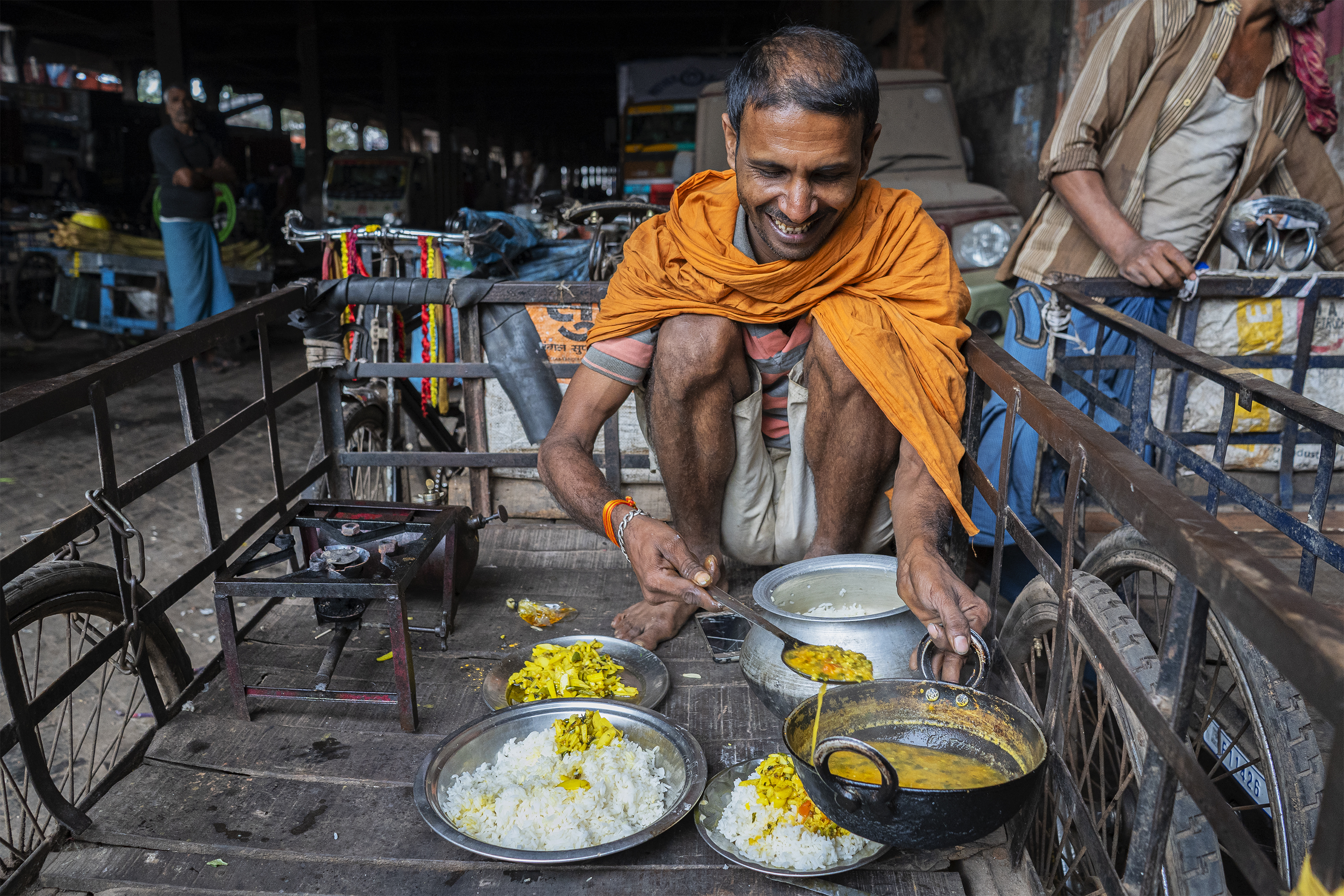
Sudip Maiti, Kolkata, West Bengal, India.
Photo caption: Open air restaurant
{credit}Sudip Maiti{/credit}
“A daily-wage worker cooks lunch for himself and his fellow workers in a hand-pulled cart below the famous Howrah Bridge in Kolkata, India. I was drawn to this scene because cooking is a private matter, mostly done indoors. In this man’s life, this important activity of the day happens in a busy, public space. The photo conveys the hardships such people face for their daily food, with a smile on their faces.” — Sudip Maiti.
Congratulations Sudip for making it to top 10!
Watch this space as we announce the other finalists in the coming days.
The winning pictures will get cash prizes worth $350, $250 and $200 respectively. The top 10 finalists will be featured here, on Nature India’s blog Indigenus and in our subsequent annual issue.
These entries have been judged for novelty, creativity, quality and print worthiness. The winner and two runners-up will also receive a copy of the Nature India Annual Volume 2019 and a bag of Nature Research goodies (including Collector’s first issues of Nature and Scientific American and some other keepsakes). Winning entries stand a chance of being featured on the cover of one of our forthcoming print publications.
We are back with the annual Nature India photo contest.
This year’s theme is ‘Food’.
Say ‘food’ and everyone has a story to share. These stories could be as diverse as ‘I love pasta’ to ‘the cyclone ruined our paddy yield this year’ to ‘half my country is malnourished and the other half obese’.
These stories point to our deep-seated and lifelong relationship with food. For some food is nutrition, for some others it’s an emotion – a memory, perhaps associated with a smell, taste, place or person?
For a farmer, food may mean a farm, the seeds, the equipment, the land, the market, floods or famine or a harvest festival. For a school going child, food is the lunch box or a piping hot mid-day meal served in the classroom. For many communities, food is a social binder, intrinsically linked to the culture of their land.
For scientists, food is the metabolic, biochemical or physiological process that underlines how an organism uses its source of nutrition. For global policy makers, food is the challenge of securing nourishment for close to 10 billion people by 2050. Food is health, food is environment and many times the connection between the two.
So which face of food would you want to capture in a photograph? Which of these nuanced stories do you want to tell? For the Nature India photo competition this year, we urge you to think deeper about food, beyond just an Instagram-worthy plateful.
Think of pictures that demonstrate how food fundamentally influences or interacts with health, how food security defines the health and happiness of people or how the lack of food may result in a plethora of unwanted consequences. We would also be happy to receive entries that talk to us about the link between the food we eat and our environment, or ones that depict how balanced nutrition makes for healthy people and healthy communities.
You may also draw inspiration from scenes that portray the process and techniques of growing food, cooking it in many interesting and unique ways, of infant nutrition or the politics behind food storage and supply, or even the merits or demerits of packaging food.
The canvas is wide open.
So get set, click and send your entries by 21 December 2019!
Prizes
The top three pictures will get cash prizes worth $350, $250, $200. The top 10 finalists will be featured on Nature India’s blog Indigenus.
Entries will be judged for novelty, creativity, quality and print worthiness. Winners will be chosen by a panel of Nature Research editors and photographers. The winner and two runners-up will receive a copy of the Nature India Annual Volume 2019 and a bag of Nature Research goodies (including Collector’s first issues of Nature and Scientific American and some other keepsakes). Winning entries also stand a chance of being featured on the cover of one of our forthcoming print publications.
Eligibility
The contest is open to all – any nationality, any occupation, any profession. You may use whatever camera you wish – even your cell phone – as long as the photograph you send us is unedited, original, in digital format and of printable quality. Just make sure you are not violating any copyrights. Also, no obscene, provocative, defamatory, sexually explicit, or other inappropriate content please (refer to the contest terms and conditions below).
Please send your entries in jpeg format to npgindia@nature.com with your name and contact details. Please mention “Nature India Photo Contest 2019” in the subject line of your email. The photograph must be accompanied by a brief caption (please see some photo captions here for reference) explaining the subject of the picture along with the date, time and place it was taken.
We will accept a maximum of two entries per person. The last date for submissions is midnight of December 21, 2019 Indian Standard Time. On social media, please use the hashtag #NatureIndphoto to talk about the contest or to check out our latest updates.
The theme for our inaugural photo competition in 2014 was “Science & technology in India”. Our themes have then covered “Patterns”, “Nature”, “Grand Challenges” and “Vector-borne Diseases”. We have received some breathtaking entries from across the world all these years. You might want to take a look at the winning entries of the Nature India Photo Contest 2014, 2015, 2016, 2017 and 2018 for some inspiration and to get an idea of what we look for while selecting winners.
[TERMS AND CONDITIONS
Please read these terms and conditions carefully. By entering into this Nature India Annual photo contest (“Promotion”), you agree that you have read these terms and that you agree to them. Failure to comply with these terms and conditions may result in your disqualification from the Promotion.
This Promotion is run by Nature Research, a division of Springer Nature Limited a company registered in England with registered number 00785998 and registered office at The Campus, 4 Crinan Street, London N1 9XW (“Promoter”).
To enter this Promotion you must be: (a) resident in a country where it is lawful for you to enter; and (b) aged 18 years old or over (or the applicable age of majority in your country if higher) at the time of entry. This Promotion is void in Cuba, Iran, North Korea, Sudan, and Syria and where prohibited or restricted by law.
This Promotion is not open to directors or employees (or members of their immediate families) of Promoter or any subsidiary of Promoter. Promoter reserves the right to verify the eligibility of entrants.
The Promotion is open for entries between 00:00 on 21/11/2019 and 00:00 on 21/12/2019 IST.
No purchase is necessary to enter this prize Promotion and will not increase your chances of winning.
You can enter this Promotion by emailing npgindia@nature.com
Only two entries per eligible person. More than two entries will be deemed to be invalid and may lead to disqualification.
Promoter accepts no responsibility for any entries that are incomplete, illegible, corrupted or fail to reach Promoter by the closing date for any reason. Proof of posting or sending is not proof of receipt. Entries via agents or third parties are invalid. No other form of entry is permitted. Please keep a copy of your entry as we will be unable to return entries or provide copies.
The prize for the Promotion consists of the following: Three cash awards worth $350, $250 and $200 for the top three entries respectively, a copy of the Nature India Special Annual Volume 2019 and a bag of goodies (which includes Collector’s first issues of Nature, November 1869 and Scientific American, August 1845; and some other keepsakes) from Nature Research.
The prizes shall be awarded as follows: The prize will be decided in the week following the close of the Promotion. The winners will be notified via email. Winners will be selected by a four person panel of Nature staff, at least one of which will be independent from the Promotion, based on photographic merit, creativity, photo quality, and impact. Full names of the judging panel will be available on request. Any decision will be final and binding and no further communication will be entered into in relation to it.
Ownership of entries: for consideration into this Promotion, you must sign a license to publish form granting the intellectual property rights to Nature Research for your image. This may be used in promotional or marketing material in print and online. You confirm that your entry is your own original work, is not defamatory and does not infringe any laws, including privacy laws, whether of the UK or elsewhere, or any rights of any third party, that no other person was involved in the creation of your entry, that you have the right to give Promoter and its respective licensees permission to use it for the purposes specified herein, that you have the consent of anyone who is identifiable in your contribution or the consent of their parent, guardian or carer if they are under 18 (or the applicable age of majority), it is lawful for you to enter and that you agree not to transfer files which contain viruses or any other harmful programs.
The winner(s) of the Promotion shall be notified by email no more than two weeks after the Promotion closes.
The winner(s) will be required to confirm acceptance of the prize within ten working days and may be required to complete and return an eligibility form stating their age and residency details, among other details. Promoter will endeavour to ensure that winner(s) receive their prizes within 30 days of the date they confirm acceptance of the prize. If a winner does not accept the prize within ten days of being notified, they will forfeit their prize and Promoter reserves the right to choose another winner(s). Promoter’s decision is final and Promoter reserves the right not to correspond on any matter.
The name, region of residence and likeness of the winners may be used by Promoter for reasonable post-event publicity in any form including on Promoter’s website and social media pages at no cost.
You can find out who has won a prize by sending an e-mail to npgindia@nature.com or checking the Nature India blog website Indigenus (https://blogs.nature.com/indigenus).
Promoter reserves the right to cancel or amend these Terms and Conditions or change the Prize (to one of equal or greater value) as required by the circumstances. No cash equivalent to the Prize is available.
All personal data submitted by entrants is subject to and will be treated in a manner consistent with Promoter’s Privacy Policy accessible at https://www.nature.com/info/privacy.html. By participating in this Promotion, entrants hereby agree that Promoter may collect and use their personal information and acknowledge that they have read and accepted the Promoter Privacy Policy.
Promoter may at its sole discretion disqualify any entrant found to be tampering or interfering with the entry process or operation of the website, or to be acting in any manner deemed to be disruptive of or prejudicial to the operation or administration of the Promotion.
Other than for death or personal injury arising from negligence of the Promoter, so far as is permitted by law, the Promoter hereby excludes all liability for any loss, damage, cost and expense, whether direct or indirect, howsoever caused in connection with the Promotion or any aspect of the Prize. All activities are undertaken at the entrants own risk. Your legal rights as a consumer are not affected.]
As part of Nature India’s 10th anniversary celebrations, we produced a special issue on ‘Grand Challenges’. (Download your free copy here.)
India is headed towards an astonishing population surge. With 1.34 billion people recorded in early 2018, the country is estimated to add another 100 million by 2024 overtaking China, currently the most populous nation in the world. Therefore, her daunting demographics are integral to any discussion around the challenges faced by India.
The mammoth population coupled with limited resources, and growing urbanization and energy needs are important factors behind many socio-economic issues. Be it poverty, healthcare delivery, literacy, pollution or waste management — each of India’s problems can be directly linked to and are intensified by its teeming millions.
Some of the most pressing challenges raised by a large population are in the public healthcare, energy and sanitation sectors. Successive Indian governments have made tremendous efforts to meet public needs and expectations. However, health concerns such as tuberculosis, maternal and infant mortality, vector- and water borne-diseases, malnutrition, hygiene and sanitation remain major problems.
The Nature India special issue on Grand Challenges takes a closer look at some of these hazards, which are experienced across the developing world. What are the grand challenges for the country’s 1.3 billion people? Can science help find solutions to some of the public health problems? Can innovation provide long-term answers?
Through in-depth commentaries by subject experts, this special issue looks at the state of affairs in malaria
management, maternal and child health, malnutrition and tuberculosis. It also looks at the science-led innovations and solutions already on offer. In a reprint section, we compile some recent articles from across Nature Research publications that highlight the grand challenges and research-based solutions that India and the rest of the developing world have adopted.
The volume also features a special photo section curated from top entries to the 2017 Nature India photo competition, themed ‘Grand Challenges’. These pictures are compelling visual narratives of some deeply moving and familiar circumstances.
With examples and case studies of evidence-based solutions, the Nature India special issue on Grand Challenges hopes to be an enlightening read for scientists, policy-makers, business leaders, and societies across the developing world.
Nature India is proud to be associated with the International Crops Research Institute for the Semi-Arid Tropics (ICRISAT) as media partner for the fifth edition of the InterDrought conference being held in Hyderabad (February 21-25, 2017).
The conference brings togther experts from across the world to debate key issues in improving drought and other stress tolerance in crops. Scientists from around 56 countries will come together to explore the possibilities of scientific and technological applications in crop improvement.
ICRISAT Director General David Bergvinson says the conference will bring together the disciplines of plant and crop physiology, genomics, genetics and breeding. It will talk about recent advances in these fields related to plant responses to water deficit and climate change, phenotyping and genetic variability.
According to the conference chair Rajeev Varshney this is the largest conference in the InterDrought series with 850 participants from 56 countries. Earlier conferences in the series habe been held in France, Italy, China and Australia.
Nature India put together this cover for the abstract book depicting the three important elements of the drought story — the starkness of drought, its deep impact on humans and the science-driven solution to meet the challenge — drought-resilient crop varieties.
Here’s Nature India‘s editorial for the conference abstract book:
Looking for a Plan C in water-scarce times
An issue that stirs emotions among scientists, policy makers and the general public alike is ‘water’. Or, in the present times, the lack thereof.
In these water-scarce times, in India, as in many other parts of the world, the issue of groundwater depletion is a subject of concern and serious study. And so, apart from the parched patches that the world inherited from the 20th century, we are looking at times of new aridity triggered by plummeting groundwater tables. It’s actually a vicious circle – news studies are now suggesting that excessive pumping of water for agriculture may not be the reason behind the plunging groundwater levels after all. Long-term changes in monsoon rainfall could instead be influencing this, and that in turn is forcing farmers to dig deeper for water.
Why this preamble on water? Especially when water-scarcity is an issue almost embedded in the DNA of scientists attending InterDrought conferences.
Essentially because it’s nice to take a step back once a while and look at the larger canvas. For scientists and technologists working on a Plan B to counter drought – that is, to still be able to grow nutritionally-rich, drought-resistant crops – these conferences are a wonderful reminder of the big picture. Interestingly, InterDrought-V is hoping to be the largest such congregation in recent times with over 850 scientists from around 56 countries. This provides a canvas bigger than ever before to create new milestones, fortify strategies that have worked so far, and solemnly bury the ones that don’t work so well in the changing climate scenarios.
The Nature Research Group devotes significant energies to the coverage of the “Grand Challenges”, which include our coverage of climate, water and food – issues that resonate well with InterDrought-V. Nature India, a showcase of India’s science, is proud to be associated with the conference as its media partner. We hope that the conference, bringing together the who’s who of the discipline from across the world, will identify issues and concerns to evolve a futuristic Plan C for drought-friendly agriculture.
Its that time of the year when mobile phone screenshots increasingly lend themselves to Facebook posts grimly declaring regional temperatures from across the country — most on the wrong side of 40 and some hovering around 50 in degree celsius. It’s the time for the deadly heatwaves that kill thousands every year, close down schools and offices and, in general, make life miserable for millions.
The increasing intensity and number of these heatwaves between March and June every year have been a subject of concern for scientists for close to a decade now. In daily conversations, it is not unusual to encounter someone loosely blaming ‘global warming’ or ‘climate change’ for the phenomenon.
{credit}S. Priyadarshini{/credit}
Scientists from the Japan Agency for Marine-Earth Science and Technology in Yokohama and India’s ministry of earth sciences have now come together to analyse the anatomy of these heatwaves in a paper1 published in Scientific Reports last week. They tried to understand what causes these severe spells of heat. They looked at observed patterns and statistical analyses of the maximum temperature variability and have identified two types of heatwaves in the country — the first over north-central India and the second over coastal eastern India.
They associate the first one over north-central India with ‘blocking’ over faraway North Atlantic, which results in a cyclonic anomaly west of North Africa at upper atmospheric levels. All of this triggers a chain of events that eventually affects the Indian subcontinent causing heatwave conditions over India. The heatwave in coastal eastern India, on the other hand, is due to anomalous cooling in the Pacific which generates ‘northwesterly anomalies’ over the landmass reducing the land-sea breeze and resulting in heatwaves.
As several studies, including IPCC estimates, suggest that the frequency of heatwaves would only increase in near future, understanding the science behind India’s heatwaves would help policy makers design better strategies to tackle these annual extreme events.
In another related study2 in Scientific Reports last week, a group of international scientists, primarily from China and USA, have questioned earlier estimates of groundwater depletion in the Northwest India aquifer based on data from NASA’s Gravity Recovery and Climate Experiment (GRACE) satellites. Research in the past showed that groundwater levels in northern India have been declining very rapidly — by as much as a meter every three years — between 2002 and 2008. And also that the calamity was almost entirely man-made. In the hotbed of this unprecedented deletion are Rajasthan, Punjab, and Haryana — states with staggering population growth, rapid economic development, and water-hungry farms — accounting for about 95 percent of groundwater use in the region.
Last week’s study, however, says accurate ground water depletion estimation is challenging because of ‘uncertainties in GRACE data processing’ and that earlier studies might have overestimated the depletion over this region. This study highlights uncertainties in the estimates and the importance of incorporating a priori information to refine spatial patterns of GRACE signals that could be more useful in groundwater resource management.
Ratnam, J. V. et al. Anatomy of Indian heatwaves. Sci. Rep.6 (2016) doi: 10.1038/srep24395
Long, D. et al. Have GRACE satellites overestimated groundwater depletion in the Northwest India Aquifer? Sci. Rep.6 (2016) doi: 10.1038/srep24398
Doesn’t look like great times to be an environment journalist in India.
More than 3000 environment journalists from across the world have spent sleepless nights over the last 10 days to cover the Paris climate talks (or the 21st Conference of Parties — COP21) concluding today. However, excesses of a different kind threaten their peers elsewhere, according to a new report released by Paris-based body Reporters Sans Frontieres (RSF or Reporter Without Borders).
India has emerged as the deadliest country for environment journalists, according to a global investigation by RSF, with at least two inquisitive reporters in the Asian nation being murdered in 2015 and many others harassed, threatened and subjected to physical violence. Closely following is Cambodia, where one reporter was killed in 2014.
Source: RSF
Jagendra Singh, a freelancer for Hindi-language papers for more than 15 years, died from burn injuries in Uttar Pradesh state after he posted an article on Facebook accusing a government minister of involvement in illegal mining and land seizures. Sandeep Kothari, another Hindi language reporter, was found dead in neighbouring Madhya Pradesh. Police said local organized crime members had pressured him to stop investigating illegal mining.
Ten environment reporters have been murdered since 2010, according to RSF’s tally. In the past five years, almost all (90 percent) of the murders of environmental journalists have been in South Asia (India) and Southeast Asia (Cambodia, Philippines and Indonesia.) The one exception is Russia. Mikhail Beketov, the editor of Khimkinskaya Pravda, a local paper based in the Moscow suburb of Khimki succumbed in April 2013 to the injuries he sustained in November 2008 while campaigning against the construction of a motorway through Khimki forest.
The RSF report points out that journalists who cover environmental issues live in a dangerous climate and are exposed to potentially devastating forces. “We are not talking about nature’s hurricanes, squalls, downpours or lightning,” says Christophe Deloire, RSF Secretary-General. At the intersection of political, economic, cultural and sometimes criminal interests, the environment is a highly sensitive subject, and those who shed light on pollution or any kind of planetary degradation often get into serious trouble, Deloire said in the report.
The situation of environmental reporters has worsened in many countries since 2009, when RSF conducted the first global study on the issue. Environment stories range from global warming to deforestation, the exploitation of natural resources, pollution – issues that often involve more than just protection of the environment, especially when they shed light on the illegal activities of industrial groups, local organized crime and even government officials. Environment reporters are often pitted against very strong lobbies and end up paying a high price for their journalistic pursuits. RSF says, like political and business reporters, many environmental reporters acknowledge being approached by companies trying to bribe them.
RSF notes that forming peer associations to protect themselves would be a better way of dealing with these atrocities instead of fighting lonely battles against mighty corporations, corrupt politicians and mafia groups.
Madhav Gadgil, Professor of Interdisciplinary Studies at Goa University and Chair of India’s expert panel on Western Ghats ecology, shares this year’s prestigious Tyler Prize for Environmental Achievement with Jane Lubchenco of Oregon State University, USA. The 2015 Tyler Prize, announced today, recognises their leadership and engagement in the development of conservation and sustainability policies in India, the United States and internationally.
Gadgil’s landmark report on the biodiversity of Western Ghats known as the “Gadgil Committee” report offered guidelines on the protection and development of India’s Western Ghats, a UNESCO World Heritage site and one of the eight most biological diverse areas on earth. His body of work has helped India draft the National Biological Diversity Act. Lubchenco, the former administrator of the federal agency National Oceanic and Atmospheric Administration (NOAA) has for long advocated the importance of the ocean and the need to protect it. The U.S. Department of State named her the first-ever science envoy for the Ocean, to promote this focus on ocean science, marine ecology, climate change and smart policy to a global audience.
“Drs. Lubchenco and Gadgil represent the very best in bringing high-quality science to policy making to protect our environment and ensure the sustainability of natural resources in their respective countries and around the world,” said Tyler Prize Executive Committee Chair Owen T. Lind, Professor of Biology at Baylor University announcing the prize winners. Lubchenco and Gadgil will share the $200,000 cash prize and each receive a gold medallion. The Prize, awarded by the international Tyler Prize Executive Committee with the administrative support of the University of Southern California, honours exceptional foresight and dedication in the environmental sciences and policy.
Gadgil’s career has been dedicated to marrying environmental science with policy making in India and promoting environmental science nationally. Through his public speaking and writing, Gadgil has advanced the field of environmental science and put it on the national radar. “From an early age, my father’s work inspired me to work with people and think about the impact of our collective activities,” Gadgil said in a release. “This first came about in my work in 1975 when traditional basket weavers who depended on bamboo in the Western Ghats approached the government and said the overexploitation of bamboo for paper mills was hurting their livelihood.”
Gadgil’s work began examining the tension between economic development, traditional use of resources among local communities and environmental conservation. This cross-sector approach drove the publication of his first book, This Fissured Land, which is used in environmental education across India, as well as a resource for policy makers.
According to Gadgil, the Western Ghats are central to India’s water supply, genetic diversity, economy and quality of life. “The Indian constitution is about empowering people and our resource management is too top down. Local communities do a better job of balancing economic development and conservation. We must have policies that empower local people to make these choices.”
Working with local forest communities in the central Indian forest belt, Gadgil has seen that that management in the hands of locals is most effective ensuring economic opportunity and sustainable use of natural resources while preserving sacred groves and local cultures. “We must engage local people who are most directly affected by policies if we want to develop policies that promote sustainability and balance the economics, culture and conservation,” Gadgil said in the release. “Empowering people is the key.”
Gadgil is a recipient of India’s highest civilian honours the Padma Shri in 1981 and the Padma Bhushan in 2006. He also received the Shanti Swarun Bhatnagar Award for biological sciences in 1986.
At a workshop discussing what the take homes for Asian countries might be from the latest assessment report of the Intergovernmental Panel on Climate Change (IPCC) — AR5 — it was pointed out that there wasn’t enough science coming out of developing countries to feed the database on emissions or warming in the larger climate change debate. Local scientists need to conduct more climate change related experiments, write more scientific papers and bolster regional science in order to make a case for these developing countries in the international discourse on climate change.
“We also need more authors from the developing world to participate in writing the chapters for the IPCC reports,” says Jonathan Lynn, Head of Communication at the IPCC. Lynn says though there is substantial science emanating from India now, some other small Asian countries such as Indonesia lag far behind. The IPCC collates scientific data from across the world to make predictions for future scenarios with the help of scientists, economists, policy makers and government representatives. Most of the work done by scientists in this process is voluntary and not paid for. Developing country scientists, who also do consultancy work for a living, would expect such work to pay off for their time — this could be one of the reasons why not many developing country scientists are interested in the job, Lynn says.
The IPCC assessment reports try to turn all available scientific evidence into something that would make sense to policy makers and businesses — therefore, the authors have explained the science at hand this time in terms of “risk management” parameters. “And since there are questions of ethics and equity involved in this highly political debate, we now have philosophers in the IPCC team to make sure those aspects are taken care of,” Lynn says.
Joyashree Roy, an economist from the Jadavpur University in Kolkata is the lead author of the industry chapter in IPCC’s assessment report five. She says Asia needs to urgently decouple the high energy sector from emissions. “Almost 44 per cent of the global emissions are from the energy and industry sectors of China and India — there lies an opportunity for south Asia. Can we think of a low emission-high energy scenario?”
Roy says population and economic growth are responsible for the surge in energy demand as well as emissions in south Asia.
Another IPCC author Navroz Dubash from New Delhi-based thinktank Centre for Policy Research points to an inherent dichotomy in the report — the number of countries which have adopted mitigation strategies or have a national action plan for climate change has gone up many times, especially in Asia post-2005. Simultaneously, the emission rates of Asia have zoomed and the world as a whole is hurtling at great speed into a carbon-based future. How is that possible, you wonder. “Well, there have been a slew of national policies in the last few years but they will take around 3-4 years to bear fruit. The more optimistic outlook would be to review the scenario in a couple of years and see if these policies have led to significant action,” he says.
Dubash says India will also benefit from the new stand of IPCC where ‘co-benefits’ of climate-friendly policies are being seen in new light. Earlier, IPCC talked of climate change mitigation plans as the main goal with parameters such as development or health as co-benefits. “The idea now is that the concept of co-benefits could work both ways, meaning if a development project brings in climate change mitigation as a spin-off, it should be totally acceptable. This concept is at the core of India’s national plan and now IPCC has sanctified it — so there’s a huge opportunity.”
According to A R Paneerselvan, advisor to the executive director of Panos South Asia, an organisation informing public and policy debates on environment issues, there are talks of a south Asian intiative for climate related insurance. The insurance would cover farmers against any vulnerability stemming from climate change. The initiative is still at a nascent stage and there’s pressure from the cash crop sector in south Asian countries to make a case for climate-related insurance, he says.
As for IPCC’s fifth assessment report and what’s in it South Asia, London-based Climate and Development Network brought out a good primer that explains just this. The Intergovernmental Panel on Climate Change (IPCC) chairperson Rajendra Kumar Pachauri also spoke about what it means for India at an outreach programme in New Delhi today.