Enough doom and gloom part 2: Curiosity is the currency of science

Science funding sources have varied over the decades, and will continue to do so as the sociological and political influences change, says Scott Chimileski.

Contributor Scott Chimileski

Twenty-first century science is global, rapidly communicated and irreversibly intertwined with virtually every aspect of society. This immensity creates the impression that our current scientific culture has been established for a very long time. However, the National Science Foundation (NSF), NASA and the Department of Energy (DOE), pillars of basic science that we recognize them to be, were all established after many of today’s senior investigators were born. In addition to appreciating the cyclical nature of funding (see part one), it is critical to consider how and why funding sources have changed throughout the history of science.

From the scientific revolution at the end of Renaissance through the 19th century, science was largely self-funded or driven by the patronage of other independently wealthy individuals. Many famous forefathers of science had side jobs. Antonie van Leeuwenhoek, whose observations of bacteria in the 17th century inspire microbiologists to this day, was a house manager. Little is known of how he made his microscopes, let alone exactly how he paid for supplies. His contemporary Robert Hooke, another pioneer of microbiology, was an architect and city surveyor. Johannes Kepler wrote horoscopes. And, Galileo Galilei – celebrated for early observations of Saturn’s shape and the Milky Way Galaxy – pitched his telescopes to the military of the Republic of Venice as naval instruments, and to the House of Medici in Florence as a means for naming distant moons after members of this powerful dynasty.
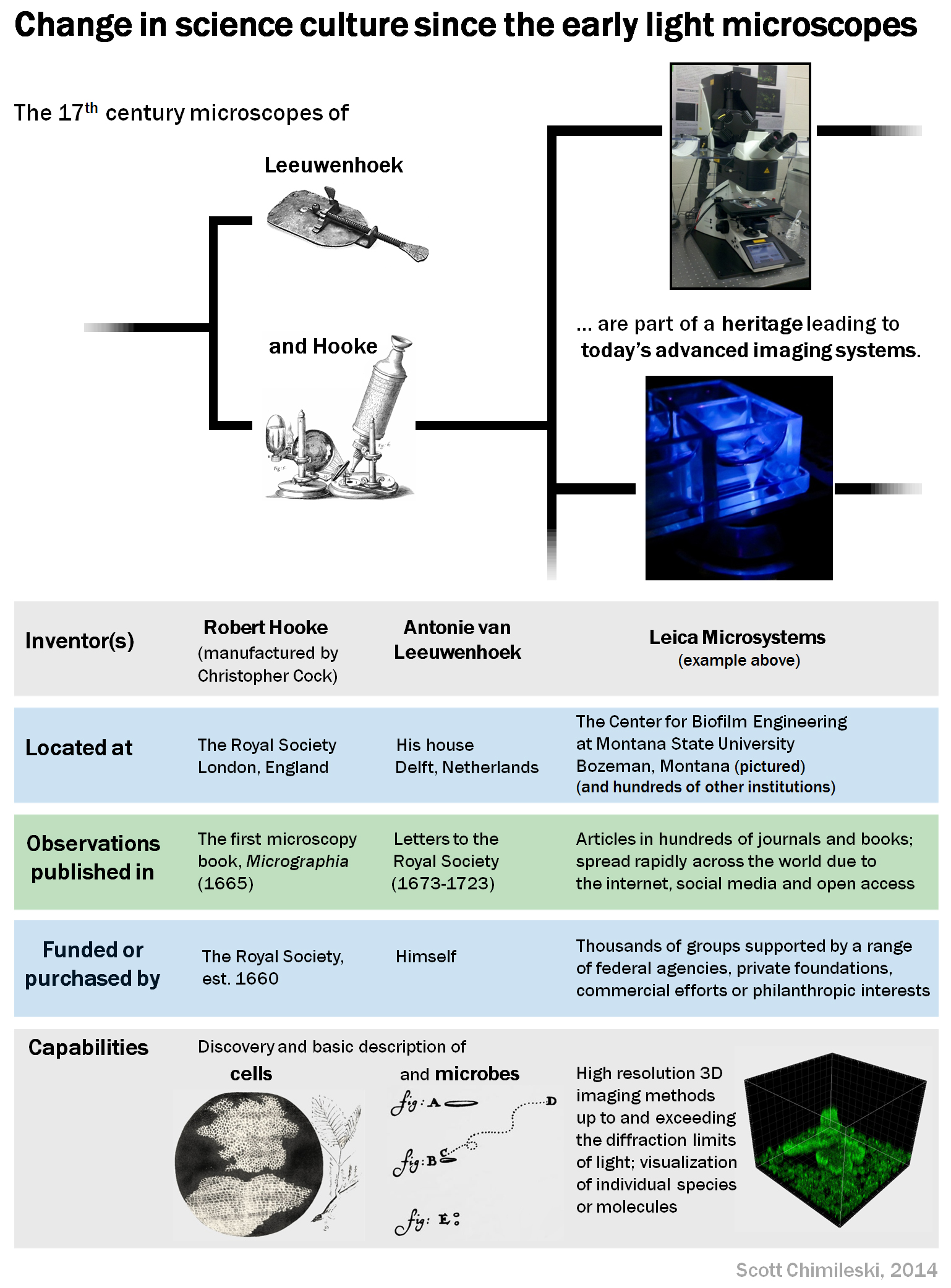
science-funding-inventors Continue reading

Enough doom and gloom part 1: Science funding is cyclical

Contributor Scott Chimileski

A few months away from finishing a PhD, my social media feeds are filled with negativity about postdocs, jobs and funding. Article after article, elaborate infographics – there are even special calculators now that predict your chances of becoming a principal investigator.

labpredictor-scott-chimileski

{credit}Image credit: Scott Chimileski{/credit}

It is certainly true: the competition for a position as a science professor and to earn funding as a researcher is increasing. Raising consciousness around these issues is important, and these articles, driven by genuine concern, do help. However, I think it has gone too far. I see it affecting my peers on Facebook: “Wee!! Sadly this motivated me to get out of bed, someday I could make $40k!” accompanied by a link to the article “Too Few Jobs for America’s Young Scientists.” This same sort of sentiment is echoed on Twitter.

It’s human nature to focus on bad news; but it is long overdue to have a critical look at all the doom and gloom. Before we panic – before we decide there are too many PhD students and dream-up ways to intervene – let’s consider the history surrounding these issues, allow a little optimism in, and explore the positive. In this three part series, I want to help uplift my fellow young scientists. Continue reading

Naturejobs picks of the week

With Cordova’s election as the NSF director, we’ve been doing some science funding-focussed reading

books

{credit}PhotoDisc/Getty Images{/credit}

So is the amount of science funding available dwindling? Or are we just imagining it? Our reads this week have been looking into how boom-bust cycles are taking shape, how funding proposals are being made and how all of this might just be a myth.

“Without fail, the science community complains about a lack of funding, the business community complains about a lack of translation of research to commercial outcomes, and the government promotes our many achievements, offering up new programs paid for from the termination of previous ones.” Is what Brian Schmidt writes in his article for the Financial Review about the endless boom-bust loop. He’s talking specifically about his experiences in Australia, but they seem to be mirrored in other places.

Even Barack Obama put out a call for more science funding – hoping to increase it by 0.7% according to a SciAm article“In the 2015 proposal, “there’s not enough money to do anything interesting,” says Kevin Wilson, director of public policy at the American Society for Cell Biology in Bethesda, Maryland, which tracks spending at the NIH.” Write the authors  Lauren Morello, Jessica Morrison, Sara Reardon, Jeff Tollefson, Alexandra Witze and Nature magazine.

It isn’t looking good. Jack Hassard blogged about this rather depressing topic too. He summarised some of the key findings from the Chronicle of Higher Education’s survey report “Strapped Scientists Abandon Research and Students” (unfortunately behind a pay wall) by Paul Basken and Paul Voosen. He quotes from the report that “Nearly half have already abandoned an area of investigation they considered central to their lab’s mission. And more than three-quarters have reduced their recruitment of graduate students and research fellows because of economic pressures.” (Read more of his summary on his blog post “Why are scientists abandoning their research?“).

But is it all a myth? Could this funding crisis just be part of something fictional? Are scientists imagining this bust part of the boom-bust cycle? Robert N. Charette thinks so. He did a pretty long form discussion about this (and the lack of science jobs) on Spectrum IEEE with his piece The STEM Crisis is a Myth.

““If there was really a STEM labor market crisis, you’d be seeing very different behaviors from companies,” notes Ron Hira, an associate professor of public policy at the Rochester Institute of Technology, in New York state. “You wouldn’t see companies cutting their retirement contributions, or hiring new workers and giving them worse benefits packages. Instead you would see signing bonuses, you’d see wage increases. You would see these companies really training their incumbent workers.””

So maybe there is light at the end of this potentially mythical tunnel.


Number of new US science PhDs falls for first time in seven years

The number of science doctorates awarded in the United States fell by 1% in 2010, ending a seven-year run of annual increases.

The new figures from the National Science Foundation (NSF) also show that in the decade from 2000 to 2010, the number of PhDs in agricultural sciences and psychology both fell by more than 5% – whereas all other major science fields saw an increase in the number of PhDs.

Other key figures include the following:

  • Between 2005 and 2010, there was a 29% increase in the number of women receiving a science or engineering (S&E) PhD – more than double the increase seen for men (13%)
  • The share of S&E PhDs awarded to women increased from 38% in 2005 to 41% in 2010
  • The share of S&E PhDs awarded to US citizens and permanent residents who identify themselves as members of a minority group rose from 22% in 2005 to 24% in 2010

Improving work-life balance: US National Science Foundation wants your ideas

Do you have a creative suggestion for how to address issues with career-life balance in mathematics and physical sciences in the United States? If so the National Science Foundation (NSF) wants to hear from you. In an open letter published yesterday, NSF’s Edward Seidel called for the mathematics and physical sciences community to contribute to NSF’s recently launched Career-Life Balance Initiative.

Ideas specific to mathematics and physical sciences can be sent to MPSplans@nsf.gov.

General ideas for any scientific discipline can be sent to career-life-balance@nsf.gov.

Practices to improve work-life balance that NSF encourages include:

  • No-cost extensions or temporary suspensions of NSF awards due to family leave
  • Flexible start dates for NSF awards
  • Supplements for additional personnel to sustain research when principal investigators are on family leave
  • Options for remote panel participation
  • Local childcare recommendations for panellists
  • Flexible postdoctoral fellowships to accommodate dual-career placements