Female scientists give fewer colloquium talks than do their male counterparts, finds a study in the Proceedings of the National Academy of Sciences.


My PhD journey is coming to its end and I am considering a non-academic career. Looking at job descriptions, I know I tick the box marked ‘strong analytical and problem-solving skills.’ However, there are other boxes to consider: ‘Strong time and project management skills.’ ‘A team player with a proven track record of collaborations.’ ‘The ability to communicate clearly and concisely to a wide range of stakeholders.’
I worked in a ten-person research group but I did most of my work on my own – does that really make me a team player? And what does “a wide range of stakeholders” mean, anyway? I don’t have the time or money to pursue further training to gain these skills, and I feel like the four years I spent getting my PhD in Human Genetics were a waste.
{credit}David Luders/Flickr https://www.flickr.com/photos/42988571@N08/13158201924{/credit}
What is the most important skill to become a PI? An eye for numbers, an ability to perform repetitive tasks accurately, optimism in the face of relentless failure, the ability to play nicely with others, sheer bloody mindedness, self-belief? All of these skills will strap you into the driving seat but once there, you’ll need to press the pedals yourselves. The most vital skill is creativity; the ability to see new connections — linking old data in new ways and using what we do know to interpret what we don’t.
Epitome is a Singapore biotech start-up whose product pipeline is based on engineered tail proteins to tackle bacterial diseases. It wants a slice of the US’s $6bn acne market. Epitome’s founders are seeking raise $10m to build a factory where its cosmetic products can be manufactured. Investors will be rewarded with a seat on its board.
The launch team describe the company at a presentation attended by other young entrepreneurs. They brace themselves for some tough questions from a judging panel. One judge asks how a factory can be built for $10m Another challenges the team’s plan to launch an acne treatment as a cosmetic product, which means they won’t mention acne on the label (the team adopted this approach to make the US regulatory process more straightforward).
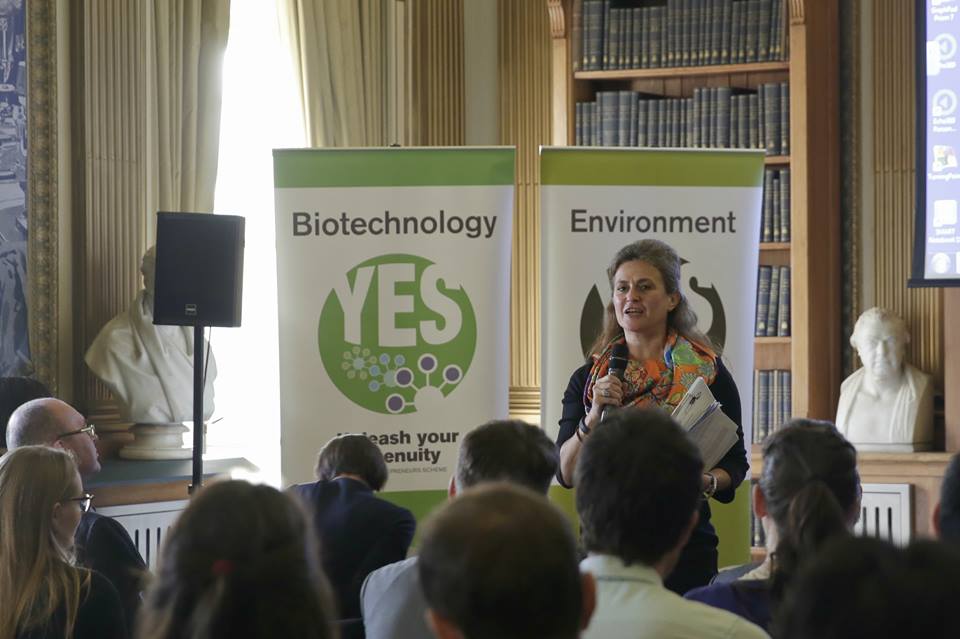
Elena Lurieluke, Head of Global Life Sciences Open Innovation, Corporate R&D at P&G, addresses fellow YES judges and finalists.