Getting the message out

How do you engage people with your science?

So you’re all over Twitter and Facebook and you even have a blog. Good on you – you’re your own public-relations and outreach specialist, getting the word out about your science. But what about the other kind of outreach – what’s still called science communication? Can you talk with a member of the press for an interview, or deliver your message to key thought leaders – such as government officials who decide on funding agencies’ annual budgets? Is it just a bit scarier than tweeting?

Continue reading

Skills for your next networking adventure

Networking may seem terrifying, but once you master the basics, it can be a real career boost

Naturejobs journalism competition winner Andy Tay

Networking during academic events such as conferences and seminars can be nerve-wrecking. Most of us can remember when we pretended to be engrossed in a programme booklet, wishing we could finally muster the courage to speak to the speaker with ground-breaking research standing ten feet away. You’re not alone, and there is a solution. Effective networking is a skill and anyone can benefit from more practice.

Do your homework

It’s a good habit to read the abstracts of presenters and download their papers to learn more about them before you join a conference. If you’re interested in their work, look up their profiles on platforms like Google Scholar, PudMed and ResearchGate. These platforms automatically update publications and can be better sources of information than many lab webpages, which are less regularly updated. By being diligent, and finding out more about the presenters and their research, you’ll be more confident and ready to ask critical, intelligent questions.

{credit}iStockphoto/Thinkstock{/credit}

Continue reading

Women in science: Clogging the leaky pipeline

Karin Bodewits and Philipp Gramlich think we should stop actively persuading women to study life sciences – a field in which they face unique challenges.

Guest contributors Philipp Gramlich and Karen Bodewits

Philipp Gramlich and Karin Bodewits


Continue reading

Five top tips for getting your paper noticed

Your research breakthrough doesn’t just need to be read by the experts, says Mark Lorch.

Guest contributor Mark Lorch

You’ve just made the breakthrough you’ve been dreaming of. The days-weeks-months-years in the lab or field have all paid off, and everything has dropped into place. It’s the sort of moment that we scientists live for – the buzz of discovery. So now it’s time to publish.New Image

Tell your peers about your work and hope it leads to new and even greater things for you, your fellow scientists, and society. But is that really enough? Maybe there’s a wider audience for your science, outside of the narrow confines of your academic circle. Maybe it has applications in other fields, or perhaps the public would like to (or even should) know about it. Plus of course if you get your paper noticed it’s much more likely to have the citations and impact that you, your department and all the metric measurers have been hoping for.

In the open access era there’s nothing stopping anyone from downloading your paper. But there are still hurdles to overcome before getting the wide readership your paper deserves. Based on my experience, here’s five tips for helping your paper reach the widest possible audience. Continue reading

Scientific communities: How to avoid getting scooped on social media

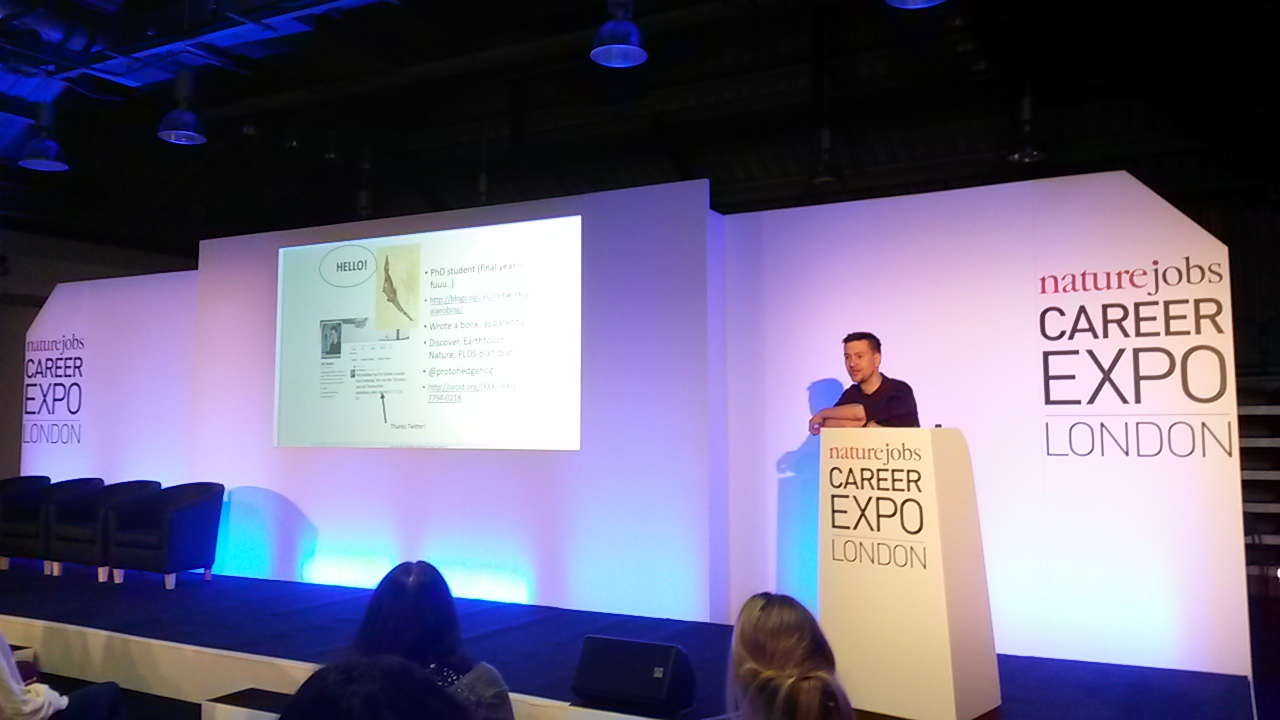
Being prepared before broadcasting is a sure way to avoid being scooped, says Jon Tennant at the 2015 London Naturejobs Career Expo.

Many scientists are nervous about sharing their scientific work before publishing. The fear of being scooped is there when it comes to social media, but it will be difficult for someone to scoop your work based on a 140-character sentence.

Sharing your science on social media is all about being selective. You can make data and methods open when you’re ready – there is no rush to get things out before you are prepared.

Further reading:

Scientific communities: Build your own.

Scientific communities: How to follow the right people on Twitter

Scientific communities: From Twitter to paper

Scientific communities: Membership at learned societies

Scientific communities: How to get your blog noticed


Scientific communities: How to get your blog noticed

Increasing engagement and using social media can help get your blog posts to wider audiences, says Jon Tennant.

At the 2015 London Naturejobs Career Expo, Scientific communities panelist Jon Tennant, an avid science blogger, shared a few top tips on getting your blog noticed.

Top tips from Jon Tennant:

  1. Tag your posts so that they are easily searchable.
  2. Share your posts on social media (Google+, LinkedIn, Facebook, Twitter…).
  3. Ask for feedback by getting people to comment on your posts. This can stimulate conversations around the topics covered, which will increase engagement.
  4. Ask people to share your content in their own circles so that it reaches a broader audience.

Further reading:

Scientific communities: Build your own.

Scientific communities: How to follow the right people on Twitter

Scientific communities: From Twitter to paper

Scientific communities: Membership at learned societies

Scientific communities: How to follow the right people on Twitter

Following the right people on Twitter can help develop supportive and beneficial communities, say speakers at the 2015 London Naturejobs Career Expo.

Jon Tennant, a paleontologist and avid social media user shares his tips on how to make the most of a social media community on Twitter.

Jon Tennant’s four top tips:

  1. Identify learned societies in your field and find out who they follow. These people will be high-profile scientists in that particular speciality.
  2. Tweet at conferences and you’ll quickly find that people follow you back, especially those who cannot attend.
  3. Curate your feeds into lists. For example, develop a list appropriate to science communication, or on microbiology. You can be as specific as you like
  4. If you don’t like what someone does/says on Twitter, you can unfollow them.

Further reading:

Scientific communities: Build your own

Scientific communities: Membership at learned societies

Scientific communities: From Twitter to paper

Scientific communities: From Twitter to paper

Networking on Twitter can lead to new collaborations, research projects and, ultimately, published papers.

Jon Tennant spent time networking  with fellow paleontologists on Twitter. Unbeknownst to him, this method of communication would ultimately lead to a new research collaboration and a published paper. Here he explains his story at the 2015 London Naturejobs Career Expo.

Further reading:

Scientific communities: Build your own

Scientific communities: Membership at learned societies

Scientific communities: Build your own

Learned societies and online platforms can be great ways to develop a mutually beneficial network, say panellists at the 2015 Naturejobs Career Expo in London.

Guest contributor Paul Brack
Jon-Tennant-NJCE15-communities-naturejobs-blog

Jon Tennant and the merits of online scientific communities {credit}Image credit: Julie Gould{/credit}

“Networking isn’t just me trying to get something from you,” said Julie Gould, editor of Naturejobs, as she opened the session on Building Scientific Communities at the 2015 London Naturejobs Careers Expo. “Networking is about building a relationship with another person that will benefit both of you.” The two invited speakers in this session, Sarah Blackford, head of Education & Public Affairs at the Society for Experimental Biology, and Jon Tennant, an Imperial College London PhD student, discussed some methods that early career scientists can use to start these types of relationships.

Learned societies

Learned societies, such as the Royal Society of Chemistry or the Biochemical Society, are, according to Blackford, “clubs for people with a similar interest in an academic discipline.” Early-career scientists often underestimate how useful learned societies can be in helping them advance their careers. Blackford pointed out that learned societies have quite a lot of money, and, as they’re not-for-profit, “they give that money back into the scientific community.” Learned societies do this partly by organising and subsidising events, such as conferences on topics that interest their members and giving travel grants to early-career scientists to enable them to attend external meetings. Continue reading

Networking for introverts

Being prepared can help introverts start conversations at big conferences, says Paul Brack.

Guest contributor Paul Brack

social-media-naturejobs-blog

Social media is a great tool for networking for introverted scientists.{credit}iStockphoto/thinkstock{/credit}

In the last few years, introverts have become the new geeks. In the past we were painted as miserable wallflowers. Now, thanks in large part to Susan Cain’s book Quiet and her accompanying TED talk in 2012, we’re often portrayed as the conscientious, thoughtful people who are going to quietly invent the technology needed to save the world.

Whilst the reality has of course always lain somewhere between these two extremes, there’s one thing that is true for introverts: we generally struggle with networking. Introverts find over-stimulating environments, like large groups at conferences, difficult to navigate. But that shouldn’t put an introverted scientist off from adapting their networking tools to suit their character.

At its heart, networking is about forming relationships. Some psychologists have suggested that introverted people take longer to make connections than extroverted people, as they find it more tiring. This is based on the description formulated by Katharine Cook Briggs and Isabel Briggs Myers (building on the work of Carl Jung), the developers of the Myers-Briggs Type Indicator ‘personality test’, that whereas extroverts are energised by meeting new people, introverts are drained. Continue reading