#scidata16: Open data should be easy

There’ll always be reasons not to share data. It’s time we stop making excuses and start making plans, says Atma Ivancevic.

On the morning of October 26, 2016, a group of scientists convened in London to discuss the state of open data. The third Publishing Better Science through Better Data conference kicked off with morning tea, international introductions, and furious scribing from @roystoncartoons. The premise was simple: “Today is all about being open”, said conference chair Iain Hrynaszkiewicz. We settled in to learn the advantages of data sharing at both the individual level and for the scientific community at large.

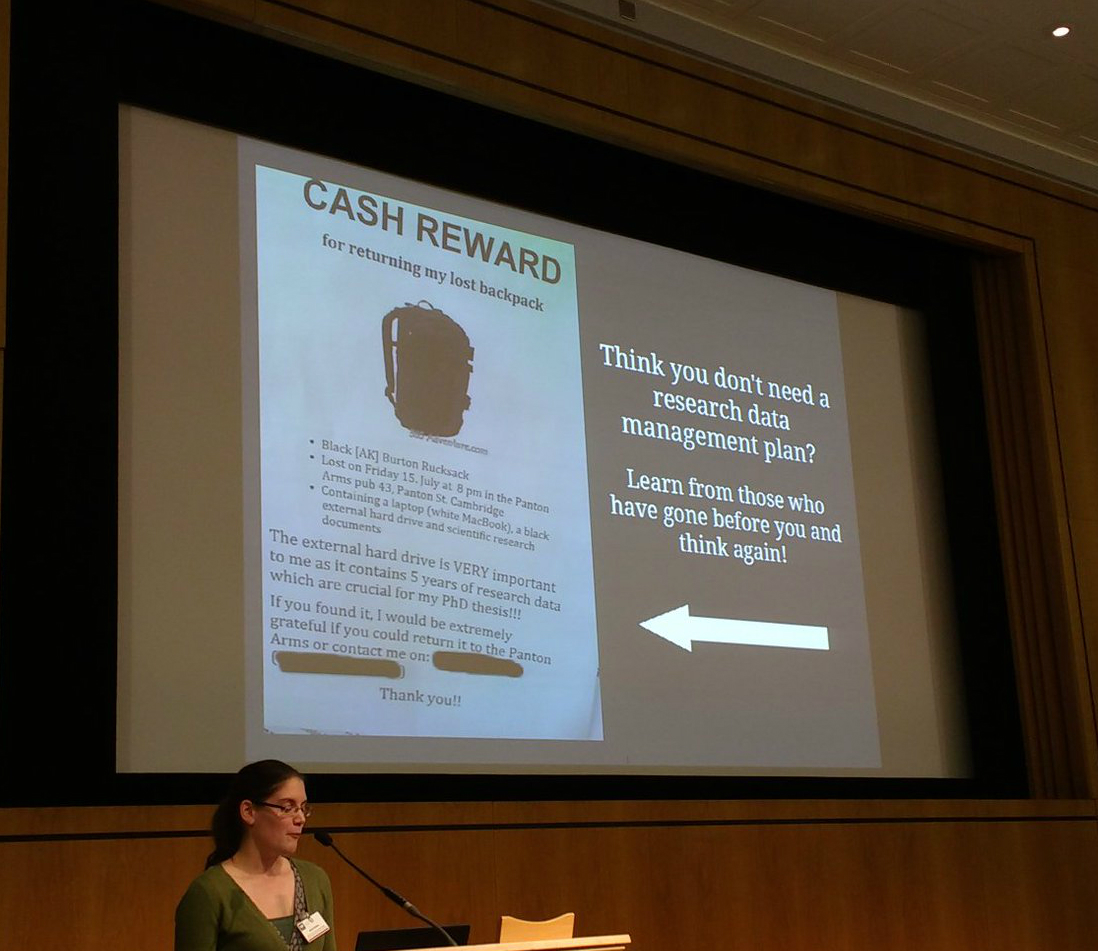
“Open data should be easy,” said Dr Jenny Molloy from the University of Cambridge as she explained the importance of building a data management plan. She pulled up a poster of a missing black backpack: “CASH REWARD” it read, “contains 5 years of research data which are crucial for my PhD thesis!”  I laughed along with everyone else, internally reflecting how similar my life had been before I discovered version control.
IMG_20161102_213011-smaller

Think you don’t need a research data management plan?
Continue reading

Uncertain Airspace: Changing career paths is disorienting and exhilarating

Pursuing a new career makes PhD student Jonathan Wosen feel like a baby goose—and he loves it.

Sometimes I ask people, “if you weren’t studying biology, what would you do?”

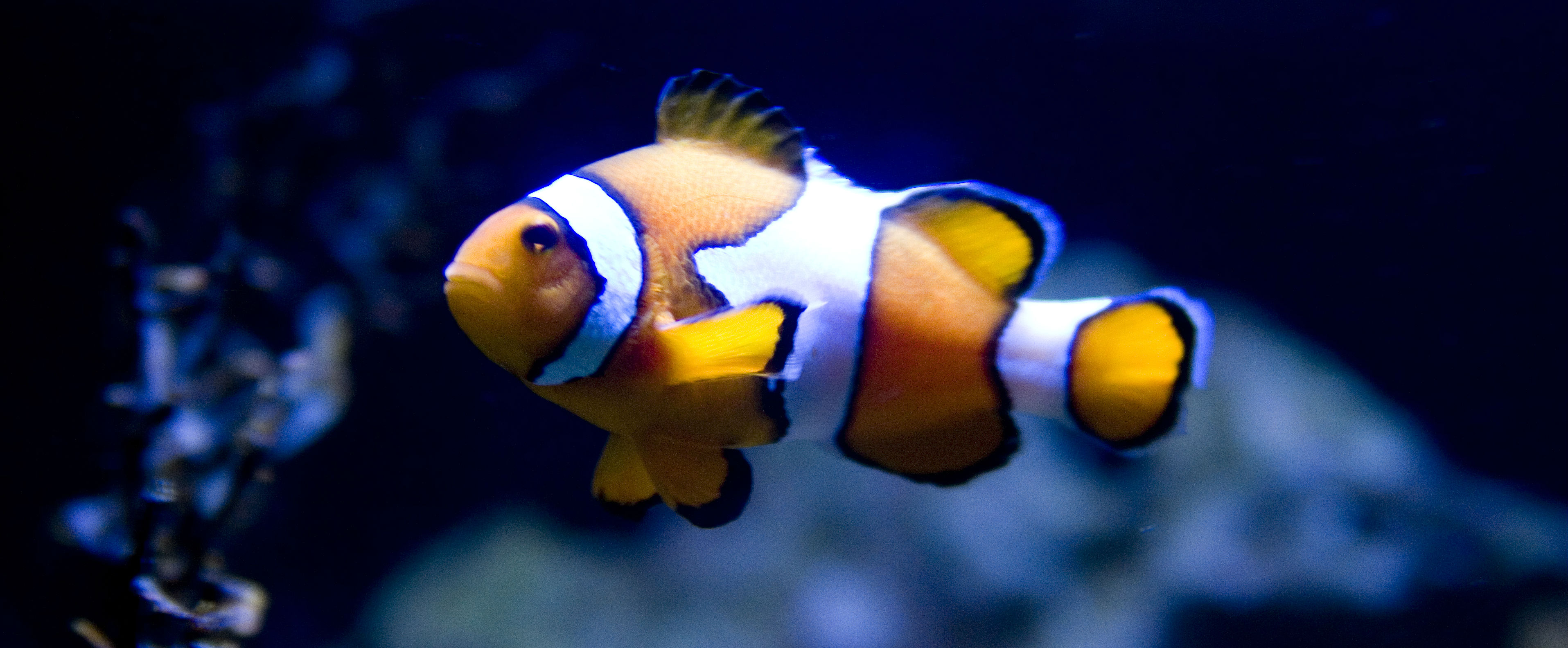
At first, they’re taken aback, and I don’t blame them. PhD students are self-selected for a certain kind of persistent, focused thinking; that’s what it takes to become the world’s leading expert on your thesis project. We are as deeply immersed in our work as a fish in water. That makes asking a graduate student to consider a different field of study a lot like asking a fish to imagine life on dry land.

Clownfish_in_blue_water-smaller

“We are as deeply immersed in our work as a fish in water. That makes asking a graduate student to consider a different field of study a lot like asking a fish to imagine life on dry land.”

Continue reading

Back to the thesis

We share Nature’s back to the thesis videos, and some of our favorite #threewordthesis tweets

Last week, Nature visited a few prominent scientists to take them back to their theses.

First up was Francis Collins, director of the NIH, with Semiclassical theory of vibrationally inelastic scattering, with application to H+ and H2 (1974). This is how it went.

Continue reading

A day in the life of a Scientific Reports assistant production editor

Charlotte Alldis helps shed some light on the publishing business for Scientific Reports and Naturejobs.

I’ve worked as an assistant production editor for Scientific Reports for almost a year now, and one thing I should mention is that Scientific Reports is an unusual journal. We’re completely open access (which means anyone can access and re-use the research we publish), and we publish loads of research in a rapid timeframe. Ensuring papers are published within the shortest possible time following acceptance is the key driver and focus of the work I complete on a daily basis in the production team.

Untitled

Charlotte Alldis


Continue reading

Study system envy

Graduate students must often weigh the pros and cons of straying from an advisor’s research program

Guest contributor Carolyn Beans

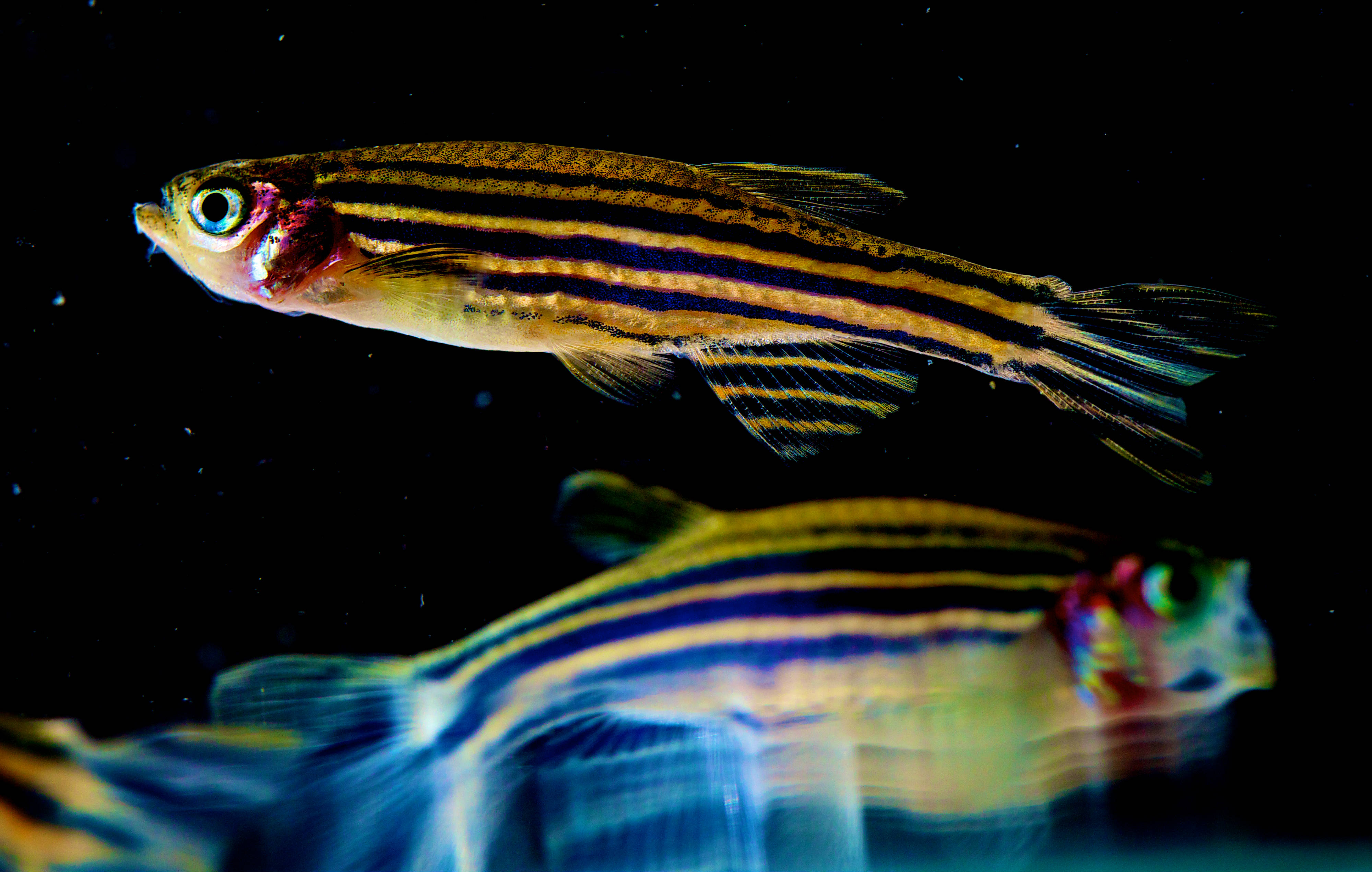
Early in graduate school, I had total study system envy. In many biological fields, including my own field of evolutionary ecology, a study system is a specific species that a scientist uses to run tests. Some of these species like mice, zebrafish, and the plant Arabidopsis are model organisms, and have been well-studied for decades or more. Whether scientists choose a model organism or a relatively unknown species as a study system can have drastic consequences for their research.

Zebrafish

Zebrafish{credit}Uri Manor, NICHD{/credit}

Continue reading

Assessing PhDs: The thesis or the alternative

James Lewis discusses whether the traditional PhD thesis is the best way for assessing PhD students, and what a good alternative might be.

Contributor James Lewis

write-think-naturejobs

{credit}Wavebreak Media/Thinkstock{/credit}

Writing up several years of research into a thesis is one of the most challenging hurdles in the long process of getting a PhD. I began writing up in April 2015 and I find myself frequently wondering whether such a mentally taxing task is the best way to examine students before sending them off into the wider world. At the end of July I published a two question poll on my personal blog designed to find out the opinions of others in academia. Over the course of 12 days, 111 people responded. The full results for the poll can be found directly here.

I encouraged people to comment and give their thoughts and suggestions. It is widely accepted that a thesis is the best form of assessment for the humanities so here I focus on whether it’s compatible with the sciences, where research is primarily shared through peer reviewed journal articles.

The traditional thesis

The first poll question asked whether the PhD thesis is an effective way to assess students and 63% stated that they believe it is.

Those in favour argued that it’s the most flexible format for developing writing skills, demonstrating knowledge and allowing discussions of ideas, speculation and negative results that wouldn’t make it into a published paper. Thesis writing also directly demonstrates a student’s ability to plan, carry out and write up a research project to examiners and future employers. Details of method development can be particularly useful resources for laboratories as those following in the student’s footsteps can quickly find out what worked and what didn’t. Continue reading

How to procrastinate efficiently (if you cannot stop)

Daisy Hessenberger outlines how she turned her procrastinating into time well-spent whilst writing her PhD thesis.

Contributor Daisy Hessenberger

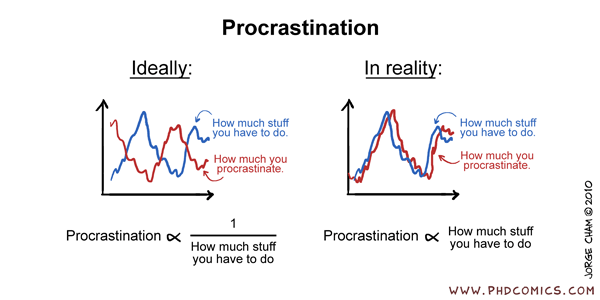
Early in the fourth year of my PhD I went to a talk titled “The Power of Procrastination” by Dr Jorge Cham (here is a similar talk that Dr Cham did in Washington), the creator of PhD comics. Although intended as a comedy set, I also left with an important take home message: procrastination may not be that bad. Dr Cham argues that procrastination, especially in an academic setting, is undervalued and that we should endeavour to procrastinate more. His reasons for this are that great ideas are more likely to come during times of procrastination and that by procrastinating we are doing what we want to be doing with our life. Concentrating on the former process, I found that I agreed, remembering the countless times I had spent hours of intent focus on data analysis only for the answer to come to me while on my bike or illustrating for a student article.

procrastination-graph-jorge-cham

Image credit: Jorge Cham

I was about to embark on writing my PhD dissertation, and though ideally my procrastination levels would drop as my workload increased, past experience told me that time spent procrastinating was proportionate to work load (see comic). So, I decided to be proactive and to actively plan in procrastination sessions in my writing process in the hope that my brain would yield enlightened ideas during this time, and that I would limit the time spent on useless procrastination. Continue reading

Most read on the Naturejobs blog: August 2014

August has been a busy month for the Naturejobs team, especially as the Naturejobs Career Expo is coming up on September 19th in London (we hope to see many of you there). But we’ve still had plenty of time to bring you some great posts on the Naturejobs blog, and we wanted to share your 10 favourite posts from August.

PhD and coffee

Thesis writing tip for the I-left-it-to-the-last-minute PhD student {credit}Image credit: Daisy Hessenberger{/credit}

1. Thesis writing tip for the I-left-it-to-the-last-minute PhD student.You’ve read all the other writing tips and they all say the same thing: start earlier! Unfortunately, that’s no help to you. So here are some top tips for those who have left it a little later than planned. Good luck! 

2. I am a scientist because… shows just how diverse scientists are. Theconversation continues on Twitter with the #IAmAScientistBecause hashtag. 

3. A PhD is more than just research trainingAre there too many PhDs? Only if you consider a one-track career path in academia. But this post shows that academia and a PhD can provide you with a vast set of skills that set you on the right footing for many different career paths. Continue reading

Top Tips on writing your PhD thesis

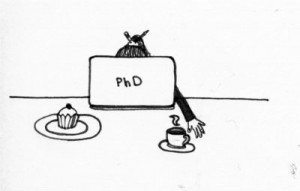
We’re trying something new: crowd-sourced #TopTips, garnered from the Naturejobs Twitter and Facebook pages. In this first one, we’re looking at how to best to tackle the daunting task of writing a PhD thesis. It’s not something you worry about when you start: you’ve got at least three years to go, so why bother? Well, those years will go by in a flash, so it’s worth being prepared.

Plan

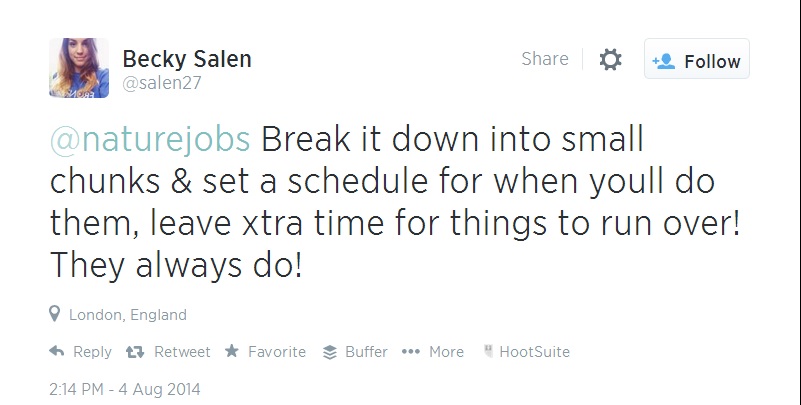
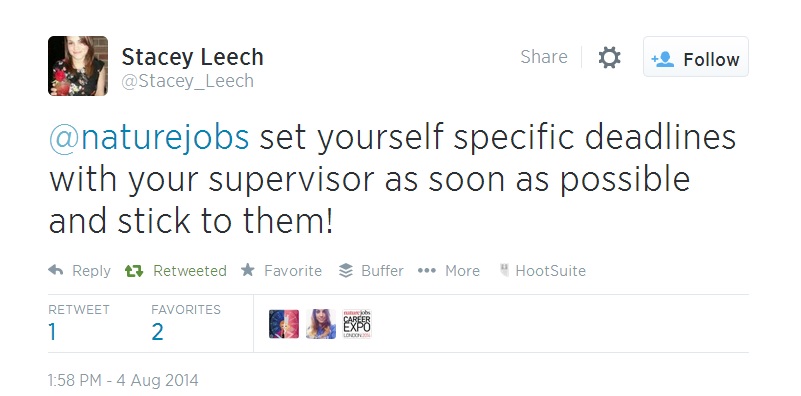
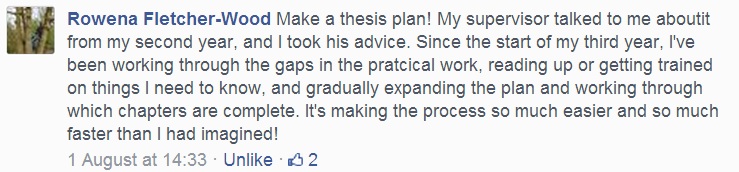
Plan your time. Something as simple as dividing the time you have by the number of chapters you need to write gives you an instant grasp of what your targets need to be. And be sure to involve your supervisor.

plan-1

plan-2

rowena comment 2

Read well

Read papers that are both in and related to your field of research, but take care that this doesn’t become an unmanageable pile of paperwork.

read

Continue reading