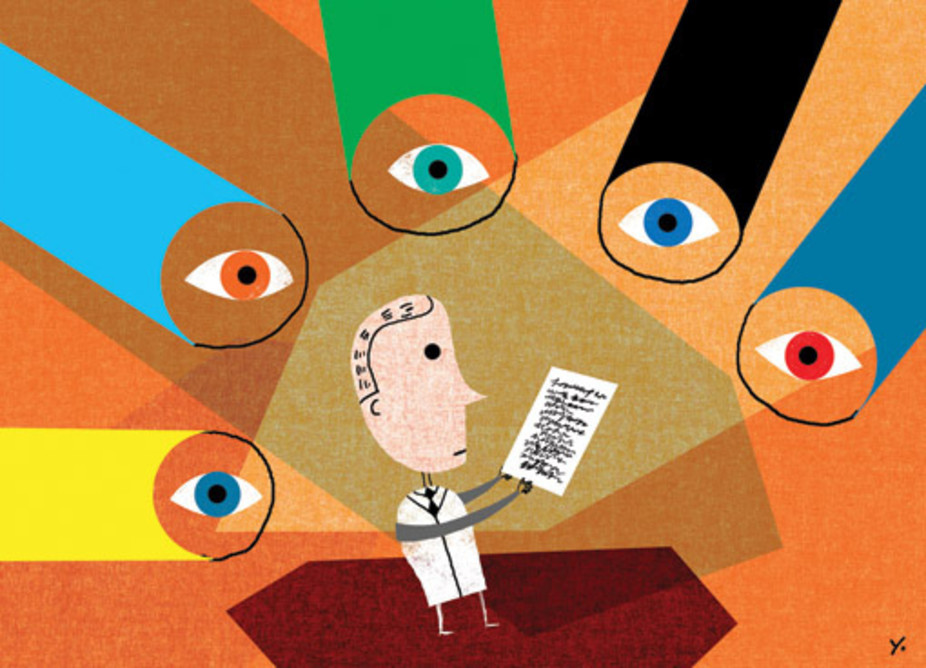
How not to respond to reviewers: Eight simple tips

Responding to reviewer reports is a key part of publishing academic work in peer reviewed journals. But if you’ve received mixed reviews of a paper or are publishing for the first time, where do you start?

This piece was republished from Sophie Lewis’ blog.

My first attempt at publishing a paper was a breeze. A collaborator was asked to contribute to a special issue and offered me the opportunity to lead the paper. I was a PhD student at the time, and spent two months visiting her lab overseas and writing. By the end of my visit, I’d carved out a draft that I left behind for comments. After a bunch of emails and several rounds of revisions over the next month, we were ready to submit.
Flickr/AJ Cann, CC BY-SA

Flickr/AJ Cann, CC BY-SA

Continue reading

Follow your passion when choosing a career in science

What are you passionate about?

Guest contributor Aliyah Weinstein

This question plays a role in the career decisions for almost everyone, yet is absent from most conversations when it comes to early-career scientists. Questions all PhDs hear are: What kind of research are you interested in doing? Do you want to work in academia, or in industry? But these questions make a fundamental assumption: every scientist wants to pursue a career in research. I, for example, have had a lifelong interest in writing and languages.

WEB_Astronomy-sky_65870

Continue reading

What almost derailed you?

We ask academics at the Naturejobs career expo, San Francisco, to name one moment that almost derailed their career.

https://youtu.be/OkDhBqL2A0M

From academia to industry: A short guide

 When long hours in the lab threaten to bring you down, and the vision of a paper is a blur out in the distance, your own internal cheerleader can only carry you so far.

Guest contributor Aliyah Weinstein

Sometimes, a career change into a new environment is just the thing you need to refresh your love for science. But how can an academically-trained scientist make this transition?stairs-1014065_1920

Continue reading

The power of volunteering – getting ahead by getting involved

As an undergraduate and PhD student, I was unsure of how to continue my career. Volunteering helped me to explore alternative career paths, find my niche and get ahead.

Guest contributor Roda Niebergall

“The best way to find yourself is to lose yourself in the service of others.”

– Mahatma Gandhi

For university graduates, volunteering is a great opportunity to gain some work experience. Even if you’ve already advanced in your career and are planning to switch fields, volunteering is a powerful tool to convince your future employer that you’re serious and enthusiastic about changing your profession. Many PhD students and postdocs quickly realize that they either do not want to or cannot continue their career in research. There are many exciting alternative careers out there, like science management, teaching or publishing. But when applying for these jobs, researchers cannot solely rely on skills gained in the lab.

volunteers-601662_1920

Continue reading

Informational interviews: The right push for your career?

Confused about your next career move? Informational interviews can help you get started.

Guest contributor Meenakshi Prabhune

The job search is difficult and intimidating, especially during a career transition. While there are tons of articles and advice on dealing with the much dreaded job interview, they rely on a major assumption: you’ve been called for an interview in the first place! What if you’re still figuring out what jobs you should start applying for? This is where informational interviews come in.


dominos Continue reading

Teaching as an academic

We asked Elizabeth Joyce’s opinion on teaching as an academic at the Naturejobs career expo, San Francisco.

https://youtu.be/PwXGjUBtSrY

Scientific data + effective communication = big changes

The science community should recognize the influence that research has when it’s translated for everyone.

Guest contributor Thais Moraes

2014-06-29 15-smaller

Thais Moraes

The conference comm4science – communicating science beyond the lab – in Heidelberg, on the 6th and 7th of May, put together many popular names involved in science communication both in and outside of Germany. They all highlighted the importance of communicating science. But they also recognized the many problems we face today concerning dialogue between scientists and the public. In my opinion, one critical point is to make scientists understand how essential it is to share their research with society. Continue reading

The Naturejobs Career Expo, San Francisco

Check out our feature video from our first event in San Francisco!

https://youtu.be/9U2nG3LbnRw


Sad you missed it? Our London expo is now open for registrations here.


Suggested posts

How to start a startup

How did you cultivate mentors?

How can people reach you?

Career paths: What do you need to think about before taking your next step?

Before choosing a new career path, take the time to get to know yourself, and you may be surprised at how well things fall into place.

 Naturejobs journalism competition winner Mary Gearing

Any career, scientific or otherwise, is the product of choices. In my own path in science, the first set of choices was clear: major in biology, conduct undergraduate research, enroll in a PhD program. This was a comforting, well-trodden path, but it left me unprepared to make the next big decision: my post-PhD direction. Now, as I near the end of my graduate studies, I’ve realized that this decision is much simpler than I thought. The most important tool for a career change is self-awareness – the willingness to analyze yourself as thoroughly as you would any key experiment.

Continue reading