Making headlines: Choosing the best title for your paper

It may feel like an afterthought, but taking the time to write an effective title for your paper could be an easy way of promoting your research, says Helen Robertson.

Writing up a manuscript for publication is a multi-faceted process. You’ve finished the literature review, detailed your methods, discussed your findings and formatted your figures. Now, the only thing left is to come up with the title.

Easy, right?

original

Is is that easy to come up with a title? {credit} Alias la Patata by Pierpaolo Voci. CC-SA-3.0 {/credit}

Continue reading

Do you think your career was harder as a woman in science?

Academic speakers at the Naturejobs Career Expo, London, 2016, discuss sexism in academia.

https://www.youtube.com/watch?v=rdfqXdibc0k

Continue reading

The talent prize that flies the Spanish flag for organometallic chemistry

In 2016 Eva Hevia published her 100th paper, had her second child, celebrated her 40th birthday, and won a £14k prize which she will use to strengthen links between scientists in the UK and her native Spain. David Payne attended the prizegiving.

Hevia, professor of inorganic chemisty at the University of Strathclyde, Glasgow, described herself as a “molecular architect” after receiving the Society of Spanish Researchers in the UK’s inaugural Emerging Talent Award at the Spanish Embassy in London this week.

embassy

Continue reading

#scidata16: Open data should be easy

There’ll always be reasons not to share data. It’s time we stop making excuses and start making plans, says Atma Ivancevic.

On the morning of October 26, 2016, a group of scientists convened in London to discuss the state of open data. The third Publishing Better Science through Better Data conference kicked off with morning tea, international introductions, and furious scribing from @roystoncartoons. The premise was simple: “Today is all about being open”, said conference chair Iain Hrynaszkiewicz. We settled in to learn the advantages of data sharing at both the individual level and for the scientific community at large.

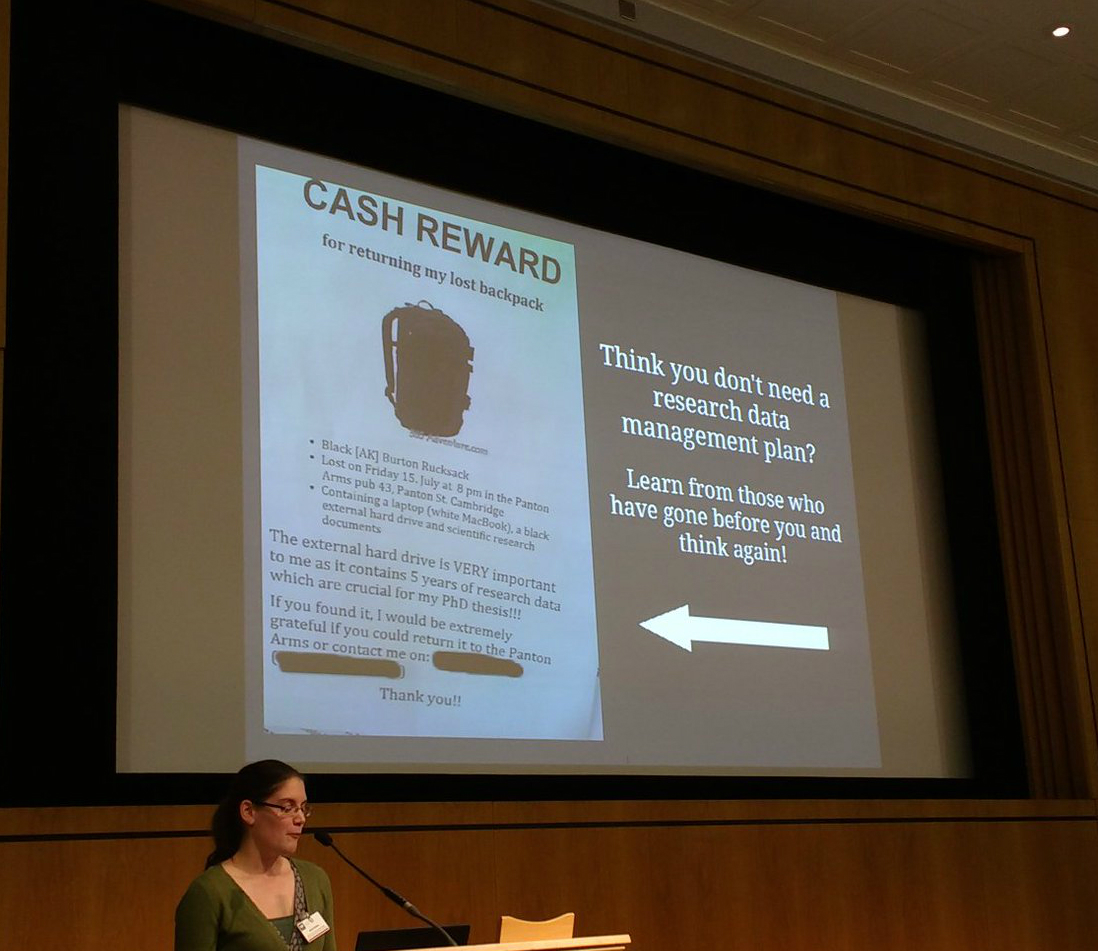
“Open data should be easy,” said Dr Jenny Molloy from the University of Cambridge as she explained the importance of building a data management plan. She pulled up a poster of a missing black backpack: “CASH REWARD” it read, “contains 5 years of research data which are crucial for my PhD thesis!”  I laughed along with everyone else, internally reflecting how similar my life had been before I discovered version control.

IMG_20161102_213011-smaller

Think you don’t need a research data management plan?

Continue reading

The Art of Supervision in the Arab and Gulf Region

The upcoming generation of Arab scientists has to be mentored differently, says Mohamed Boudjelal

This piece was cross-posted with Nature Middle East

professor-1696568_1280-smaller

The majority of the Arab world gained independence from western colonization during the second half of the 20th century. While Western states were building their research base then, most Arab states were focused on education. Now, the Arab world is trying to catch up. The two main challenges we face today are improving scientific training, and engaging more women in science.
Continue reading

Away from Home: Blending remote sensing with social sciences

We’re bringing you the best stories in lab mobility from Nature India

The ‘Away from home‘ blogging series features Indian postdocs working in foreign labs recounting their experience of working there, the triumphs and challenges, the cultural differences and what they miss about India. They also offer useful tips for their Indian postdocs headed abroad. You can join in the online conversation using the #postdochat hashtag.

KRC

Koel Roychowdhury

This week we have a young scientist from the United Nations University (UNU) in Tokyo, Japan at the end of her postdoc tenure. Koel Roychowdhury, an alumnus of the University of Calcutta, uses remote sensing technology to look at environmental and agricultural sustainability. Koel says the fascinating opportunity of doing science for social good is what keeps her going. Continue reading

Lost for words — the language of science communication

While English is largely regarded as the global language of science, science communication doesn’t enjoy a unifying language.

Naturejobs journalism competition winner Catherine Carnovale explores this distinction.

GettyImages-550382899-smaller Continue reading

The changing landscape of pharma: a new route for PhDs?

The pharmaceutical industry is changing – challenging for some, but an open road to opportunity for others. And the latest opportunity in the world of pharma comes from a rapidly growing demand for Medical Science Liaisons (MSLs), says Dr. Martijn Bijker.

As more drugs come to market and pharma’s business model shifts from selling drugs directly to fostering earlier engagement, companies are looking for highly skilled scientifically- and clinically-trained candidates. Could this be an outlet for the overflowing pool of PhD (and MD) graduates produced every year?

So what is an MSL?

An MSL is the scientific and clinical disease expert within a pharmaceutical or biotech company. They’re the go-to person for any complex questions about a specific drug. That could include questions about the science behind the drug, the mode of action, the competitors’ drugs, side effects, clinical trials, research opportunities, and disease-related questions.

MSLs work at the interface between internal stakeholders in the company and external stakeholders in the field – called Key Opinion Leaders (KOLs). MSLs help to bring innovative new drugs to the market and provide education about the proper use of drugs that are already on the market. KOLs – broadly defined as leaders in their field – can be heads of departments at teaching hospitals, heads of pharmacies, professors of medicine, the CEO of a patient organisation, physicians involved in pharmaceutical clinical trials and sometimes clinical scientists themselves. In short, MSLs work with the most influential stakeholders in a therapeutic area.

scientist-762627_1920

MSLs help to bring innovative new drugs to the market and provide education about the proper use of drugs that are already on the market.

Continue reading

Keep the lights on

Energy entrepreneurs, take note – you have an opportunity to compete for a cash prize and the chance to network with investors. piggybank

The Deutsche Energie-Agentur (dena), or German Energy Agency, has launched ‘Start Up Energy Transition’, a global business competition open to start-ups and early-stage companies in the energy sector. Continue reading