Take a lesson on open data from scientific megaprojects, says Sara Osman.


Naturejobs journalism competition winner Jessica Gorrill
The future of STEM (science, technology, engineering and mathematics) in the UK is on shaky ground. The numbers of entries at A-level for Biology, Physics and Chemistry dropped by 1%, 2.6% and 1.6% respectively in 2016, according to statistics collected by the Joint Council for Qualifications. This ends the steady increase seen since 2009. Whilst this drop may be attributed to the first year of new government reforms, it could be the beginning of a worrying trend of students neglecting careers in science.

{credit}Topp_Yimgrimm/ThinkStock{/credit}
{credit}Noel Hendrickson/Getty{/credit}
Better Science through Better Data writing competition winner Katie Ember
Every Monday in the University of Edinburgh’s School of Chemistry, the Campbell group gather in Room 233 for a lab meeting. If you’re hosting the meeting, you bring cake. Or you forget and everyone pretends they’re not feeling a bit hungry and disappointed. Then, two scientists in the group present that month’s work.
Every Friday in the Centre for Regenerative Medicine, a fifteen minute cycle from the School of Chemistry, the Forbes group file into the first floor meeting room. After battling with the “motion-activated” lights, we all talk through what we’ve achieved that week.
The reason I go to two lab meetings in one week is because I’m attempting to detect liver damage using laser light. It’s multidisciplinary and it’s hard: requiring input from biologists, physicists and transplant surgeons from different institutes. The end result is that I spend about four hours each week not doing science but discussing it. Whilst this may seem like a strange way to do research, I cannot overstate how important it is. Continue reading
Better Science through Better Data writing competition winner Anastasia Greenberg

From Jisc: Many hands make light work
“Information is power. But like all power, there are those who want to keep it for themselves.” Those were the words of Aaron Swartz, a young programming prodigy and the creator of Reddit, in his Guerilla Open Access Manifesto. In 2011, Swartz wrote some code that systematically downloaded millions of academic papers from the JSTOR database onto his computer, which was hidden in a basement closet at the Massachusetts Institute of Technology (MIT). This act of hacktivism resulted in felony charges, with potential for decades of jail time. Swartz hanged himself in 2013.
To some, Swartz’s story embodies the open-science movement, but it is far from clear what his motives for downloading JSOR’s database were, and which, if any, segments of the open science movement Swartz identified with. Continue reading
Over one thousand scientists attended the Naturejobs Career Expo last week in London. With professional CV checking, exhibitors from academic institutions and companies from around the world, and career-focused talks from Nobel Prize winner Professor Venki Ramakrishnan, science communication expert David Urry, popular blogger and senior lecturer Dr John Tregoning and many more, this was a resource-packed event for researchers.
Spending the day absorbing so much great careers advice left me feeling punch-drunk by the end. Some themes cropped up repeatedly — distilled wisdom on scientific success.
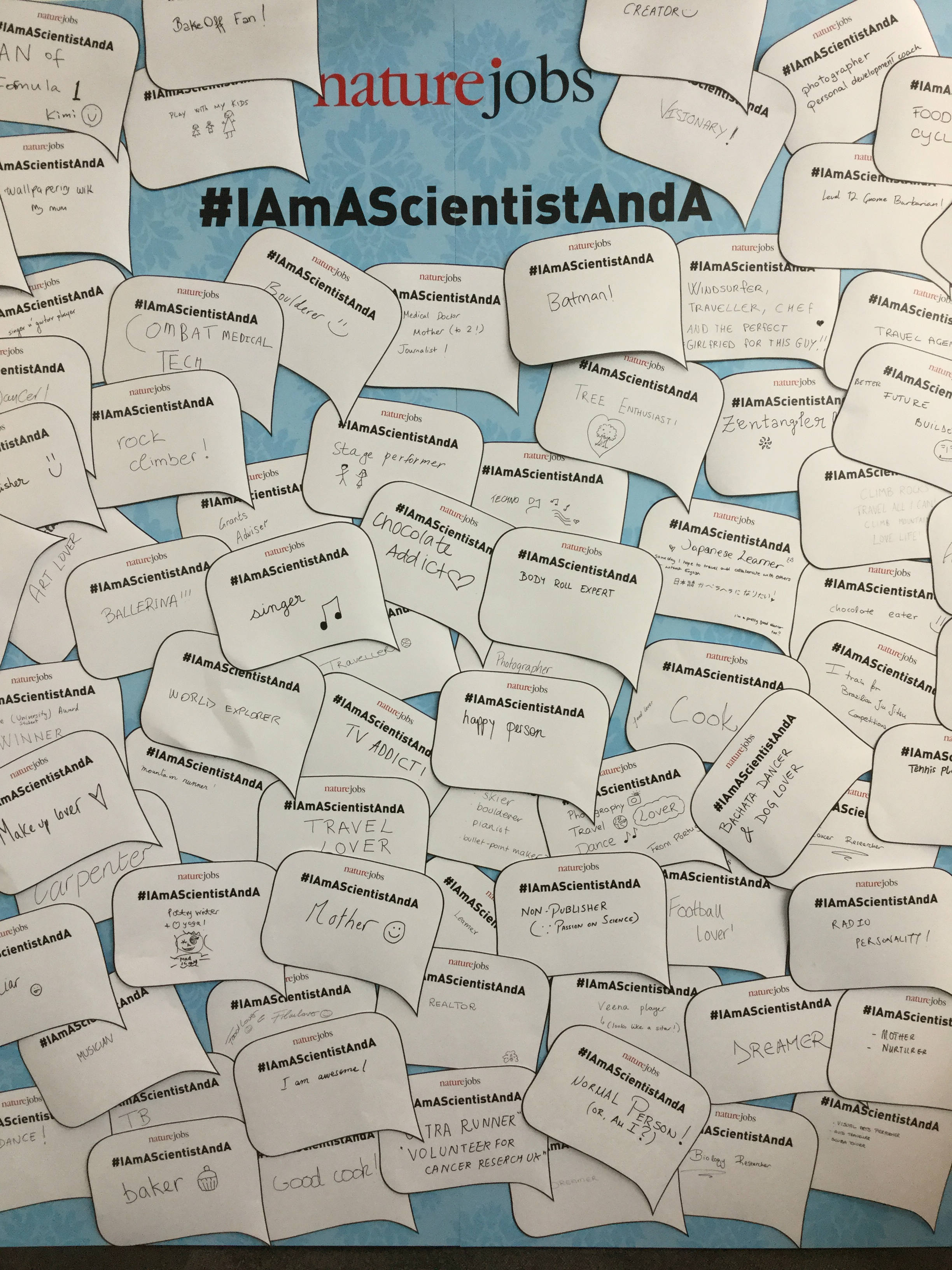
Some of the submissions to the Naturejobs Career Expo photoboth
Naturejobs journalism competition winner Jiska van der Reest
Naturejobs journalism competition winner Eileen Parkes
Having spent years trying to find the perfect mentor, I’ve learned there is more to mentorship than first appears.
Mentorship is given when someone with expertise and experience takes an aspiring scientist under their wing, to share their knowledge and advice, and to provide support and guidance in career development. It is distinct from coaching, or sponsorship, where the coach can give critical feedback or a sponsor may intervene directly in a protégé’s career. Importantly, mentorship is driven by the mentee, who should define their own needs for mentorship and career development.
Better Science through Better Data writing competition winner Ayushi Sood

Recently, an economist friend told me that “scientific inquiry is inherently cursed.” At first I was offended. But I had to agree after he elaborated further – science today suffers from something economists enigmatically call the “winner’s curse”. Continue reading
 Applications for two grant schemes open on 3 August, including ‘Starting’ grants of up to €1.5 million for up to 5 years for PIs who earned their PhD within 2-7 years ago; and a new collaborative programme, the ‘Synergy’ grant, which will fund 2-4 PIs in a cross-disciplinary project. The Synergy scheme, which awards up to €10 million for 6 years, was piloted in 2012 and 2013. The deadline is 17 October for Starting grant applications and 14 November for Synergy applications.
Applications for ‘Proof of Concept’ grants will be accepted starting in September, and for ‘Consolidator’ grants starting in October.
The 2018 grant programme will collectively fund about 900 PIs and is estimated to support 6,000 PhD students, postdocs and other lab members. ERC’s grant-success rate is 10-15%.
To apply for a Starting grant, click here . For a Synergy grant application, click here. Good luck!