Crowdsourcing science site Marblar revamps patents-to-products contest

A website that gave out more than US$50,000 in cash prizes to visitors who suggested uses for patented research discoveries is changing tack, after a score of prizewinning ideas got nowhere.

Marblar, which launched a year ago in an effort to find uses for the vast pools of unused intellectual property produced by research organizations, is now partnering with electronics giant Samsung, based in Seoul, and giving the firm exclusive rights to commercialize any crowdsourced suggestions.

The new agreement has changed incentives: website visitors will get 10% of the royalty payments if Samsung makes a product out of their idea. Marblar is also adding around $500 million worth of patented work from NASA, the University of Pennsylvania in Philadelphia and South Korea’s Electronics and Telecommunications Research Institute. One of the new patents involves the famous ‘flying robots’ from Vijay Kumar’s laboratory at the University of Pennsylvania — apparently still looking for an application.

Marblar’s founders — all young doctoral students — had hoped last October that their crowdsourcing site would solve an important problem: much interesting science that emerges from university labs lies fallow even when patented, because it’s hard to come up with useful commercial applications. So acute is the problem of patented but useless research that, increasingly, universities are simply selling their patents off to companies sometimes called ‘patent trolls’ — which stockpile intellectual property but rarely get inventions to market (see ‘Universities struggle to make patents pay’).

But though the website paid out more than $50,000 in prize money over 30 technology competitions — showing that their users are not short on invention — not a single idea has come close to commercialization. The problem, says co-founder Dan Perez, at the University of Oxford, UK, was that “we gave the universities back the ideas — but they couldn’t do much with them”. That was “demoralizing” for the site’s users, he says: “A lot of universities weren’t even reading the ideas for their own technology.”

The answer? Come at it from the side of the big corporate firms, who work from the view of product needs, rather than browsing lists of university patents, reckons Perez. Hence the link with Samsung, and Perez is hoping that other firms will come on board in future. Users will be able to mix and match different patents to suggest possible products. Will Marblar’s community — some 14,000 have signed up — be worried at Samsung’s entry into what started as a crowdsourcing effort for the good of science? Not a bit of it, says Perez — site visitors are keen to see their suggestions realized in products. (There’s also a strong sense that the site might serve as a recruitment opportunity, with those making the most useful suggestions essentially advertizing their entrepreneurial instincts to Samsung, or any other firm browsing the patents.)

Perez himself, a garrulous American, has essentially switched his PhD studies from biochemistry to technology transfer. He still thinks that Marblar, and its users, can do a better job of unlocking the value of research patents than technology-transfer offices have. “There is no reason for universities and government research labs to be sitting on piles of unused [public] innovation, or worse, selling that innovation to trolls. It’s time they opened up and allow new applications and products to be formed from their [intellectual property],” he says.

Immunologist calls on university to disclose details of misconduct claims

An immunologist accused last year by the National University of Singapore (NUS) of “serious scientific misconduct” relating to 21 research papers says that he refutes the accusations and is calling on the university to make public its report into the matter.

“I categorically deny having been party to any fraudulent or scientific misconduct,” Alirio Melendez, who worked at NUS before joining the University of Glasgow and the University of Liverpool in the UK, wrote on a new website on 16 October, and at the site Retraction Watch, which has been tracking the case.

Melendez has maintained for two years that he is not to blame for the problems found in papers that he co-authored. Yet in December 2012, NUS said that a committee report had found fabrication, falsification or plagiarism associated with 21 papers, and no evidence indicating that other co-authors were involved in the misconduct. Or as Melendez sees it: “without showing any proof whatsoever that I am the guilty party for scientific fraud”.

Thirteen of those papers have now been retracted, and Melendez concedes that as corresponding author he is at fault for signing off the work without overseeing it adequately — a form of misconduct in itself. But in seven of the papers in which NUS found irregularities, he stated last week, he did not contribute data generation, analysis or any part of the manuscript writing.

So far, Melendez’s counterclaims have lacked convincing detail. That is, in part, because neither Melendez nor NUS would provide details of the papers, nor the committee report. Now, Melendez tells Nature that he will shortly post a “paper-by-paper response” on his website, but that it will be his “personal statement” on the papers, not the whole report. “Since this report is confidential I cannot publish it myself without NUS permission,” he claims.

But a spokesperson for NUS told Nature last December that it is “standard procedure” there to keep research-misconduct investigations confidential (although this is not the case at some other universities that have investigated research misconduct). Pressed, she repeated this week that internal inquiries were confidential and did not reply to a query about whether a redacted version of the report might be released.

There is also dispute about whether Melendez’s concerns have been given a fair confidential hearing by  NUS. The university says that it “conducted interviews with as many authors as possible” and that Melendez declined responses when a committee visited the United Kingdom in 2011 (which Melendez puts down to ill health).

Melendez says that last year, he did send two replies to the NUS investigation, but that they did not take these responses into consideration for their final report. The NUS spokesperson agrees, and says that Melendez’s responses in 2012 did not address the irregularities that NUS found and were also not sent in time for the deadlines that the university allowed, as guided by its research integrity code. Therefore, they “were not considered part of the record of the inquiry”. But Melendez says he was never made aware of this.

In addition, the NUS stated:

As a leading research university, NUS is committed to ensuring that all allegations of research misconduct are investigated thoroughly and fairly. This investigation involved a detailed examination of the papers concerned. The University had also liaised with the various institutions involved and conducted interviews with as many authors as possible. NUS offered every opportunity at each stage to Dr Melendez to respond to the Committee’s questions during the period of the investigation. In all, the 21 papers concerned were carefully examined with the journals involved. Since then, several retractions and corrections have been issued by the journals.

Initiative gets $1.3 million to verify findings of 50 high-profile cancer papers

One of the major concerns in biomedical research today is that many basic findings cannot be easily replicated by other labs. Might the literature be stuffed with unrepeatable results that were not sufficiently checked out before publication? Such doubts have increased in the past year, especially after scientists at Amgen and Bayer reported that they had been unable to reproduce the vast majority of ‘landmark’ papers describing promising approaches to treat disease.

How to raise standards? One answer has been to argue for more independent verification — but agencies are not sure how to fund such work, as it lacks the excitement of generating novel results.

Now a project set up expressly to replicate important research results has secured funding to check 50 high-profile studies, it announced today.

The Reproducibility Initiative, co-founded by former geneticist Elizabeth Iorns, says it has been awarded US$1.3 million from the Laura and John Arnold Foundation to validate 50 of the highest-impact cancer findings published between 2010 and 2012. They include 27 papers published in Nature, says Iorns, along with nine three studies in Cell, three in Science and others from well-recognized journals such as Proceedings of the National Academy of Sciences, Cancer Cell and Nature Medicine. Update (29 October): a list of the papers involved has been posted at the Open Science Framework, here.

“The lack of reproducibility in cancer studies is a major obstacle in the development of viable therapies to cure cancer,” Iorns stated in a press release announcing the move. “The funding will be instrumental in not only verifying cancer studies, but also helping to institutionalize scientific replication.”

The work will be carried out through Science Exchange, a commercial online portal that matches scientists with experimental service providers, which Iorns co-founded. She says that independent scientists will tell authors when they are trying to replicate their work, and will ask them to check the planned methods and request specific materials. The study results will be published piecemeal in PLoS ONE; Iorns expects that they will all be done by September 2014.

When Nature last wrote about whether federal agencies such as the US National Institutes of Health might require independent validation of studies, not everyone was happy with the idea. “It is unbelievably difficult to reproduce cutting-edge science,” warned Peter Sorger, a systems biologist at Harvard Medical School in Boston, Massachusetts.

But William Gunn, co-director of the Reproducibility Initiative, said in the press release today: “This project is key to solving an issue that has plagued scientific research for years.”

The Arnold Foundation, based in Houston, Texas, has a history of supporting efforts for open science and research integrity. Earlier this year it gave away $5.25 million to help establish the Center for Open Science, based in Charlottesville, Virginia, which hopes to encourage the openness, integrity and reproducibility of science research. With the funding today, the Reproducibility Initiative is also announcing its collaboration with the similarly named Reproducibility Project, a crowd-sourced effort by scientists to reproduce many published studies in psychological research (see ‘Replication studies: Bad copy’). The Center for Open Science will administer the funding for the project.

Toxicologist denies wrong-doing in asbestos case

A leading toxicologist whose work on asbestos is suspected by a US court of aiding fraud has responded to critics who accuse him of not disclosing a conflict of interest in the case.

Ken Donaldson, an emeritus professor at the University of Edinburgh, UK, says he contributed to academic studies on the effects of asbestos in good faith, but was “naïve” not to note his separate paid consulting for the company involved, Georgia-Pacific, an Atlanta-based multinational and subsidiary of Koch Industries.

He did not know at the time that the research was done under the auspices of lawyers for Georgia-Pacific, who planned to use the results to fight asbestos-related cancer lawsuits, he adds.

A New York Appeal Court this June ordered that Georgia-Pacific turn over the raw data and internal communications related to eight papers that, judges said, were “intended to cast doubt on the capability of chrysotile [white] asbestos to cause cancer”.

Donaldson, who was a co-author on three of the papers, has come under fire from other environmental health researchers, both for failing to declare his interests on the papers, and later for claiming (misleadingly, he admits) that he had no links or funding connections to asbestos manufacturers. Some are calling for Edinburgh University to sever ties with Donaldson, a world expert on lung diseases caused by inhaled particles from asbestos to carbon nanotubes.

But he told Nature that Edinburgh University was “not intending to run me off the premises yet”, saying that he welcomed open review of the papers in the court case, which would “show that I acted in good faith, and I have no worries about that”.

Continue reading

European Research Council funds arXiv — a taste of changes to come

The European Research Council (ERC) announced today that it has joined the list of more than 170 institutions to financially support arXiv, the major online repository for pre-print papers operated by Cornell University Library in Ithaca, New York.

The cash involved is peanuts: US$1,500 for the remainder of 2013 and $3,000 a year thereafter. (The ERC is already giving €90,000 this year to the life-sciences archive website Europe PubMed Central). But the ERC’s support is significant because it is a taste of what may be to come, says arXiv programme director Oya Yildirim Rieger.

At meetings today and tomorrow in New York, she and other arXiv advisory board members will discuss how to allow other research funders, and potentially publishers, to support the website, which now funds its annual costs (around $800,000) mainly through libraries and philanthropic organizations. They will also discuss whether publishers might deposit articles directly into arXiv, which could change the website’s author-centric character.

Continue reading

European Parliament votes to limit crop-based biofuels

The European Union Parliament voted today to limit Europe’s use of biofuels based on crops such as palm oil and soya beans, years after scientists pointed out that making fuel from food crops can do more harm than good to the environment.

The vote shows that politicians want to slow the use of conventional crop-based biofuels, after a decade of encouraging their expansion.

But what was agreed in Brussels did not go far enough to satisfy campaigners concerned about the environmental and ethical impacts of crop-based fuel. It is also far from being final legislation: after tense negotiations, another Parliamentary vote will be needed, if — as is almost certain — ministers from Europe’s member states quibble with the new policy.

Continue reading

Europe’s politicians vote to resuscitate carbon market

The world’s largest carbon-trading market may awaken from its coma: politicians in Europe’s parliament today agreed a plan to revive market prices which have collapsed in the recession.

It’s a change-of-heart from a parliament which had rejected the same idea in April. But although it would lift the market out of total irrelevancy, the plan still won’t raise carbon prices high enough to spur investment in low-carbon energy, which was one of the European trading scheme’s key goals when it was launched in 2005. So some politicians say much deeper reforms are needed. What’s more, the plan still needs to be approved by the ministers of Europe’s member states — a decision that won’t be taken until after Germany’s elections in September.

In Europe’s carbon-trading scheme, polluters from 27 member states buy and sell permits to emit carbon dioxide under an overall emissions cap. The idea is that if permits get too expensive — say, upwards of €30 (US$40) per tonne — industry will find it worthwhile to generate energy without emitting carbon dioxide. But the financial recession led to a slump in industrial activity, and the region’s emissions are now far below the cap set by politicians.
As a result, the market is awash in unneeded allowances, and market prices have fallen to around €3 per tonne. This price collapse is bad news for all low-carbon technologies, but particularly carbon capture and storage (CCS), which was supposed to benefit specifically from sales of market permits.

So the European Commission suggested a rescue plan: taking 900 million tonnes of allowances out of the scheme up to 2015, tightening the emissions cap and raising prices. The allowances would be re-injected into the market sometime before 2020, effectively ‘back-loading’ the permits.

The parliament narrowly rejected this in April (causing a further price collapse), but today passed the measure. “This is the most bullish thing to happen to the carbon market for quite some time,” says Stig Schjolset, an analyst at Thomson Reuters Point Carbon. Still, to keep this in perspective, he thinks the price impact will be limited, raising carbon prices only by €2–3 per tonne. Overall, the generous emissions cap remains in place up to 2020.

And the ministers of Europe’s member states have yet to approve the scheme. That will probably hinge on the position of nations such as Germany, where chancellor Angela Merkel has said nothing will be decided until after national elections in September. In Germany, industry has been worried about the effect of carbon prices on energy costs, although on the other hand, the country has also set ambitious policies supporting a shift to renewable energy.

The deeper battle, to reform the carbon-trading scheme entirely, remains in the background. The emissions cap might be lowered, for example, by cancelling the delayed permit sales altogether.

“We need to urgently work on a more long-term structural reform … and gain back momentum in the fight against climate change,” Chris Davies, a British member of the European parliament, said in a statement e-mailed to reporters. Not that this will be easy, given the controversy over “what should have been a modest regulatory adjustment”, Davies points out. “I welcome the decision but it is very clear that the appetite for measures to tackle global warming is now very small indeed,” he added.

UK climate secretary Ed Davey told reporters in a statement: “There should be a parallel focus on the urgent need for structural reform of the European Emissions Trading Scheme, in order to promote growth in low carbon industry in the longer term. We are calling on the European Commission to bring forward legislative proposals by the end of this year, along with 11 other EU Member States.”

NIH sees surge in open-access manuscripts

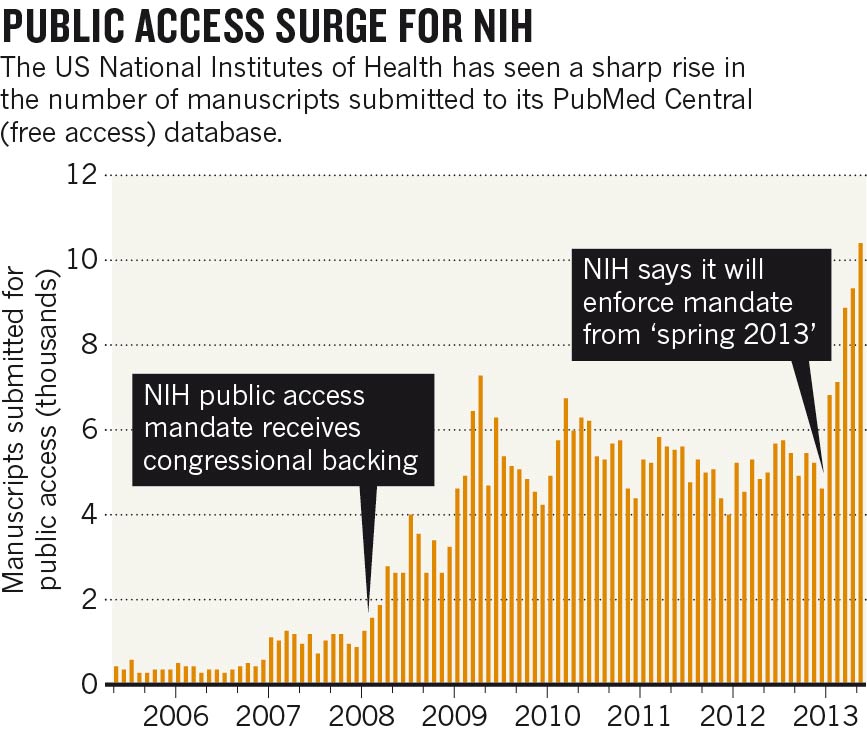
Last November, the US National Institutes of Health (NIH) said that “as of spring 2013” it would start cracking down on enforcing its public-access policy — and it seems the agency is now seeing positive results.

NIH public manuscript submissions

{credit}National Institutes of Health{/credit}

In May, authors approved more than 10,000 peer-reviewed manuscripts arising from NIH-funded research to go into the agency’s online free repository, PubMed Central. That’s a huge jump from the average 5,100 per month in 2011–12, and suggests the agency is nearing its goal of getting everyone it funds to make their papers publicly available. (Numbers available in csv format; the NIH also publishes them, so far without the May update, here).

Continue reading

Dutch psychology fraudster avoids trial

Disgraced Dutch social psychologist Diederik Stapel, who in 2011 was found to have fabricated data in at least 30 published papers, will not face trial for misuse of public research funds. Instead, in a pre-trial settlement, Stapel has agreed to 120 hours of community service, according to a statement (in Dutch) from the Dutch public prosecutor’s office.

In the settlement, Stapel also agreed not to make a claim on 18 months of half-pay salary that he might have been entitled to contest under Dutch law, as he had said he was sick when he was suspended and fired in September 2011 by Tilburg University.

Dutch authorities opened an investigation into Stapel last October. According to Dutch newspaper NRC Handeslblad, public grants that Stapel had used for his fabricated work included some €2.2 million (US$2.8 million) from the Dutch Organization for Scientific Research.

But the public prosecutor said today that there was no abuse of the grants. The funds went mainly to salaries of staff (PhD students), who did the work they were paid for — even though that work was partly based on fabricated data. “He didn’t use the money for personal enrichment — for example, to buy a car or a house,” explained a spokesperson for the public prosecutor’s office. The community service settlement is appropriate, the statement concludes.

Stapel had already suffered severe consequences for his actions, which had been taken into account in the settlement, the spokesperson added; he had returned his PhD, and cooperated with the criminal investigation, and with the three-university committee that investigated his academic fraud.

“The case is now closed,” the spokesperson says. A Dutch newspaper, NU.nl, adds that Stapel’s PhD students did not want to see the story raked over again in court.

New record: 66 journals banned for boosting impact factor with self-citations

Science publishers are sending out decidedly mixed messages about how seriously they take the impact factor — the much-maligned measure of how often the average research paper in a journal is cited.

A record number of journals — 66 of them, including 33 37* new offenders — have been banned from this year’s impact-factor list (released today) because of excessive self-citation or because of ‘citation stacking’ (in which journals cite each other to excessive amounts). This year, the named-and-shamed titles include the International Journal of Crashworthiness and the Iranian Journal of Fuzzy Systems. Only 51 were banned last year (28 new offenders), and 34 the year before that. Along with the record numbers, Thomson Reuters has posted a new explanation of why it decides to ban journals — essentially because the self-citations distort the rankings. *Thomson Reuters updated the number of new offenders from 33, to 37, on 20 June.

But while these journals (just 0.5% of the total 10,853) appear to have taken the impact-factor game far too seriously, other publishers have pledged to ‘reduce emphasis on the impact factor as a promotional tool’. That came as part of a May statement called DORA (the San Francisco Declaration on Research Assessment), which more broadly deplored the fact that the impact factor is used not only to judge journals, but also to judge individual scientists and the quality of their research papers.

In the middle of these two stances — the don’t-care and the care-too-much — come the vast bulk of journals, whose editors will have been waiting keenly to see their new scores, even though they recognize the limitations of the metric. As has been pointed out many times — and again in DORA — the impact factor judges only how much a journal is cited on average and bears little relation to the individual papers within a journal.

According to one recent paper, moreover, the variance of research papers’ citations around their journal’s impact factor is widening, making the metric an even poorer judge of journal impact, as George Lozano argued earlier this month on the London School of Economics blog.

For what it’s worth, Thomson Reuters says that 55% of journals increased their impact factor this year, and 45% decreased. Among those declining is the world’s largest journal by number of papers published, PLoS ONE, which has dropped 16% from an average impact factor of 4.4 in 2010 (when it published 6,749 articles), to 3.7 in 2012 (when it published 23,468 articles). Since the journal’s publisher, PLoS, is a signatory of DORA, it probably does not mind.

Indeed, Damian Pattinson, the editorial director of PLoS ONE, wrote in a blog post about impact factor yesterday: “The more notable achievement is that we really are publishing all kinds of research, regardless of its estimated impact, and letting the community decide what is worthy of citation … it’s a good time to remember that it is the papers, not the journals they´re published in, that make the impact.”