SciArt scribbles: Music to tackle PhD blues

Many scientists embrace the artistic medium to infuse new ideas into their scientific works. With science-art collaborations, both artists and scientists challenge their ways of thinking as well as the process of artistic and scientific inquiry. Can art hold a mirror to science? Can it help frame and answer uncomfortable questions about science: its practice and its impact on society? Do artistic practices inform science? In short, does art aid evidence?

Nature India’s blog series ‘SciArt Scribbles’ will try to answer some of these questions through the works of some brilliant Indian scientists and artists working at this novel intersection that offers limitless possibilities. You can follow this online conversation with #SciArtscribbles .

Today Manasi Kulkarni- Khasnis, a biologist at the National Centre for Cell Science in Pune, India, underlines the importance of music, a passion that became an important tool to constructively shape her research career. Manasi, who investigates the structural underpinnings of molecular cross-talks in host-pathogen interactions, formed a musical band (called ‘Vadyankit’ or ‘ornamented with instruments’) with peers — all of whom ultimately became a life-long emotional support group to tackle career blues.

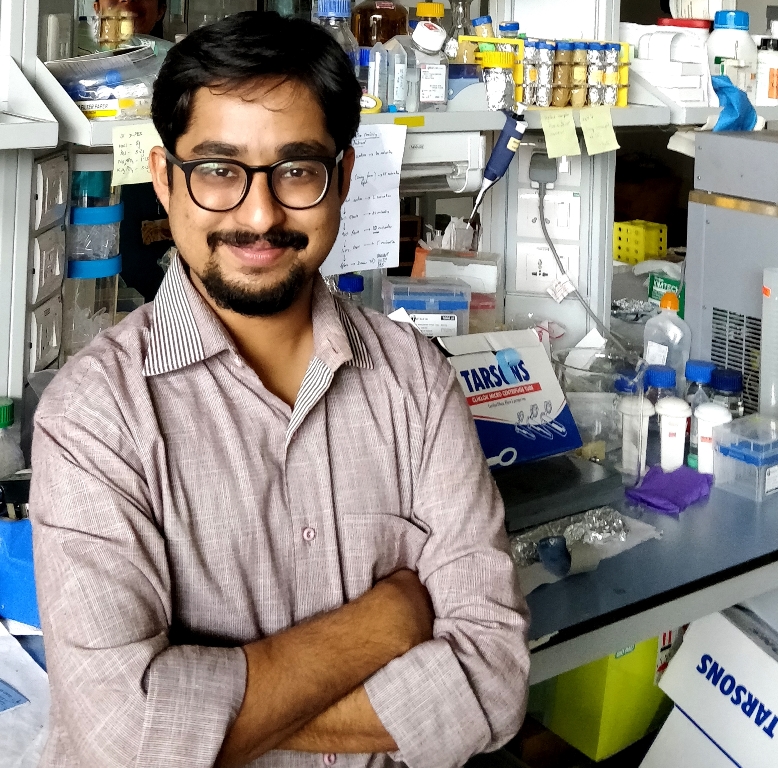
Manasi Kulkarni-Khasnis{credit}Akash Pawar{/credit}

When I joined a PhD programme at the Indian Institute of Science Education and Research (IISER) in Pune, I was triumphant. That was in August 2010, and it was another highlight in an already happy year: a few months earlier, I got engaged to my boyfriend of seven years. Everything felt like it was in place. I chose my favourite PhD project, had long discussions with my supervisor, plotted aims, objectives and experiments and started my journey towards a doctoral degree.

But as days and months of hard work in the lab went by, small failures in my experiments hijacked my mental health — something I think many others are familiar with. Despite my great year — we were married in May 2011 — I started to sink into depression.

I would get easily discouraged if something did not work. Unusual results started bothering me. Later, this became so pronounced that I started blaming myself for every tiny thing that went wrong. Did I prepare my buffers correctly? Did I forget to add primers to my polymerase chain reactions? I started forgetting my past achievements, and began to belittle myself. I wasn’t sleeping properly. I was losing weight. In a nutshell, I was depressed. I could see more negatives than positives. Nothing interested me. I would cry over small things and nothing could make me smile.

My husband noticed this change in my behaviour and wanted to help. One evening, he wrote some lyrics and handed them over, encouraging me to compose something. He said he’d booked a slot for us to go on stage in a couple of months and perform a song.

I’ve played the harmonium since I was seven, but over the course of my PhD I’d lost interest in music. I didn’t immediately accept his offer, but he persisted, and I eventually picked up my harmonium and composed something that worked with his lyrics. We had a song! It was the first time I had felt satisfied with an accomplishment for over a year. Almost immediately, I was feeling better.

I never imagined that a hobby could be powerful enough to breathe enthusiasm and enjoyment back into my life (and for many people, it might not be — if depression persists, please seek professional help). My harmonium was sitting idle, and the daily grind of work at the bench had taken over everything else. Before I could realize that I was missing something important, my mental health had begun to deteriorate.

The challenge of going on stage and performing my own compositions fuelled my day-to-day life. I woke up fresh with a new aim and enthusiasm. I started planning my work efficiently so that I could get home in time and devote time to music. Every composition I made came with a neurological boost. My experiments started working, or, more accurately, the failures weighed upon me less. I started to see each unexpected result as a new question to explore, rather than as a roadblock in my own work. Two months later, we went on stage in front of a full house. My PhD supervisor and other scientists from the institute came to support us, which was a huge boost to my confidence. We had a great night together.

Music became the secret to my happiness, and I shared this with my peers. We created a band (called ‘Vadyankit’; literally ‘ornamented with instruments’) and started playing together. We performed on stage 11 times in our entire PhD tenure.

We have now all graduated. I’m working as a scientist for the National Centre for Cell Science here in Pune, India; our keyboardist is a medical writer; our percussionist is at the Indian Institute of Science, Bengaluru; our guitarist is in South Africa for his postdoc. Music is still our true companion. We’re scattered post-PhD, but we’re all careful to support others struggling in the research environment, and to encourage colleagues to take up hobbies outside of work.

If you are also struggling with your emotional health, make sure that you spend a good amount of time doing the thing that you like the most. Be it music, painting, writing, reading, hiking or anything else. Remember what you enjoyed that you’re now missing out on. In my experience, a hobby that might at first seem like an indulgence helps to beat stress and to set the mind free.

[This article originally appeared in Nature Careers].

Suggested reading:

SciArt scribbles: Coupling creation and analysis with collages

SciArt scribbles: Technology to aid dance
SciArt scribbles: Playing science out

Artists on science: scientists on art

SciArt scribbles: Playing science out

Many scientists embrace the artistic medium to infuse new ideas into their scientific works. With science-art collaborations, both artists and scientists challenge their ways of thinking as well as the process of artistic and scientific inquiry. Can art hold a mirror to science? Can it help frame and answer uncomfortable questions about science: its practice and its impact on society? Do artistic practices inform science? In short, does art aid evidence?

Nature India’s blog series ‘SciArt Scribbles’ will try to answer some of these questions through the works of some brilliant Indian scientists and artists working at this novel intersection that offers limitless possibilities. You can follow this online conversation with #SciArtscribbles .

In the opening blog of the series, we feature neuroscientist-dramatist-playwright Prabahan Chakraborty, a PhD student at the National Centre for Biological Sciences, Bengaluru, who fondly refers to his twin love for science and theatre as ‘the two vices of my life’. In dividing his time between the two, Prabahan says he finds a symbiotic give and take that enriches each of his passions in more ways than one.

Prabahan Chakraborty

Everyone loves a good story. It could be about how brain cells store memories or a comedy about travelling musicians. Told well, stories have the wondrous ability to captivate an audience like nothing else can.

This is the invaluable lesson looking me in the face as I stand at the crossroads of two decades of theatre training and many years of graduate school. Right now, I am getting ready to submit my doctoral thesis and have just published an anthology of short plays – the story-teller in me embracing the scientist in a loving sort of way.

Nurturing the twain

Though I had been acting in plays since I was two and a half, my love for theatre blossomed with my first ‘big’ play at school when I was ten. Around the same time, I was presenting a field-based research project on medicinal properties of indigenous plants – first at a National Children’s Science Congress in 2000, at Indian Institute of Engineering Science and Technology, Shibpur, West Bengal and the very next year at the Indian Science Congress in New Delhi.

In the decade that followed, my summer vacations were filled with science camps, my weekends with theatre classes under the stalwart of modern Bengali theatre Ramaprasad Banik, and the last few pages of my notebooks with poems, stories and doodles.

My parents made sure I never missed a single tuition class (which I wanted to miss sometimes) or a single theatre rehearsal (which I never wanted to miss). Growing up, therefore, theatre and science coexisted peacefully in my life. Twenty years down the line, I feel incredibly lucky that none elbowed the other out.

The symbiosis

Connecting the dots on hindsight, my scientific curiosity around animal behaviour probably has its roots in how I saw characters behave in a play. A sudden crisis-inducing dialogue on stage seemed fascinating. A burst of song and dance that left a smile felt wonderful. Later, I learnt about the amygdala, and how it processes such emotional stimuli – how principles of Hebbian plasticity lead to long term changes that leave a lasting memory of fear. I learnt how amygdala was to be blamed for the anxiety I felt before every stage show and how the friendly hippocampus helped me remember precise cues for dialogues and choreography during a performance.

During the day, I study how stress affects neurobiological processes such as learning, memory and fear. By night, I am de-stressing and recharging myself with theatre. My scientific training, on the other hand, helps me structure each play with logic and reason. The canvas of a stage mirrors in its emptiness an unwritten Power Point slide. A stage looks ‘balanced’ with sets and actors, a slide with graphs and text.

As the twain merged, science instilled in me the belief that nothing is impossible. That helped me step out of my creative comfort zone and challenge myself. This spirit reflected amply in the plays I wrote about ‘nothing’, or a ludicrous black comedy about a man who suddenly finds a newspaper growing out of his nose, or telling one woman’s incredible life story using only two chairs, or even devising a musical on how we are rarely punctual. My scientific training was egging me to dare, to probe into the seemingly improbable ‘what if’.

Feeding back into science

I should accept, however, that I am not beyond the quirks of a usual scientist who tends to start paragraphs with ‘in conclusion’ and thinks of decisions in terms of ‘statistical significance’. Practicing theatre has given me an added feather in the cap – that of communicating science better to an uninitiated audience. Most recently, I attempted it in a play called ‘Triangles and Squares’, a short musical about habitat loss, man-animal conflict and animal cruelty through song and dance. When the audience saw a drunkard killing a puppy with a stone, they shivered. When they saw the animated movements of a lowly peddler caging a common sparrow, they laughed their guts out. But they got affected. When the show got over, they came to discuss all the above ‘ecological’ terms we never stated even once in the play.

Prabahan (in front) in one of his plays ‘Triangles and Squares’, a musical on habitat loss and man-animal conflicts.

At this time, if you ask me whether I can survive without either of my two vices, my answer would be no. Theatre is my therapy for scientific roadblocks, science my caffeine for the ‘little grey cells’.

If you ask me if it is really possible to manage both simultaneously, a question that I get asked very often, my answer would be yes, absolutely. Sure, three hours of intense rehearsal at the end of a whole day of experiments is tiring, but it gives you a creative high and a sense of exhilaration which is irreplaceable. The happiness in designing a novel experiment is as much as writing a new script. The joy of having my research published is as much as a standing ovation at the end of a show.

For me, it all boils down to telling captivating stories that I want everyone to remember. When the curtain falls, that is all that matters.

(Prabahan Chakraborty can be contacted at prabahan.ncbs@gmail.com )


Suggested reading:

SciArt scribbles: Coupling creation and analysis with collages

SciArt scribbles: Technology to aid dance

SciArt scribbles: Music to tackle PhD blues

Artists on science: scientists on art

Nature India Photo Story: Aqua Tales

In our visual storytelling blog series titled the ‘Nature India Photo Story’, we feature artfully told stories that explore the realms of science, wildlife, environment, health or anything else that smells of science.

In today’s photo story, we feature experimental physical chemist Mohammad Tariq from the Faculty of Science and Technology, New University of Lisbon, Caparica, Portugal. The theme of his story is something that touches all life on Earth — water.

Tariq traces his journey with water through ‘Aqua Tales’ — a nuanced narration that looks at water not just as the most bountiful resource of Nature, but also as his passionate research interest, and as the metaphorical wave that keeps propelling him to newer shores.

Water is a complex, wondrous fluid, essential for life on Earth. It is the most abundant chemical in nature. Apart from the interest it generates among scientists and academics, water has been the most important element for the survival of many civilizations that thrived on banks of rivers. Water is also the reason flora and fauna flourish on Earth.

My journey and interaction with various water bodies started from my native town Bijnor in Uttar Pradesh, India. It is in Bijnor that I had the rare privilege of befriending the mighty river Ganga. The deep stream of the river flows throughout the western boundary of Bijnor.


Ganga in Bijnor.


The Ganga flows quiet under this barrage in Bijnor.

My doctoral research at Jamia Millia Islamia University in New Delhi was focused on the characterization of thermophysical properties of liquids and liquid mixtures including aqueous solutions at different concentrations and temperatures. In the final years of PhD, my research interest started to shift towards the properties of a novel
class of exotic salts known as “ionic liquids”. Sea and salt have a long known relationship.

After finishing PhD, I moved for a postdoc assignment to the Institute of Chemical and Biological Technology (acronym ITQB in Portuguese) in Portugal — the land of great explorers and navigators. Apart from its excellent research facilities, what makes ITQB remarkable is its location in the beautiful town of Oeiras, around 17 Kilometers away from the capital of Lisbon. My office faced the Atlantic Ocean. Out of the several interesting projects at ITQB, the most appealing to me was the detailed study of the effect of structurally diverse ionic liquids on the density anomaly of water. This also laid the foundation of my future research.


The beautiful Santo Amaro beach near Oeiras with a scenic view of a very old lighthouse (bugio) situated in the estuary of the Tagus river.


The pavement across the Santo Amaro beach lends itself to a nice stroll.

I got an opportunity to work at the University of Vigo, Spain in 2012, where I witnessed the immense beauty of one of the best and most eco-friendly beaches of the world at Islas Cies — a group of three islands. At the University of Vigo we used the speed of sound and density measurements on solutions of a series of ionic liquids to characterise their self-assembling process in water.

The beautiful Samil beach in Vigo, Spain.


A breathtaking summer sunset at Cies Island, Spain.

After spending almost 6 years in Europe, I moved to Qatar and got introduced to the Persian Gulf. The pleasant view of the corniche in Doha, which brought the shallow water of the Persian Gulf to the middle of the city, was always a sight. An hour’s drive from Doha city took one to the sand dunes and in-land sea (Khor-al-adaid) at the border of the Kingdom of Saudi Arabia and Qatar.

At Qatar University, my passion for the peculiar properties of water continued and I studied a distinct form of structured water known as “gas hydrates”, hydrogen bonded water molecules in which the guest gas molecules are trapped in cavities. Formation of gas hydrates within gas pipelines is a persistent problem faced by the oil and gas industry worldwide, including in Qatar. Gas processing from the deep-sea, where temperatures are low and pressures are high, provides suitable conditions for the formation of gas hydrates.

The inland sea (Khor-al-adaid), Qatar.


In the pursuit of a work-life balance, I moved back to Portugal in 2016 but this time to the other side of the river Tagus where I now work at the New University of Lisbon. The university is situated near Costa da Caparica, a tiny, breathtakingly beautiful coastal town. Here, I am engaged in the in-depth study of clathrate-hydrates, specially the role of hydrogen bonding and water structure in their formation and dissociation.

Juan G Beltran wrote the following in an article in the Journal of  Chemical Thermodynamics (117, 2018) and I think it aptly sums up my passion for hydrates:  “A snowflake is a letter from heaven (U. Nakaya), a diamond is a letter from the depth (F.C. Frank). What then is a gas hydrate?”

The 25th April Bridge on the river Tagus connecting Lisbon to the municipality of Almada, Portugal.


High tides in the coast of Caparica, Portugal, attract many surfers.

During this decade-long scientific journey across cultures, languages and continents, I have observed a change in my research interests. However, they have always centered around the properties of liquids and aqueous solutions. Now I am eagerly waiting to see if water will allow me to settle down or another wave will sail me towards a new destination.

Mohammad Tariq can be contacted at tariq@fct.unl.pt

Dance your Science: Where did Indians come from?

Nature India‘s most recent and most creative foray into science communication is through a format called dance-narration. At the beautiful confluence of science and arts, these dance-narration productions are a unique new way of science story telling using the rich medium of traditional Indian performing arts.

We recently did a couple of experiments with the format and found that it won hands-down in terms of audience engagement and in conveying complex science ideas through a simple science-led script, dance expressions and music.

Here’s a piece we executed at the 10th Anniversary celebrations of Nature India on 16 April 16 2018. This dance narration tries to trace the origin of human life in India through a review of recent population genetics studies in the country. The troupe consisted of a trained classical Odishi dancer, a trained keyboard player and a science journalist.

The medium of dance and music allow the science story to become more personal and thus immediately understandable. Not surprisingly, this dance narration video is one of the most viewed, shared and liked content on our social media channels.

The script for the narration is culled from scientific studies, just like any journalistic science story. Some popular elements of science writing – drawing analogies, describing the human side of science, or contextualizing data and numbers – are used to enliven the script. Voice modulation and music variations are used to highlight the important points of the story and to add drama and excitement to the narrative.

We look forward to your feedback on this new experiment. Nature India hopes to bring to you many more dance narrations from various scientific disciplines in the near future.

NI Photo Contest 2016: Finalist #1

The New Year is around the corner, and so it’s that time of the year when we roll out the finalists of the Nature India photo contest!

The third edition of our photo contest has, as usual, received a fantastic response — hundreds of entries from around the world. The theme for this year’s contest was simply ‘Nature’. But like always, we were looking for some inherent connect of the entries with science — the more the science element in the photos, the merrier!

The quality and novelty of some of the entries this year has been beyond our expectation — some of the pictures are actually pieces of art. We have had a mix of amateur and professional photographers, scientists and non-scientists, mobile cameras and high-end DSLRs — all vying to spot and capture science in Nature.

Tough job, as usual, for the Nature India editorial and design team in selecting just three winners. The winners stand a chance of seeing their entries grace the cover page of one of our forthcoming print publications. The winner and two runners-up will receive a copy of the latest Nature India Special Annual Volume and an enviable bag of goodies from Springer Nature.

As a run up to the final announcement, we will be rolling out the top 10 finalists of the photo competition (in no particular order of merit) over the next few days on the Indigenus blog as well as our social media platforms (Twitter and Facebook). The final results will be announced in late December 2016.

So brace up as we announce the Nature India photo contest 2016 finalist number one:

Ravi Hegde, Bengaluru, India

Photo Caption: ‘Bubbling moments’

Bubbling moments

{credit}Ravi Hegde{/credit}

Ravi, who works in the Department of Psychopharmacology, National Institute of Mental Health and Neuro Sciences (NIMHANS), Bengaluru, India, describes his photo thus:

Ravi Hegde

Ravi Hegde

“This is one of the most memorable photographs I shot in my life. I was fortunate to capture this exciting moment while an incredible Sand Bubbler was actively engaged in feeding and making tiny sand balls. I lied down for an hour, wetting all my clothes in seawater to capture this very rare moment. The Sand Bubbler tosses the sand bubble in a fraction of a second. Bubblers sieve the micro-nutrients grains of sand and feed on them, and then repack unwanted particles in the form of tiny balls, generally 2-3mm in diameter. During low tides, the intense feeding activity of these creatures makes for beautiful intricate patterns of sand balls on the seashore.”

This photograph was taken at the Dhareshwara seashore, near Honavar, Uttara Kannada district, Karnataka, India in May, 2013.

Congratulations Ravi for making it to the top 10!

Nature India’s final decision to chose the winner will be partly influenced by the engagement and reception he/she receives here at the Indigenus blog, on Twitter and on Facebook. To give all finalists a fair chance, we will take into consideration the social media engagement of each picture only during the first seven days of its announcement.

So watch out for our other finalists and feel free to promote, share and like your favourite entries with the hashtag #NatureIndphoto.

Care for some beatboxing with bird songs?

Travancore Scimitar Babbler

Travancore Scimitar Babbler{credit}Prasenjeet Yadav{/credit}

First hear this amazing beatbox groove.

That’s a bird — the Travencore Scimitar Babbler (right) — giving fair competition to any rap or reggae artiste.

This week Bangalore is going to see some unusual beatbox campaigners — Ben Mirin, a music producer, an internationally recognized beatboxer and a birder from New York; Prasenjeet Yadav, photographer,  explorer and researcher; and V. V. Robin, a bird ecologist from the National Centre for Biological Sciences (NCBS).

Together the trio is putting together the SkyIsland Beatbox project, which will use beatbox to create music with bird songs and make videos of rare birds.

This month, Ben will conduct workshops and bird watching trips in Bangalore, Ooty, Kodaikanal, Kochi and Trivandrum where people can join in, make music with bird songs, and learn about music and birds. Prasenjeet Yadav, who was among the winners of last year’s Nature India photo contest, will then produce a YouTube video with information on different birds that are included in the music.

The birdsong beatboxers: (Left to right) Ben, Robin, Prasenjeet

The birdsong beatboxers: (Left to right) Ben, Robin, Prasenjeet

The idea is to take the conservation story to the people. The project revolves around the Western Ghat mountains, home to many birds found only there and nowhere else in this world. “Some of these special birds live only on the tops of mountains – areas called sky islands. While most people appreciate birds for their unparalleled singing ability, they are often unaware of the unique bird species in their landscape that are threatened with extinction,” the project summary says.

The group will make original music using a combination of bird song and beatbox as a means of creating awareness in these audiences about birds and engaging them in bird conservation. The music will be mixed with high-quality photographs and films of these birds to produce a video identifying the bird species responsible for each sound in the composition.

So three cheers to team and their unique project — let the music play!

Film on scientists gets national award

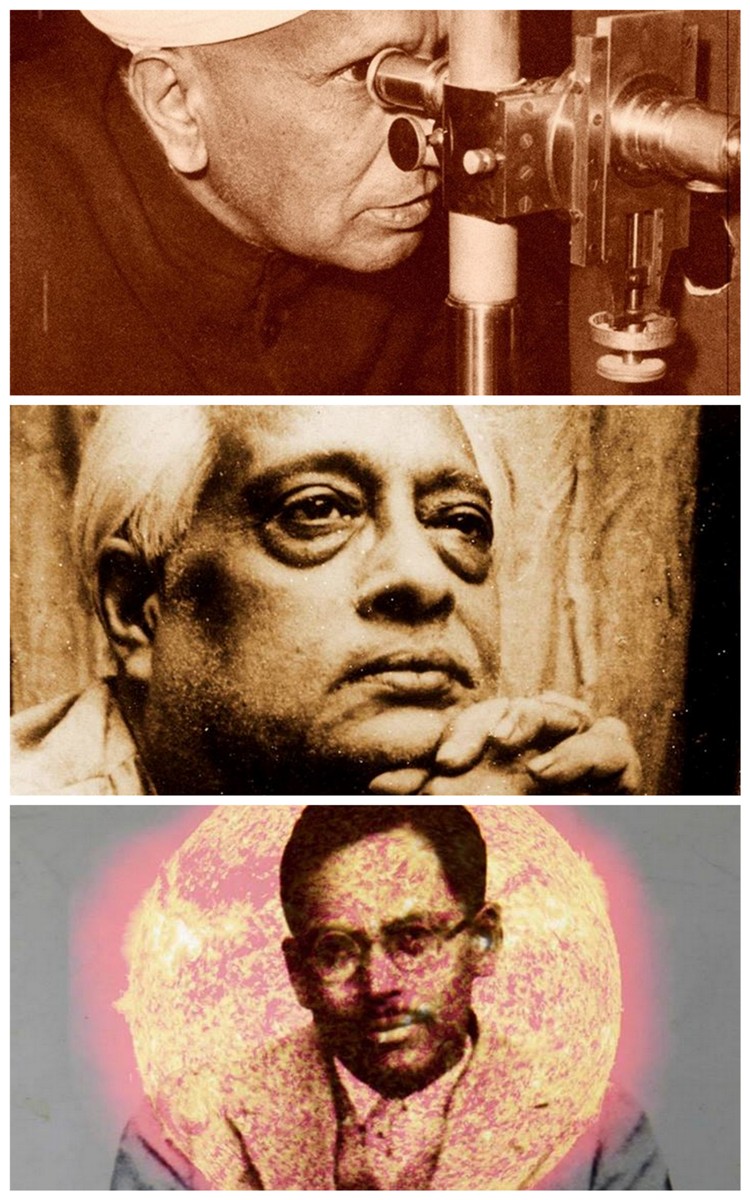
Featured on this blog earlier for its powerful narration of the life and science of India’s celebrated scientist triad Bose-Raman-Saha, The Quantum Indians has now won India’s National Film Award as the best educational film of 2013.

Raja Choudhury

Raja Choudhury

The Quantum Indians written and directed by Raja Choudhury celebrates the lives of India’s three great yet almost forgotten scientists Satyendra Nath Bose, Sir C V Raman and Meghnad Saha. The national award jury has chosen the film “for an extremely efficient and precise analysis of the contributions of three renowned scientists in a manner that not only educates today’s generation but also provides insights into complex scientific phenomena in an accessible manner.”

The film tells the compelling and inspirational story of three amazing Indians who revolutionised the world of quantum physics in the 1920s giving us Bosons, The Bose-Einstein Statistics, the Raman Effect, the Saha Equation and India’s first and only Nobel Prize for science. Their work was also responsible for building the science infrastructure upon which much of India’s future was built.

Raja says he wanted to inspire the young people of India and help restore their interest in basic science as an essential and rewarding career path today. To take the message to the youth, the film is now being shown around the world at Indian embassies and cultural centers, in academic institutions, on TV, on the Indian Diplomacy Youtube Channel and on DVD by co-producers Public Service Broadcasting Trust (PSBT).

Raja is now making another science-based film called The Indian Mind that looks at the great inventions and ideas that India has given to the world — from the cotton of the Indus Valley, from the ‘Zero’ to the Bosons and the quest for Mars.

Congratulations to the team of The Quantum Indians and here’s hoping the film influences some young minds and redirects them towards the glory of basic sciences.

A young scientist’s tribute to Sachin Tendulkar

Last week I received an interesting email from India-born scientist Arnab De who lives in New York, USA.

Arnab has just defended a PhD at Columbia University in the Department of  Microbiology and Immunology. He developed new animal models to potentially study cancer. The 32-year-old also discovered a new biological pathway essential to defend against bacteria and viruses.

But that’s not why we are discussing his science here.

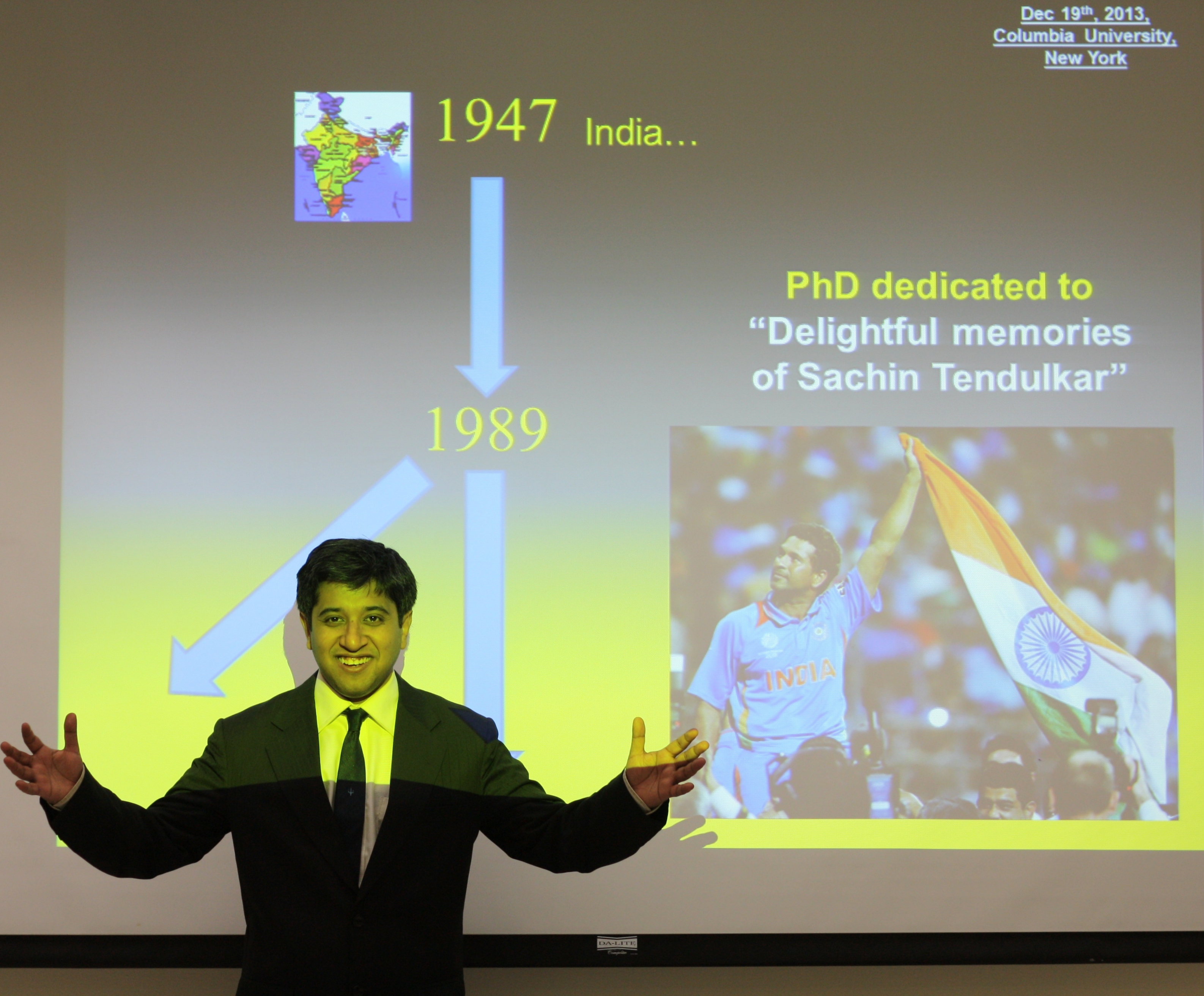
Arnab went ahead and dedicated his PhD to Sachin Tendulkar, perhaps a first in the world of science where a hard-core Ivy league thesis was dedicated to a sporting icon. And why, you will obviously ask, did he do something as inconceivable?  “Not for his cricketing achievements, but for the way Sachin has inspired history and impacted the social psychology (and confidence) of the Indian youth today”, Arnab explained in the e-mail.

Arnab De defending his PhD thesis at Columbia University

Arnab De defending his PhD thesis at Columbia University

On the face, it would look like another crazy fan pulling a quick publicity gimmick. But the young scientist defends his action. “There have been other dedications to Sachin in different fields. However, this is the first PhD to be dedicated to Sachin. I do believe that this article will be widely quoted internationally in different contexts in the future with the growing clout of India, especially as the legacy of Sachin Tendulkar is bitterly debated.”

This different stroke got Arnab some media publicity as well.

Well, you’ve got a point there, young man! Might appear a tad twisted to many, but that’s always the risk when you follow your heart, I guess.

Arnab considers Sachin Tendulkar the greatest batsman of the post World-War era “just as Bradman has been proposed to be the greatest pre-war”.

At the cost of drifting away from his science to sportingly accommodate his effervescent spirit, I quote him further from his email: “Cricket is evidently a British-Australian game and there is wide-spread reluctance to concede this. Hence the argument that Sachin is as good as a Ponting or Lara, probably a little better than them, but certainly not as good as Bradman. To counter such assertions, it might be good for our media to publish the peripheral influences of Sachin (such as this dedication). This is something that the western media has done in the past.”

I have no hesitation in admitting that Nature India considered publishing a scientific analysis of Sachin Tendulkar’s cricketing genius on the day of the legend’s retirement. We considered talking about any patterns in his cricketing career or of other legends such as Sir Don Bradman, any scientific papers that unravel the best techniques used by successful cricketers or why he has been a great cricketer and not such a great cricket captain.

But we stopped short of what would have been a story purely driven by popular demand rather than scientific insight after hearing from Bruce Elliott, Head of the School of Sport Science, Exercise and Health at the University of Western Australia. Elliott, an internationally-acclaimed expert in  the biomechanics aspects of performance enhancement and injury reduction, brought our editorial team down to terra firma with a single-line email in reply to our frenzied queries: “While I fully acknowledge Tendulkar’s greatness, I am not able to add anything to the story.”

Though I do not quite agree that media makes a man beyond what he stands for, or that dedicating a PhD to him would alter Sachin Tendulkar’s (or Arnab’s) fate dramatically, I am willing to take the enthusiastic scientist’s spirit positively. It is always a pleasure to see someone add that zest to science by thinking differently, in this case by trying to connect his varied passions — science and sports —  in a small way.

That’s precisely why this blog is even featuring Arnab De. He certainly has added a zing to biological pathways as we know them!

What can India learn from Bose, Raman & Saha?

When I was referred to a documentary film on India’s scientific greats by its maker Raja Choudhury this week, I was wondering if there’d be anything beyond what I already know about  them in the hour-long film. To find this out, it also meant dedicating an hour to watch the film on YouTube with its infamous buffering time. But I was ready to endure that, partly because the title of the film was inviting — The Quantum Indians — and partly because I had not been able to take up Raja’s earlier offer to feature in this film as an ‘expert’ on India’s science. After watching the film today, I am happy I declined that offer — it would have been audacious for me to talk about Indian science’s legendary trio — Satyendra Nath Bose, Chandrashekar Venkat Raman and Meghnad Saha — whose life and times Raja has so aesthetically weaved on celluloid.

The 'Quantum Indians': Raman, Bose, Saha.

The ‘Quantum Indians’: Raman, Bose, Saha.

First up, things that you might or might not have heard about these greats — Raman was a supreme egotist, Saha loved mathematics as much as he dug history, Bose tore off a scientific paper of significance and threw it in the bin when he heard of  Einstein’s death. And similar anecdotes, which lend the film a human touch.

‘The Quantum Indians’ traces the scientific legacy of India through the lives of these scientists, all of whom “fought colonialism, British rule, racism, inadequate funding and limited resources to place India at the cutting edge of world science more than 20 years before Independence.” And it does so by going back in time to see what life was like for Bose, Raman and Saha — all starting their careers at the Calcutta University in 1917 and going on to become Fellows of the Royal Society. Raman also won India her sole science Nobel till date.

Contemporary scientists and India’s science establishment who, quite often, face the embarrassing question “Why hasn’t India got a Nobel in science after Raman?” have lessons to learn from him. Not just from his immense dedication and scientific genius. But also from the way Raman ‘pushed’ what he thought was a Nobel winning discovery and made sure he had the attention of people who mattered in the Western world. In short, creating a buzz about his work. The film talks at some length about Raman’s concerted quest for the Nobel — how he wrote to industrialist G D Birla asking him to fund a spectrograph in return for a promise to win a Nobel for India, how he sent a paper to Nature via telegram to beat anyone else with a similar idea, how he sought out Nobel Laureates such as Ernest Rutherford and Neils Bohr asking them to nominate him for the Nobel. And how he called a press conference to claim that he had made a significant discovery — a candidate for a Nobel — eventually getting the attention of acclaimed physicists such as Albert Einstein and Arnold Sommerfeld, who backed him.

Raman is the only one of whom we see some significant live footage, presumably from his post-Nobel television interviews to the Western press. He is introduced as a man of many contradictions —  “a great teacher but an intolerant perfectionist, a simple man at heart but a supreme egotist, a recluse who loved children and teaching. But without doubt a genius.”

Through interviews with leading contemporary scientists — Partha Ghose (also Bose’s last PhD student), Milan Sanyal, G. Srinivasan, Kankan Bhattacharya, N. Kumar and Sandip Chakrabarti —  Raja has tried to bring out the scientific and social sides of the trio. Also featuring in the documentary is Bose’s grandson Falguni Sarkar taking viewers around Bose’s ancestral home in Calcutta. The city — epicentre of the Bengal Renaissance —  has an interesting scientific legacy but has seen some reversals in recent times. The film could serve as a tool to inspire young scientists to get their act together.

Bose, who lends ‘bosons’ his name, (and there has been significant debate in India about why he shouldn’t be nominated for a Nobel too) is called a ‘forgotten hero’ in a BBC footage in the film. I like the way Partha Ghose describes the last paper written by Bose — the one he tore off on hearing of Einstein’s death. Ghose calls it the ‘unfinished symphony’, much in line with Bose’s other passions — the Esraj and the flute.

Of the three, Saha seems to be the one most comfortable with administration and science policy making. He is credited with bolstering India’s scientific infrastructure, forming the backbone of its atomic energy policies and even joining politics with the ambition of strengthening India’s scientific prowess. It is befitting then that the scientist who loved history as much as mathematics died of a heart attack on the stairs of the Planning Commission. Just like the Rajput warriors who happily die on battleground, the narrative notes.

Barring the western pronunciation of Indian names, which sticks out like a sore thumb in most Western productions, I relished the film, primarily for its intense research and scientific clarity. It was previewed at The Indian Association for the Cultivation of Science to celebrate their Foundation Day on July 29, 2013. You can watch it free on YouTube here.

Of a swear word & a most cited Indian-American

Confessions first. The inspiration for this quirky-titled blog comes from an equally unusual and brilliant blog by Nature Chemistry resident wordsmith and chief editor Stuart Cantrill. The journal is rolling out its 50th issue in May 2013 and Cantrill lists, in his trademark style, all the seriously funny things these guys do at Nature Chemistry. What all [1, 2, 3, 4, 5, 6] goes on at the Nature Publishing Group in the name of science, I tell you!

The mention of the ‘swear word’ in the title of this blog is just to get your attention. Erm, yes you read that right the first time. Why? Amusingly, among the 50 wonderful things (coinciding with the 50th edition) Cantrill lists, one is how the f-word made its debut in Nature Chemistry through one of their blogrolls in July last year. Also the explanation for it. I’m not sure if the word or similar such have a longer association with NPG. I shall investigate that for our curious readers. Coincidentally, the blog also mentions why the journal uses ‘f’ for sulfur and does not spell it ‘sulphur’. Some coincidences just fit in so well, don’t they? In fact, the first draft of this blog’s headline read ‘Of the f-word &…’ but I rephrased it for reasons that might need a separate blog to elaborate.

Gets us back to the oft-debated question of why serious academic journals continue to remain stiff and refrain from embracing a little bit of pop punch in their writing. Also, why eyebrows are raised when editors try to experiment with not-so-serious headlines or off-beat formats for something that fall within the realms of so called “serious science”? All this even while they have tried hard to do so without “dumbing down the science”.  Takes me to two fine topical reads: one by Kaj Sand-Jensen of the University of Copenhagen, Denmark titled How to write consistently boring scientific literature and the other by Adam Ruben — The unwritten rules of journalism. There is a huge lot of interesting literature to be read in this regard, please feel free to point us and our readers to them in the comment section.

Science bloggers, of course, are a league apart and have made science reading online a lot more bearable. More strength to their ever-growing breed!

I see Nature Chemistry do a whole lot of such refreshing things. At Nature India, we have tried playing around with fun headlines for a while now — some have been brilliant, some a bit far-fetched, some turned out dumb and some were plain eyeball-grabbing exercises (the present blog being an excellent case study in the latest category). Sample these and you’ll know which one belongs where (or nowhere): Long live chapattis, Care for some gum?, Don’t kill the mice, Smell my tea, Guava for gold, The nano love triangle, Magnetic charm in the genes and Honey, I shrunk the antioxidants

Some more apparently thought-provoking ones meant to draw you into reading (there, we are giving out our secrets!): Go for whole blood, Do scientists believe in God, ghosts, Women are from Venus, are magnetic bacteria from Mars?, Wanted: traffic policemen for space, Michael Jackson and science, You haven’t got mail, Rat race for chocolate and Old habits don’t die

Ajayan

Ajayan{credit}Rice University{/credit}

And to fully justify the headline of this particular blog (as also my salary and job), I must turn my attention back to Cantrill’s blog. Here’s the newsy bit for Nature India’s readers — Nature Chemistry‘s most cited article with 390 citations till date is by an Indian-American Pulickel Ajayan and his co-workers. The paper ‘New insights into the structure and reduction of graphite oxide‘ is by Ajayan and his group at Rice University in Texas, USA.

Interestingly, apart from 370 journal papers with more than 32,000 citations and an h-index of 89, Ajayan is a double Guinness Book record holder — one for the creation of the smallest brush and the other for creating the darkest material. Ajayan’s early education was in Kerala, India and he moved out of the country with a metallurgical engineering degree from the Indian Institute of Technology, Banaras Hindu University,Varanasi. He is a keen poet and has been quoted in the past as saying that if he didn’t stumble into the world of carbon nanotubes he might as well have been a movie director.

Now how much more punch can one pack into a single hydra-headed blog struggling to stay focused!