Top 20 books: discovering worlds

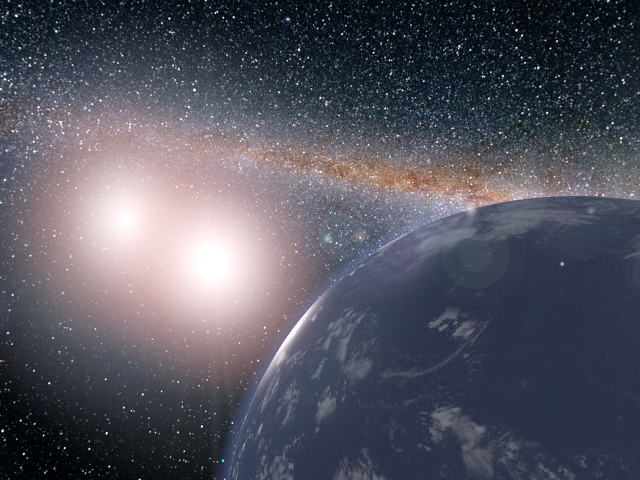
Artist's conception of a hypothetical planet covered in water around the binary star system of Kepler-35A and B.

Artist’s conception of a hypothetical planet covered in water around the binary star system of Kepler-35A and B.{credit}NASA/JPL-Caltech{/credit}

In terms of job satisfaction, discovering worlds must take the Sachertorte. Sibling astronomers William and Caroline Herschel, for instance, rejoiced in a haul that included Uranus, eight comets and several moons gleaned from what William called the “luxuriant garden” of the skies. Their final tally of deep-sky objects, with that of William’s gifted son John, numbered in the thousands. I’m sure their minds would be boggled by today’s exoplaneteering exploits — such as the TRAPPIST-1 system of seven Earth-like planets that fully emerged this year.

In my way, I’m in the business of discovering — and rediscovering — worlds. That they’re between two covers and on sale in your local bookshop is neither here nor there. And the 2017 harvest has been rich. We revisited Jonathan Swift’s 1726 Gulliver’s Travels, for instance — which, Greg Lynall noted in his eye-opening essay, is a journey across an unfamiliar Earth that even features Swift’s accurate prediction of the moons of Mars, 150 years before their detection. (The terra incognita flavour of this year’s events gave all that particular resonance.)

As for the new books sifted from the non-stop stream, as always I entered their portals with the open mind of an explorer. Thus, through Caspar Henderson’s A New Map of Wonders we scope the known cosmos with new eyes. In Hetty Saunders’s My House of Sky we sift the psyche of reclusive nature writer J.A. Baker. And in Jonathan Silvertown’s Dinner with Darwin, we see a plateful of food transformed into a repository of dazzling evolutionary stories.

It has, in short, been an astounding year for those of us engaged in tracking literary planets across the publishing firmament. Here’s my sky survey.

Improbable Destinies, Jonathan Losos. Riverhead. In a “deep, broad, brilliant” study, the biologist explores how evolutionary solutions, morphological to molecular, repeatedly emerge. (Reviewed here.)

A Crack in Creation, Jennifer A. Doudna and Samuel H. Sternberg. Houghton Mifflin. A pivotal player in the CRISPR saga delivers her dispatch from the genome-editing frontline. (Reviewed here.)

Collecting the World, James Delbourgo. Allen Lane. A life of Hans Sloane — medic, Royal Society president, ‘wondermonger’ and collector extraordinaire — is limned by an accomplished historian. (Reviewed here.)

The Death Gap, David Ansell. University of Chicago Press. The social epidemiologist lays bare how ‘structural violence’ in US healthcare fosters disparities in life expectancy. (Reviewed here.)

The Great Leveller, Walter Scheidel. Princeton University Press.  In a magisterial socio-political chronicle, the historian untangles the deeper roots of inequality. (Reviewed here.)

The Imagineers of War, Sharon Weinberger. Knopf.  The defence writer delves into the shadowy history of DARPA, the US agency that forecasts “imagined weapons of the future”. (Reviewed here.)

Miracle Cure, William Rosen. Viking. The accomplished writer’s swansong superbly captures the rise of antibiotics, from the discovery of penicillin on a mouldy cantaloupe to the war on resistance. (Reviewed here.)

The Vaccine Race, Meredith Wadman. Viking. A former Nature journalist tells the convoluted story of human fetal cell line WI-38, still deployed in vaccine research. (Reviewed here.)

Deep Thinking, Garry Kasparov. PublicAffairs. The chess titan revisits his 1997 match against computer Deep Blue in an “impressively researched” history of AI. (Reviewed here.)

The Songs of Trees, David George Haskell. Viking. In a sensory tour de force, a biologist documents the exquisite interconnections of arboreal life. (Reviewed here.)

Rigor Mortis, Richard F. Harris. Basic Books. The science journalist jumps into the deep end of biomedicine’s reproducibility crisis. (Reviewed here.)

Dawn of the New Everything, Jaron Lanier. Bodley Head. The virtual-reality pioneer traces the unconventional trajectory of an extraordinary career. (Reviewed here.)

The Origins of Creativity, E.O. Wilson. Liveright. In exploring the wellsprings of creativity, the ecologist calls for a “third enlightenment” meshing science with the humanities. (Reviewed here.)

Outside the Asylum, Lynn Jones. Weidenfeld & Nicolson. A psychiatrist working in war and disaster zones elucidates both policy implications and the uncommon courage of survivors. (Reviewed here.)

The Quantum Labyrinth, Paul Halpern. Basic Books. A physicist unpicks the intertwined lives of consummate theoreticians and chums Richard Feynman and John Wheeler. (Reviewed here.)

Life 3.0, Max Tegmark. Knopf. The cosmologist peered into possible risks and benefits of evolving AI, from an autonomous-weapons arms race to quark-powered ‘sphalerizers’. (Reviewed here.)

A Mind at Play, Jimmy Soni and Rob Goodman. Simon & Schuster. A journalist and a political theorist vividly portray information theorist — and rocket-powered-Frisbee inventor — Claude Shannon. (Reviewed here.)

Stalin’s Meteorologist, Olivier Rolin. Harvill & Secker. A harrowing account of a Soviet researcher exiled to the Gulag testifies to the endurance of science in the midst of political chaos. (Reviewed here.)

The Darkening Web, Alexander Klimburg. Penguin. The policy expert reports on the new cold war between ‘free Internet’ and ‘cybersovereignty’ forces. (Reviewed here.)

The Seabird’s Cry, Adam Nicolson. William Collins. The environmental writer’s inspired survey of 10 seabird species — albatross to shearwater — is a paean to life at the edge. (Reviewed here.)


For Nature’s full coverage of science in culture, visit www.nature.com/news/booksandarts.
Bricks + Mortals: mapping the racist roots of science

Posted on behalf of Buddhini Samarasinghe

Subhadra Das,xxx

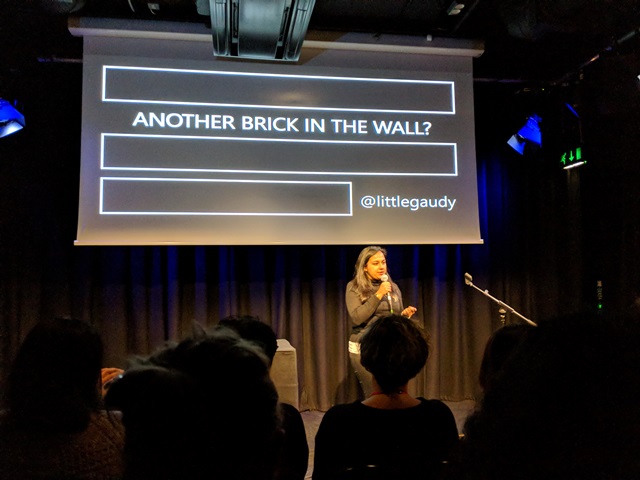
Subhadra Das, curator of the UCL Galton and Pathology Collections, at the opening show for Bricks + Mortals.{credit}Buddhini Samarasinghe{/credit}

If walls could speak: the saying might have been tailor-made for University College London’s new exhibition. Bricks + Mortals uses the campus buildings to tell the story of how eugenics gained a foothold at the university over a century ago. The epicentre, a lab for “national eugenics”, was set up in the early 1900s by Francis Galton, the Victorian mathematician and ‘father of eugenics’ whose crude bolting of statistics to human variety marks a nadir of modern science. Several UCL buildings and lecture theatres still bear the names of eugenicists.

The story uncovered by Bricks + Mortals — brainchild of the inspiring Subhadra Das, who curates the UCL Galton and Pathology Collections — is one I was only vaguely aware of. Uncomfortable topics make people uncomfortable: it’s easier to look the other way and pretend that the past belongs in the past. It’s convenient to believe that we gain nothing from considering its sepia-toned mistakes too closely.

This show proves otherwise — and is, moreover, a valuable puzzle piece in a historical jigsaw covering much of the globe. While geneticists today wielding the CRISPR scissors focus on ending disease, Galton had very different ideas for ‘bettering’ society. His theories (as he put it in the 1883 Inquiries into the Human Faculty and Its Development) aimed to allow “the more suitable races or strains of blood a better chance of prevailing speedily over the less suitable”. Galton’s racism and conflations of class and intelligence accelerated an early twentieth-century movement in Britain, Canada, the United States and much of Europe that targeted minority groups and people with disabilities as ‘unfit’ to reproduce (such as the infamous US case of Buck v Bell).

Given the depth of that stain on science history, it’s remarkable that Bricks + Mortals was launched at a comedy show in November, hosted by iconoclastic comic Sophie Duker. As it turned out, comedy was a great way to confront and tackle the topic.

The evening began with short acts performed by UCL students and staff. Biologist Oz Ismail, social scientist Amanda Moorghen, health scientist Asma Ashraf and biochemist Michael Sulu shared their experiences of working in academia with affecting honesty. Their humour worked because we the audience could relate to them — it was a case of if you don’t laugh, you’ll cry. For example Ismail, cofounder of Minorities in STEM, shared how during his research he learned about Emil Kraepelin, co-discoverer of  Alzheimer’s disease, and his racism and anti-Semitism. Moorghen, a researcher with the English Speaking Union, talked about the influence of Nazi ideology on education and intelligence testing.

Digging for the backstory

Das then spoke about the Galton collection — the instruments, papers and personal memorabilia endowed by the mathematician to UCL, along with a bequest funding the first chair of eugenics in Britain. The university still has a Galton Professor, although today it is of Human Genetics – yet you’d have to dig to discover that backstory. Das approaches her work with nuance and depth. She is frank about Galton’s racism; she also notes his contributions to ideas and inventions, for example in meteorology and criminology.

Das reminded us that any narrative on eugenics must include its racist and colonialist roots — as well as how its ideas have to some degree seeded research today. As she notes, “When Empire happened, science happened at the same time.”

Bricks + Mortals — a tour marking out UCL buildings with historical links to the university’s involvement in eugenics — is a palpable testament to that. The show’s podcast, downloadable here, can be used as a walking guide for understanding the legacy. For example, the tour describes the Galton Lecture Theatre. The Pearson Building, once home to the department of eugenics and now housing the geography department, was named in honour of the statistician and ardent eugenicist Karl Pearson, a close friend and collaborator of Galton’s.

For me, the comedy night and the exhibition were a reminder that we need to extend the scrutiny Das suggests to all branches of science. For example, it is chilling to appreciate that American physician J. Marion Sims, hailed by some as the ‘father of gynaecology’, experimented on enslaved women without their consent or anaesthesia, because it was widely believed at the time that women of colour were incapable of feeling pain. Indeed, this racist belief exists even today: a recent study demonstrated racial bias in how medical providers assess black patients’ complaints of pain, leading those providers to consistently undertreat black patients and ignore their symptoms. It is sobering, too, to recall that in the seventeenth century, a number of Royal Society members also belonged to the Royal African Company, a key player in the slave trade.

Projects such as Bricks + Mortals provide necessary historical context for understanding today’s scientific concepts. Too often we forget that although science and the scientific method have ideals unencumbered by biases or emotions, scientists are people and are subject to the same cultural norms and beliefs as the rest of society. And as this exhibition and show remind us, we carry the weight of centuries of biases.

Buddhini Samarasinghe is a science writer with a background in molecular biology and cancer research. Her writing can be found at Jargonwall. She is also the founder of STEM Women, an initiative dedicated to promoting and celebrating women in STEM. She tweets at @DrHalfPintBuddy.

Bricks + Mortals runs through 22 December.


For Nature’s full coverage of science in culture, visit www.nature.com/news/booksandarts.


Women in Medicine: opening the clinic door

Posted on behalf of Heidi Ledford

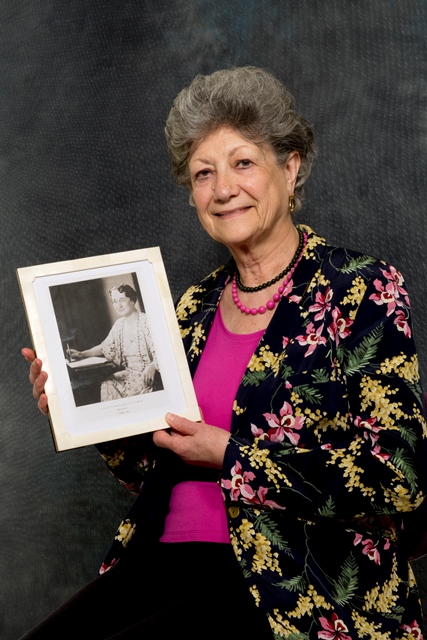
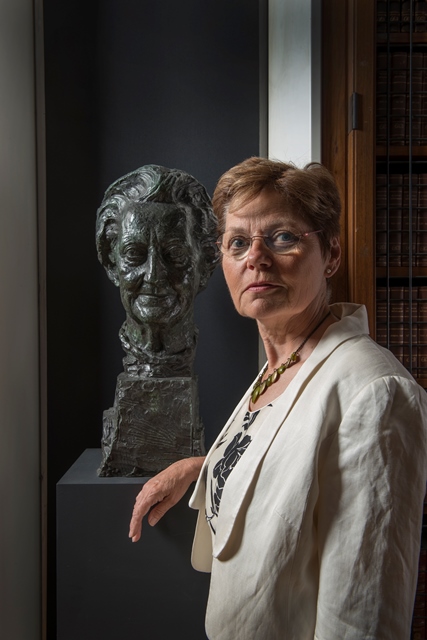
Flic Gabbay, xxx, next to a bust of xxx.

Flic Gabbay, co-founder of the Society for Pharmaceutical Medicine, next to a bust of Cicely Saunders, founder of the hospice movement.{credit}John Chase (c) Royal College of Physicians{/credit}

Visitors stepping into the Royal College of Physicians (RCP) in London are normally greeted by the sombre stares of imposing men, in portraits lining the walls. From today, women outshine them, in 26 photographic portraits of modern female clinicians ranged along the central stairwell. Each holds an image of a historical figure who inspired them.

The exhibition, Women in Medicine: A Celebration, comes as the RCP — which accredits UK physicians and represents over 30,000 doctors globally — readies for its 500th birthday in 2018. Over that time, it has had just three female presidents: unsurprising, given that women could not join until 1909.

The contemporary clinicians in the portraits are esteemed in their own right, and there is still plenty of trail left for them to blaze. But it is the historical photos that drew my eye.

Fiona Caldicott, xxx, holding a photograph of xxx.

Fiona Caldicott, a past president of the Royal Society of Psychiatrists, holding a photograph of pioneering psychiatrist Helen Boyle.{credit}(c) Oxford University Hospitals NHS Foundation Trust {/credit}

Recent years have brought a welcome spate of books, movies and exhibitions dedicated to honouring pioneering women in science. The best of these, like the book and film Hidden Figures, draw attention to forgotten achievements and struggles, and reveal a history that had, shockingly, gone untold. More often, such collections tend to sample from the same pantheon. And although Marie Curie and Rosalyn Franklin deserve their fame, I’m often left with the feeling that we are overlooking important contributions from others.

The RCP show steps outside this elite circle. Here is Helen Boyle, one of the first women psychiatrists in Britain, who led the charge for early diagnosis and treatment of mental disorders near the end of the nineteenth century. Holding her photo is Fiona Caldicott, a past president of the Royal College of Psychiatrists, and perhaps best known for her work on the 1997 Caldicott Report, a guidance document about protecting confidential patient information.

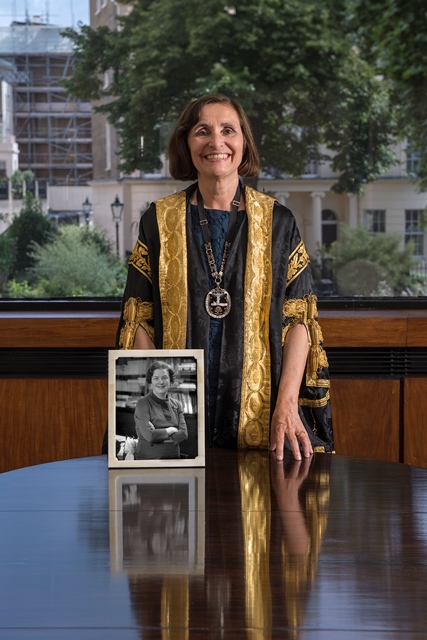
Jane Dacre, xxx

Jane Dacre, Royal College of Physicians president, with a photograph of pioneering hepatologist Sheila Sherlock.{credit}John Chase (c) Royal College of Physicians{/credit}

Jane Dacre, the current president of the RCP, selected physician Sheila Sherlock, who founded hepatology, the study of the liver. According to an online biography connected to the exhibition, Sherlock said that she opted to study that organ because “no one else was doing it”.

All these women racked up notable achievements — and overcame tremendous obstacles to do so. But too many of the write-ups on the accompanying website read like CVs: it is sometimes difficult to glimpse the person behind the achievements, no doubt due to limited space and historical records. Still, there is plenty to whet the appetite. For example, I’m eager to learn more about the friendship with a dying man that led Cicely Saunders to found the modern hospice movement.

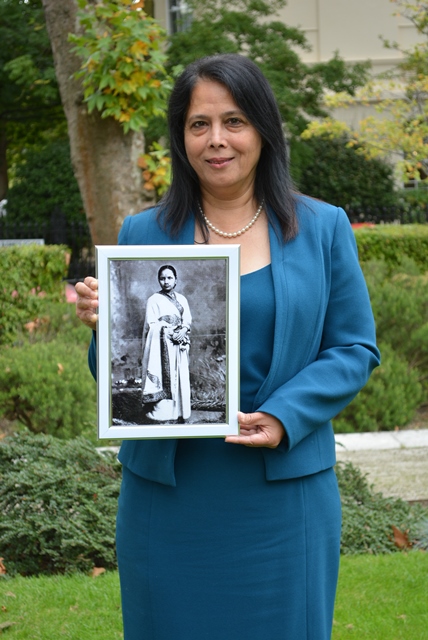
Asha Kasliwal, xxx, holds portrait of xxx in the Women in Medicine exhibition at the xxx.

Asha Kasliwal, president of the Faculty of Sexual and Reproductive Healthcare, with a photograph of Anandibai Gopal Joshi, one of the first women in India to study Western medicine.{credit}(c) FSRH{/credit}

Happily, the exhibition’s brief biography is enough to reveal why Anandibai Gopal Joshi — among the first Indian women to practice Western medicine — chose to enter medicine. Married at age 9 and a mother at 14, Joshi’s child died ten days after he was born due to inadequate medical care. “My soul is moved to help the many who cannot help themselves,” Joshi wrote in her application to the Women’s Medical College of Pennsylvania. (Her photograph is held by Asha Kasliwal, who trained in Mumbai and is now president of the Faculty of Sexual and Reproductive Healthcare.)

For perspective, a trip downstairs to the Treasures Room, featuring medical tools from past centuries, is fascinating. Among them is a ‘modesty doll’. In a time when clinicians were all men, women would point to areas on the doll corresponding to the body part in question to describe their symptoms.

In a nearby display case hangs the ornate formal robe, heavy with real gold thread, of the RCP’s president, next to a photo of Dacre wearing it. The robe cannot be shortened, and positioning it on Dacre’s petite frame took some doing. Yet you’d never know it: it fits her perfectly.

Heidi Ledford is a reporter for Nature in London. She tweets at @heidiledford.

Women in Medicine runs at the Royal College of Physicians until 19 January 2018.


For Nature’s full coverage of science in culture, visit www.nature.com/news/booksandarts.

The Colorado: elegy for an overused river

Posted on behalf of Monya Baker

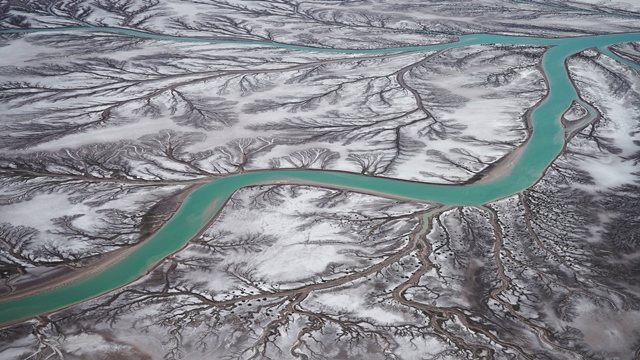
The Colorado River

Tidal waters in the delta region of the Colorado River.{credit}Murat Eyuboglu{/credit}

The Colorado River in the US West proves the adage that you never step into the same river twice. Lined by a vast array of landscapes, communities and industries it has shaped, its waters run variously aqua, navy blue, muddy brown — or not at all. Over its 2,334 kilometres, it sustains some 40 million people, 2 million hectares of farmland and the Hoover Dam. It is also polluted, depleted, diverted.

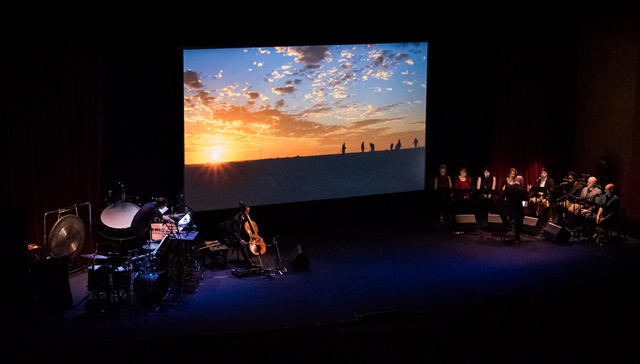
Now this mighty waterway is celebrated in The Colorado — a music-based documentary that delivers a powerful environmental and social message. Produced by VisionIntoArt, the project brings together several composers including Paola Prestini and live performance ensemble Roomful of Teeth, among others. (See below for the trailer.)

Glenn Kotche and Jeffrey Zeigler performing at the New York premiere of The Colorado.

Glenn Kotche and Jeffrey Zeigler performing at the New York premiere of The Colorado.{credit}Jill Steinberg{/credit}

At a pre-show talk on 22 April at Stanford University in Palo Alto, California, the project’s director Murat Eyuboglu noted that his inspiration was the story of the Salton Sea in California’s Colorado Desert. This huge inland lake was created by accident in 1905, when engineers’ plans for irrigation canals succumbed to the river’s might. Now saltier than the Pacific Ocean, the lake is filled with toxic sludge and hosts acres of deserted lakeshore development, yet is essential habitat for migrating seabirds. “I’ve never seen so much beauty and devastation cohabiting in one place,” said Eyuboglu. That sentiment holds for the film as well.

Eyuboglu’s interest in the Salton Sea led him to contact writer William deBuys, who has chronicled the natural histories of water in the region in books such as Salt Dreams (coauthored with Joan Myers). DeBuys signed on to advise Eyugoblu on the project, then became his co-scriptwriter and lyricist. Filmed over four years (and 20 trips into the river’s drainage basin), their documentary meanders from the artificially fertile fields of Imperial Valley to the artificially parched expanses in the Sonoran Desert as well as the Salton Sea.

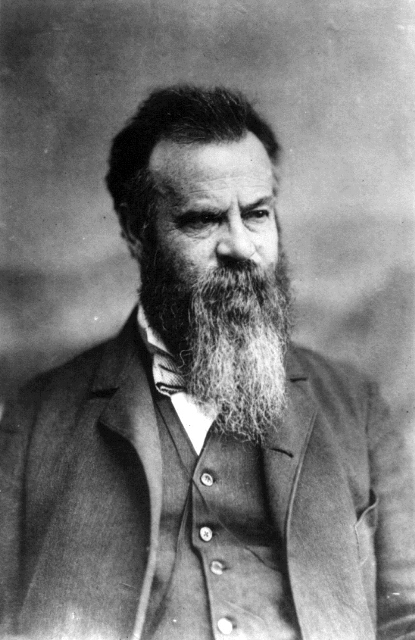
Geologist John Wesley Powell, the first to explore the Colorado River for scientific purposes.

Geologist John Wesley Powell, the first to explore the Colorado River for scientific purposes.

The work is divided into nine sections. Each begins with a narrative introduction by actor Mark Rylance, grounded in stories of people who explored, exploited or were exploited by water-fueled power. After the narration stops, we are steeped in stunning cinematography and archival footage.

The first to explore the Colorado for scientific purposes was noted geologist and Civil War veteran John Wesley Powell. (During that conflict Powell, who lost an arm in combat, would instruct his soldiers to watch out for fossils while digging trenches.) On his first, grueling three-month 1869 expedition, Powell recognized that the river had cut through millennia, pronouncing the region “a Book of Revelations in the rock-leaved Bible of geology” that he was determined to read. Mapping the basin, Powell made a coherent case that political units should follow the same boundaries, to balance the needs of those dwelling upstream and downstream at a time when land speculators carved property for their own benefit. That lost opportunity is repeatedly apparent in the film.

Another story is that of David Brower (1912-2000). Founder of environmental organisations including Friends of the Earth and first head of the Sierra Club, Brower successfully fought to stop a dam slated to flood the Dinosaur National Monument in Colorado and Utah. He proposed Glen Canyon as an alternative, despite never having seen it. After mapping Glen Canyon, he realised that burying its magnificent rock “cathedrals in the desert” and thousands of ancient indigenous sites under what is now Powell Lake would go down as the biggest US environmental mistake in history — and admitted his part in it. We see footage of the canyon being dynamited pre-dam, run backwards. Witnessing the canyon walls reform, we feel what has been lost.

In other sections, we see the tons of produce grown in Imperial Valley, irrigated by the river and harvested mainly by farm labourers from Latin America. Finally, we glimpse the nearly bone-dry delta of the Colorado in Mexico. With farms and industries each due a cut of “liquid property”, the water generally fails to reach the sea despite governmental efforts. The delta’s former fecundity is now relegated to the memories of octogenarians.

The Colorado is, for the most part, emotionally and intellectually rich — sometimes too much so. At one point, I missed a series of explanatory texts on screen because I was pondering the source of the sound accompanying them — it was, I eventually realized, the cellist striking his bow alternately on the instrument’s base and a plastic water bottle. Birdsong at the start of one segment is the call of the canyon wren, whose characteristic trill inspires a vocal piece later on. But I would not have recognized either fact without the pre-show talk.

The river is disappearing under the constant demands of civilization, yet is beautiful even in decline. The film closes with a Yuman poem, once description, now wish. “This is my water, my water… It shall flow forever.”

Monya Baker writes and edits for Nature from San Francisco, California. She tweets at Monya_science. The Colorado will travel to Washington DC in March 2018, as part of the Kennedy Center’s inaugural season of Direct Current, a celebration of contemporary culture. View a trailer for The Colorado here. A Nature Q&A with Paola Prestini can be found here.


For Nature’s full coverage of science in culture, visit www.nature.com/news/booksandarts.

Fibonacci’s real mathematical legacy

Posted on behalf of Davide Castelvecchi

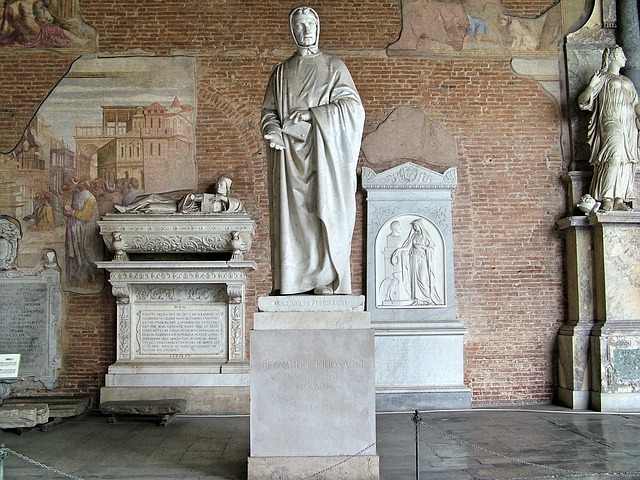
Statue of Leonardo Pisano (Fibonacci) in Pisa.

Monument of Leonardo Pisano (Fibonacci) by Giovanni Paganucci (1863) in the Camposanto di Pisa.{credit}Hans-Peter Postel, Wikimedia Commons{/credit}

For hundreds of years until the ebb of the Italian Renaissance, one name was synonymous with arithmetic. This was Leonardo — not the polymath from Vinci, but Leonardo Pisano (ca. 1170-1250), now popularly known as Fibonacci.

Yet we know little of Fibonacci’s life beyond the nickname and his Pisan roots: most details come from a 160-word autobiographical sketch written in 1202. He is often assumed to have discovered the so-called ‘Fibonacci sequence’, which starts with zero and 1 and is thereafter the sum of the two previous numbers (so 1, 2, 3, 5 and so on). The sequence shows up with astonishing frequency in natural spiral structures such as shells and plant tendrils.

Fibonacci did not, however, discover the sequence – it was recorded in Sanskrit at least as far back as 200 BC. Nor does the sequence explain anything about artistic beauty via the so-called ‘golden section’, as Keith Devlin reminds us in his new book Finding Fibonacci. The Pisan’s greatest legacy was to help Europe dump the ancient system of Roman numerals and switch to Hindu-Arabic numbers from 1 to 9 and, perhaps most importantly, 0, which Fibonacci called zephirum after the Arabic ṣifr. (Finding Fibonacci repeats some of Devlin’s arguments in his 2011 The Man of Numbers, and indeed is in large part a meta-narrative exploring the making of that earlier book.)

A page of Fibonacci's Liber Abaci from the Biblioteca Nazionale di Firenze showing (in box on right) the Fibonacci sequence with the position in the sequence labeled in Roman numerals and the value in Hindu-Arabic numerals.

A page of Fibonacci’s Liber Abaci from the Biblioteca Nazionale di Firenze showing (in box on right) the Fibonacci sequence with the position in the sequence labeled in Roman numerals and the value in Hindu-Arabic numerals.{credit}National Library of Florence, Wikimedia Commons.{/credit}

During Fibonacci’s lifetime, much of Italy was part of the Holy Roman Empire, yet many Italian cities were in practice independent city-states. Pisa, Genoa, Amalfi and Venice had been gaining prominence as maritime powers, establishing trade routes across the Mediterranean. As commerce boomed, Italian merchants needed to keep track of finances efficiently. Roman numerals made multiplication and division extremely cumbersome (try dividing MXCI by LIII); they were no match for the 10-digit positional system invented by the Hindus some time before 700 AD and common in the Arab world. And compared to using, say, an abacus, calculations in Hindu-Arabic numbers also allowed an “audit trail”, as Devlin points out: “An individual sitting in Pisa controlling a network of traders needed to be able to review the financial books on a regular basis.”

To fill that need, in 1202 Fibonacci (the son of a notary working for Pisan traders) published Liber Abaci, a compendium of Hindu-Arabic arithmetic and its practical applications to trade. The 600-page book introduces the numerals and explains how to use them for basic calculations. Like every good maths textbook, it also features many practical problems, such as how to convert currencies (Italy alone had 28 at the time, Devlin notes), or puzzles such as this:

It is proposed that 7 rolls of pepper are worth 4 bezants and 9
pounds of saffron are worth 11 bezants, and it is sought how
much saffron will be had for 23 rolls of pepper.

Such problems may seem trivial to someone trained in modern elementary-school algebra, but the symbolic notation for equations with x’s and y’s had not yet been invented at the time, so all solutions had to be spelled out in words. As mathematician John Hannah wrote in his 2011 review of The Man of Numbers,“It is awe-inspiring to see how far medieval mathematicians could progress using such primitive tools.”

Liber Abaci was published in Latin, as was the norm for learned texts. But soon, ‘popular arithmetic’ books in local vernacular, many citing Fibonacci as their source, began to appear. These ‘abacus books’ became standard in schools; at least 600 were written over the next few centuries. Through these texts Italy, and later Europe, learned to do maths.

In Finding Fibonacci Devlin tells us (22 times) that Liber Abaci “changed the world”, comparing the medieval mathematician to tech giant Steve Jobs. He even contends that the book made Western science and technology possible. But although Liber Abaci seems to predate the vernacular abacus books, did it actually inspire them?

Devlin points out that Fibonacci had also written a shorter, simpler abacus book in the vernacular, intended for merchants. That is now generally considered to be lost. If this book could be found, he argues, it might turn out to be the “missing link” between Liber Abaci and the spread of popularized arithmetic texts that came later.

Medieval whodunit

In 2003, historian of mathematics Raffaella Franci discovered such a vernacular text, Livero de l’abbecho, from the late 1200s. Devlin centres both his books on the assertion that Franci concluded that this text was a copy of Fibonacci’s lost book; Devlin avers that it is a “slavish” copy.  He states that thanks to Franci and subsequent studies by other researchers, “we can now say with historical certainty” that Livero de l’abbecho is indeed Fibonacci’s missing link.

But is this as certain as Devlin claims? Franci wrote to me: “I do not believe and I have never claimed that Livero de l’abbecho should be attributed to Leonardo Pisano.” She found evidence that Livero de l’abbecho was based on Fibonacci’s lost book — not that it was a word-for-word copy. Another historian of mathematics, Elisabetta Ulivi, adds that Livero cannot be an exact copy as it’s written in an Umbrian dialect, not Fibonacci’s Tuscan. And historian Jens Høyrup even disputes the importance of Livero and Fibonacci to the importation of Hindu-Arabic arithmetic.

Devlin emailed me that Livero “can be taken to be a fairly close copy” (in Finding Fibonacci he describes it as “a medieval equivalent of a photocopy”) of Leonardo’s lost book. “My duty as a writer of history is not to list the ‘facts’,” he added. “It is to present the best account I can.” Devlin did not respond to follow-up questions about why, in both his books, he describes his attribution of Livero to Fibonacci as “Franci’s conclusion”.

Still, Finding Fibonacci showcases Devlin’s writerly flair. My favourite passages are the incredible story of how Liber Abaci (or at least, the edition he wrote in 1228, the sole surviving one) became available in English for the first time – to this day the only modern-language translation. Mathematician Laurence Sigler had made it his mission to translate the book, rushing to complete the task right before he died of lymphocytic leukemia in 1997. But his editor moved on, and the manuscript languished on floppy disks for years. For a while Sigler’s widow Judith Sigler Fell, fearing the project would be killed, took the extraordinary step of impersonating her husband in communiqués.

By the time Fell found a new publisher, Springer Verlag (now part of the same publisher as Nature), floppy disks had been superseded and she had to hire a hacker to extract the files. Fell then discovered that Springer only accepted submissions in TEX format, the technical standard for physics and mathematics texts. She learned it and spent six months retyping the text. Fibonacci’s Liber Abaci was finally published in 2002 — the 800th anniversary of the book’s first appearance.

Davide Castelvecchi is senior physical sciences reporter at Nature. He tweets at @dcastelvecchi.


For Nature’s full coverage of science in culture, visit www.nature.com/news/booksandarts.

A wily plotter and his pioneering atlas

Posted on behalf of Rosalind Cotter

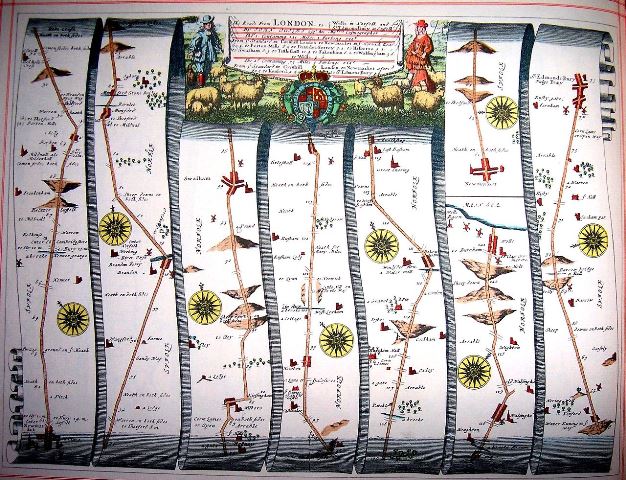
A colour version of the Britannia strip map showing the route from Newmarket, Suffolk to Wells-next-the-Sea, Norfolk.

Figure 1 One of the ‘Principal Roads of England and Wales’ displayed in John Ogilby’s Britannia atlas. It shows the route from Newmarket in Suffolk to Wells-next-the-Sea in Norfolk. As well as towns, villages, bridges and churches, these scaled strip maps record every wood, common, ford and metal mine along the way. {credit}Wikimedia Commons{/credit}

When it comes to unearthing facts and piecing them together into a bigger picture, scientists arguably have it easier than historians. The forensic scientist has recourse to DNA, soil and pollen analyses. The astrophysicist and molecular biologist have big data and an arsenal of technology to collect and unravel it. Even the palaeontologist has a formidable taxonomic lexicon to fall back on. Historians have to make do with piecemeal facts and shadowy context, guided by sources that are often incomplete, unreliable and open to misinterpretation. They cannot systematically test their hypotheses or devise controls to shore them up.

Remarkable, then, to take a little-known seventeenth-century cartographer, shake together a kaleidoscope of disparate facts from his long life, and apply them to tease out a sinister political strategy, all carefully concealed in Britain’s first road atlas.

In The Nine Lives of John Ogilby, Alan Ereira does just that. Ereira is a master story-teller, and his biography of Ogilby (1600-76) is a riveting ride never dulled by its meticulously referenced detail. The backdrop to Ogilby’s colourful life includes the Gunpowder Plot, the English Civil Wars, the execution of Charles I, the Restoration of Charles II, the Plague and the Great Fire of London. His career encompassed the eponymous “nine lives”, as entrepreneurial lottery founder, celebrated dance master to barristers, impresario, poet, soldier and sea captain, secret agent, publisher of deluxe editions of classics and – at the grand age of 70 – Cosmographer and Geographic Printer to Charles II.

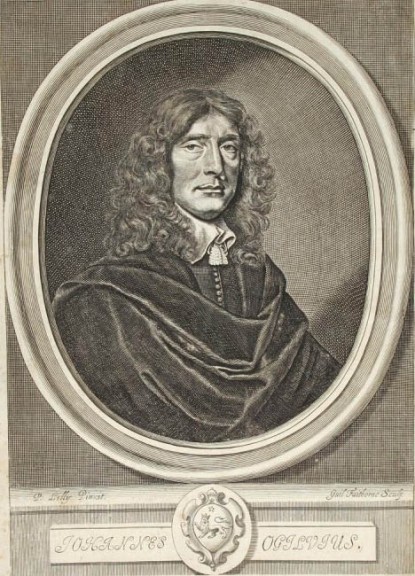
Portrait of John Ogilby (from a 1660 edition of Homer's Illiad).

Portrait of John Ogilby (from a 1660 edition of Homer’s Illiad).{credit}Wikimedia Commons{/credit}

Of these exploits, the most fascinating (and puzzling) to a scientist is the last. The king tasked Ogilby to draw up a road atlas of England and Wales as an aid to the fledgling postal service, but this was to be much more than a simple precursor of today’s motoring guides. Using a device he dubbed a “wheel dimensurator”, a push-along wheel 5 metres (16.5 feet) in circumference that incorporated a dial to record distance, Ogilby painstakingly compiled mile-by-mile strip maps of 73 roads (see Figure 1, above). Between them, these covered 12,070 kilometres (7,500 miles). He plotted details of natural and man-made landmarks along the way at a scale of 1 inch to the mile, a mapping standard later adopted by the British Ordnance Survey until the 1970s. The distances catalogued, allowing for land contours, accord to within roughly 5% of interpolations from Google Earth.

At that time, precision measurement was equated with scientific authority. Therefore the king commandeered physicist Robert Hooke  and architect Christopher Wren, both fellows of the Royal Society, to advise Ogilby. They devised questionnaires for the project’s surveyors to ask locals as they passed through villages:  strange questions, about possible landing sites and unusual tides, watercourses and locations of farms and metal mines. No expense was spared. The eye-watering production costs, equivalent to roughly half a billion pounds today (comparable with Google’s annual expenditure on Google Maps), were at odds with the impoverished state of the country after the English Civil Wars (1642-51) and the second Anglo-Dutch War (1664-67).

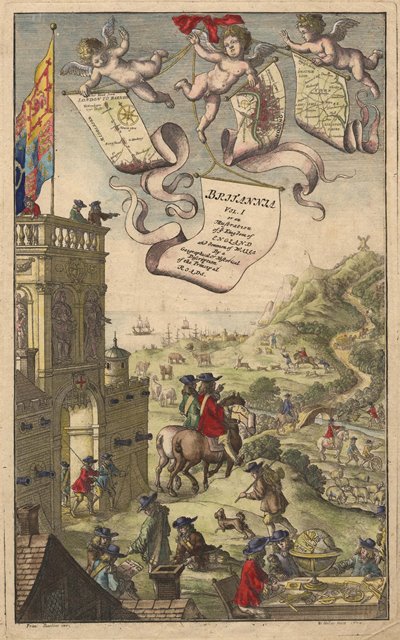
The stupendous efforts of Ogilby and his surveyors and engravers culminated in a magnificent volume comprising 100 plates, Britannia, published in 1675 (its resplendent frontispiece is shown in Figure 2, below). Weighing almost 8 kilograms, it was hardly handy for travellers. The routes depicted were surprising too. Why London to Aberystwyth, a small place today and a mere fishing hamlet in the seventeenth century? And why no mention of key commercial thoroughfares such as the road to Liverpool?

Figure 2 The frontispiece of John Ogilby’s Britannia. The gateway is flying the royal standard and bears the arms of the City of London. In the foreground, a map is being made by surveyors at a table of instruments. The three distant figures on the right are working with Ogilby’s measuring wheel: one is pushing it, one is cleaning the mud off, and the horseman behind is making notes and checking the direction of travel on a compass. Curiously, they are moving along a small track and not along the main highway. This and other mysteries, as well as secret codes hidden in the plate, are discussed in The Nine Lives of John Ogilby.

Figure 2 The frontispiece of Ogilby’s Britannia. The gateway is flying the royal standard and bears the arms of the City of London. In the foreground, a map is being made by surveyors at a table of instruments. The three distant figures on the right are working with Ogilby’s measuring wheel: one is pushing it, one is cleaning the mud off, and the horseman behind is making notes and checking the direction of travel on a compass. Curiously, they are moving along a small track and not along the main highway. This and other mysteries, as well as the secret codes hidden in the plate, are discussed in The Nine Lives of John Ogilby.{credit}Courtesy of Swansea University, Information Services & Systems (ISS){/credit}

Ereira picks up on all the signs that Britannia could be a military atlas rather than a postal one, as officially designated. The routes seem to have been selected for landing marching armies, punctuated with conveniently placed metal mines for producing armaments. There were Catholic shrines marked too — surprising in a Protestant nation. Ereira’s hunch is given credibility by the secret Treaty of Dover, drawn up in 1670 by Charles II with his cousin Louis XIV of France just before the start of the Britannia project. That secret lay hidden for almost 100 years.

The Treaty stemmed from Charles’ vulnerability to covert political and religious forces across the land, after nine years in exile during Oliver Cromwell’s interregnum. Charles’ solution was to seek direct power for himself. (His inspiration was Frederick III of Denmark, who set himself up as Europe’s first monarch to rule by absolute decree after a resounding victory over the Swedes in 1660 gained him immense popularity.) First, Charles needed a glorious military victory over the Dutch, preferably funded by France. But the price for French assistance would be to shift Britain back to Catholicism. The Treaty was duly signed. Ogilby, now turned spy, was commissioned by Charles to amass the information necessary for military back-up by French troops in the event of popular insurrection. They could land unobtrusively at any of the potential invasion points identified on the map as having a functioning roadway, such as Aberystwyth or Wells-next-the-Sea.

As it turned out, no such invasion was necessary. The victory over the Dutch was modest and contributed nothing to Charles’ popularity. There was no uprising. Instead, Charles achieved absolute power by dispensing with Parliament and using the information in Britannia to remove opposition town by town. Ogilby died the year after Britannia was published — but Ereira has given new life to this extraordinary man and his meticulously compiled roadmap.

Rosalind Cotter is Nature’s Correspondence editor.


For Nature’s full coverage of science in culture, visit www.nature.com/news/booksandarts.

Hidden Figures: the movie

Posted on behalf of Elizabeth Gibney

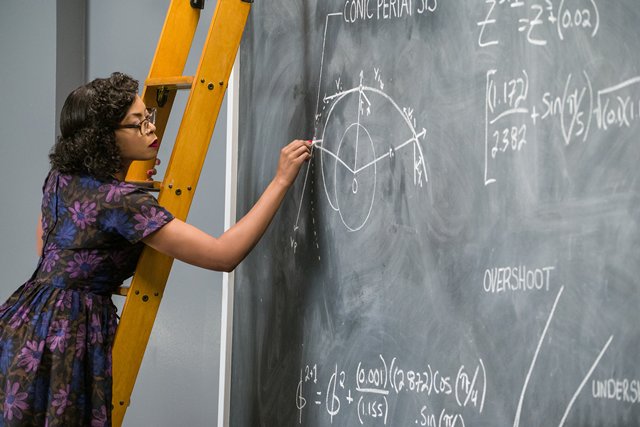
Taraji P. Henson as NASA ‘human computer’ Katherine Johnson. Over the course of her career, Johnson calculated the trajectories and launch windows for flights including the early missions of John Glenn and the Apollo 11 flight to the Moon, and did early work on the Mars mission.{credit}Courtesy of Twentieth Century Fox{/credit}

High-profile protests dominated the media during the civil rights era in 1960s America. At NASA, a quieter struggle was already underway. From the 1940s, African-American women had been chipping away at perceptions and making incursions into the early space programme — that otherwise very white, male world.

The stories of three of these scientific whizzes – Dorothy VaughanKatherine Johnson and Mary Jackson – are now told in Hidden Figures, a film directed by Theodore Melfi and based on a book of the same name by Margot Lee Shetterly (reviewed here for Nature by Alexandra Witze).

This sharp, witty triple biopic captures the focused frenzy of the United States’ space race with the Soviet Union, when NASA was trying to figure out how to achieve the remarkable feat of launching a man into orbit atop a rocket and returning him safely. That all-out effort meant opening the doors to the best people — which in turn created an opportunity for these pioneering African-American women to take on roles previously barred to them.

xxx

The Langley band of ‘human computers’ led by Dorothy Vaughan (played by Octavia Spencer).{credit}Courtesy of Twentieth Century Fox{/credit}

The movie recreates NASA’s Langley Research Center in Virginia, a state that in the early 1960s remained segregated. Vaughan, Johnson and Jackson are among Langley’s human “computers”: women hired to do the mathematics behind space flight, in the days just before the room-sized first IBM machine did it for them. This smart, passionate band, who made up the West Computing group, spend their days calculating launch and landing trajectories and air flow around capsules, armed only with pencils and reams of paper.

The trio were truly extraordinary. Vaughan, played by Academy Award-winner Octavia Spencer, is the matriarch. Although head of the computing group, she is not initially recognised as such for racist reasons. The film shows her initiative over the years in becoming an expert programmer of computing machines as the march of technology sees electronic counterparts to human computers emerge. Meanwhile Jackson, played with spirit by singer Janelle Monáe, wants to be an engineer. She struggles to reach ever-moving goalposts, including segregation laws that prevent her from attending the only school where she could get the necessary qualifications. Monáe’s vivacity earns her most of the film’s best lines.

xxx

Octavia Spencer as ‘human computer’ supervisor Dorothy Vaughan.{credit}Courtesy of Twentieth Century Fox{/credit}

The main focus in on Johnson, perhaps the most remarkable of the three. Her work stands at the very heart of US success in space. The film opens with her as a child prodigy, then zips past degrees in mathematics and French, and graduate school at West Virginia University — where she was one of the first black students to attend. At NASA she was soon picked to join the Space Task Force, who needed her talents in calculating the geometries of parabolic and, later, orbital flight. So indispensable was she that astronaut John Glenn asked for her to personally check the calculations of his trajectory by hand, ahead of the first US orbital flight in 1962.

Johnson is portrayed by Taraji P. Henson as quiet, tenacious and warm-hearted. The character could not be more different from Henson’s role as gangster Cookie Lyon in the music-industry television drama Empire. Johnson is a whizz with the chalk, often seen up a ladder scrawling calculations on a giant blackboard. She carves out her own position in the team, and in colourful outfits and heels offers a human face as often the only woman in a sea of white-shirted, pencil-tied men. (Among many excellent supporting actors, such as The Big Bang Theory’s Jim Parsons, Kevin Costner as a fictional amalgamation of several real NASA leaders deserves special mention. Gum-chewing and hard-nosed, he insists on referring to his team as “gentlemen” despite Johnson’s presence; but his desire to reach the heavens is what gives her her chance.)

xxx

Janelle Monáe as Mary Jackson, who later became a NASA engineer.{credit}Courtesy of Twentieth Century Fox{/credit}

Hidden Figures succeeds in revealing the institutionalised racism faced by the women and their families. Bathrooms, drinking fountains, schools, libraries — all were segregated. One of the best exchanges is between Vaughan and computing pool supervisor Vivian Mitchell (Kirsten Dunst), who insists, “I have nothing against y’all”. To this, Vaughan kindly replies: “I know you probably believe that.” And the women’s status as invisible engines driving the space programme contrasts clearly with the pomp surrounding the astronauts, who as the faces of NASA seem constantly showered with red, white and blue confetti.

Yet the upbeat film can sometimes come across as sanitised. There are no real baddies: even the racist characters, flawed with conscious or unconscious bias, seem ultimately good. A touch more anger wouldn’t have detracted from the enjoyable feel-goodness, epitomised by a bouncing soundtrack  by co-producer Pharrell Williams (composer of mega-hit Happy).

On another level, this may be an effort to avoid the film being solely about race. Rather, it is about women and their love of science. Vaughan, Johnson and Jackson had families to support and could not risk everything in the political fight for equality. In chasing their passions, these three chose to foment change from the inside. Hidden Figures fleshes its characters out into real human beings, and tells their cracking story with grace.

Elizabeth Gibney is a reporter on physics for Nature based in London. She tweets at @LizzieGibney. Hidden Figures’ US premiere is 25 December 2016; general release is on 6 January. The film’s UK premiere is 10 February 2017; general release is on 17 February.  


For Nature’s full coverage of science in culture, visit www.nature.com/news/booksandarts.

Versed in science

natlogoWorld Poetry Day may seem a strictly literary shindig. But despite the ongoing evocations of C.P. Snow’s 1959 ‘two cultures’ lecture, science and poetry are not-so-strange bedfellows. Nature itself is the perfect exemplar: the journal’s very title is taken from a poem by English Romantic poet William Wordsworth.

That was Wordsworth’s 1823 sonnet ‘A Volant Tribe of Bards on Earth are Found’, which contains the lines “To the solid ground/Of nature trusts the Mind that builds for aye.” That inspired choice by Nature’s first editor, Norman Lockyer, was amplified by the journal’s first article, ‘Nature: Aphorisms by Goethe’. In opening with the work of a poetic titan equally versed in morphology and anatomy (who also authored a highly original colour theory), the biologist T. H. Huxley admitted that the journal’s new readers might find it “terribly Pantheistic”. But he noted, too, that Goethe himself (who wrote the lines in 1786, while en route to discovering the human intermaxillary bone) was aware of that, and even wryly critical of it. And many of the lines still carry a satisfying scientifically poetic punch.

As Ruth Padel (Charles Darwin’s great-great granddaughter and a celebrated poet) notes, science and poetry have been entangled since the birth of Western culture. In a 2011 Guardian article she reminds that poetry was “the first written way we addressed such questions as what is the world made of, and how did it come to be”. From the pre-Socratics of the fifth and sixth centuries BC to the eighteenth-century physician Erasmus Darwin, who predicted the theory of evolution in his poem ‘The Temple of Nature’, poetry has been a vehicle for ‘big science’ — sometimes the very biggest. Advances in astronomical observation from early telescopes to Hubble have energised poets from the eighteenth-century celebrant of the ‘cosmic sublime’ Anna Barbauld to Tracy K. Smith, part of whose 2011 collection Life on Mars celebrates her father’s role as a Hubble engineer.

Speculating on this ancient fusion of science and poetry, Padel points to their mutual use of metaphor; their predication on precision; their toleration of uncertainty. But I’ll let Wordsworth — that preeminent ‘nature’ poet — have the last word. In the 1802 edition of Lyrical Ballads, co-written with Samuel Taylor Coleridge, he wrote that if scientists’ labours “should ever create any material revolution”, then “The remotest discoveries of the Chemist, the Botanist, or Mineralogist, will be as proper objects of the Poet’s art as any upon which it can be employed”.

For Nature’s full coverage of science in culture, visit www.nature.com/news/booksandarts.

The top 20: a year of reading immersively


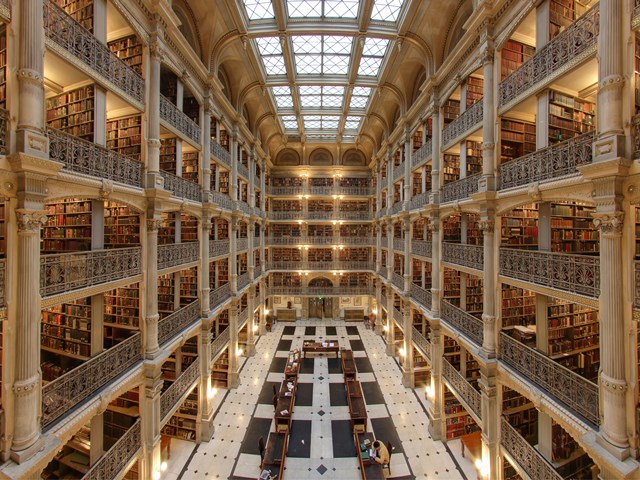
George Peabody Library, Baltimore, Maryland.

George Peabody Library, Baltimore, Maryland.{credit}Matthew Petroff{/credit}

It has been quite a year. We found ourselves saturated with light and knee-deep in soil — even diving down the rabbit hole with Alice to explore Lewis Carroll’s legacy for logic. There were discoveries (the pockmarked beauty of Pluto) and rediscoveries (the taxonomic reinstatement of Brontosaurus).

Meanwhile, in my parallel biblio-Universe, hundreds of science, social-science and science-history books hove into view. As I read, relished, reviewed and commissioned, I too made discoveries. Fascinating patterns emerged — ripples from shifts in science, society, culture. Robots held pole position, as authors grappled with the deep implications of twenty-first-century mechanisation and AI. There was a burst of books on the soup-to-nuts story of the cosmos, and an astonishing irruption of butterfly studies. Bedbugs had a moment (in Richard Jones’s House Guests, House Pests, reviewed here, and Brooke Borel’s Infested), as did pigs (in offerings such as Barry Estabrook’s Pig Tales, reviewed here).

As always, pulling ‘the best’ out of this flood has been tough. The 20 that stood out for me have an original grain — not going with the flow but creating whorls of their own. Several are biographies themselves representing a life’s work for their authors. Death, rainforests, seashells, Alexander Humboldt and DNA get a look-in. In no particular order, here goes.

The Invention of Nature: Alexander Humboldt’s New World, Andrea Wulf. Knopf. The accomplished historian delivers an inspired biography of the German polymath, explorer, prescient proto-environmentalist and discoverer of climate zones. (Reviewed here.)

Life’s Greatest Secret: The Race to Crack the Genetic Code, Matthew Cobb. Profile. A zoologist reframes the double-helix story, interweaving findings across physics, chemistry and biology with the lives of the luminaries involved. (Reviewed here.)

On the Edge: The State and Fate of the World’s Tropical Rainforests, Claude Martin. Greystone. The seasoned conservationist traces decades of rainforest losses to map future strategies for sustainable management in a key report to the Club of Rome. (Reviewed here.)

Our Kids: The American Dream in Crisis, Robert D. Putnam. Simon and Schuster. The astute political scientist and author of Bowling Alone (2000) exposes the insidious erosion of US social mobility that is disenfranchising a generation. (Reviewed here.)

Spirals in Time: The Secret Life and Curious Afterlife of Seashells, Helen Scales. Bloomsbury Sigma. A marine biologist tours the exquisite morphology and multidimensional functionality of that architectural marvel, a mollusc’s shell. (Reviewed here.)

Pure Intelligence: The Life of William Hyde Wollaston, Melvyn C. Usselman. University of Chicago Press. A meticulous, engrossing biography of the Enlightenment polymath — discoverer of cystine and palladium — by the late chemist. (Reviewed here.)

Weatherland: Writers and Artists Under English Skies, Alexandra Harris. Thames & Hudson. A cultural historian traces the weather fronts moving through English literature and art, from Shakespeare’s storms to Turner’s meteorological sublime. (Reviewed here.)

Birth of a Theorem: A Mathematical Adventure, Cédric Villani. Bodley Head/Faber and Faber. The flamboyant French recipient of the 2010 Fields Medal parts the curtains on the “strange alternate universe” of a mathematician’s life. (Reviewed here.)

The Black Mirror: Looking at Life Through Death, Raymond Tallis. Yale University Press. The former geriatric specialist uses his future corpse as the philosophical focus for a layered journey through his sensory and emotional life. (Reviewed here.)

Alfred Wegener: Science, Exploration, and the Theory of Continental Drift, Mott T. Greene. Johns Hopkins University Press. The science historian brilliantly biographises the physicist, meteorologist and explorer who discovered the precursor to plate tectonics. (Reviewed here.)

Concrete Revolution: Large Dams, Cold War Geopolitics, and the US Bureau of Reclamation, Christopher Sneddon. University of Chicago Press. A geographer surveys the US hegemony in twentieth-century dam engineering that has spawned a mixed global legacy. (Reviewed here.)

The Brain: The Story of You, David Eagleman. Pantheon. The virtuosic neuroscientist skips into the skull for a cutting-edge tour of how meat can generate self. (Reviewed here.)

The Reproach of Hunger: Food, Justice and Money in the 21st Century, David Rieff. Verso. The veteran development observer reveals how philanthrocapitalists and aid agencies are failing to crack the deep political problem of poverty and hunger. (Reviewed here.)

The Invention of Science: A New History of the Scientific Revolution, David Wootton. Allen Lane. A robust, expertly synthesised revisionist retelling of the scientific revolution by a commanding historical mind. (Reviewed here.)

Applied Minds: How Engineers Think, Guru Madhavan. W.W. Norton. A bioengineer lifts the lid on the rigorous, solution-oriented, constraints-savvy mindset of the made world’s hidden heroes. (Reviewed here.)

Why Are We Waiting?: The Logic, Urgency, and Promise of Tackling Climate Change, Nicholas Stern. MIT Press. The towering economist examines the hellish complexities of climate change and the potential of future innovation to tackle them. (Reviewed here.)

The Vital Question: Why Is Life the Way It Is?, Nick Lane. Profile. The evolutionary biochemist analyses the “improbable” moment, 1.5 billion years ago, when an endosymbiosis event created the cellular forebear of complex life. (Reviewed here.)

Plant Behaviour and Intelligence, Anthony Trewavas. Oxford University Press. The plant physiologist draws on 50 years of research for a rollicking exploration of botanic behaviours. (Reviewed here.)

Sharing Cities: A Case for Truly Smart and Sustainable Cities, Duncan McLaren and Julian Agyeman. MIT Press. Two urban sustainability thinkers propose a paradigm for collaboration and inclusivity in cities that far outpaces the commercial sharing-economy model. (Reviewed here.)

Scientific Babel: The Language of Science from the Fall of Latin to the Rise of English, Michael Gordin. Profile/University of Chicago Press. A linguist and historian deftly analyses the irresistible rise of English as the scientific lingua franca. (Reviewed here.)


For Nature’s full coverage of science in culture, visit www.nature.com/news/booksandarts.
Electrifying: Tesla on television

Posted on behalf of Liesbeth Venema

teslaseries_poster_medtAn eccentric genius in an impeccable suit and a level-headed young sidekick who have to use their wits to combat a time-travelling automaton and save the Earth. No, this is not the plot of the latest Doctor Who. It is Nikola Tesla and the End of the World, a fun and highly original four-episode science fiction series created by Ian Strang nominated at the 2015 Raindance film festival best British Series category (and available free to view online).

What is the greatest innovation the world has ever seen? According to physicist Sophie Clarke (played by Gillian MacGregor), the doctor in this fictional duo, it is the transmission of energy. This is a topic the real-life nineteenth-century engineer-inventor Tesla thought a great deal about, and in a way that often leaped far ahead of his time. Tesla shaped the modern world with inventions such as the alternating current system for large-scale electric power distribution, radio transmission and fluorescent light bulbs.

Several of these exist only as sketches for patents, and more than a few conspiracy theories about their intended purposes do the rounds. It doesn’t help that Tesla himself made outrageous claims such as being able to receive extraterrestial signals. He indulged in ambitious visions of human advancement and tried to build a power station — the infamous Wardenclyffe tower in New York —  that would provide the world with free wireless communication and energy by making use of the Earth’s electromagnetic field. The project was doomed, leaving Tesla penniless and with his reputation shattered. Recent years have seen a renewed interest and re-appreciation of his work. For example, a new documentary, Tower to the People, hymns the concepts and humanitarian vision behind the Wardenclyffe project.

Doubly ahead of his time

For an SF series like Strang’s, it is a stroke of genius to transport to the present a charismatic inventor decades ahead of his contemporaries and pair him up with a down-to-earth physics lecturer. The action starts when Clarke stumbles upon a detailed sketch for a wireless power transmitter with Tesla’s signature and does the only reasonable thing a clear-thinking experimental physicist would do: tries to build it.

Tesla (Paul O'Neill) and Dr Clarke (Gillian MacGregor) find their way round the London Underground.

Tesla (Paul O’Neill) and Dr Clarke (Gillian MacGregor) find their way round the London Underground.{credit}Ian Strang{/credit}

Clarke’s first test, sensibly carried out outside at a safe distance from any power cables, doesn’t go as expected. The machine’s mechanical components become unexpectedly electrified: discharge currents flow, bulbs light up, an energy beam shoots out and finally, a rift in time and space appears through which a rather dashing Tesla (Paul O’Neill) materialises.  And with him, a whole bunch of misguided conceptions about technology, humanity and social norms.

This Tesla is full of initiative and wants to see immediately what great social advances his inventions have wrought. Inevitably, modern life disappoints him. He decides the world needs to be enlightened with his ideas — which for him, means he has to enlist the support of industrialists: “Bring me to Richard Branson!”

Clarke’s answer to Tesla’s rash plans is to go to her London university to do proper tests. But her motto — “There’s value in understanding how things actually work” — falls on deaf ears. The two must, however, overcome their differences as it soon turns out something went horribly wrong. The time machine conveyed a villainous figure to the present who also intends to deploy Tesla’s inventions — but to destroy the human race. Soon, lightning bolts are striking all over London and, as a warm-up, the Bank of England is blown up.

Dr Clarke and the 'time machine'.

Dr Clarke and the ‘time machine’.{credit}Ian Strang{/credit}

Only in the fourth episode do we see this mysterious figure – and an answer to the burning question of why he has a bad French accent (no spoilers, you’ll have to see for yourself). Fortunately, by the end Tesla has learned to value Clarke’s common sense and has accepted her as his equal.

Strang has taken a great physics geek idea and run wild with it. There are some wonderful exchanges between Tesla and Clarke: in one striking scene, the mismatched duo walks back to London along a deserted path on an icy afternoon, arguing about whether or not Tesla waves are possible. Unavoidably, a few action scenes feel a bit amateurish, but a huge amount of attention has gone into details such as the original musical score by Canadian songwriter Connie Kaldor.

One quibble: though Clarke disproves many stereotypes and doesn’t overplay the geek-card, she could do with a bit more personality. Throughout she remains unreasonably unfazed. She announces that “something is wrong with the weather and I am pretty sure we have something to do with it” as if saying she may have accidentally knocked over a shelf in Ikea’s furniture showroom.

But her character will surely develop in further episodes, which I absolutely hope will be filmed. (Strang promises to do so if there is sufficient interest.) For now, we have to trust that Clarke isn’t going to sit still knowing there is an evil force lurking in the future waiting to destroy the world as we know it, using Tesla’s invention of free energy transmission. “I’d better get on that,” she assures us.

Liesbeth Venema is senior physics editor at Nature. She tweets at @LCVenema.

For Nature’s full coverage of science in culture, visit www.nature.com/news/booksandarts.