Nanotechnology and food

NNanoFeb.gif

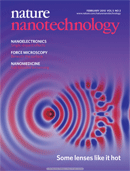
The food industry will only reap the benefits of nanotechnology if issues related to safety are addressed and companies are more open about what they are doing. This ethical question is addressed by Nature Nanotechology in its February Editorial (5, 89; 2010), an excerpt from which follows.

So far nanotechnology has largely escaped becoming ‘the next GM’ — which is shorthand for the rejection of genetically modified food by the public in the UK and elsewhere in Europe — but this has largely been because many applications of nanotechnology have been inherently non-controversial: who can object to stain-free trousers or faster computers? The popularity of products such as the iPod Nano has also helped with public acceptance of nanotechnology, even to the extent that distinctly non-nano products — such as the Tata Nano car — have sought to exploit the ‘nano’ brand. However, the introduction of nanomaterials into food and food packaging is a completely different matter, involving important factors that do not arise when developing new materials or electronic devices.

Nanotechnology could benefit the food industry and consumers in two main ways: by using engineered nanomaterials to reduce the amount of fat, salt or sugar in food without changing its taste; and by developing new packaging that keeps food fresher for longer and, possibly, tells the consumer if the food inside has gone off. Improved packaging might also allow more foods to be stored under ambient conditions, rather than in fridges and freezers, thus reducing energy consumption.

However, as made clear in a new report by the House of Lords’ Science and Technology Committee, there are relatively few foods (probably just two products) containing engineered nanomaterials on the market at present. There could be as many as 400 companies around the world are researching possible applications of nanotechnology in food and food packaging — and many of them don’t want their customers to know about this. The House of Lords’ committee says that it is “regrettable” that “far from being transparent about its activities, the food industry was refusing to talk about its work in this area.” While acknowledging that the food industry is afraid that the public might react negatively to food and food packaging that contains engineered nanomaterials, the Lords’ committee argues that “this is exactly the type of behaviour which may bring about the public reaction which it is trying to avert.”

Nanotechnology has much to offer to the food industry, and this report has much to offer food manufacturers, government, funding agencies and regulators.
Nature Nanotechnology journal website.

A climate of constructive communication

NRCCFeb.gif

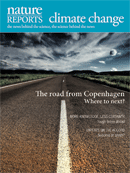
February’s Editorial in Nature Reports Climate Change looks over the past two months, an unnerving time for the international climate community. Once seen as one of the most esteemed scientific organizations in the world, the Intergovernmental Panel on Climate Change has suffered some serious blows to its reputation.

First, ‘Climategate’ saw thousands of emails obtained illegally from the University of East Anglia posted on the Internet. Carefully timed ahead of international climate policy negotiations, the emails showed apparent attempts by a handful of IPCC climatologists to withhold data from climate deniers and to exclude contentious information from the panel’s report. Unsurprisingly, this cast doubt on the credibility of the UN body.

In addition, over the past month, the panel has admitted that a key statistic quoted in its 2007 report — that Himalayan glaciers could disappear by 2035 — was in error, and its source of dubious origin.

These unfortunate events do not call into question the evidence that warming is unequivocal and that human activity is the primary cause. But they undoubtedly create confusion among the public at a time, post-Copenhagen, when the world now lacks a unified vision of the way forward for climate policy.

For the IPCC, the challenge is clear. Faced with political inertia and denialism, they must communicate their results clearly and their message constructively. The 2007 report — and the Summary for Policymakers in particular — represented a giant leap forward for science communication. For the next report — due out in 2013 — the challenge will be greater still. In trying to understand the climate system more fully, scientists could reveal greater uncertainty about the range of possible climate outcomes. At the same time, policymakers and the public will demand greater certainty so that they can plan accordingly. The climate research community recognizes this problem. Now it must make a priority of addressing it.

See also: Climate of suspicion, Editorial (free to read online) in Nature 463, 269 (2010).

Nature Reports Climate Change homepage

Nature Reports Climate Change current issue.

Climate Feedback, the NRCC blog.

Science books to inspire new generations

nature4feb.jpg

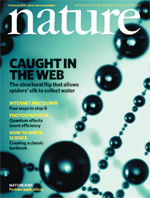
Five leading writers of science books are offering advice for budding authors in a series of interviews running from 4 Feb to 4 March in Nature‘s Books & Arts section. Researchers should be recognized for writing books to convey and develop science, according to an Editorial in Nature last week ( 463, 588; 4 February 2010, free to read online). Here is an extract:

“As the era of the electronic book dawns, perhaps hastened by Apple’s much-touted iPad, researchers should prime themselves to take advantage of the spacious book format. Unlike a tweet, blog or research paper, a good book offers space to breathe, to contemplate complex ideas and to convey a mode of thinking. But most scientists don’t think of writing one, and, if they do, they do it in secret.

In the hope that this might change, Nature last week began a series of weekly interviews with science book authors in its Books & Arts section, collected into a Web focus. Peter Atkins reveals the hard work behind a successful textbook; Carl Zimmer highlights how passion is essential for popular science; David Brin will reveal that criticism improves fiction writing; Georgina Ferry will share research tips for biographies; and Joanna Cole will explain how to convey science to children.

The role of textbooks in handing down the tenets of disciplines is changing as online components take over from printed text. Atkins acknowledges that the extra effort of producing layers of educational material for the web today makes writing a textbook daunting. Most researchers, he admits, would not be able to devote so much time to translating their work for students. Covering broad core subjects such as general chemistry would be nigh on impossible to do in snatched moments. He is lucky that, following his publishing success, his department supported his shift to full-time writing and teaching. Many would see their careers set back if their research was displaced.

Beyond textbooks, the human side of research deserves exposure as much as it ever has, through popular science accounts, biography and fiction. Although the publishing markets today apply a narrow filter, future readers can expect to enjoy access to a wider range of topics through e-books, which are easier to distribute and lack the overheads of print. As a specialist area, science stands to benefit.

Rather than limit scientific discourse to curt journal papers, researchers should embrace the book as another means of expressing not only their insights but also their visions. Through the various styles of writing, all aspects of science can be explored and laid out for posterity and learning. The expansiveness of a book allows sophisticated arguments to be put forward and widely debated; new ideas that cross disciplinary boundaries can more readily be shared and worked through.

But if this exhortation is to have any traction, the effort and skill required to write a book needs to be rewarded in the career recognition of scientists who devote time to mastering the art to good effect — a recognition that is commonplace in the social sciences and humanities. It is time to bring the book back into the science mainstream. This needn’t be a mass movement: just a dedicated few, but more of them, could fulfil the reasonable hope that their books will inspire a new generation. And they should be encouraged to do so."

Nature Web focus: how to write a science book. Selected content is free to read online during February.

British scientists need to adopt a positive tone

cover_nature28Jan.jpg

This is a shortened version of an Editorial in Nature ( 463, 402; 28 January 2010), which is free to access online.

On 11 January, a coalition of 20 leading British research universities published an editorial in The Guardian newspaper warning of impending calamity. If the spending cuts being proposed by the government are implemented, the authors asserted, the nation’s entire higher-education system, eight centuries in the making, could be undone in just six months.

Such alarmist statements have worked before. In an ordinary budget year, cries of falling skies and loss of leadership can pressure politicians to shift resources towards research. But the coming budget for Britain looks anything but ordinary. Politicians may wish to support science, but asking them to put research ahead of front-line government services such as policing and public health is not just unrealistic, it risks making scientists look petulant.

Rather than trying to convince politicians that the problem is pressing, researchers should prove to them that science can be a solution to the recession, by providing world-class education for its citizens and innovations that will set Britain apart from its competitors. They should also move the debate beyond the budget cuts, and into a broad consideration of how best to spend the limited funding that will be available.

This pro-science message will be effective only if politicians hear it again and again from all corners of the scientific establishment. At the moment, however, that seems far from happening. Most groups now mobilizing in support of science are fighting for their particular corner of the research enterprise. Fortunately, the tools for a more coherent effort are already in place. The Campaign for Science & Engineering in the UK (CaSE) is a broad coalition of charities, universities and industry that promotes science. In the run-up to the UK election, CaSE is preparing a series of letters encouraging politicians to form a positive science agenda along the lines described above. Individual researchers should add their voices to the chorus by inviting local politicians to their campuses, and by signing on to CaSE’s agenda.

The positive tone will not be enough to shield British science entirely from the cuts that lie ahead: research is only one national need among many, and cannot claim a special entitlement. But done right, it can help to ameliorate the losses and ensure that science grows quickly whenever the nation begins its recovery.

Latest Nature videos up at YouTube

nature video.jpg

The Nature Video editors have been busy this year, posting some beautiful movies at YouTube. Here’s a brief description of a few of them.

Eight billion years of dwarf galaxy evolution, accompanied by Strauss. This beautiful animation shows how exploding stars are a key force in shaping dwarf galaxies. Fabio Governato and colleagues present computer simulations that appear to have solved a longstanding problem in cosmology — namely, how the standard cold dark matter model of galaxy formation can give rise to the dwarf galaxies we see around us. From: Bulgeless dwarf galaxies and dark matter cores from supernova-driven outflows by F. Governato et al. Nature 463, 203-206 (2010).

Bacteria Make Mexican Waves. By synchronizing our clocks, we can coordinate our activities with people around the world. Now, scientists have engineered bacteria to synchronize their molecular timekeepers, creating the stunning fluorescent waves you see in this video. Hear more about synthetic biology on the Nature Podcast . From: Synchronized quorum of genetic clocks, by Tal Danino, Octavio Mondragón-Palomino, Lev Tsimring & Jeff Hasty Nature 463, 326-330 (2010).

The most vulnerable brains. Nature reporter Erika Check Hayden visits a San Francisco hospital where doctors are using new treatments to help infants at risk of brain injury. Read the full report at Nature 463, 154-156 (2010).

Robot roach extracts order from chaos. Scientists have created a robot that can move around just like an insect, powered by a simple circuit capable of generating many complex behaviours. The circuit employs chaos theory the idea that systems are very sensitive to small changes, which can quickly become magnified. The robot, called AMOS, can use its simple circuit to respond to light and sound, pull its foot out of a hole, or run away from obstacles thrown in its path. From: Self-organized adaptation of a simple neural circuit enables complex robot behaviour by Silke Steingrube, Marc Timme, Florentin Wörgötter & Poramate Manoonpong (Nature Physics Advance Online Publication, 17 January 2010). See also a related Nature News story.

Nature video channel at YouTube.

Nature’ s online video streaming archive.

Arrogant gods of certainty or subtle sophistication?

homecover.gif

If you’re reading this, you’re probably a scientist. Would you label yourself, then, an “arrogant god of certainty”? Nature Physics, in its December Editorial (5, 851; 2009) takes issue with “the continued misperception of science”, in this case by A. N. Wilson in The Daily Mail newspaper, in a article which attracted 462 comments from readers. From the Nature Physics Editorial: "According to Wilson, “What scientists are saying basically is that they will brook no contradiction”; “science rules” and needs “to distort and control the brains of men and women who might otherwise think for themselves.” Any scientist surely struggles to recognize this description. What must be appreciated, by politicians and populace alike, is that there can be certainty in science, but there can also be contradiction. There are issues on which there is scientific consensus, there are others on which there is not. To pick on less emotive issues than the examples offered by Wilson, think of how tried and tested the standard model of particle physics is (even if in need of some extension), and yet how controversial the mechanism of high-temperature superconductivity remains.

It is a subtle, sophisticated picture, and men and women do need to think about it for themselves. It is vital to appreciate what it means to know something scientifically, and what it means to not know; what science can say, and what it can’t. We don’t claim that science is all. That would be arrogant. But we are certain that it cannot be ignored."

Nature Materials looks to second worlds

materials.gif

Virtual worlds such as Second Life present an intriguing premise for scientific use. But are the benefits sufficiently clear for widespread uptake? In a Commentary in the current (December) issue of Nature Materials ( 8, 919-921; 2009), Tim Jones discusses the advantages virtual worlds allow in the context of science and science communication, including allowing research collaborators to meet in a virtual space, or larger events such as talks where the audience can interact with each other.

An Editorial in the same issue of Nature Materials (8, 917; 2009, free to access online) points out that despite its advantages, growth of Second Life membership has occurred at a relatively slow pace, certainly when compared with popular social networks such as Facebook or Twitter, possibly because of the need to install software and have a fast broadband connection, or possibly because one has to adopt a flippant name in order to participate. If you are interested in trying out Second Life, the Editorial draws attention to Science Friday, a weekly radio show broadcast to a live audience gathering at a joint location in Second Life; and Nature’s weekly podcasts and Nature Publishing Group events at Second Nature that stimulate lively discussions between participants. Large institutions such as NASA and the US Centers for Disease Control and Prevention have already built representations. Second Life may have the look and feel of a computer game, but more serious applications have started to emerge.

A Scientist’s Guide to Talking to the Public, reviewed

neuroscience.gif

Nature Neuroscience‘s December issue features a review of Cornelia Dean’s book Am I Making Myself Clear? A Scientist’s Guide to Talking to the Public ( Nature Neurosci. 12, 1477; 2009). Dean is a journalist and former editor of the popular science section at the New York Times, and according to reviewer Dario L Ringach of the University of California, Los Angeles, “extends a compelling invitation to researchers to participate more in public life, to explain their work to science journalists, to contribute to national policy debates and to do so not only when their funding is at stake.” In the review, Ringach asks why scientists should communicate with the public, and mentions some obstacles in communication between scientists and journalists. He concludes:

“It is time for all of us to have a more active role in society and provide our input to public policy; we must go beyond the publication of scientific articles. I admit my own recent incursion into the media was not driven by any of the above considerations, but from threats by animal-rights extremists. I don’t recommend you take the same road. Instead, read this powerful book and you will be easily convinced that it is your obligation to devote time outside the laboratory to communicating the wonderful work you are doing, your excitement, its importance and how the public stands to benefit from it. Is there anyone out there ready to talk about science? I certainly am.”

Am I Making Myself Clear? A Scientist’s Guide to Talking to the Public

By Cornelia Dean

Harvard University Press: 2009 288 pp. $19.95

0674036352.

Nature Nanotechnology on public attitudes and responses

The proportion of the public that knows about nanotechnology has reached a plateau, which means that it is now necessary to develop new approaches to explore public perceptions in greater detail than before, according to the November Editorial in Nature Nanotechnology (4, 695; 2009). The Editorial draws attention to “the publication of the first meta-analysis of survey data on public attitudes towards the risks and benefits associated with nanotechnology (see ”https://dx.doi.org/10.1038/nnano.2009.265">page 752 of this issue). Terre Satterfield and colleagues looked at 22 publications reporting the results of surveys and found that the public response to nanotechnology has, so far, been different to the responses to previous new technologies in a number of ways. In particular, and contrary to expectations, unfamiliarity with nanotechnology is not strongly associated with risk aversion. The meta-analysis also reveals that twice as many people think that the benefits will outweigh risks as vice versa, but the authors caution that “a large minority of those surveyed (44%) is unsure, suggesting that risk judgments are highly malleable.” Satterfield and colleagues also call for the development of new methods to understand public responses to nanotechnologies. In an accompanying News & Views on page 705 Dan Kahan concludes that “the meta-analysis suggests that public attitudes toward nanotechnology remain open to the guidance of sound science, but that it would be a serious error to take such receptivity for granted.”…. It is important that the nanotechnology community — researchers, funders, regulators and others — continues to work hard to ensure that nano does not become the next GM, all the time accepting that there might always be new questions to answer and new challenges to address."

Nature’s past and future after 140 years

From an Editorial in Nature (462, 12; 5 November 2009):

Nature‘s first issue appeared on Thursday 4 November 1869. 7,269 issues later, a little bit of satisfaction may be in order given that the journal has survived wars and, so far, the Internet’s onslaught on traditional models of publishing. Nature’s papers are highly cited for what seem to us to be good reasons. Lots of people (millions online every month) want to read the journal. So where do we need to be self-critical? Readers will no doubt have many answers, but here are a few.

> Others sometimes put more weight on our judgement than it can justifiably bear. Large grants, philanthropic donations and personal chairs have been awarded on the strength of a paper in Nature — in effect, using editors’ decisions as a surrogate for independent judgement. This is an abdication of the decision-makers’ responsibility, and is a pitfall to be avoided.

> We endorse efforts to create systems that reach beyond the crudeness of the impact factor — systems that make transparent the citations and other effects of papers, and that record impacts of scientists’ other work, such as their contributions to databases and the hard slog of peer review.

> We have enhanced our journalism and externally authored opinion in recent years, and readers can anticipate further developments ahead.

> Nature has to reflect the values of its authors and readers. The core values of science — objectivity, independence, self-critical thinking and a relentless urge to observe, experiment and explore — are also important principles of good journalism and editing. As an unusual hybrid of magazine and journal, Nature can only retain readers’ respect if it follows those principles while adding substantial value to the lives and work of researchers and others seriously interested in science. Our commitment to fulfil these ambitions is as strong as it has ever been.

More about Nature.

Nature’s own history website.