Compound kills drug-resistant tuberculosis through novel mechanism

Tuberculosis is an old disease that demands new drugs. More than one million people die each year from Mycobacterium tuberculosis infections and a growing percentage of new infections—at least 9%—are caused by strains of the bacterium that can’t be killed with many of the drugs now available.
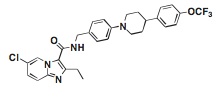
Q203

Q203

A new experimental compound could help. In a paper published online today in Nature Medicine, researchers describe a small molecule called Q203 that thwarts drug resistant tuberculosis infections in mice by targeting the mycobacterial cytochrome bc1 complex—a mechanism distinct from that of existing agents.

“Q203 works in ways [other] drugs do not,” says Kevin Pethe, project head of the antitubercular program at the Institute Pasteur Korea in Gyeonggi-do, who led the study, “and it can work against the resistant bacteria.”

To find the new drug, Pethe and his colleagues screened more than 100,000 different chemical compounds for their ability to inhibit tuberculosis growth in mouse macrophages. They identified 106 molecules that killed the infectious agent without harming the cells. One compound—a kind of imidazopyridine amide (IPA)—stood out for its ability to wipe out drug-resistant strains of tuberculosis isolated from human clinical specimens. The researchers made small changes in the chemical structure of this molecule to derive Q203. They then tested the compound in mice infected with tuberculosis, and observed that animals given Q203 showed fewer lung lesions than those treated with isoniazid, a commonly used first-line anti-tuberculosis agent. Plus, the mice tolerated high doses of Q203 without any noticeable side effects.

To understand how Q203 stopped the bacteria from replicating, Pethe’s team studied six tuberculosis strains that were resistant to the killing power of Q203. By sequencing the genome of these strains, the researchers pinpointed a common mutation affecting the cytochrome bc1 complex, which is involved in energy metabolism. They then measured ATP levels in Q203-sensitive cells and showed that ATP production dropped significantly after treatment with the experimental agent.

The finding that the cytochrome bc1 complex is the primary target of Q203 is consistent with the results of two recent reports showing that IPAs can broadly inhibit energy transduction systems in the tuberculosis pathogen. In one study, a British team from the University of Birmingham and the pharma giant GlaxoSmithKline discovered a series of molecules in this same chemical class directed at the same target, although these compounds were less effective at inhibiting tuberculosis growth as Q203. In the other report, Pethe and his former colleagues at the Novartis Institute for Tropical Diseases in Singapore showed that a panel of 13 different IPA compounds could kill tuberculosis by depleting ATP.

“The IPAs are getting a lot of attention because they are really inexpensive to make, seem to be safe, and work against drug-resistant tuberculosis,” says Marvin Miller, an organic chemist at the University of Notre Dame in South Bend, Indiana, who, together with colleagues at Indiana’s Eli Lilly, reported earlier this year on yet another set of IPAs with promising anti-tuberculosis and pharmacokinetic properties. “They could be very practical.”
Immunologist effort aims to improve hyperlinking of research papers to raw data

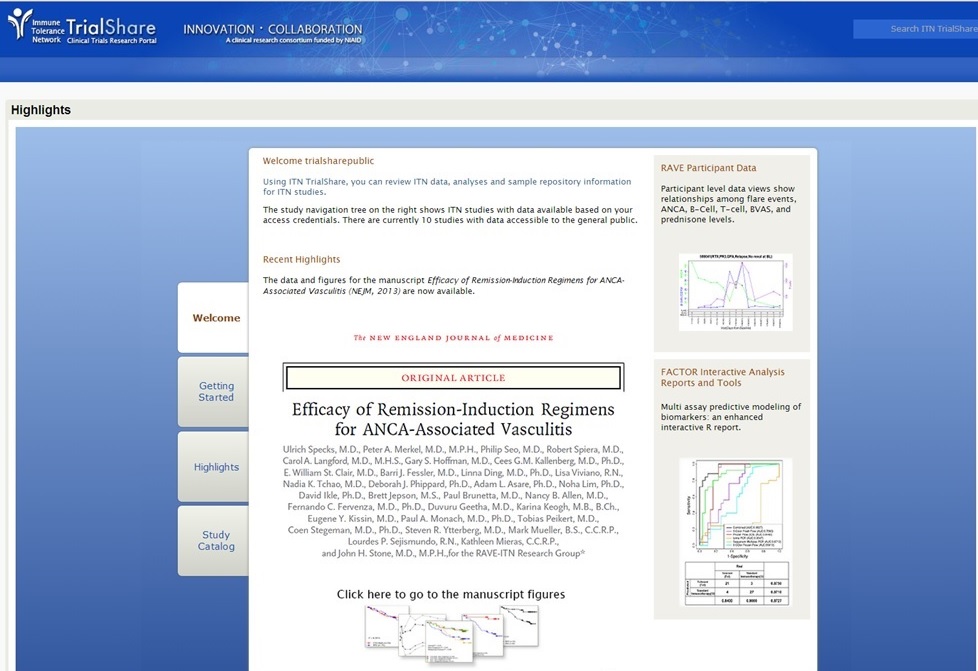
TrialShareA study published today in the New England Journal of Medicine reports that people suffering from ANCA-associated vasculitis, a disease in which the body attacks its own defense system, can now be effectively treated with one month of weekly infusions of rituximab, instead of the standard 18-month regimen with daily pills of cyclophosphamide, which has strong side effects. But that is not the only thing that makes the report noteworthy. According to its authors, the study is the first to contain hyperlinked charts or graphs that redirect users to an information-sharing system called TrialShare, where they can instantly access data amassed during this clinical trial and others.

The interactive platform was developed by the Immune Tolerance Network (ITN), a consortium of clinical researchers who study everything from allergies to organ transplants. The ITN is headquartered in Seattle, Washington, and funded by the US National Institute of Allergy and Infectious Disease, in Bethesda, Maryland.

Even without an online version of the article, anyone can sign on to the website, at www.itnTrialShare.org. However, the site is geared toward researchers who want access to information acquired during a study—for example, the twice daily blood pressure readings of patients that a researcher might have reported as an average instead of logging every measurement—which may not have made it into the published paper or supplementary material. Creators of the website emphasize that the information about the patients is anonymized.

This isn’t the first effort to put more information about clinical trials in the hands—and minds—of more people, with the hope of improving the design of future studies and avoiding redundant work. There are some groups, such as the Biomarkers Consortium, based in Bethesda, Maryland, and founded by a combination of private and public agencies that include the US National Institutes of Health (NIH), focused on specific collaborations that only share research data only among their partnership members. TrialShare, by comparison, is now open-access.

Other databases, such as the Gene Expression Omnibus (GEO) run by the NIH’s National Center for Biotechnology Information, act as repositories for data, but they lack the clinical data seen in the TrialShare site.

Continue reading

Mouse study shows heat shock protein protects against hearing damage caused by common antibiotic

Every drug has the potential to cause side effects. With aminoglycosides, a group of antibiotics that includes those used to treat tuberculosis and other serious infections, hearing loss can affect as many as 20% of people taking the drug. Despite a spate of efforts, there is currently no treatment or prevention for the damage to sensory cells caused by these drugs.

Ear photo

However, in a paper published today, in the Journal of Clinical Investigation, Lisa Cunningham and her colleagues at the US National Institute on Deafness and Other Communication Disorders in Bethesda, Maryland, show that the protective effect of a heat shock protein, HSP70, may provide a new therapeutic option to prevent inner ear cells injury by these antibiotics.

Heat shock proteins (HSPs) are produced by cells in response to stress, such as a sudden spike in temperature. Dubbed ‘molecular chaperones’, HSPs may be best known for their stabilizing role inside cells where they help sort, separate and fold other proteins. But scientists continue to discover the protective role that heat shock proteins can play outside of cells—from activating the body’s defense system to helping repair injured muscle. With a lengthening research record of showing up when cells get injured, HSP70 may be a good therapeutic focus to avert aminoglycoside-induced hair cell death.

“We know diseases can be caused where there is deficient or inadequate chaperone function,” says Rona Giffard, a neuroscientist at Stanford Medical School, in Palo Alto, California. If researchers find a way to increase HSP70 in areas where cells could be harmed, that ability to create a ‘super-response’ may give us ways to support cells that are stressed and unlikely to survive, Giffard says. “We might be able to push cells over the edge, to survival.”

Continue reading

Gilead under pressure to produce stand-alone version of new HIV drug

TAF_TDF

{credit}National AIDS Treatment Advocacy Project{/credit}

In 2001, the US Food and Drug Administration approved a new HIV medication called tenofovir disoproxil fumarate (TDF). Patient advocates hailed the decision, noting that it represented the first novel antiviral agent to get the green light after the FDA turned down a similar drug  two years earlier. But a lot changes in a decade. For one thing, the maker of TDF, Gilead Sciences of Foster City, California, has a newer, better formulation of tenofovir, called tenofovir alafenamide (TAF). Meanwhile, patient advocates at the International AIDS Society Conference in Kuala Lumpur this week are crying foul that the company isn’t working on a stand-alone version of TAF and plans to sell it only in expensive combination pills.

Currently, TDF is available from Gilead as a solo formulation (sold as Viread). It’s also available as part of Stribild, a fixed-drug combination ‘quad’ pill that also includes the drugs elvitegravir, cobicistat and emtricitabine—the four drugs designated for first-line treatment by the World Health Organization. TAF is currently in development as part of three different combination pills: as a dual-drug tablet with emtricitabine; and in two different combination pills, one of which uses TAF as a substitute for TDF in the currently available ‘quad’ pill, and then in another new single-pill treatment which contains darunavir, cobicistat, and emtricitabine.

Without a stand-alone version of TAF, health programs in poorer parts of the world cannot combine it with cheaper alternatives, such as lamivudine, which works like emtricitabine but, at $37 for a year of treatment, costs about half as much.

Continue reading

Rwandan model proposed as solution to deadly scourge of counterfeit drugs

The problem of counterfeit drugs has made headlines in recent years with, for example, the discovery of fake versions of the cancer drug Avastin showing up in US hospitals. But the problem is worst in developing countries, where up to 25% of drugs in developing countries are falsified or substandard, according to the World Health organization (WHO).

Some global health advocates say that international players such as the WHO have not outlined sufficiently effective plans to deal with the problem of counterfeit drugs. In an essay published online today in PLOS Medicine, health policy specialists, including the Rwandan Minister of Health, Agnes Binagwaho, review data from 17 countries and suggest that Rwanda, a country once engulfed in conflict, serves as an example of how a committed approach can safeguard drug supplies.

The essay highlights the safety of Rwanda’s tuberculosis drugs, as reported in a March 2013 study published in The International Journal of Tuberculosis and Lung Disease. In that earlier study, researchers posing as local customers visited 19 cities to obtain 713 samples of tuberculosis treatment medications. No active ingredient was found in almost 10% of all the samples. The proportion of counterfeit drugs rose to 17% among medications taken from the 11 African nations in the study. However, no falsified medications came from Rwanda.

The East African nation’s success is founded on the government’s integrated approach, linking health and enforcement agencies to regulatory control, says Amir Attaran, a senior author on the new essay and a health law expert at the University of Ottawa. Some of the stringent steps the Rwandan government takes include giving drug contracts only to manufacturers with current WHO-approved certificates of good manufacturing practices, mandatory inspections of incoming drug shipments and routine sampling of medications. The country’s Ministry of Health drafted guidelines  in 2011 detailing measures to ensure drug quality, such as setting up agency outposts at 469 health centers to the rollout of patient forms for reporting adverse drug events. Rwanda also banned the majority of private pharmacies in the nation from selling tuberculosis drugs, making it easier to control the drug supply chain.

Continue reading

Researchers question ‘read-through’ mechanism of muscular dystrophy drug ataluren

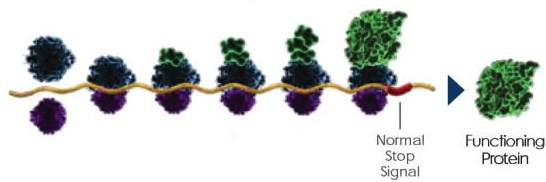
Ataluren's proposed mechanism of action

Ataluren’s proposed mechanism of action {credit}PTC Therapeutics{/credit}

A drug in clinical trials for muscular dystrophy and cystic fibrosis might not work through the molecular mechanism that scientists think it does. Although the new findings do not cast doubt on the clinical efficacy of the medication, the new experiments suggest that researchers might need to double-check that therapeutics believed to rescue normal protein production by helping parts of the cell ‘read through’ the genetic sequences actually do just that.

The drug in question, ataluren, was developed by New Jersey’s PTC Therapeutics to treat illnesses caused by nonsense mutations such as Duchenne muscular dystrophy, a disease in which disrupted production of dystrophin, a protein critical to muscle structure and stability, leads to progressive muscle deterioration. The drug has also shown clinical benefit in the 10% of cystic fibrosis patients with a mutation in the CFTR gene that causes truncated proteins and has potential for treating other ailments, including hemophilia.

Overall, about 11% of genetic mutations found in inherited diseases involve changes in the code of messenger RNA that prematurely stop protein translation to produce a dysfunctional or nonexistent protein product. But ataluren, formerly known as PTC124, was thought to work by cozying up to parts of the cell known as ribosomes and allowing them to ‘read through’ these errors and continue to make a normal protein.

The developers of ataluren had conducted experiments in human embryonic kidney cells in which the drug succeeded in reading over a mutation and restoring normal production of the enzyme firefly luciferase (FLuc), which causes cells to glow. However, two subsequent reports found evidence that ataluren boosted production of FLuc without assisting the read-through of the code for the enzyme.

In a new study published today in PLoS Biology, researchers ran additional experiments and came across more data placing the read-through mechanism in doubt. Stuart McElroy, a molecular biologist at the Drug Discovery Unit at the University of Dundee, UK, and his team tested ataluren against G418 activity, a well-documented antibiotic read-through agent, in four non-luciferase assays and found in each case that G418 rescued production of proteins but ataluren did not. Researchers also manipulated the sequence of nonsense mutations in another 12 assays and, again, found no measureable effect of read-through activity with ataluren.

Continue reading