
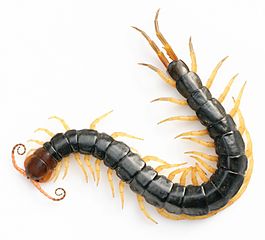
 Placing a Chinese red headed centipede on a burn can speed up the healing process, according to ancient Chinese medicine. But a mouse study published today suggests that what the Chinese interpreted as a healing effect may in fact have been the handiwork of a pain-inhibiting peptide contained within this centipede’s venom, which kills insects but is harmless in humans. The results indicate that the peptide, called m-SLPTX-Ssm6a, is a powerful analgesic that, in some cases, surpasses the effect of morphine. Given its apparent lack of side effects, Ssm6a is seen by scientists as an attractive candidate drug compound that might prove suitable for treating chronic pain.
Researchers first discovered Ss6ma’s effect by screening it, and other peptides, for the ability to inhibit Nav 1.7, a channel located on the surface of nerve cells that allows sodium to transmit pain signals when the cell membrane is depolarized. Nav 1.7’s importance in pain signaling came to light in 2006 when researchers linked mutations in the channel to a rare genetic condition in which people are unable to perceive pain. The finding led many researchers to suggest developing pain medications composed of small molecules that could block the channel.
But there was a problem with this approach: Nav 1.7 is one of nine types of so-called ‘voltage-gated sodium channels’, all endowed with similar channel entrances that, if blocked all at once, would lead to major neurological malfunctions including cardiac arrest. “This makes it really hard to get selectivity,” explains Glenn King, a structural biologist of the University of Queensland, Australia, and a co-author of the study, which appears in the Proceedings of the National Academy of Sciences. Luckily, he says, “toxins found in venoms are much bigger,” so their action does not take place at the channel entrance.
