Under the covers (Nature revealed) – 15 May 2014

In this week’s Under the covers (Nature revealed) blog, Nature’s Art Director Kelly Krause discusses the inspiration behind this week’s front cover choice.

Caption:

Many migrating birds rely on the Earth’s magnetic field for their sense of direction, although what mechanism they use to detect this extraordinarily weak field is unknown. Following the surprise observation that night-migratory songbirds (European robins) tested between autumn 2004 and autumn 2006 in wooden huts on the University of Oldenburg campus seemed unable to orient in the appropriate migratory direction, Henrik Mouritsen and colleagues performed controlled experiments to establish what was happening. They find that robins lose the ability to use the Earth’s magnetic field when exposed to low-level AM electromagnetic noise between around 20 kHz and 20 MHz, the kind of noise routinely generated by consumer electrical and electronic equipment.

Interestingly, the magnetic component of this electromagnetic noise is a thousand times weaker than the lower exposure limits adopted in current World Health Organization (WHO) guidelines, yet it can disrupt the function of an entire sensory system in a higher vertebrate. The birds regain the ability to orient to the Earth’s magnetic field when they are shielded from electromagnetic noise in the frequency range from 2 kHz to 5 MHz or when tested in a rural setting. Credit: Kim Taylor–Dorling Kindersley–Getty/ Karl Harrison–Henrik Mouritsen
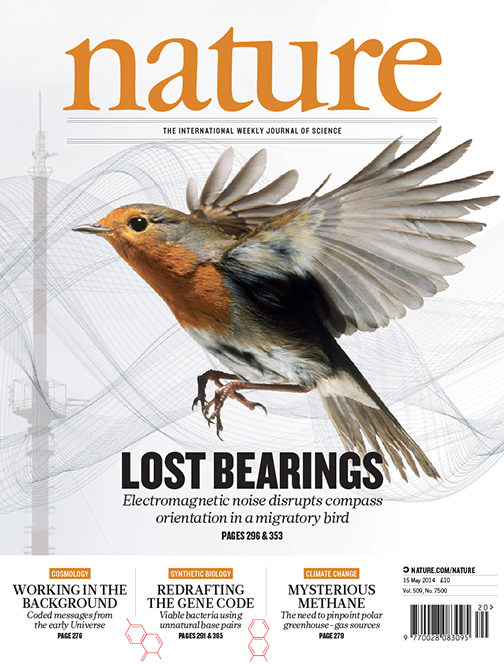
Electromagnetic noise disrupts compass orientation in a migratory bird
Electromagnetic noise disrupts compass orientation in a migratory bird

Continue reading

Under the covers (Nature revealed) – 8 May 2014

In this week’s Under the covers (Nature revealed) blog, Nature’s Art Director Kelly Krause discusses the inspiration behind this week’s front cover choice on the future of synthetic biology.

Caption:

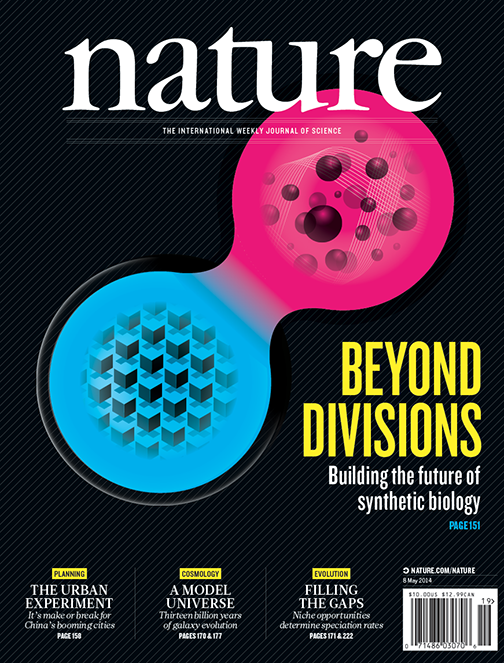
In little more than a decade synthetic biology — building on the foundations of genetic engineering — has developed into a multifaceted field with exciting and sometimes controversial potential. Tools now being developed enable the redesign of existing, natural biological systems to perform specific tasks, and the design and construction of new biological systems with capabilities beyond those achieved in the natural world.

A package of reports and commentaries in this week’s Nature— coordinated with articles in Nature Methods and Nature Reviews Microbiology — surveys the current state of synthetic biology and speculates on what startling advances we can expect to see in the near future. Cover: Thomas Porostocky.

Building the future of synthetic biology.

Building the future of synthetic biology.

Continue reading

Under the covers (Nature revealed) – 24 April 2014

In the latest Under the covers (Nature revealed) blog, Nature’s Art Director Kelly Krause discusses the inspiration behind this week’s front cover choice on the evolution of the Y Chromosome.

Caption:

Mammalian Y chromosomes, known for their roles in sex determination and male fertility, often contain repetitive sequences that make them harder to assemble than the rest of the genome. To counter this problem Henrik Kaessmann and colleagues have developed a new transcript assembly approach based on male-specific RNA/genomic sequencing data to explore Y evolution across 15 species representing all major mammalian lineages. They find evidence for two independent sex chromosome originations in mammals and one in birds. Their analysis of the Y/W gene repertoires suggests that although some genes evolved novel functions in sex determination/spermatogenesis as a result of temporal/spatial expression changes, most Y genes probably persisted, at least initially, as a result of dosage constraints.

In a parallel study, Daniel Bellott and colleagues reconstructed the evolution of the Y chromosome, using a comprehensive comparative analysis of the genomic sequence of X–Y gene pairs from seven placental mammals and one marsupial. They conclude that evolution streamlined the gene content of the human Y chromosome through selection to maintain the ancestral dosage of homologous X–Y gene pairs that regulate gene expression throughout the body. They propose that these genes make the Y chromosome essential for male viability and contribute to differences between the sexes in health and disease. Cover: Daren Newman

The evolution and multiple functions of the mammalian Y chromosome.

The evolution and multiple functions of the mammalian Y chromosome.

Continue reading

Under the covers (Nature revealed) – 10 April 2014

In the latest Under the covers (Nature revealed) blog, Nature’s Art Director Kelly Krause discusses the inspiration behind this week’s front cover choice on brain-wide axonal projection patterns.

Caption:

Axonal projection patterns from 21 distinct cortical areas (differentially colour coded) derived from 21 mapping experiments to sample the entire cortex, and rendered in 3D by the Brain Explorer program. In this issue, Hongkui Zeng and colleagues present the first brain-wide, mesoscale connectome for a mammalian species — the laboratory mouse — based on cell-type-specific tracing of axonal projections. The wiring diagram of a complete nervous system has long been available for a small roundworm, but neuronal connectivity data for larger animals has been patchy until now. The new 3D Allen Mouse Brain Connectivity Atlas is a whole-brain connectivity matrix that will provide insights into how brain regions communicate. Much of the data generated in this project will be of relevance to investigations of neural networks in humans.

A 3D wiring diagram for the mouse brain.

A 3D wiring diagram for the mouse brain.

Continue reading

Under the covers (Nature revealed) – 27 March 2014

In this week’s Under the covers (Nature revealed) blog, which features weekly interviews with the art team at NatureArt Director Kelly Krause explains the decision behind this week’s front cover choice on Quantum Cryptography.

Caption:

Can you keep secrets safe from eavesdroppers? Yes you can, say Artur Ekert and Renato Renner. They argue that recent developments in quantum cryptography, coupled with the fact that we still possess free will, suggest that truly private communication will always be possible, even in a world with access to as yet undiscovered code-breaking technologies. The answer lies in new insights into the nature of randomness and non-local correlations. Thus equipped it should be possible to outsmart even the most powerful surveillance procedures. Cover: Andy Potts

Quantum Cryptography, randomness and cunning can outfox the snoopers.

Quantum Cryptography, randomness and cunning can outfox the snoopers.

Continue reading

Under the covers (Nature revealed) – 20 March 2014

In this week’s Under the covers (Nature revealed) blog, which features weekly interviews with the art team at NatureArt Director Kelly Krause explains the thinking behind this week’s creative front cover choice on Direction-Selective Ganglion Cells (DSGCs).

Continue reading

Under the covers (Nature revealed) – 14 March 2014

In this week’s Under the covers (Nature revealed) blog, which features weekly interviews with the art team at NatureArt Director Kelly Krause explains the thinking behind this week’s creative front cover choice on microfluids.

Continue reading

Under the covers (Nature revealed) – Week 7

In week seven of the Of Schemes and Memes blog series, which features weekly interviews with the art team at NatureArt Director Kelly Krause and Cover Designer Brad Baxley explain the decisions behind this week’s futuristic front cover on quantum droplets. Also, in this week’s blog, Mackillo Kira, one of the paper’s authors, explains the scientific process behind the research.

Continue reading

Under the covers (Nature revealed) – Week 6

In week six of the latest Of Schemes and Memes blog series, which features weekly interviews with the art team at NatureArt Director Kelly Krause explains the decisions behind this week’s striking front cover image focusing on emerging honeybee diseases.

Continue reading