In Your Element round up

Here’s a round up of the In Your Element essays we’ve published so far. Each non-faded element tile links out to the essay about that element in the journal — these are currently free to access. We’ll update this post as and when we publish new essays.

Most recent element added: lutetium

—————-

Some notes:

1. In case you’re looking at the different colours and scratching your head wondering what on Earth I’ve done, the colour scheme was inspired by this periodic table.

2. I’m an editor, not a web designer/programmer, so while this might not be the most elegant solution, it’ll do for now…

3. If you spot any broken links, please leave a comment pointing out the problem. Try not to be too sarcastic.

Reactions coupled with palladium

This month’s ‘in your element’ article (subscription required) is from Matthew Hartings (or @sciencegeist as he is known on Twitter) who proposes the bold idea that, rather than carbon, it is palladium that has assumed the role of most important element in many a famous organic reaction. And so he goes on to elaborate — and it appears that he does have a point. Think of some coupling reactions that were recognized by the Nobel prize in Chemistry two years ago, and of the Wacker process.

Another interesting aspect in the history of palladium is that its incredibly practical role initially stemmed from curiosity. Francis Phillips, Professor at Western University (which now goes by the name of the University of Pittsburgh), came across an example of palladium’s catalytic activity as early as 1894, while studying gases in Pennsylvania. Of course, he didn’t exactly start using palladium to couple all sorts of organic molecules through carbon–carbon bonds, and others must be credited for their role in understanding and developing this reactivity — read the article to find out the roles in particular of Smidt and Heck. But still, in 1894 Phillips had described the reaction of olefins over palladium and noted that no CO2 was formed. The rest, as they say, is palladium-catalyzed chemistry.

I just love old manuscripts — of course I like brand new ones, too! I see these a lot more often — and so I went and located here this PDF of the American Chemical Journal in which the work of Phillips appeared.  Jump to the pages 163 and 255 to find out more about the oxidation and chemical properties of gases.

Anne

Anne Pichon (Associate Editor, Nature Chemistry)

Life and death with nitrogen

During our essay competition last year, quite a few participants who chose to write about nitrogen mentioned that they were interested, intrigued or amused by the fact that nitrogen was deemed ‘lifeless’ when it was first discovered as an element.

It is true that elemental nitrogen — the N2 gas that constitutes a large part of the Earth’s atmosphere — does not on its own support combustion or life. Based on this observation, chemists referred to it as ‘noxious’, ‘fixed’ or ‘burnt’ air, or delightfully antique names like ‘mephitic’ or ‘phlogisticated’ air. This last term comes from the wonderful ‘phlogiston theory’ that appeared in the 17th century to explain combustion (in particular) through the presence of the fire-like element ‘phlogiston’. I’ll leave you to read about it and its decline, which saw phlogiston gradually demoted from a substance to a principle, to an outdated theory when the role of oxygen was better understood.

© ALEX WING

In this issue’s ‘in your element’ article (free to nature.com registrants), Michael Tarselli — the author of the winning entry on nitrogen for last year’s competition — mentions quite a few traits of nitrogen that illustrate just how obsolete its previous appellation is.

Although N2 is colorless, odorless, tasteless, and really not very reactive, we’re spoilt for choice when it comes to mentioning nitrogen’s involvement in crucial processes. Both chlorophyll and haem enzymes, for example, rely on porphyrins to take care of the tiny matters of photosynthesis and transporting oxygen in the blood. A possible way to ferry hydrogen as a fuel is through ammonia borane (H3N–BH3) complexes and — to stay in the realm of renewable energies — the ‘hangman’ architectures devised by the Nocera group as active water-splitting catalysts also feature a macrocycle coordinated to a cobalt centre through nitrogen atoms.

Of course we can find many examples of nitrogenated compounds that do have pretty harmful effects, either on the environment or our health — Tarselli explains how the high nitrogen:carbon ratio of melamine (nitrogen-packed 1,3,5-triazine-2,4,6-triamine) recently attracted attention for all the wrong reasons.

On an ambiguous note, the Haber–Bosch process developed in the early 20th century to ‘fix’ N2 and convert it into useful species (something some plants do very well but chemists not so easily) produces ammonia and other nitrogenated species by reacting N2 and H2 over an iron catalyst. It was quickly put to use, to make both nitrates for the gunpowder and explosives of World War I and cheaper fertilizers that would dramatically boost food production worldwide. I refer you to this C&EN article on the topic.

But it’s impossible to try and mention all of the fields greatly impacted by nitrogenated species. I’ll just mention another one of nitrogen’s traits, for those of you who like bangs and flashes: its tendency to form explosive compounds. Just think of the well-known TNT, nitroglycerin, nitrogen triiodide, but also the recently synthesized azobis(tetrazole) (C2H2N10!)

Anne

Anne Pichon (Associate Editor, Nature Chemistry)

Peculiar protactinium

In this month’s ‘in your element’ article (subscription required), Richard Wilson from the Argonne National Lab presents some peculiar aspects of protactinium’s history and properties.

One of protactinium’s particularities is that it was independently identified (and named) twice, just a few years apart. In 1913, Kasimir Fajans and Oswald Helmuth Göhring discovered a short-lived element 91 (234mPa) — whose half-life was only one minute — which they accordingly named brevium. A few years later, in 1918, when Lise Meitner and Otto Hahn were examining a silica residue extracted from pitchblende, they successfully identified the element that decays into actinium. It turned out to be a different isotope of brevium (231Pa) — but one that had a much longer half-life. This gave their suggested name, protoactinium (which later evolved in the simpler protactinium), the edge over Fajans’ brevium.

© SHUTTERSTOCKPHOTO.COM
TISCHENKO IRINA

Protactinium isn’t really so well-suited to extensive, thorough, detailed characterization — it is rare, difficult to isolate, highly radioactive and toxic. It further confused chemists by its seemingly contradictory properties. Was it a transition metal, as its pentavalent oxidation state seemed to suggest? An actinide, owing to its tetravalent oxidation state available on reduction? The situation became clearer once the place of actinides in the periodic table was established — yet protactinium still differentiates itself from most actinides, find out how in the article.

Despite a period of activity related to thorium-based nuclear power, protactinium hasn’t elicited much interest in terms of practical applications. Its electronic structure however, especially owing to its 5f electron, makes it a very valuable element in computational studies to understand the reactivity of 5f elements. As Richard Wilson observes, “[protactinium’s] future contributions to chemistry may well come from where Meitner and Hahn first found it, in silico”.

Anne
Anne Pichon (Associate Editor, Nature Chemistry)


Ambiguous bromine

At first sight bromine seems to be ‘just another halogen’, a helpful counter-anion or leaving group in SN2 or cross-coupling reactions. Of course this isn’t the whole story, as Matt Rattley — a chemistry student at the University of Oxford and the author of the winning essay on bromine for last year’s contest — points out in his article (subscription required).

Bromine was isolated independently by Carl Jacob Löwig from a mineral water spring, and Antoine Balard from seaweed, in 1825 and 1826. Having identified that he’d obtained a substance between chlorine and iodine, Balard first thought it was idodine chloride before recognizing it as a new element. It seems unclear who exactly from Balard or Gay-Lussac thought of the name brôme but we know it comes from the Greek bromos, stench — a fair description of gaseous bromine. In addition to its rather unpleasant smell, bromine is also toxic — as Rattley puts it, bromine’s orange-brown colour is convenient because “avoid it you should”. In the sunlight, elemental bromine (Br2) splits into radicals that readily attack other species, including lung tissues.

Brominated compounds have been used throughout history for a variety of purposes, with varying degrees of success — find out in the article how one was dangerous (likely lethal, really) to ancient Egyptians in the seemingly mundane form of a lipstick. More successful applications include that of potassium bromide, which acts on the nervous system, as an efficient epilepsy remedy, an anticonvulsant and a sedative during the late-19th and 20th centuries. It still is used in veterinary medicine, but bromide’s chronic toxicity has since put a stop to human uses. Other instances have also exploited toxicity — Rattley mentions the insecticide chlorenapyr, whose rather peculiar structure comprises three different halogens — while in others no particular problems arose. A polybrominated dye for example has been widely used to stain various cell components for imaging purposes.

In light of such diversity, it certainly doesn’t seem unreasonable to think that bromine will continue to feature prominently both in research and practical applications.

Anne

Anne Pichon (Associate Editor, Nature Chemistry)

The four worlds of carbon

Our element of the month is carbon. Carbon is so ubiquitous, with its various allotropes and as part of the many, many compounds and living organisms it makes up, that it’s hard to know where to start. Well, why not in New York City? As Simon Friedman from the University of Missouri Kansas City — interviewed here in Reactions — puts it in his article (subscription required) “The organic chemist’s view of carbon can be like the New Yorker’s view of the world, which to them ends at the edge of Manhattan.” And so he goes on to explain.

The first world of carbon is undeniably organic chemistry, with the incredibly varied species — such as drugs, pesticides, dyes — that it endeavours to synthesize. Yet beside the undisputed, elegant role carbon assumes in organic chemistry, it is also a key component of steel. It is true that iron is by itself a useful material, but it is carbon doping that converts it into steel, an altogether much stronger, much more durable material that can be used to build robust structures. Read Friedman’s article to find out how carbon atoms achieve this.

Another world of carbon — also related to materials and their bulk properties — that has become an inherent part of our lives is plastic. It’s hard to fully grasp just how omnipresent plastics are, from invaluable and advanced items (for example, lenses implanted within the eye) to an unfortunate mountain of junk items filling up landfill sites and even covering a vast area of the Pacific Ocean. Some forms of carbon really are forever, or close enough that we must think carefully about whether this is a good thing or not before (over)using them.

Finally, the last thing you can do with your carbon-based molecules is burn them for energy. We’ve been relying on oil, coal and natural gas for energy — yet in terms of usage of carbon this is more than a little upsetting. I particularly like how Friedman expresses this sentiment: “to the organic chemist, simply burning carbon for its energy must surely be akin to burning your books when you are cold, or eating next year’s seeds when you are hungry”.

Anne


Anne Pichon (Associate Editor, Nature Chemistry)

Element of the month: Counting on copper

Readers of this blog will be familiar with last year’s essay competition — as Stuart mentioned here a few days ago, the winning  essay on copper, written by Tiberiu Moga, appears in this month’s ‘in your element’ feature.

Copper has been part of our lives pretty much for ever — the Copper Age started around 5,000 BC (give or take a couple of thousand years depending on whether you count the Copper–Stone Age or not), made its way into epic poetry (read the article to find out how it features in the Kalevala) and copper-based materials are still virtually everywhere, from the humble penny to electrical wiring. So what exactly does copper do, apart from giving her copper(II) carbonate-green colour to the Statue of Liberty? Scientifically speaking, lots of things.

Moga is a Medical Doctor student at the University of Toronto, and previously studied both chemistry and biology at Dartmouth College — he is thus particularly interested in copper’s biological functions and catalytic role in the synthesis of new medicines. He identifies three processes that cover most of its abilities: Lewis-acid catalysis, single-electron-transfer processes, and two-electron-transfer reactions.

One of the best-known reactions involving copper as a Lewis acid is the popular ‘click’ azide–alkyne cycloaddition that connects the two groups to form an azole ring. This fast, reliable reaction is generally easy to carry out and makes for a highly efficient step in a wide variety of processes including, for example, natural product total syntheses.

Single-electron-transfer processes where copper adopts either a Cu+ or Cu2+ form are widespread in biosystems. Cellular respiration in organisms, for example, relies on a succession of these steps carried out by copper-containing enzymes to oxidize glucose, and extract its energy. Two-electron transfer reactions are also common — they go through a slightly more complex mechanism involving a halide ion.

Of course, this is by no means an exhaustive list. Copper is looking increasingly like a good alternative to palladium catalysts, and it’s also a useful building block — remember the copper nanotubes?

As it turns out, we’re still very much in a copper age, and it looks all set for the duration.

Anne


Anne Pichon (Associate Editor, Nature Chemistry)

Urey, deuterium, and the Rosenbergs

Posted on behalf of Dan O’Leary. It’s a bit much longer than our usual blog entries, but it is more than worth it. Grab a coffee (or other favourite beverage), sit back, and enjoy — Stuart

— — — — — — — — — — — — — — — — — — — —

This month’s In Your Element essay is entitled ‘The deeds to deuterium’ (subscription req’d). I appreciate Stuart letting me take on the essay, for which he provided such a clever title, and for the opportunity to write this blog post. Many thanks also to Sarah Roh, a Pomona College student who previously fused anime and isotope effects, for the artwork featured in this project.

Now here’s a question: why did the hydrogen isotopes garner names when all others remained numerical? Harold Urey, George Murphy, and Ferdinand Brickwedde published spectroscopic evidence for the mass-2 form of hydrogen in 1932 (ref. 1) and suggested the name deuterium shortly thereafter (ref. 2). They thought a unique name was justified because it would alleviate any formulaic confusion caused by the use of ‘hydrogen two.’ In Cathedrals of Science, Patrick Coffey writes (ref. 3) that Frederick Soddy, who coined the term ‘isotope’ after a suggestion by Margaret Todd, wasn’t even sure that the heavy form of hydrogen met his definition of an isotope. In his view, isotopes had different atomic mass but identical chemical properties. The large mass difference between 1H and 2H gave deuterated substances unique properties relative to their lighter counterparts, thus making their discovery more elemental. Writing in the 1933 pages of Nature (ref. 4), Ernest Rutherford surmised “…the question of a suitable nomenclature is in this case of such general importance to scientific men that it deserves very careful consideration.”

When I started researching the IYE essay, however, I wasn’t much interested in isotopic appellations. I thought that part of the story was old news. At the outset of my research, I was much more intrigued by Harold Urey the person.

While I didn’t know much about him, I had read somewhere that Urey was involved in the Rosenberg espionage case in the 1950s. Chronicling his involvement in that hysteria-induced American tragedy would make for an intriguing essay, I thought, something along the lines of: deuterium & Nobel provide scientist with platform for Cold War political activism. But letters in his archive caused me to change my plan and I instead wrote a piece describing how Urey’s heavy-handed former doctoral advisor played a key role in his decision to name the mass-2 isotope ‘deuterium’. But before we get to that part of the story, indulge me with the activism angle for several more paragraphs.

Urey argued publicly that it made no sense to execute Julius and Ethel Rosenberg, but that was their fate after a brief trial in 1951. The evidence against them and the quality of the atomic secrets they supposedly passed, as known by the public at the time, were disputable. Declassified documents and other information, some made available as recently as 2008, suggests that only Julius was directly involved in delivering classified atomic information to the Soviets. Other conspirators were given prison sentences, but the government’s case against the Rosenbergs came down to a game of chicken in which Ethel could have avoided the electric chair if she testified against her husband. She remained silent, and they were executed within minutes of each other at Sing Sing prison on June 19, 1953.

Urey’s papers (ref. 5) are archived at the University of California at San Diego. An extensive set of documents provide a roadmap of his efforts to galvanize support within the scientific community and speak with the public about the case. The scientist in Urey left an imprint on the record, such as his use of charts to diagram the real and inferred flow of information between the Rosenbergs and Soviet General Consul Anatoli Yakovlev, Klaus Fuchs, Harry Gold, Morton Sobell, and David Greenglass (Ethel Rosenberg’s brother who testified against them at trial and served a 10 year prison term).

Urey even wrote personal appeals to Presidents Truman and Eisenhower to reverse the execution order. When these efforts failed, Urey largely withdrew from the cause and from communists eager to ally themselves with him. Particularly telling is a handwritten draft of a 12 February 1953 telegram (ref. 6) sent to an organizer hoping to use a pre-recorded Urey speech at a Los Angeles rally protesting newly-elected President Eisenhower’s decision not to commute the death sentences: “I believe meeting should be held and do not wish my recording to be used. Case will now be used by communists to embarrass the U.S. (emphasis his) and I do not wish to help them. We can not help the Rosenbergs. (text strikeouts his) Harold C. Urey”

In an unpublished 1970 autobiography (ref. 7), Urey wrote: “I doubted seriously if justice had been done. My own concern was not a matter of communism or capitalism of my country or some other country at all, it was only a question as to whether justice had been done by the courts of the United States. That was my interest entirely. I was not a friend of the Rosenbergs or Sobell.”

Although there is evidence in the archive suggesting Urey regretted his involvement in the Rosenberg case, his spirits were lifted by a letter dated 17 June 1953, which read: “Dear Urey, your intervention in the Rosenberg case has been one my most heartening experiences in the human sphere. With kind greetings and my highest respect, yours, A. Einstein.” Urey responded (ref. 8) on 25 June, saying in part “But your support of my position and your letter have been most heartening to me, for very few scientific people have troubled to consider the case at all.”

So the IYE essay was almost about the deuterium-enabled Urey and his frustrating quest for justice in the Rosenberg case. But the essay could have been about other heavy topics, such as H-bombs and their deuterated fusion cores, prepared by a post-war team led by Ferdinand Brickwedde. Of these devices, Urey — himself a key player in the Manhattan Project — wrote (ref. 7): “I once thought deuterium would be as useful as to be produced in small amounts to be used for trace techniques in chemistry, and turns out to be an important part in the hydrogen bomb. I am sorry that that it is part of such a destructive instrument as that, and I would be awfully glad if it were not.”

I was taking a break from Rosenberg-related material at the UCSD library when I reached for a folder containing letters between Urey and Brickwedde, his collaborator and supplier of hydrogen enriched in the heavy isotope. This correspondence, dated May and June of 1933, surprised me. It revealed that Urey and Brickwedde were all over the place in terms of what to name the ‘the hydrogen.’ Early candidates, beyond ‘iso-hydrogen’, were property-based: Pycnydrogen or pycnogen [pycnos = thick or dense (Greek)], barydrogen, barogen, or barhydrogen [baro/bary/bar = weight, heavy (Greek)]. Urey was favoring pycnogen in the first of these letters (ref. 9).

Brickwedde then suggested a numbers-based system inspired by a colleague: diplogen or diplohydrogen for the heavy form while hydrogen would become haplogen or haplohydrogen [diplous = double (Greek), haplous = single (Greek)]. He anticipated that Urey wouldn’t like those names and wrote “I know you won’t like them when you first hear them but after a few days they don’t sound so bad.”
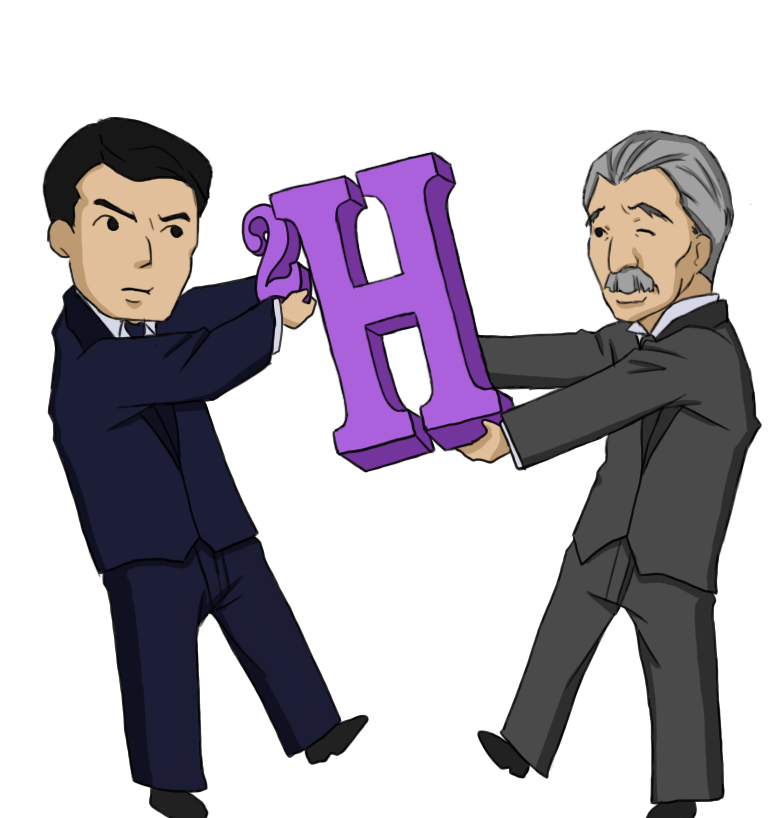
Urey vs. Lewis. Credit: Seo (Sarah) Roh

Where was the name deuterium in these exchanges? Well, if Urey has been considered the naming protagonist then it is only fitting this drama has a deuteragonist. The character of secondary importance was none other than Urey’s doctoral advisor, G.N. Lewis. He was also working on the isotope and had lobbied Urey to name the isotope dygen. Then he changed his mind and suggested the name deuton for the mass-2 nucleus. This suggestion, coupled with Brickwedde’s numerical proposition, seems to have inspired Urey to consider the name deutium and then, after consulting Greek experts at Columbia University, deuterium. These names worked nicely, because they could be bookended by names like protium or proterium and tritium or triterium. Urey and his crew ultimately decided to go with protium, deuterium, and tritium and published these in the Journal of Chemical Physics on 1 July 1933 (ref. 2).

One of my favorite quotes from the exchange is Urey’s prediction (ref. 9) to Brickwedde on 6 June 1933: “As to tritium, it will probably never be needed, for we have proven here that it does not exist to more than one part in five billion of protium, and therefore, I believe it does not exist at all.”

A year or so later, tritium’s existence was discovered in Ernest Rutherford’s deuterated collision experiments. As noted earlier, the Right Honourable Lord Rutherford — who named the proton — also had strong nomenclature opinions and published his preferences in Nature on 23 December 1933: diplon for the nucleus and diplogen for heavy hydrogen (ref. 4). Urey’s names persisted, although it took some time for the matter to settle down. News of the disagreement went as viral as one could imagine in the 1930s, with Time magazine even reporting on the controversy (ref. 10).

A very detailed account of the interactions between Lewis, Urey, and Rutherford was written by physicist Roger Stuewer in 1986 (ref. 11). In addition to the diplon/diplogen possibility, Rutherford had also considered deuteron/deuterogen and dion/diogen as names for the nucleus and the heavy isotope and was discussing names with Lewis before he did with Urey. Stuewer also chronicles a part of the story that was new to me, that Urey apparently lost his temper at a meeting of the American Physical Society on 19 June 1933, where he introduced his soon-to-be published names and received a negative response.

Missing from accounts such as Steuwer’s is what was happening within the Urey camp. It is now clear that it was Lewis who suggested a name based upon the Greek deuteros, and Urey grudgingly says as much in a letter to Brickwedde. Of course, you’ll need to read the IYE essay to see his exact language. The letters in the UCSD archive left me with the impression that some historical accounts need correcting. Coffey’s Cathedrals, for example, accurately portrays Lewis as trying to influence Urey but is incorrect in asserting that Urey “had already decided the isotope’s name.” Then again, Coffey studied correspondence from the Lewis archive at UC Berkeley, and these letters reflect only what Urey wanted Lewis to hear. The Urey–Brickwedde exchange puts the matter in a new light. One can imagine Urey maintaining a poker face in communications with his overstepping former advisor. Stuewer’s article affirms this view by reproducing tracts from the Urey–Lewis correspondence, and in these Urey comes across both polite and blunt.

On 18 May 1933: “As to the name deuton for the hydrogen two nucleus, it is a very suggestive one. My own personal reaction to it, however, is that it is unnecessary [to provide a name for something not a fundamental particle].” And later in the same letter, Urey wrote (ref. 11): “If the California group will not give us a little time and be a little patient, they will force us into publishing a name for this isotope which may not be satisfactory for some reason or another. I would suggest, therefore that the California group use the name hydrogen two provisionally and allow the discoverers of this element to name it when they see fit.”

It’s interesting that the Urey archive at UCSD, as extensive as it is, does not catalogue any Urey–Lewis or Urey–Rutherford correspondence. In their absence, the record is defined by the drafts sent or received by Lewis and Rutherford (ref. 11). Steuwer’s excerpts project Urey as diplomatic once he’s made up his mind to publish his names. After writing a measured letter outlining protium/deuterium/tritium to Lewis on 29 May 1933 he closes with a request to hear Lewis’ opinion of them before publication. Lewis, who by Steuwer’s account had started the naming rush in the first place, answered by saying he felt Urey’s names were “very good” although he would “slightly prefer ‘protium’ and ‘deutium,’ or even ‘protum’ and ‘deutum’… .” But he also realized that he had caused a ruckus and closed with “kindest regards, and apologies for the deuton’… .”To a 20 June Rutherford letter outlining the diplon/diplogen, deuteron/deuterogen , and dion/diogen possibilities, Urey responded on 6 July outlining the names he was publishing and apologized for not reaching out to scientists in Europe regarding the names, citing the rush caused by the Berkeley people. He added that it was “interesting that so many people have thought of very much the same names.”

But there is another snippet (ref. 11) from that 6 July letter that is perhaps most revealing about how Urey felt about the entire nomenclature quagmire. “Protium” and “deuterium,” Urey wrote to Rutherford, were “as good a compromise as we could get.”

In his autobiography written some forty years later, Urey wrote (ref. 7) of Lewis’ presence in the hunt for deuterium: “I have always felt badly about Professor Lewis’ attitude in this matter. I have tried in the years since then, whenever my former students make an important discovery, to help them as much as possible rather than to try to take the subject matter away from them.” In a 1972 children’s book about Urey (ref. 12), written from the autobiography, these sentiments were rephrased as “Urey felt a little hurt at this. In future years, whenever one of his students made an important discovery, he tried to help the student as much as possible, rather than take the subject away from them.”

Urey’s philosophy of support for his students — forged in the early deuterium years — is probably best exemplified by one of his other significant works, the single-authored Science paper by then-graduate student Stanley Miller, whose Miller–Urey experiment opened the field of prebiotic chemistry. Urey has been quoted (ref. 13) as saying “There are a lot of people around who are smarter than me. But I pick only the most important problems.” Indeed, these contributions included a method to determine geological temperatures, the development of the field of cosmochemistry, and providing a leading role in lunar science and exploration. Any one of these accomplishments would have made a scientist’s career. Readers who want to learn more about Harold C. Urey, a remarkable chemist, are encouraged to read his biographical memoir at the US National Academy of Sciences.

DAN O’LEARY is in the Chemistry Department at Pomona College in Claremont, California 91711, USA.
e-mail: doleary@pomona.edu

References

1. Urey, H. C., Brickwedde, F. G. & Murphy, G. M. Phys. Rev. 39, 164–165 (1932). [LINK]
2. Urey, H. C., Murphy, G. M. & Brickwedde, F. G. J. Chem. Phys. 1, 512–513 (1933). [LINK]
3. Coffey, P. Cathedrals of Science: the Personalities and Rivalries That Made Modern Chemistry. Oxford University Press, 2008.
4. Rutherford, Rt Hon. Lord Nature 132, 955–956 (1933). [LINK]
5. Harold Clayton Urey Papers, Mandeville Special Collections Library, University of California, San Diego. An online catalog of the collection can be found here.
6. Rosenberg file, Harold Clayton Urey Papers, Mandeville Special Collections Library, University of California, San Diego.
7. Unpublished autobiography dated 1970, Harold Clayton Urey Papers, Mandeville Special Collections Library, University of California, San Diego.
8. Urey–Einstein correspondence, by date, Harold Clayton Urey Papers, Mandeville Special Collections Library, University of California, San Diego.
9. Urey–Brickwedde correspondence, by date, Harold Clayton Urey Papers, Mandeville Special Collections Library, University of California, San Diego.
10. Science: Deuterium v. Diplogen
11. Stuewer, R. H. Am. J. Phys. 54, 206–218 (1986). [LINK]
12. Silverstein, A., & Silverstein, V. Great Men of Science: Harold Urey, the Man Who Explored From Earth to Moon. John Day Company, 1971.
13. Harold Urey, Scientist, Dies at 87; War foe’s work led to H-bomb

Element of the month: Cool as helium

This month’s ‘in your element’ article (subscription required) is also a winning entry from last year’s competition. Christine Herman, known on Twitter at @CTHerman, a PhD student at the Department of Chemistry, University of Illinois at Urbana-Champaign, who also likes to write about science — for example she contributes to C&En’s Just Another Electron Pusher — shares why she loves helium.

In 1868, astronomers Jules Janssen and Norman Lockyer — who was about to found a certain Nature journal — both noticed (independently) a bright yellow line in the spectrum of the Sun that could not be accounted for by known elements. The suggestion that this line might come from an element present in the Universe but so far undiscovered on Earth seemed bizarre at first, but was to be later unambiguously backed up. Luigi Palmieri detected this element in 1882 in Mt Vesuvius’ lava, and William Ramsey managed to isolate it in 1895 by treating a sample of the uranium mineral (cleveite) with sulfuric acid, liberating helium that had been produced by the radioactive decay of uranium.

It’s perhaps no wonder that this noble gas wasn’t noticed earlier — it is, after all, colourless, odourless, tasteless, non-toxic, and escapes easily from the Earth’s atmosphere so that its concentration is only about 0.0005% by volume. It does however get trapped under the surface, usually with natural gas, and this is where we get the helium we need.

And need it we do, not just for balloons and squeaky voices at parties. You already know this if you’re, among other things, a paleontologist, a deep-sea diver or an arc welder; read Herman’s article to find out more.

She does make a fair point — helium is cool. So much so that many scientists in many fields (for example physics and medicine but also nuclear energy applications) use it as a cryogen. And if you go down to temperatures below 2 K, helium becomes downright bizarre and very intriguing: it adopts a superfluidic state that has no viscosity but a very high thermal conductivity. It is also enticing to chemists who, undeterred by its inertness, keep trying to combine it with various elements. Some of these — excited dimers rather than actual compounds — went on to find a use in lasers.

And, as if helium wasn’t exciting enough in its own right, antihelium observed last year made for the heaviest anti-particles produced so far. All in all, colourless, odourless, tasteless, non-toxic element 2 is very far from dull.

Anne


Anne Pichon (Associate Editor, Nature Chemistry)


Element of (last) month: A pinch of sodium

In the midst of the blog relaunch, a trip to China last December (which I plan on telling you about in a future post), and the end-of-year holiday period followed by a start-of-year busy period, I didn’t get the chance to write about our December in your element article. This is the first competition winning essay that we’ve published — I think I did mention last year’s essay competition a couple of times.

Margit Muller – PhD student in pharmacology at the University of Copenhagen – highlights how sodium is far from being as mundane as it may seem. Wise daughters from old fairy tales who tell their royal father they love him as much as sodium chloride (they might have said “salt” in the original version) know this, but let’s take a look at the chemistry arguments.

Since its discovery in 1807 by Sir Humphry Davy – who was on a rather impressive element-discovering spree – sodium has amazed chemists. Reports dating back to the 1850s already describe its spectacular reactivity, including its reaction with water that contributes to entice generations of (mischievous) school kids to chemistry according to some Reactions pieces. Among other applications, it is also what makes for pretty yellow flames in fireworks.

Read the article (subscription required) to find out just how crucial sodium is in biological processes, and how essential it is to maintain a good balance of sodium outside and within the cells. Membrane proteins are in charge of controlling specific sodium channels, which let Na+ ions in and out of cell as required and regulate all sorts of processes related to pretty much everything we do, from muscle contraction to neurotransmission. You have been warned, disturbing this sodium influx can have pretty serious consequences! For example, this is just what makes tetrodotoxin from pufferfish (or fugu) — one of the most toxic substances on earth — poisonous…

Anne


Anne Pichon (Associate Editor, Nature Chemistry)