Blue LED discovery wins Physics Nobel

Nobel

{credit}Akademie/Alamy{/credit}

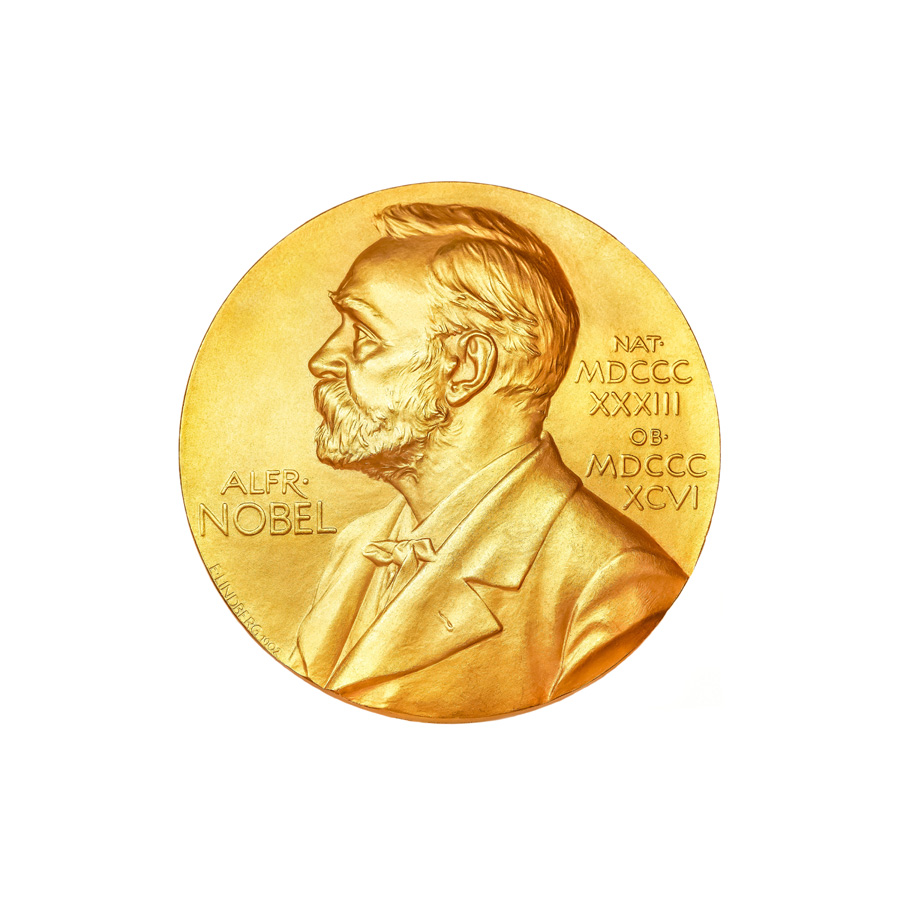
The 2014 Nobel Prize in Physics has been awarded to Isamu Akasaki, Hiroshi Amano, and Shuji Nakamura.

The three researchers won the award for their invention of diodes that emit blue light, “which has enabled bright and energy-saving white light sources,” the prize-awarding committee announced in Stockholm today (see press release).

Combining blue, green and red diodes creates a long-lasting, efficient white light. But despite earnest industry efforts to work out how to get gallium nitride-based semiconductors to shoot out blue beams, it took until the 1990s before Akasaki and Amano – working together at Nagoya University in Japan – and Nakamura, working at a company in Tokushima called Nichia Chemicals, made the breakthrough.

Nakamura, like the other winners, was born in Japan. But in 2000, he left the country to take up an academic position at the University of Santa Barbara in California, and is now a US citizen. At the time, he said that the United States offered better working conditions: “Japanese industrial research and development may be on its way to becoming obsolete.” He later sued Nichia Chemicals over the compensation he received for inventing the blue LED technology, in January 2005 eventually settling for ¥840 million ($7.6 million at the time).

Update 2.25pm

Scientific American have a profile of Nakamura, written in 2000, which reveals how hard he had to push to develop the technology at Nichia Chemicals:

In January 1988 [Nakamura] bypassed his boss and marched into the office of Nichia’s CEO, Nobuo Ogawa, with a list of demands. He wanted about $3.3 million in research funding to work on blue-light devices and also a year off to study metallorganic chemical vapor deposition, or MOCVD, at the University of Florida. MOCVD was then emerging as the technology of choice for producing exotic semiconductors, such as the ones capable of emitting blue light.

Nakamura’s move would probably raise a few eyebrows at most in a small American start-up company, but it was absolutely outrageous in the feudal, seniority-based Japanese system. “I was very mad,” he explains, when asked what prompted his ultimatum. “I wanted to quit Nichia. I didn’t care about anything. It was OK for them to fire me. I was not afraid of anything.”

Much to his amazement, Ogawa simply agreed to all his demands.

Nature full news story on the prize is here.
Schön loses last appeal against PhD revocation

schon

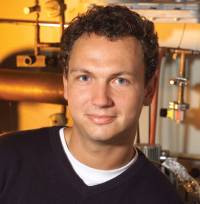
Jan Hendrik Schön
{credit}Materials Research Society{/credit}

The German Federal Constitutional Court in Karlsruhe has confirmed on 1 October that the University of Constance was within its rights to revoke the PhD thesis of physicist Jan Hendrik Schön, who was dismissed in 2002 from Bell laboratories in Murray Hill, New Jersey, for falsifying research results.

Schön was still in his early 30s when he was dismissed after being found guilty of 16 counts of scientific misconduct.

He had worked in nanotechnology and had been considered a star scientist, able to create transistors out of single molecules. He published numerous papers in rapid succession in high-profile journals, including Nature and Science.

Two years later, following local investigations in Germany, the University of Constance decided in to revoke the PhD it had awarded to Schön in 1998. The university said that although it had no evidence that Schön engaged in wrongdoing during his PhD work, he no longer merited the degree because he had brought science into disrepute.

Schön has appealed that decision through different courts, and in 2010 a court in Freiburg ruled that he should get to keep his graduate degree. But the Federal Constitutional Court has the last word, and the university’s decision stands.


CERN at 60: Biggest moments at flagship physics lab

LEP-startup

CERN director Carlo Rubbia (wearing tie) and other staff celebrate the first particles racing through the Large Electron-Positron collider on 4 July 1989.
{credit}CERN{/credit}


CERN, Europe’s particle-physics laboratory and the place famous most recently for the discovery of the Higgs boson, is celebrating its sixtieth birthday today.

The name CERN originally was the French acronym for Conseil Européen pour la Recherche Nucléaire, or European Council for Nuclear Research, and its convention officially came into force on 29 September 1954. In the wake of a war that had torn the continent apart, a small group of scientists and policy-makers created CERN in an attempt to use fundamental research to reunite Europe.

From 12 founding members, the organization has today grown to 21 states, with scientists at the lab hailing from almost 100 countries around the globe.

While CERN hosts a celebration at its home near Geneva, Switzerland, Nature looks back at some of the lab’s most significant moments from the past six decades. The links below are to a mixture of free and paywall pages, and will no doubt miss out many big CERN moments. Please add your own to the comments section below.

1954: CERN is set up. Nature outlines plans for the organization in an essay published in October of the previous year. CERN’s ‘official birth’ had come in 1952, with an agreement establishing the provisional council.

1968: Georges Charpak invents the multiwire proportional chamber. Until this time, particle physics had looked for traces of particle collisions by photographing their wake in bubble chambers or spark chambers. Charpak’s invention — a gas-filled box in which amplifiers boosted the signals detected by each wire — allowed for a 1,000-fold increase in detection rate. To this day, most high-energy physics experiments still use detectors based on this principle. Charpak’s Nature obituary in 2010 celebrated his life and achievements.

1978: CERN stores antiprotons for the first time. Paul Dirac had predicted the existence of antimatter in 1928, and antiprotons were discovered in 1932. In 1978, CERN succeeds in circulating several hundred antiprotons for 85 hours in a machine called the Initial Cooling Experiment, in a study aimed at exploring the feasibility of colliding beams of high-energy protons and antiprotons. Today CERN’s antiproton decelerator delivers low-energy antiprotons  for studies a range of experiments studying the properties of antimatter.

1983: CERN’s 6.9-kilometre-long Super Proton Synchrotron (SPS) discovers the particle carriers of the weak force, the W and Z bosons. In this Nature News and Views from April 1983, Frank Close, a particle physicist now at the University of Oxford, UK, discusses the first signs of the W boson at the SPS’s UA1 experiment, and hints that the Z will be next.

1984: According to a Nature News & Views (penned by John Maddox, then Nature‘s editor-in-chief), CERN discovers the top quark, the last missing element in the family of six known quarks that includes the ‘up’ and ‘down’ quarks that make up protons and neutrons. That announcement, however, will turn out to be premature, and the credit for the discovery of the top quark now goes universally to CERN’s biggest US competitor, the Fermi National Accelerator Laboratory (Fermilab) in Batavia, Illinois. It found the top quark in 1995.

1989: CERN computer scientist Tim Berners-Lee’s drafts a paper outlining plans for an information-management system, which at the time he termed “the mesh” but which later becomes known as the World Wide Web. Berners-Lee’s boss, Mike Sendall, famously replies that the proposal was “vague, but exciting”, giving Berners-Lee the green light for development. The world’s first web page address is born the following year (this copy is from 1992).

2000: The 27-kilometre Large Electron-Positron (LEP) collider at CERN closes after 11 years of operation to make way for the Large Hadron Collider (LHC), to be built in the same tunnels. LEP experiments have confirmed the Standard Model, the theory that describes fundamental particles and forces, to an extraordinary degree of precision. Nature reporter Alex Hellmans reports on the melancholy, and hope, in the wake of the shutdown.

2012: On 4 July scientists at the LHC’s ATLAS and CMS experiments announce that they have found a clear signal of the Higgs boson, and reporter Geoff Brumfiel records the moment in a live blog (and later in an article). The announcement, made by the ATLAS and CMS experiments, causes waves around the world, and in 2013 earns theoretical physicists François Englert and Peter Higgs the Nobel Prize in Physics for their prediction of the mechanism.

Nobel laureates call for release of Iranian physicist

Posted on behalf of Michele Catanzaro.

Golfer_UnlockIran_JR_095.jpg

Omid Kokabee (pictured at left) was among 13 Iranian prisoners featured in an exhibition across from the United Nations in New York in February.
{credit}Unlock Iran{/credit}

[Update 14 October: An Iranian court has granted Kokabee a retrial, according to the International Campaign for Human Rights in Iran.]

Eighteen Physics Nobel laureates have signed an open letter addressed to Iranian Supreme Leader Ali Khamenei, calling for the release of Omid Kokabee, a 32-year-old physicist who has spent the last 3 years and 8 months in a Teheran prison.

The letter is a joint initiative by Amnesty International; the Committee of Concerned Scientists (CCS), an international human-rights organization headquartered in New York; and the Committee on the International Freedom of Scientists of the American Physical Society (APS), based in College Park, Maryland.

In January 2011 Kokabee, who at the time was a PhD student at the University of Texas in Austin, was arrested during a visit to his native Iran. He was later sentenced to 10 years of jail on charges of ‘communicating with a hostile government’.

Kokabee denied all charges in an April 2013 open letter, in which he claimed that his jailing was an attempt to pressure him into collaborating with a military research project (see ‘Iranian says he was jailed for refusing to engage in military research‘). Kokabee’s research included work on a type of laser that could be used in nuclear enrichment.

The Nobel laureates’ letter describes the accusations as “spurious charges related to [Kokabee’s] legitimate scholarly ties with academic institutions outside of Iran”. It also urges Khamenei “to exhibit compassion and allow him to return to his studies”.

Eugene Chudnovsky, the co-chair of the Committee of Concerned Scientists, says that the letter’s release has been timed to coincide with Iranian president Hassan Rouhani’s visit at the United Nations (UN) in New York, where on 25 September he addressed the UN General Assembly.

Earlier this month, the CCS has said that Kokabee’s health conditions have worsened, and that he was allegedly being denied medical care.

Kokabee has received sustained support from the international scientific community since Nature first covered his case in the West. In 2013, he was awarded the APS Andrei Sakharov Prize, which recognizes scientists who promote human rights. Amnesty International declared him to be a prisoner of conscience last year.

In March Kokabee submitted a paper to the physics preprint archive, signed from Teheran’s Evin jail. He has also submitted several contributions to local and international optics conferences, among them the 2014 Conference on Lasers and Electro-Optics (CLEO), which took place in June in California. Although some of these papers were accepted, he was allegedly denied permission to leave the jail temporarily to attend any of those conferences.

The Nobel laureates who signed the open letter are Alexei Abrikosov, Nicolaas Bloembergen, Claude Cohen-Tannoudji, Leon Cooper, Andre Geim, Sheldon Glashow, John Hall, Anthony Hewish, Wolfgang Ketterle, Klaus von Klitzing, Toshihide Maskawa, John Mather, Konstantin Novoselov, Arno Penzias, David Politzer, Jack Steinberger, Daniel Tsui and James Cronin.

Possible space weather role in downing of US copter

Posted on behalf of Mark Zastrow.

In the predawn hours of 4 March 2002, as the United States and its allies battled Al Qaeda in the mountains of Afghanistan, a US army helicopter was sent to drop reinforcements on Takur Ghar, a mountain peak blanketed by snow — and enemy fire. Attempts to warn the chopper off by satellite radio failed. At the landing zone, it was hit by a rocket-propelled grenade and crash-landed, stranding its force in a fierce firefight that killed four US soldiers.

 US_10th_Mountain_Division_soldiers_in_Afghanistan

{credit}SSG Kyle Davis{/credit}

Now, research suggests that space weather — in the form of enormous bubbles of plasma high above Earth’s atmosphere — disrupted the chopper’s satellite communications.

Plasma populates the upper layers of Earth’s ionosphere during the day, when sunlight breaks atmospheric particles into their charged constituents. At sunset, turbulence can develop as the plasma recombines, forming buoyant regions of lower density than their surroundings. These bubbles typically form near the magnetic equator, which snakes around the planet at low latitudes. During the night, they can grow to be tens of kilometres wide and extend towards the poles for thousands of kilometres. Smaller-scale turbulence inside these writhing tubes distorts radio waves that pass through it the way heat roiling above hot tarmac sets distant images dancing.

Typically, this distortion — called scintillation — is forecast by measuring the loss of signal along the line of sight from ground stations to communications satellites, or directly by satellites that fly through the bubbles. But in work published online this month in Space Weather, scientists analysed ultraviolet images from NASA’s TIMED satellite, which passed over the Afghanistan theatre at the time of the battle.

Their work indicates that a plasma bubble lay roughly 500 kilometres over the battlefield, directly between a pair of communications satellites overhead. The bubble’s clearly defined perimeter suggested the presence of radio-disruptive turbulence within.

The team notes that the initial disruption from space bubbles was probably small, but interference from radio echoes off the surrounding peaks could have greatly amplified the signal breakup. Lead author Michael Kelly, of the Johns Hopkins Applied Physics Laboratory in Laurel, Maryland, also notes that the battle occurred in the absence of a solar storm; such storms carry the potential for even greater impacts on military or emergency response communications. “It’s kind of this esoteric topic and yet it can affect society in very compelling ways,” he says.

Keith Groves of Boston College in Massachusetts says that it would be unusual for plasma bubbles to form at the latitude of Afghanistan, but not implausible. Groves led development of the ground-based system the US Air Force currently uses to measure radio wave scintillation. He’s sceptical that ultraviolet images alone can indicate the small-scale turbulence that is the culprit, but thinks they could be a powerful tool when used in tandem with current techniques.

Correction: This post has been changed to indicate that the ground-based system for measuring radio wave scintillation developed by Keith Groves is deployed by the US Air Force.

Ephemeral superheavy atoms coaxed into exotic molecules

Posted on behalf of Katharine Sanderson.

If you were ever to get excited about a chemical reaction, now might be the time.

An international team led by Christoph Düllmann at the Johannes Gutenberg University in Mainz, Germany, has managed to make a chemical compound containing the superheavy element seaborgium (Sg) — which has 106 protons in its nuclei — and six carbon monoxide groups.

The resulting molecule, reported on 18 September in Science, could be the start of a new chemical repertoire for the manmade superheavy elements, which do not exist in nature.

These elements are interesting not only to nuclear physicists — who use them to test how many protons they can pack into one nucleus before mutual electrostatic repulsion makes it explode — but also to chemists. The protons’ electrostatic pull on the electrons orbiting the nucleus is stronger in these elements than it is in lighter ones. This means that the electrons whiz around the nucleus at almost 80% the speed of light, a regime where Einstein’s special theory of relativity — which makes particles more massive the faster they get — begins to have a measurable effect. “It changes the whole electronic structure,” says Düllmann, making it different from those of elements that sit directly above the superheavy elements on the periodic table (see ‘Cracks in the periodic table‘).

Some chemists therefore expect superheavy elements to violate the general rule that elements in the same column should have similar electron structures and thus be chemically similar.

It is a brave chemist who attempts chemical reactions with superheavy elements. These cannot be studied with normal ‘wet chemistry’ methods and ordinary bunsen burners because they are made in very small numbers by smashing lighter atoms together, and tend to be extremely unstable, quickly ‘transmuting’ into other elements via radioactive decay. But it can, and has, been done, and researchers have identified fluorides, chlorides and oxides of these elements.

The difference this time is that the chemical reaction was done in a relatively cool environment, and a different kind of chemical bond was formed. Rather than a simple covalent bond, where the metal and the other element share electrons, Düllmann made a compound with a much more sophisticated sharing of electrons in the bond, called a coordination bond.

Untitled

Nuclei of the superheavy element seaborgium were created from a beam of neon ions (top right) and slowed down in a gas-filled chamber (RTC), where they reacted with carbon monoxide to produce a new kind of molecule.
Credit: P. Huey/Science

Düllmann’s team used the RIKEN Linear Accelerator (RILAC) in Japan to make seaborgium by firing a beam of neon ions (atomic number 10) at a foil of curium (96). This process yielded nuclei of seaborgium-265 — an isotope with a half-life of less than 20 seconds — at a rate of just one every few hours.

The beam also produced nuclei of molybdenum and tungsten, which are in the same column of the periodic table as seaborgium. The team separated the resulting seaborgium, molybdenum and tungsten from the neon using a magnetic field, and sent them into a gas-filled chamber to cool off and react with carbon monoxide. Molybdenum and tungsten are known to form carbonyls (Mo(CO)6 and W(CO)6).

Using a technique called gas chromatography, the team found that the seaborgium formed a compound that was volatile and tended to react with silica, the way its molybdenum- and tungsten-based siblings would. This indirect evidence was enough to convince Düllmann that he had made the first superheavy metal carbonyl (Sg(CO)6). “It was a fantastic feeling,” he says.

In this case the prediction — which the experiment confirmed — was that special relativity would make the molecule behave more like its lighter counterparts than might analogous compounds of different superheavy elements.

In an accompanying commentary, nuclear chemist Walter Loveland of Oregon State University in Corvallis writes that similar techniques could be applied to other superheavy elements from 104 to 109. In particular, the chemistry of element 109 (meitnerium) has never been studied before, he notes.

Balzan prizes honour plant ecologist and mathematician

Plant ecologist G. David Tilman of the University of Minnesota in Saint Paul and mathematician Dennis Sullivan of the City University of New York are among the four winners of this year’s prestigious Balzan Prize. The announcement was made on 8 September.

The prize is awarded by the International Balzan Prize Foundation, based in Milan, Italy, and Zurich, Switzerland. Each year, the jury selects four different categories for the award. Each winner receives 750,000 Swiss francs (US$800,000) and must spend half of it on research projects carried out, preferably, by young scholars or scientists.

Tilman was recognized for contributions to theoretical and experimental plant ecology that have illuminated how plant communities are structured and interact with their environment.

Sullivan was recognized for his work in topology and the theory of dynamical systems, as well other fields of maths, including geometry, the theory of Kleinian groups, analysis and number theory.

The other 2014 winners were Mario Torelli of the University of Perugia, Italy, for classical archaeology, and Ian Hacking of the University of Toronto, Canada, for epistemology and philosophy of mind.

The categories for the 2015 prizes will be oceanography, astroparticle physics including neutrino and γ-ray observation, history of European art (1300–1700) and economic history.

Mathematicians claim share of science’s most lucrative prize

Five mathematicians will take home US$3 million each as winners of the inaugural Breakthrough Prize for Mathematics, announced today.

Funded by billionaire philanthropists, the prize tops, in terms of money, mathematics’ most prestigious awards, including the $1-million Abel prize and the $14,000 Field’s Medal.

Mathematics is the third field to benefit from the Breakthrough Prizes, which were established in the life sciences in 2013 and in theoretical physics in 2012. The high-profile awards, which have been met with praise, puzzlement and criticism within the scientific community, aim to raise researchers to celebrity status.

Winners of the 2014 mathematics prize include Simon Donaldson, of Stony Brook University in New York and Imperial College London, who drew ideas from physics to devise a method to understand when calculus can be done in a four-dimensional space; and Jacob Lurie of Harvard University in Cambridge, Massachusetts, who works on an abstract version of algebraic geometry.

Also awarded were Terence Tao of the University of California, Los Angeles — known for his work on problems involving prime numbers — and the number theorist Richard Taylor, of the Institute for Advanced Study in Princeton, New Jersey, who contributed to solving Fermat’s last theorem.

For the remaining winner, Maxim Kontsevich of the Institute of Advanced Scientific Studies in Bures-sur-Yvette, France — who has worked at the intersection of mathematics and physics and on string theory in particular — the award will be his second $3-million pay-out, as he also won one of nine founding awards in fundamental physics in 2012.

Yuri Milner, an Internet entrepreneur and former physics PhD candidate, announced the mathematics prize in December last year, alongside fellow sponsor Mark Zuckerberg, the founder of Facebook.

Milner told Nature that in contrast to national funding agencies, which put their energies into funding research directly, the awards are about communicating the excitement of science to the broader public and about celebrating amazing minds.

The prizes will be presented at a televised ceremony in November. Last year’s event was hosted by actor Kevin Spacey and included entertainment by singer Lana Del Rey.

So far the prize sponsors — which, along with Milner and Zuckerberg, include the founders of Google, the Alibaba Group and 23andMe — have awarded more than $105 million.

Milner says that he hopes other people of means will think about funding science in their own way. He adds that there are currently no plans to introduce prizes in other fields.  

As with the awards in biology and physics, the five inaugural winners will now go on to sit on the selection committee responsible for choosing future winners of the annual prize — a process Milner compares to awarding to the Oscars. Six major prizes will be awarded each year in biology, and one each in mathematics and physics.

The Breakthrough Prize organizers also announced that Art Levinson, chief executive of Google technology spin-out Calico, would step down as chair of Breakthrough Prize in Life Sciences Foundation. He will be succeeded by Cori Bargmann, a neurobiologist at Rockefeller University in New York and one of the inaugural winners of the prize.

Higgs particle linked to matter, not just force, particles

Posted on behalf of Alexandra Witze.

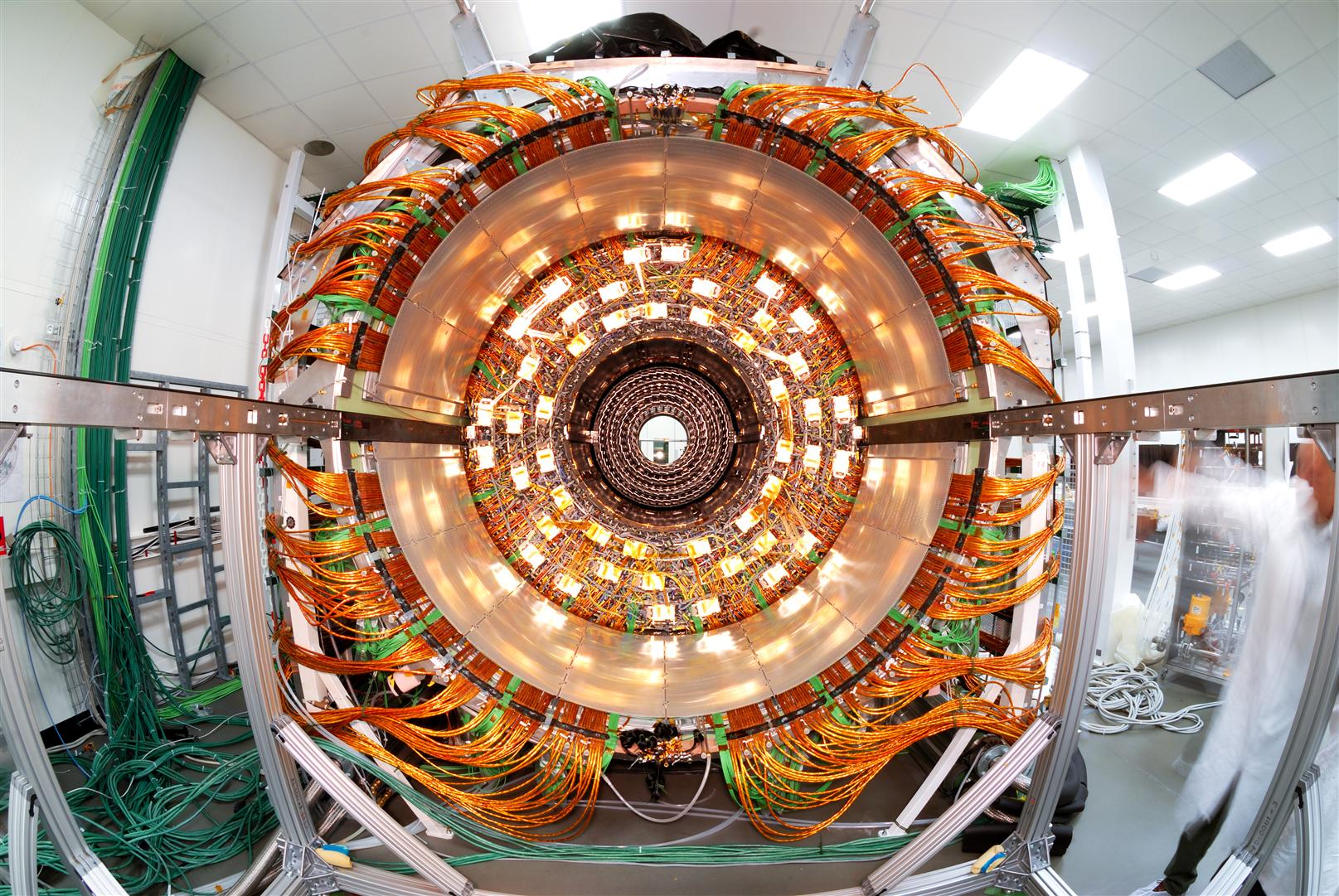
Part of the Compact Muon Solenoid (CMS) detector being assembled.

Part of the Compact Muon Solenoid (CMS) detector being assembled.
{credit Maximilien Brice/CERN}

COPENHAGEN — Physicists working at CERN, the European particle accelerator near Geneva, Switzerland, have snared a new first for the Higgs boson. They have watched it decay directly to the particles that make up matter (called fermions) rather than just the particles that convey force (bosons), as they had before.

“It’s yet another important step in understanding the behaviour of the particle,” Fabiola Gianotti, a CERN physicist, said today at a meeting of the EuroScience Open Forum here.

A CERN spokesman called it the most important Higgs discovery since the particle itself was revealed in July 2012 (see ‘Higgs triumph opens up field of dreams‘).

The results appeared on 22 June in Nature Physics. They come from the Compact Muon Solenoid (CMS) experiment at CERN’s Large Hadron Collider (LHC), which smashed protons together at great energies to tease out the Higgs. Until now, the Higgs had been seen to decay directly only to other bosons — namely, the carriers of the electromagnetic force (photons) and those of the weak force (Z and W particles). There had been indirect hints that it might decay to fermions as well, but measuring the fermion link directly is more challenging, Gianotti said. It needed to be done, though, to confirm that the Higgs was behaving as predicted.

CMS scientists measured the Higgs decaying to two different kinds of fermions: bottom quarks and their antimatter counterpart, and tau leptons and their antimatter counterpart. “Now we have actually observed it with very high significance,” said Gianotti of the CMS findings. (Gianotti is a member of ATLAS, another giant experiment on the LHC ring.)

The LHC has been shut down since early 2013 for maintenance and upgrades to its instruments and to the superconducting magnets that guide particle beams through it at high energies. It had to be opened every 20 metres along its 27-kilometre length for the upgrades. The machine is expected to re-start around April 2015, CERN director Rolf-Dieter Heuer told the meeting. Plans for this second science run call for it to operate with an energy of 6.5 teraelectronvolts (TeV) in each beam, giving a total combined energy when they smash of 13 TeV.

Only after scientists get some initial data from the 13-TeV run, Heuer said, will CERN consider beefing up the accelerator even more to get to its final design energy, of 14 TeV.

Between 2009 and 2012, in its first science run of smashing protons, the collider operated at a maximum of 8 TeV. “Altogether we foresee another 20 years of additional running,” said Heuer. “Discovering the Higgs boson was easy — the work starts here.”

Shorter list for gamma-ray telescope sites, but no home yet

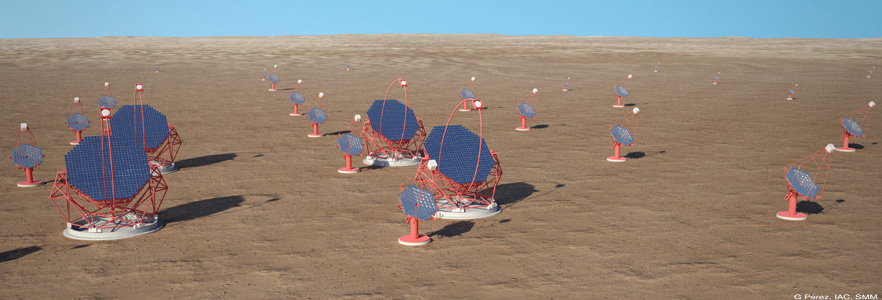
Concept illustration of Cherenkov Telescope Array

Where will the world’s next generation ground-based γ-ray detector, the Cherenkov Telescope Array (CTA), be built? No one yet knows. But a panel of funders have narrowed the field slightly, following a meeting in Munich, Germany, this week.

Scientists had originally hoped to select two sites — a large one in the Southern Hemisphere and a smaller one in the North — by the end of 2013. But the selection process for the €200-million ($276-million) project has taken longer than originally foreseen.

At a meeting on 10 April, representatives from 12 government ministries narrowed the potential southern sites from five to two: Aar, a site in Southern Namibia; and Armazones, in Chile’s Atacama desert. They also picked a reserve site in Argentina.

The committee, a panel of representatives from Argentina, Austria, Brazil, France, Germany, Italy, Namibia, Poland, Spain, South Africa, Switzerland and the United Kingdom, decided that all four possible northern sites — in Mexico, Spain and the United States — needed further analysis. A statement from the board said that a final site decision will happen “as soon as possible”.

If the CTA is built, its two sites will contain around 120 telescopes, which will look for the faint blue light emitted when very-high-energy photons slam into Earth’s atmosphere and create cascades of particles. By triangulating the data from various detectors, astrophysicists hope to piece together the energy and path of such photons. This should help them not only identify the sources of the γ-rays — extreme environments such as supermassive black holes — but also answer fundamental questions about dark matter and quantum gravity.

Like many astronomy projects, the best site for the CTA would be a high-altitude, remote location with clear skies. But the site decision must also take into account environmental risks, such as earthquakes and high winds, and projected operational costs. How much each host country would be prepared to contribute is also a factor.

Last year, an evaluation by representatives of the CTA’s 1,000-strong consortium rated Aar in Southern Namibia as the best southern site, which would contain 99 telescopes spread out over 10 square kilometres. Two sites tied for second: another Namibian site, which already hosts the High Energy Stereoscopic System (HESS) γ-ray telescope; and Armazones, where the European Southern Observatory already has a base and plans to build the European Extremely Large Telescope. The group equally ranked the four contenders for the northern site, which would be a 19-telescope array spread out over one square kilometre. Mexico is already building the High-Altitude Water Cherenkov Observatory (HAWC),  a γ-ray observatory of different type.

Although the consortium’s ranking was based largely on the science case and observing conditions, the latest decisions follows the report of an external site selection committee, which also took into account political and financial factors. Further decisions will rest on detailed negotiations, including host country contributions and tax exemptions at the various sites.

The CTA now aims to pick a final southern site by the end of the year. Board chair Beatrix Vierkorn-Rudolph, of Germany’s Federal Ministry of Education and Research, told Nature it was not yet clear whether the same will be possible for the northern site.