Breaking barriers: the US space programme’s black women mathematicians

Posted on behalf of Alexandra Witze

Mathematician Katherine Johnson at NASA's Langley Research Center, where she worked as a "computer" from 1953 to 1986.

Katherine Johnson at NASA’s Langley Research Center, where she worked as a “computer” and mathematician from 1953 to 1986. Her illustrious career included calculating Apollo 11’s trajectory on its flight to the Moon. {credit}NASA{/credit}

Some of the most intriguing stories in the history of US science have emerged over the past few years. It’s about time. These books centre on something long under wraps: the centrally important roles women played starting some 70 years ago in the great technological transition that gripped the twentieth century. Denise Kiernan’s The Girls of Atomic City (Touchstone, 2013) chronicled the contributions of the women who worked at the secret atomic-bomb laboratory in Oak Ridge, Tennessee, during the Second World War. Rise of the Rocket Girls by Nathalia Holt (reviewed here) depicted the mathematicians or “human computers” who crunched numbers at the Jet Propulsion Laboratory in southern California from the 1940s. In this catalogue, Margot Lee Shetterly’s Hidden Figures is more than just another entry.

Shetterly’s book is an exploration of the groundbreaking achievements and shocking discrimination experienced by a group of talented mathematicians in all aspects of their professional and personal lives. These African-American women — Dorothy Vaughan, Katherine Johnson, Mary Jackson and Christine Darden among them — began working from the early 1940s at the Langley Research Center in Hampton, Virginia, then the nation’s premier aeronautical laboratory. That wartime breakthrough was to propel many of them into long and successful careers at the heart of the space race. (A feature film based on the book and starring Taraji P. Henson will be released in January.)

Christine Darden in the control room of Langley's Unitary Plan Wind Tunnel in 1975. Darden became an expert on sonic booms and supersonic flights.

Christine Darden in the control room of Langley’s Unitary Plan Wind Tunnel in 1975. Darden became an expert on sonic booms and supersonic flights.{credit}NASA{/credit}

These stellar scientists broke major political and social barriers. Virginia in the American South was a segregated state. Beginning after the Civil War and lasting until the civil-rights era of the 1960s, “Jim Crow” laws enforced a rigid racial hierarchy. Shops, restaurants, public transportation — all viciously discriminated against African-Americans in matters as basic as where to use the toilet.

The mathematicians whose experience Shetterly unveils came of age in this reality. Members of a thriving African-American middle class, they went to universities such as Howard in Washington DC — historically black institutions where they were taught by eminent faculty trained at universities such as Harvard, who could not secure a position there because of their race. These accomplished young women became teachers, then generally the sole career option for educated black women. (Postgraduate education was not even possible in some states; rather than admit African-American students to its state university for graduate studies, between 1936 and 1950 Virginia paid them “scholarships” to attend graduate school elsewhere.)

Top flight

But after America entered the war in 1941, new professional opportunities opened. Langley, where engineers designed and tested technological advances that permitted US planes to fly higher and faster, needed an awful lot of number-crunchers to calculate, say, the ideal air flow over an aeroplane wing. That crushing demand opened the gates to women. Female computers began working through calculations that kept Boeing’s B-29 Superfortress bomber  aloft and the North American Aviation P-51 Mustang fighter manoeuvering through the skies.

Even here, however, segregation persisted. Vaughan and her colleagues were placed in Langley’s ‘West Computing’ unit. White women computed on the east side. At the back of the Langley cafeteria, a white cardboard sign labeled COLORED COMPUTERS directed the West mathematicians to sit together at lunch rather than mingle. Eventually, “tiny firebrand” Miriam Mann stole the sign, and the table was left unlabelled.

Margot Lee Shetterly.

Margot Lee Shetterly.{credit}Aran Shetterly{/credit}

Shetterly, who grew up in Hampton, illuminates this remarkable group’s professional careers and personal travails. Simply getting housing as a black woman was fraught with difficulty in these decades. It was only by harnessing the strong social networks of the African-American middle class that these mathematicians finally got a toehold in the American dream. Shared work experiences bound the group outside Langley: Vaughan and Mann brought their families together for local activities including a phenomenal performance in Hampton by iconic African-American singer Marian Anderson.

Postwar, the future was unclear, Shetterly shows. Would women be pushed out of the workforce? The Soviet Union’s launch of Sputnik in 1957 changed all that. In 1958, the Langley lab became part of the newly formed NASA and the centre of Project Mercury, the programme for crewed space travel. The West computers scattered to other divisions to begin work on the complex calculations of getting spacecraft into orbit.

HiddenFigures_HC HiResIn 1959 Johnson and her colleague Ted Skopinski first calculated the mathematics of firing a capsule into ballistic flight. The equations described the flight of a spacecraft, from the angle of launch, to point of re-entry, to the effect of Earth’s rotation. Their work underlay the successful 1961 suborbital flight of astronaut Alan Shepard. The following year, when John Glenn was about to make the first US orbital flight, he personally requested Johnson to double-check, by hand, the calculations of his trajectory. Johnson went on to an illustrious career in the US space programme. Her mathematics dictated the trajectory of the Apollo 11 flight to the moon, Neil Armstrong and Buzz Aldrin’s descent to the surface, and their tricky rendezvous with the command module in lunar orbit in order to make it safely home. Later, she worked on the space shuttle programme. In November 2015, she received the Presidential Medal of Freedom, the nation’s highest civilian honor, from President Barack Obama.

Vaughan, who in the 1950s had served as Langley’s first black supervisor, forged a successful career in computer programming. Jackson achieved the rank of engineer, then turned her attention to helping other women and minorities into high-level positions. Darden, one of the next generation to benefit from the barriers broken by this group, became a world expert on sonic booms and supersonic flight.

Hidden Figures is not the definitive history of women in the space programme, nor of women at Langley. It does not need to be. It lies at the intersection of the greatest scientific advances and the greatest civil-rights battles in US history.

Alexandra Witze is a correspondent for Nature based in Boulder, Colorado. Her email is witzescience@gmail.com and she tweets at @alexwitze.


For Nature’s full coverage of science in culture, visit www.nature.com/news/booksandarts.
The Hubble ‘space opera’

3Q: Paola Prestini

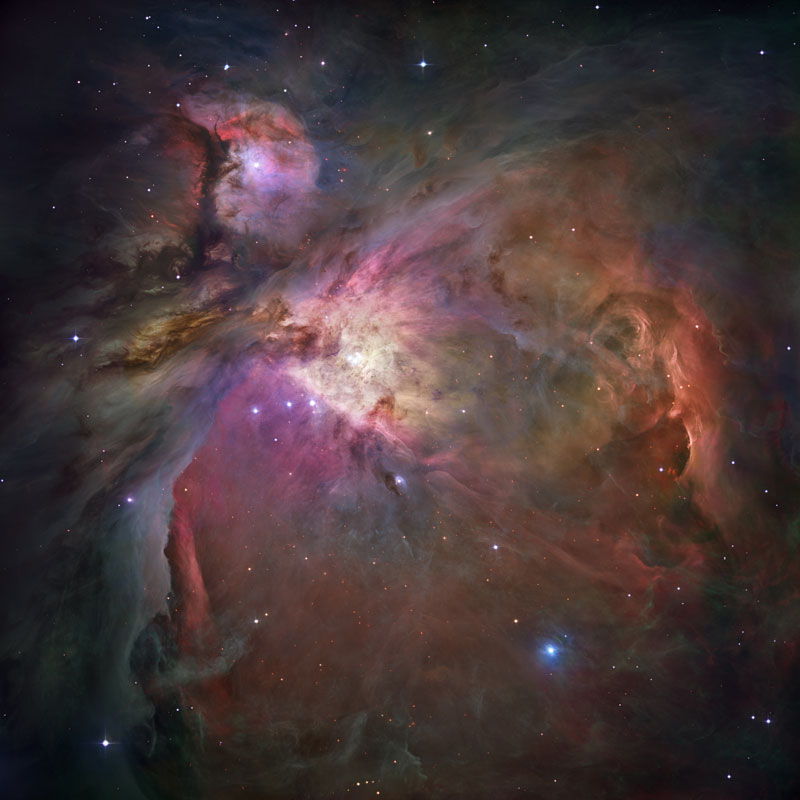
Hubble image of the Orion Nebula, at 1,500 light-years away, the nearest star-forming region to Earth. The bright glow at upper left is from M43, a small region being shaped by a massive, young star's ultraviolet light.

Hubble image of the Orion Nebula, the nearest star-forming region to Earth.{credit}NASA, ESA, M. Robberto (Space Telescope Science Institute/ESA) and the Hubble Space Telescope Orion Treasury Project Team.{/credit}

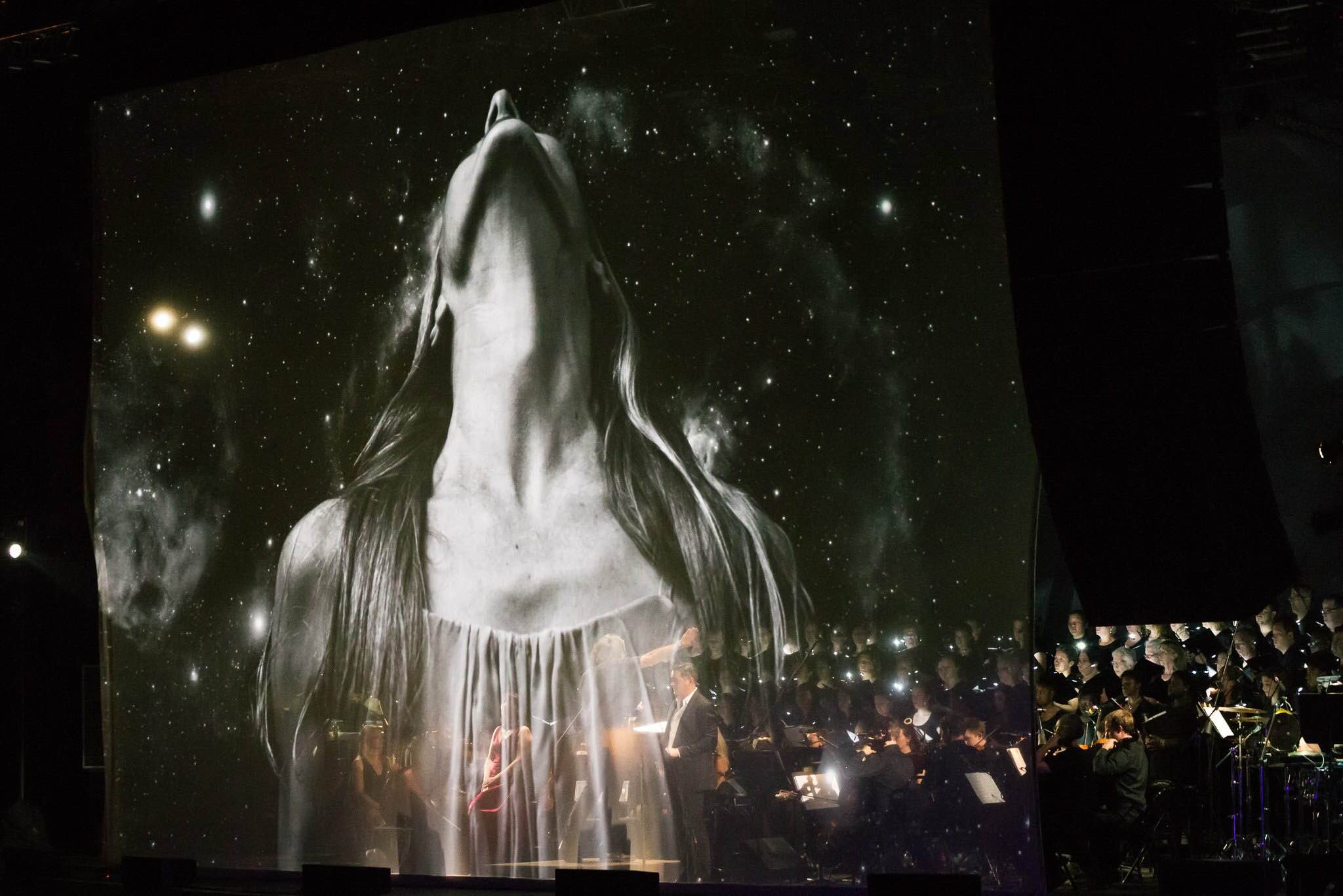
In 2012, composer Paola Prestini began collaborating with astrophysicist Mario Livio — who worked at the Hubble Space Telescope’s operations centre from 1991 to 2015 — on a “space opera” celebrating the instrument’s 25th anniversary. The result, The Hubble Cantata, debuted on the telescope’s 26th. Performed on 6 August at the BRIC Celebrate Brooklyn! festival in New York City’s Prospect Park, it is a multidimensional paean to the ‘eye in the sky’, meshing Livio’s narration with performances by Norwegian orchestra 1B1, a 100-strong chorus and Metropolitan opera stars Jessica Rivera and Nathan Gunn, and a climax featuring a 3D virtual-reality (VR) experience incorporating Hubble images that allows viewers to drift through the Orion Nebula. Here Prestini talks about the joys and challenges of putting together a highly collaborative meld of science and art.

What inspired this project?

About four years ago, I was asked by the nonprofit Bay Chamber Concerts — who were in touch with Matt Mountain, then-head of Hubble operations centre the Space Telescope Science Institute — to create a piece commemorating the telescope’s legacy and anniversary. I began to read what Mario Livio had written on his blog, and after meeting, we began to pull together a loose narrative. With the librettist Royce Vavrek, I realised that Mario could become the inspiration for the opera’s main character. What emerged from our collaboration with Mario was a cantata drawing connections between human loss, love and sorrow, and the life cycle of a star. We decided that Mario would narrate and be the voice of the lead character, an astrophysicist who had lost his wife; there would be an adult choir, children’s choir and orchestra. No Hubble images would be used until the ending, which would culminate in a VR work exploring the beauty and depth of Hubble images. I began to record Livio, and that was the launch of the cooperation.

Of the performance

Dancer Wendy Whelan projected on a scrim at the debut performance of The Hubble Cantata; singers Jessica Rivera and Nathan Gunn can be seen behind.{credit}Sasha Arutyunova{/credit}

How does your composition incorporate science?

Both in its premise, of course, and in the technological underpinnings that have gone into creating it. I worked with sound designer Terence Caulkins from engineering firm Arup to create the 3D soundscape. To present the experience outdoors, in particular for the VR experience, we needed to create an immersive experience that gives the impression sounds are moving around and through the audience space. We mixed the music in a spatialized sound format called Ambisonics, which can be used for various loudspeaker layouts. For example, in its Soundlab Arup has a sphere of loudspeakers that allows you to place sounds around, above and below listeners to enhance the VR effect. Ambisonic sound can also be mixed down to “binaural”, which is a 360-degree sound format for headphones. (This is what people downloading our free app, Fistful of Stars, will hear.) For the performance, we designed a concentric eight-point loudspeaker system surrounding the audience. The electronic narration sequences include Mario speaking about everything from baryonic matter to extra-solar life. Filmmaker Eliza McNitt created the virtual-reality film in collaboration with the Endless Collective. This is a five-minute VR video that gives a 360-degree tour through space, comprising CGI-animated Hubble imagery of the Orion Nebula. We found a company to sponsor cardboard virtual-reality glasses for audience members.

What is it like for you as an artist to work with scientists?

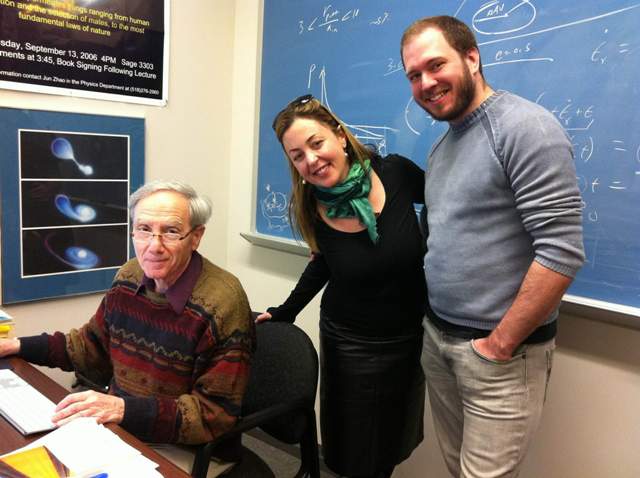
Astrophysicist Mario Livio, composer Paola Prestini and librettist Royce Vavrek (L to R).

Astrophysicist Mario Livio, composer Paola Prestini and librettist Royce Vavrek (L to R).{credit}Jill Steinberg{/credit}

It’s great fun. It’s fascinating to think about our creative processes and how different they are. Mario has worked with the Baltimore Symphony as a narrator for performances, but never really deeply in a music collaborative process before this one. There’s a great deal of learning going on for all of us. He needed to trust that we were going to bring these massive concepts to fruition, so there was a lot of back and forth. He is able to explain super-complex concepts, such as dark matter, to musicians; setting these texts as simple narrations was important to me so that they could be clearly understood. Hubble’s legacy and what it has done for our understanding of the Universe is at the core of our drive to give it a musical life. The loss of communication between loved ones in the cantata storyline is echoed by the expansion of the Universe “at the rate of our imagination” (something Mario often says). Yet as the fictional astrophysicist’s understanding of the Universe deepens, he reconstructs his wife’s story and understands her better. Woven together, those twin threads in the piece — the rarity of life in the grand cosmic scene, and Hubble’s revelation of that scene — connect human and cosmic scenarios, revealing realities that may exist at vastly different scales, but that are each vastly important.

Interview by Jeff Tollefson, a reporter for Nature based in Washington DC. He tweets at @jefftollef.

Paola Prestini is currently in conversation with several producers in the United States and overseas about presenting The Hubble Cantata again. The piece will be released as a recording by VIA Records and as a short film by an as-yet unnanounced distributor.


For Nature’s full coverage of science in culture, visit www.nature.com/news/booksandarts.
A world of change

Posted on behalf of Leslie Sage

311949

Bahama reefs from the ISS.{credit}© 2016 IMAX Corporation. Photo courtesy of NASA{/credit}

Watching the new IMAX 3D documentary film A Beautiful Planet, I was struck when astronaut Samantha Cristoforetti noted how contemplating the planet for months on end from the International Space Station (ISS) convinced her that it is a spacecraft. ‘Spacecraft Earth’ may be an old theme, but Cristoforetti spoke with passion about how humanity, as its crew, must look after the ship. The film, which showcases spectacular footage of Earth shot from the ISS, is intended in part to spur awareness of the negative influence we are having on the planet.

A Beautiful Planet — directed and written by Toni Myers, whose work includes 3D documentary film Hubble 3D (2010) — is a collaboration between NASA and IMAX. After three years of testing digital IMAX equipment on board, NASA astronauts trained in using the cameras — Kjell Lindgren, Terry Virts and Barry Wilmore, as well as former astronaut Scott Kelly — did the shoots over 15 months from the Cupola, a module of the ISS with seven windows. Cristoforetti, Kimiya Yui of the Japan Aerospace Exploration Agency and cosmonaut Anton Shkaplerov also contributed imagery.

Astronaut Samantha Cristoforetti in the ISS Cupola.

European Space Agency Astronaut Samantha Cristoforetti in the ISS Cupola.{credit}© 2016 IMAX Corporation. Photo courtesy of NASA{/credit}

I found the images stunning. The mass thunderstorms over Southeast Asia, with many lightning strikes per second, was extraordinary, as was the footage of the Atlantic Ocean around the Bahamas under a full Moon. The hundreds of plumes of smoke arising from ongoing slash-and-burn of the Amazonian rain forest were disturbing. Shots of nighttime North and South Korea were dramatic — the North almost completely dark, the South brightly spangled with light.

The film makes some serious points about climate change, such as the melting of the Greenland ice sheet and mass deforestation, without getting overly preachy. Yet it probably could have done with a little more preaching. One astronaut, for instance, noted that Earth provides everything we need to survive; the unstated subtext was that if we keep poisoning the air and water, it will no longer do so.

Lights at night over the Great Lakes region, US.

Nighttime shot of northeastern Canada, the US and beyond.{credit}© 2016 IMAX Corporation. Photo courtesy of NASA{/credit}

The actress Jennifer Lawrence narrates, her distinctive voice adding depth to what was, at times, a rather trite script. The 3D was the best I’ve ever seen, but I experienced some vertigo and nausea; anyone with balance problems should be prepared to close their eyes to rebalance.

Regaining equilibrium is ultimately what this film is about. I hope it convinces skeptics that protecting Earth is an urgent task.

Leslie Sage is senior physical sciences editor at Nature; his email is l.sage@us.nature.com.

A Beautiful Planet opens in IMAX cinemas on 29 April in the US, and 27 May in the UK.


For Nature’s full coverage of science in culture, visit www.nature.com/news/booksandarts.
Reflections of a Moonwalker

Posted on behalf of Elizabeth Gibney

LMOTM_5

Gene Cernan during the last lunar walk, as commander of the Apollo 17 mission in 1972.{credit}NASA{/credit}

The Moon landings – those grainy shots of men in bulky suits and stunning visions of Earthrise – have burned into the public consciousness for half a century. But to those who weren’t there to watch it live and who have seen human space travel since confined to Earth’s orbit, walking on the Moon seems like a distant fairytale (a fact that no doubt contributes to the conspiracy theory that it never happened).

The Last Man on the Moon, a new documentary film, is a beautiful and timely reminder of those extraordinary days when space exploration featured on prime-time television and the price of progress was fatalities of some of the world’s brightest and bravest pilots and engineers. Director Mark Craig captures this spirit from the astronauts themselves, while they are around to tell the story.

The film follows the life of Eugene (Gene) Cernan, a plain-spoken military man who in 1972 became the last person to walk on the Moon. Cernan started out as a young Navy jet pilot in the 1950s (a time when he says he felt “bullet-proof”), before heeding the call of President John F. Kennedy. At the height of the US space race with Soviet Russia in 1961, Kennedy challenged NASA to send a man to the Moon and back by the end of the decade. In 1963 Cernan was selected as one of the agency’s third group of astronauts. He reached space three times – first carrying out NASA’s second-ever spacewalk, as part of the Gemini 9 mission, then twice journeying to the Moon on Apollo 10 and Apollo 17.

Cernan now, at the Johnson Space Center, Houston.

Cernan now, at the Johnson Space Center, Houston.{credit}Mark Craig{/credit}

The Last Man on the Moon is at its best in recreating the spirit of the time and offering insight into the lives of a brave yet fallible group of extraordinary people. The movie could only have been made with the cooperation of the energetic 82-year-old Cernan. His narrative forms the bulk of the film, which Craig brings to life using funny, poignant interviews with his wife and other contemporaries, as well as archive material ranging from news clips to home movies. Computer-generated visuals add a dramatic tension to Cernan’s hair-raising descriptions of the space sequences, while a period soundtrack adds extra zip.

Cernan, Stafford and x of the Apollo 10 Mission

Cernan (left), Thomas Stafford and John Young of the Apollo 10 mission, 1969.{credit}NASA{/credit}

We witness a tight-knit group of ambitious astronauts from Cernan’s 1963 intake whose young families settled as neighbours in suburban Houston, Texas. Wives became friends, and photos of their get-togethers depict classic scenes of the era with everyone partying hard — perhaps aware that any trip could be an astronauts’ last. The images are reminiscent of television series Mad Men, albeit with even fewer women in leading roles.

There is a joy to seeing now seventy- and eighty-somethings such as Apollo 12 crew Dick Gordon and Alan Bean, and Apollo 13’s Jim Lovell, recollect lives as the nation’s heroes. Yet from the get-go, the film reminds us that reaching space can carry a heavy price. Today most space missions are robotic, and failures waste money and time, rather than lives (though Virgin Galactic’s tragic SpaceShipTwo accident in 2014 served as a stark remind of how dangerous human spaceflight remains). Back then, NASA never hid the fact that human risk was the price of progress. Between 1964 and 1969, nine astronauts died while working on agency projects. Cernan’s close calls included one in 1966, when the training plane flown alongside his, piloted by fellow astronauts Elliot See and Charles Bassett, crashed and killed them. In 1971, Cernan crashed a helicopter in training, and kept his scorched helmet as a souvenir.

Barbara Cernan during the Apollo 10 launch in 1969.

Barbara Cernan during the Apollo 10 launch in 1969.{credit}NASA{/credit}

The film is no reveal-all exposé; nor is it too rose-tinted. Alongside the professional triumphs and tragedies, it touches on what Cernan’s family sacrificed. His wife Barbara quips: “If you think going to the Moon is hard, try staying at home.” Fellow astronauts in the film acknowledge their single-mindedness and that there was no such thing as work-life balance; 60% of the astronauts from Cernan’s set ended up divorced.

The film leaves the audience to answer whether the drive of these men was selfish. Its opening scene juxtaposes images of present-day Cernan watching a rodeo, where a young bull-rider struggles to stay on his mount, with shots of the 1960s astronaut programme. But it also makes it clear that, for Cernan at least, the goal wasn’t personal glory — although he was ambitious. As he says, “The entire world was on board that spacecraft with us.”

As one of just 12 people to ever set foot on the Moon, Cernan says his experiences belong to everybody, especially the generations who weren’t around to see it. Today his goal is to charge kids with a sense that they can do something just as extraordinary — on Earth or in space. Watching the film left me pondering over the way human space exploration, which has demonstrated its phenomenal power to inspire and drive human understanding, has been reined in for the past 40 years.

Elizabeth Gibney is a physics reporter at Nature. She tweets at @LizzieGibney. 

The Last Man on the Moon is in cinemas from 8 April, with a nationwide live Q&A with Eugene Cernan on 11 April only. For Nature’s full coverage of science in culture, visit www.nature.com/news/booksandarts.

Goodbye Kalam saab

Last night when news of APJ Abdul Kalam’s death spread thick and fast on social media – many heartbroken with the scientist/ex-President’s death and many wishing the news wasn’t true – one thing became clear. That this was not just the death of a scientist, a leading light of India’s space programme, or of the ‘People’s President’ – it was the demise of an adorable, all-round-good-natured, immensely accessible human being, rooted in his humble beginnings and untouched by the highs that fame brought.

Avul Pakir Jainulabdeen Abdul Kalam (1931-2015)

Avul Pakir Jainulabdeen Abdul Kalam (1931-2015){credit}PIB{/credit}

Why do I say that? In no time, my Facebook wall was a collage of pictures featuring Kalam alongside practically everyone I knew – the quintessential smiling face beamed in each of those pictures almost saying “Come here, do you want a picture with me?” Kalam would be missed most for this ease of approach, this humility that comes with knowledge. Small wonder that he often quoted from a Sanskrit slöka that roughly translated to “A fruit-laden tree always bends low.”

For Kalam, science was one of the many, many things he was passionate about – the number one on his passions list being teaching. “You ask me to teach 20 hours a day, I perhaps can,” he said to me once.

And he always came across as a teacher you could look up to for those wonderful motivational one-liners that stay with you for a long, long time and egg you on when you are not in the best of speeds. For instance, the Christopher Morley quote “Big shots are only little shots who keep shooting” featured quite regularly in his talks. “India needs such small shots in thousands,” he would say. No big surprise that his books – strewn with such pep quotes – flew off the shelves in no time.

With a gentle sway of the head and smiling eyes, he could heap on you tonnes of data peppered with intricate statistics, effortlessly – and then cross check if you retained all of it, typical Professor-style. “An aerobic space transportation vehicle can have a 15% payload fraction for a launch weight of 270 tonnes. This trans-atmospheric space transportation system has the potential to increase the payload fraction to 30% for higher take-off weight. So what per cent payload fraction can an aerobic space transportation vehicle have?” he would ask. And you had to say, “15%”, before the conversation went any further. He made sure the learning never stopped as long as you were with him. And then he left you with further food for thought – that was the magnet of his personality.

Kalam saab, as we fondly called him (though he might have secretly preferred Prof. Kalam), wrote several books, scientific papers, essays and his public talks are all freely accessible on the internet for anyone to benefit from. One piece he wrote for the launch of Nature India, however, will always remain precious to me. “What do you want me to write on?” he asked when I said we would love to have an inaugural article from him. “You are launching Nature India – I have to write something worthwhile. Let me give it a good thought”. Kalam, then a popular President with non-stop speaking assignments, entertained several rounds of emails before the article could be finalised. “Please feel free to edit as you like,” was his standard reply to all my queries. Here’s the piece that was finally published in Nature India.

I leave you with the endearing bits from that article – they give a peek into the man’s difficult early years that ended up shaping his invincible spirit, which India will continue to look up to for years to come:

“As I embark on my discussion on space safety and security, I am reminded of my joint family in Rameswaram, a small island in southern part of India, where a number of us brothers and a sister lived together. I was the last fellow. I keenly witnessed my mother keep all her children connected in spite of their varying needs and personalities. I used to ask myself, how does she keep us united despite such amazing diversity? It was only through the inherent pure love of the mother.

During the last five decades, I have seen how many successes and a few failures of space programmes helped connect countries around the globe. Whenever a major space event takes place – man landing on the moon, first series of communication satellites in the geo-synchronous orbit or remote sensing satellites in polar orbit, NASA astronauts, including Sunita Williams, descending on earth on a rainy day – it captures the attention of the entire planet. Events in space have in a way integrated the world, like the mother unifying the family. The question is: can we use space to transform earth into a homogenously prosperous place without poverty or fear of war?”

[“With Kalam’s demise, India’s scientists will miss their champion and star supporter in New Delhi,” says veteran science journalist K. S. Jayaraman in this obituary. “Being non-political, Kalam could cut across political parties while his image as father of India’s missile programme helped him promote science and technology. An approval from Kalam almost always resulted in budgetary support for such projects like the $250 million nanotechnology initiative, or the manned space mission.” Read more on India’s missile man’s contribution to India’s science vision here.]

Aerospace engineers win global innovation challenge, virtually

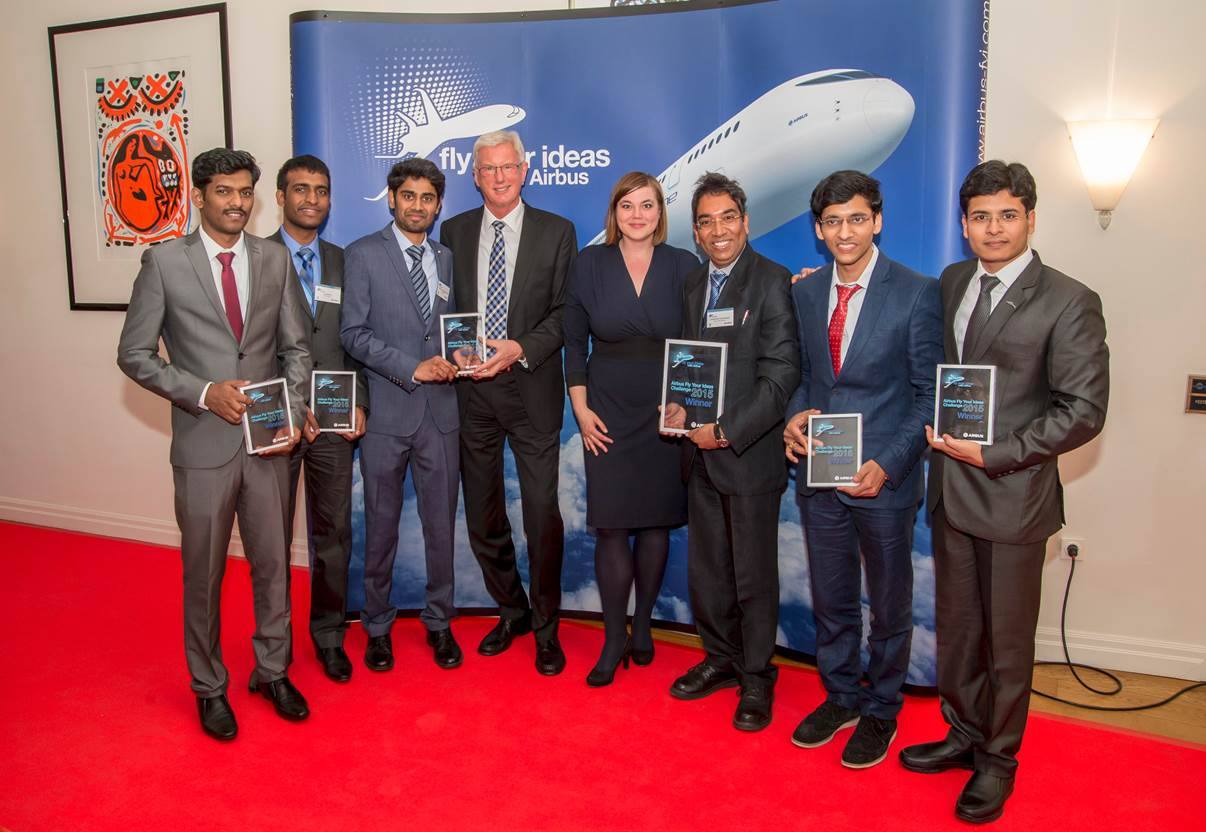
A virtually connected team of Indian aerospace engineers — based in India, USA, UK and The Netherlands — have emerged champions in a global biennial innovation challenge organised by UNESCO and the passenger aircraft manufacturing company Airbus.

Interestingly, members of the team, which aptly calls itself MultiFun, met in person for the first time only for the final round of the event last week (May, 2015). Their winning entry for the ‘Fly Your Ideas (FYI)’ competition held in Hamburg, Germany was a “hybrid battery-piezoelectric composite structure for next generation aircraft”. Simply put, they designed aircraft wings dressed in a “composite skin that harvests energy from natural vibrations” or flex in the wings.  MultiFun bagged €30,000 as prize money along with the coveted trophy.

The winning team

The winning team{credit}MultiFun{/credit}

“Piezoelectric fibres gather electrical charges from even the smallest movements during flight, storing the energy generated in battery panels integrated in the fuselage and using it to power auxiliary in-flight systems, such as lighting and entertainment systems. This reduces the energy footprint of aircraft during flight and could even replace the entire power source for ground operations,” the jury said calling MultiFun’s entry a ‘path breaking’ innovation.

The idea was sprouted in the Department of Aerospace Engineering, Indian Institute of Science (IISc), Bangalore. The chief mentor for the project was Dineshkumar Harursampath, lab head of the  Nonlinear Multifunctional Composites — Analysis & Design Laboratory at IISc. Harusampath got this globally-placed team of IISc alumni and current IISc students together through video-conferencing and virtual platforms. Team leader, Sathiskumar A. Ponnusami, a doctoral student in TU Delft, and Dhamotharan Veerasamy, a doctoral student in City University London, are IISc Masters alumni. Shashank Agrawal and Ajith Moses are current doctoral students at NMCAD Lab. And the youngest, Mohit Gupta, a Masters student at Georgia Tech, Atlanta, was an intern at NMCAD Lab a year ago.

The Indian team’s entry was shortlisted in the top five from among 518 teams representing 104 countries.  FYI is designed to identify and encourage the next generation of innovators and uncover futuristic and unconventional yet promising solutions for the evolution of flight.

Team leader Sathiskumar says the “long umbilical cords” of IISc inspired them to design and develop multifunctional materials for next generation aerospace applications. “The lab provides an environment conducive for out-of-the-box thinking and uninhibited multimedia communication without space-time limitations amongst team members,” he said in a release. “Only half the time was spent on technical issues. The rest was inspirational yet unplanned chatting leading to team bonding, true to the name MultiFun!”

The team was able to work 24 hours a day by interacting across physical boundaries from four different locations around the world and managed to present the most disruptive idea for the future of aviation at the competition. “… the winning idea is all about good vibrations,” the jury noted.

Indeed a brilliant example of virtual networking for science and innovation.

Century launch

It will be the 100th space mission for the Indian Space Research Organisation (ISRO) tomorrow (September 9, 2012) as it launches another vehicle from  its workhorse series — PSLV-C21. The 49-year-old organisation has come a long way with  62 satellites and 37 launches in its repertoire. ISRO’s first mission — the Aryabhatta satellite launched using a Russian rocket — dates back to1975.

PSLV C-21{credit}ISRO{/credit}

As countdown begins for PSLV-C21, preparations are also underway to host VIPs such as Prime Minister Manmohan Singh — in charge of space and atomic energy — at Sriharikota, the launch venue. However, considering that it’s ISRO’s 100th mission, the event has not received as much publicity as one would expect of a landmark occasion like this. The ISRO press release announcing the countdown for the launch had no mention of its historic significance. ISRO might be playing it down, making room for some cautious and deferred celebrations until after a successful launch. Rightly so.

Coming back to ISRO’s century launch, it will carry two satellites — the French SPOT-6 and Japanese PROITERES. PSLV C-21 will be lifted off Satish Dhawan Space Centre (SDSC) SHAR, Sriharikota as most of India turns on their television sets on Sunday — around 9:51 a.m. The two satellites are  expected to be propelled into an orbit of 655 km altitude at an inclination of 98.23 degrees. In the 13 years since PSLV has been undertaking business launches,  this one will also be its biggest ever commercial lift. The French satellite weighs 720 kg and the Japanese 15 kg.

Just how does ISRO count its missions considering that it launches foreign satellites and also its own satellites on foreign rockets?  An ISRO official solves the number crunching thus:  each ISRO rocket flight is considered one mission; an ISRO satellite launched by a foreign rocket is marked as one mission and; an Indian rocket (such as PSLV) launching a number of satellites built and owned by ISRO is marked as several missions — 2 if there are two satellites, 3 if there are 3 satellites.

So PSLV C-21 will be one mission — the one that strikes the ton for ISRO.


Post updated on September 9, 2012:

PSLV C-21 lifts off.{credit}ISRO{/credit}

ISRO’s 100th space mission PSLV C-21 was successfully launched from the Satish Dhawan Space Centre in Sriharikota in Andhra Pradesh at 9:53 a.m. Prime Minister Manmohan Singh, who witnessed the launch, described the mission as a ‘spectacular success’. Soon after launch, the vehicle put the two foreign satellites into orbit.

As is the norm, ISRO chief K Radhakrishnan had offered prayers at the Lord Venkateswara Temple in Tirupati yesterday for the success of the historic mission.


Year-closing eclipse

The year will close with another total lunar eclipse, though not as dark as the the mid-year eclipse of June 15, 2011. This one, to occur on the night of 10 December 2011, will have the advantage of a clear winter night.

Stargazers in India will have close to five hours to feast on the celestial event. And no, you don’t want to miss this one — the next total lunar eclipse is six years away in August 2017.

The Moon will be in the penumbral shadow of the Earth at about 5:00 p.m. Indian time, says Arvind Paranjpye of the Inter-University Centre for Astronomy and Astrophysics in Pune. For the next half hour or so, there wouldn’t be much action. Then we can see a gradual change in the brightness on the lunar disk. By 6:16 p.m. the Moon will be in the umbra of the Earth’s shadow. The dark shadow of the Earth will slowly cover the lunar disk. This phenomenon will be quite noticeable to the naked eyes, he says.

In the next 75 minutes, the Moon will be totally engulfed by the shadow of the Earth. The colour of the lunar disk will become many hues of red from crimson to brick red during this time.

The time of the maximum eclipse is 20:27:16 when the Moon will be very dark. The sky assume the likeness of a new moon night. One can see lots of faint stars. By 10:00 p.m. the shadow play will be over and a bright full moon will illuminate the Earth.

India has had six eclipses — four solar and two lunar — this year.

Lets say adieu to the year with this final cosmic event. Happy skygazing!