Pinpointing genes underlying developmental delay

A paper published online this week at Nature Genetics uses an innovative method to find new genes that contribute to neurocognitive disorders, such as autism.

The paper reports 10 new candidate genes for developmental delay or autism. The results also led to the discovery of two new subtypes of developmental delay, caused by loss of the genes SETBP1 and ZMYND11, respectively. You can find the paper reporting this study here.

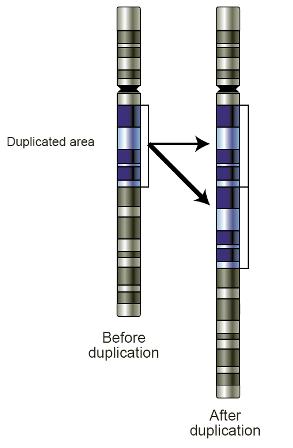
Gene-duplication

One example of a CNV. In this case, the region is duplicated. {credit}Wikipedia{/credit}

The authors of the study narrowed in on the 10 candidate genes by first building a map of all the regions in the genome with different copy numbers between the developmentally delayed and normal children. These differences, known as copy number variants (CNVs), can each include many different genes. By then integrating this map with single base-pair changes (SNVs) between the two groups, the researchers were able narrow in on the genes most likely to contribute to cognitive disorders.

I asked one of the senior authors of the paper, Evan Eichler, to tell us a little more about the background of the study and why it is important:

Q: The study includes authors from many institutions–how did you all come together to work on this project?

A: The multi-center collaboration is one that developed over the last ten years when we began our work on CNVs and genomic hotspots flanked by segmental duplications. Some connections go further back, for example, I have known Lisa Shaffer from the days when I was a graduate student and she was in charge of the molecular cytogenetics laboratory at Baylor College of Medicine.

Q: Why did you decide to focus on CNVs rather than other types of variants? Was this the plan from the start?

A: The paper actually goes after both CNVs and SNVs. We used the very large number of cases and controls to identify regions that reached nominal significance for burden (i.e excess of deletions and duplications in patients when compared to controls). We then selected genes for resequencing (using MIPs [molecular inversion probes]) and show excess of loss-of-function mutations and similarity in clinical phenotypes between the SNV and CNV patients. It was the plan from the start.

Q: What would you say is the major new breakthrough in this study?

A: A systematic approach to go from large CNVs to pinpointing the underlying gene responsible for specific forms of developmental delay and ID. The paper bridges between those two types of variants and shows the power of combining these different datasets to make discoveries.

Q: How do you envision clinicians using the results? Are there any caveats that they need to consider?

A: Hopefully, the CNV morbidity map will provide clinicians and families some guidance in terms of interpreting previous variants of unknown significance. The discovery of specific genes and intersection of exomes and CNVs should also help with interpretation of clinical exomes that are now being generated. I anticipate that more than 1/2 of the genes listed in Table 2, for example, are relevant to pediatric DD as well as other diseases. The caveat is that more data and clinical assessment are required. Despite 30,000 cases and 20,000 controls many regions are still underpowered to move them to a category of benign or pathogenic. Large clinical labs should exchange their CNV data more freely.

Q: Do you think the approach used in this study (coupling exomes and CNVs) will be useful for other neuropsychiatric (or other) disorders?

A: Yes. Many complex neuropsychiatric disorders may in fact manifest as mild DD or other learning disorders early in childhood. Case-in-point is ZMYND11. We show that it is most likely the gene responsible for the 10p15.3 microdeletion syndrome but also find that 3/4 males with truncating mutations also have neuropsychiatric diagnoses as adults. A sporadic truncating mutation of ZMYND11 was also identified in a recent trio exome sequencing study of schizophrenia family. It still surprises me that the neuropsychiatric and pediatric developmental delay fields don’t compare notes more often.

Epigenetic convergence in intellectual disability and cancer?

One of the many remarkable findings of the cancer genome sequencing projects that have been published in this and other journals is the repeated discovery of somatic driver mutations in genes that encode chromatin remodeling factors, which regulate the epigenome. De novo mutations in this same family of genes also cause several developmental syndromes, whose various features all include intellectual disability. Surprisingly, a few de novo mutations in these genes have recently been reported in autism. How do these mutations (which at least in some cases appear to be loss-of-function in both cancer and in the developmental syndromes) in the same class, and in some cases, the same exact genes cause these different diseases?

Much effort and attention is being paid toward developing drugs that target the epigenome and the proteins that regulate it. The $95M partnership between Constellation Pharmaceuticals and Genentech  and MIT’s Koch Institute’s recent symposium–Epigenetics, plasticity and cancer–are just two of many examples. But most intriguingly, can understanding the molecular mechanisms and risk factors of one of these diseases inform the biology and treatment of the others?


The epigenetic state of a genome has a vast influence over gene regulation, cellular activity and cell fate. Protein families that “write,” “erase,” and “read” the major histone marks (i.e. acetyl and methyl groups) ultimately regulate accessibility of the chromatin to transcriptional machinery.  (A useful review on epigenetic protein families and recent progress to pharmacologically modulate these proteins was published recently in Nature Reviews Drug Discovery here. )


New driver mutations in cancer

In the past few years, cancer sequencing efforts have identified driver mutations in genes that regulate histone and DNA modification in various types of cancers. In 2012, this journal published many cancer sequencing papers, four of which reported driver mutations in chromatin remodelers. While ARID1A mutations have been found in other cancers (e.g. ovarian carcinoma in Science  and the New England Journal of Medicine, Patrick Tan and colleagues reported here in April that ARID1A is mutated in 8% of gastric adenocarcinomas, and that frequent mutations in chromatin remodeling genes (ARID1A, MLL3 and MLL) were found in 47% of the gastric cancers they screened.


In May, Bin Tean Teh and colleagues reported inactivating mutations in MLL3 in 14.8% of cases of liver fluke-associated cholangiocarcinoma, a fatal cancer that occurs in the liver bile ducts that is common in parts of Southeast Asia infested with O. viverrini.  MLL3 encodes a histone-lysine N-methyltransferase and was already known to be mutated in several other cancer types. Teh and colleagues found that 75% of MLL3 mutations were likely loss-of-function, with mutation patterns reminiscent of tumor suppressor genes.


In June, Jessica Zucman-Rossi and colleagues reported that inactivating mutations in ARID1A and ARID2 were found in 16.8% and 5.6% respectively, of 125 cases of hepatocellular carcinoma.  ARID1A and ARID2 are SWI/SNF-related chromatin remodelers that control the accessibility of transcriptional machinery to promoter regions of DNA. Overall, 24% of HCC’s that they screened had at least one mutation in a chromatin remodeling gene (2 cases with SMARCA4 mutations, and single cases of many genes that encode chromatin remodelers, including SMARCA2, SMARCB1, SMARCA1, ARID4A, PBRM1, CHD3 and CHD4). Interestingly, ARID1A mutations were more often found in tumors related to alcohol intake compared to tumors related to other etiological sources (e.g. hepatitis B or C virus).


In July, Hidewaki Nakagawa and colleagues published another hepatocellular carcinoma sequencing study, which analyzed HCC tumors associated with hepatitis B or C virus infections. They initially sequenced 27 tumors and identified 2 frameshift and one missense mutation in ARID1A. Analysis of 120 more tumors identified 12 more mutations in ARID1A. Altogether, the authors found that 50% (14/27) of the tumors had recurrent mutations in genes that encode chromatin regulators. They also knocked down these chromatin regulators in a panel of 5 HCC cell lines, and found that knockdown of MLL3 led to increased cell proliferation. Knockdown of 11 genes, many of which are chromatin regulators, increased cell proliferation in at least one cell line. These results support the hypothesis that loss-of-function mutations in chromatin regulators promote cell growth in hepatocellular carcinoma.


De novo mutations in intellectual disability and autism


De novo mutations in this family of genes were recently reported in autism in Nature [see last paragraph of previous post on this blog entitled ‘Autism exomes arrive’ ], a pervasive developmental disorder that sometimes includes intellectual disability, and typically presents with cognitive and social dysfunction. In addition to the two cases of CHD8 mutations, single cases of de novo nonsense, missense and frameshift mutations were reported in those autism sequencing papers in ARID1B, CHD3, CHD7, MLL3, SETBP1 and SETD2.


As noted in that post, de novo mutations in this class of genes have also been found in recent years to cause various developmental syndromes, including mutations in MLL2 in Kabuki syndrome. This discovery was published in the landmark paper that was the first application of exome sequencing to define the cause of an autosomal dominant disorder.   This year, this journal published 5 other papers that report de novo mutations in genes that encode chromatin remodelers in developmental syndromes that vary in presentation but all include intellectual disability.


In April, Naomichi Matsumoto and colleagues reported that 20 of 23 individuals with Coffin-Siris syndrome (CSS) carried missense and truncating mutations in one of the six genes that encode SWI/SNF subunits, including SMARCB1SMARCA4, SMARCA2SMARCE1ARID1A and ARID1B.  CSS is a rare congenital syndrome (MIM 135900) that includes growth deficiency, intellectual disability, severe speech impairment, microcephaly, and coarse facial features. In all cases where parental samples were available, mutations occurred de novo. Notably, only one of the 23 cases presented with a hepatoblastoma. All of the mutations in ARID1A and ARID1B were truncating, and the authors suggest that haploinsufficiency causes CSS. At the same time, Gijs Santen and colleagues also reported truncating de novo mutations in ARID1B in CSS.


In the same issue, Joris Vermeesch and colleagues reported heterozygous mutations in SMARCA2 in Nicolaides-Baraitser syndrome (NBS, MIM 601358). The features of NBS include sparse hair, distinctive facial features, microcephaly, epilepsy and intellectual disability with marked language impairment. Altogether, the authors identified missense mutations in SMARCA2 in 36 of 44 individuals analyzed. In 15 of these patients, parental DNA was available and the mutations in each case were verified to occur de novo. None of the mutations were truncating, and the authors suggest that these mutations act in a dominant-negative or gain-of-function manner.


In June, Marcella Zollino and Bert de Vries and their respective colleagues independently reported mutations in the chromatin regulator KANSL1 in 17q21.31 microdeletion syndrome. KANSL1 is a subunit of a histone acetylatransferase (HAT) protein complex, and is required for its HAT activity. The mutations identified by both papers occur de novo and include nonsense and frameshift mutations.  Interestingly, a common feature of this microdeletion syndrome is a “happy, friendly disposition.”


Biological meaning? 


What is the biological meaning of these findings? Many of the somatic mutations in these chromatin remodeler proteins in cancer appear to be loss-of-function, but further in vivo and in vitro experiments will determine if these proteins act as tumor suppressors or oncogenes. It is also possible that different proteins can have either effect, depending on the type of cancer.  Mouse models of the developmental disorders noted here should bring further insights into how this class of proteins leads to these particular diseases.


Why does a loss-of-function somatic mutation in ARID1A cause so many types of cancer, and how can loss-of-function in this same gene also cause Coffin-Siris syndrome? How does loss of this class of proteins cause cancer in one context and intellectual disability, language impairment or autism in another? Is the sole case of a de novo frameshift indel mutation in ARID1B in autism relevant? If so, how does loss-of-function of ARID1B cause autism?  It is clear that much is still to be learned on how the epigenome regulates gene activity and how its misregulation in particular times and spaces can cause radically different severe diseases. Nevertheless, the most intriguing questions are these: 1) Where, and how, do these chromatin remodelers functionally overlap in these disparate diseases? And 2) Would a treatment for one disease be effective for another?

Autism, synapses and mice – pairs division

From Won et al.

Again, we’re behind on blogging – you guys are keeping us busy with great neuroscience – but here is the story of a pair of papers that appeared back to back in last week’s issue and a continuation of the discussion started here by Noah about the process of joint publication. The two papers by Tobias Boeckers and colleagues and by Eunjoon Kim and colleagues were independently submitted and both describe autism-like phenotypes of mice with mutations in the gene Shank2. In human studies, SHANK2 has been associated with rare cases of autism and these two mice add to the ever-growing list of rodents (according to SFARI.org, 17 rodent models debuted in 2011 alone) that are being created to investigate the functional consequences of genetic mutations linked to autism, in the hopes of understanding mechanisms underlying core symptoms. Shank2 is a scaffolding protein that regulates excitatory synapse function by holding together various molecules such as neurotransmitter receptors and signaling proteins. Mutations in another member of the same gene family, SHANK3, are also associated with human autism, and mutant mice display behaviors reminiscent of ASD symptoms, such as social deficits and obsessive behavior. So this protein family, and more generally, glutamatergic transmission, is potentially one promising line of investigation. Continue reading

SciWriteLabs 7.1: The New York Times’s Amy Harmon on neurodiversity and writing about autism

Seth Mnookin is a Lecturer in MIT’s Graduate Program in Science Writing. His most recent book, The Panic Virus: The True Story Behind the Vaccine-Autism Controversy, was called a “tour de force” by The New York Times and “a book that should be required reading at every medical school in the world…a brilliant piece of reportage and science writing” by The Wall Street Journal.

He is also the author of the 2006 bestseller Feeding the Monster: How Money, Smarts, and Nerve Took a Team to the Top, which chronicles the challenges and triumphs of the John Henry-Tom Werner ownership group of the Boston Red Sox, and 2004′s Hard News: The Scandals atThe New York Times and Their Meaning for American Media, which was a Washington Post Best Book of the Year.

Since 2005, he has been a contributing editor at Vanity Fair, and he blogs regularly at The Public Library of Science. For more information, visit his website or follow him on TwitterGoogle+, or Facebook.

On December 26, The New York Times featured the second installment in “Autism, Grown Up,” an ongoing series by Pulitzer Prize-winning science writer Amy Harmon. The 5,113-word, front-page story, titled “Navigating Love and Autism,” chronicled the courtship and romance of 21-year-old Jack Robison and 20-year-old Kirsten Lindsmith, both of whom have been diagnosed (and self-identify) as having Asperger syndrome.

Similar to Harmon’s first piece in this series, “Autistic and Seeking a Place in the World,” “Navigating Love and Autism” is an incredibly intimiate piece of journalism. It’s freckled with vignettes that wouldn’t feel out of place in short stories by Raymond Carver or Andre Dubus. But the intimacy and narrative flow shouldn’t obscure readers from the incredible effort that went into writing this piece – or the incredible amount of science reporting and research that allowed Harmon to be confident making the statements she made.

Over the last few weeks, I’ve been running lightly edited transcripts of e-mail interviews between Harmon and me about her work, science writing and reporting, and the evolving media landscape on my blog at the Public Library of Science; because of the wide interest expressed by readers, they’re going to be reprinted here. (The first entry is below, the second piece will be posted on Friday, and the final installment will run next week.) Nature.com readers interested in further exploring the issues raised in these conversations can also check out SciWriteLabs, an ongoing feature I curate that addresses issues relevant to science journalism. Finally, David Dobbs interviewed Harmon a few months ago for a great piece in The Open Notebook, a site dedicated to “the story behind the best science stories.”


New York Times science reporter Amy Harmon


SM: I want to start by going back to some articles you wrote back in 2004 that touched, either directly or indirectly, on the neurodiversity movement. That was a fairly bold topic for the newspaper of record to be tackling. What made you write about it at that time?

AH: I was interested in Asperger syndrome in 2004 because I had an adult family member who I thought fit the description. That person was not interested in being diagnosed, but I figured others must be. The diagnosis itself had only entered the Diagnostic and Statistical Manual a decade earlier, and was just beginning to be widely known.

At the time I was part of a new group of reporters assigned to write what we called “How We Live” stories, about trends in American life, so the idea fit my beat. And when I called around, and visited some support groups, I found that this was in fact happening on a fairly large scale: adults who had previously thought of themselves as fundamentally flawed because of their social oddness were finding some relief in tracing it to a neurological condition.

I never met the librarian I used in my lede to that first piece (“Finding Out: Adults and Autism; An Answer, but Not a Cure, for a Social Disorder,”4/29/04), I only spoke to him on the phone, but I will never forget how visceral his story felt, just listening to it – he wept, he told me, when he came across an article in an academic journal describing Asperger’s. Because he recognized himself.

There was a huge outpouring of response to that article, from people who saw themselves in it and people who thought they saw friends or family members. I heard from lot of people wondering “hey, am *I* on the spectrum? Is my spouse? My relative?’’ etc.  One of those people was the then-editor of the Week in Review, who urged me to do a follow-up piece. And I had wanted to address the eye-rolling that goes on about the Asperger’s diagnosis, which some people see as basically a medical excuse for bad behavior.

So I did a follow-up piece for the Review about a new term that I had not managed to work into the first story — “neurodiversity’’ – and the nascent movement calling for acceptance of all flavors of human oddity, which were increasingly being linked to variations in brain wiring.

That led to one more piece, about what was then a small but vocal group of people on the autism spectrum who were saying they did not want to be cured, that autism was part of who they were. I was fascinated by this polarization of the spectrum, with parents of the more severely affected and typically non-verbal doing everything they could to find a cure, and others, who could express themselves, saying they were part of a civil rights movement for tolerance of neurological differences.

Others have since written more about the neurodiversity movement – including David Wolman, in a memorable 2008 Wired piece, and more recently Steve Silberman, whose tweets and blog posts on the subject are thoughtful and unbelievably comprehensive (he is working on a book about it).

I might have written more then, but I had my daughter that year, and soon after I got back from maternity leave I started writing about new genetic technologies, which led to a series on a cancer clinical trial. When I finished that, at the end of 2010, I pretty much immediately returned to autism, and it was interesting to see how the landscape had changed.

SM: You noted that you were “fascinated by this polarization of the spectrum.” I’ve never covered a story that’s engendered as strong reactions as writing about autism. Did you hear from people who were upset by your stories — and if so, what types of reader responses did you get?

AH: After the 2004 story about people with autism saying “don’t cure us” ran, I got mail from parents whose children are more severely impaired who were really upset. And of course I could see that – what did these so-called autistic people mean, what did I mean, they shouldn’t try to cure their children? Children who were completely uncommunicative, who hurt themselves, whose lives seemed so horribly limited by this condition?

To have only a single term to refer to people with the vast range of autism’s manifestations strikes me as problematic. I see the importance of recognizing what are believed to be the common neurological roots of the different forms of impairment. I also see why “Asperger syndrome” has come to be considered by many experts too ill-defined to be meaningful. But there has got to be some more accurate and evocative way to describe the differences. It’s something I really struggled with in these recent stories. I don’t like “mild autism” because that seems to downplay the considerable challenges faced by people like Jack or Kirsten. And I tried to avoid the terms “high-functioning” and “low-functioning” because they are so vague–does verbal ability equate to function? Not necessarily. Are we just talking about IQ? But IQ is so hard to measure in individuals with autism. What about people who are hyper-articulate and score high on IQ tests but can’t hold a reciprocal conversation?

I heard from parents of more severely affected children after the “Navigating Love” story ran too, but these letters were a bit different. It’s not that they didn’t like the story. It was more that they feel the kind of autism they deal with every day has been marginalized. Because the vast majority of the growth in diagnosis comes from including people like Jack and Kirsten, they’ve kind of come to dominate in the popular image of what autism is. (I do hope to address that segment of the spectrum in a future story.)

I also heard from people on the spectrum who disliked various elements of the story, like the part where Jack and Kirsten contemplate treatments that might make it easier for them to gain insight into other people, including each other, because it implied that there was something wrong with them. (And, in the judgment of these readers, that is not the case.) Another person said the story implied that autistic people could only have romantic relationships with other autistic people. Of course it’s always difficult to try to illuminate the condition of a group of people by writing in-depth about one or two individuals, so I can see where all these complaints are coming from. But I did also hear from a lot of people on the spectrum who said the story gave them insight and a sense of hope. And maybe my favorite emails came from so-called “neurotypicals” — i.e., people who are NOT on the spectrum — who said they saw shades of their own relationship challenges in Jack and Kirsten’s. The main difference, one person said, is that “they are much more honest.”