
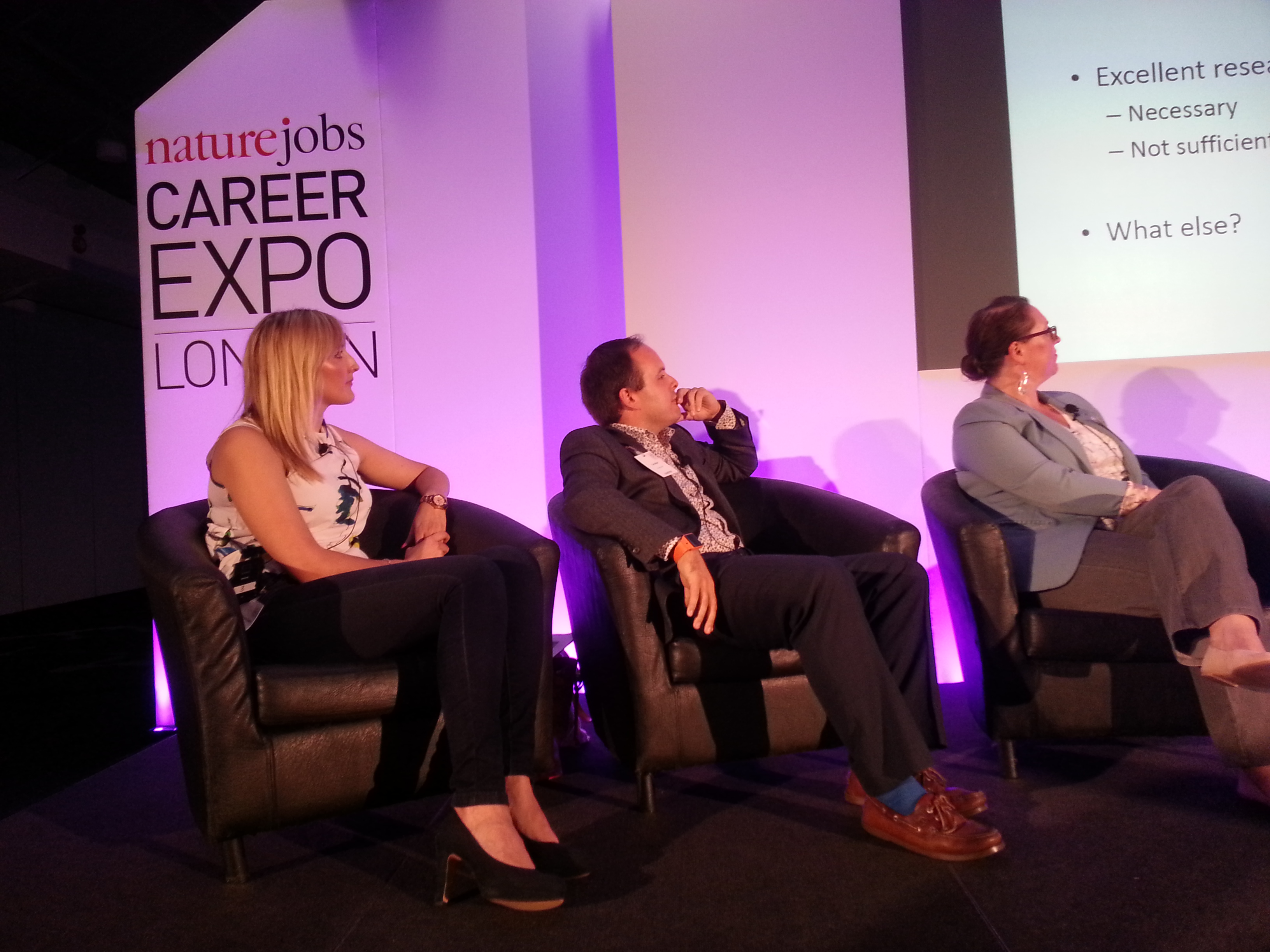
L-R: Jenna Stevens-Smith, Tom Weller, Elizabeth Bohm{credit}Creit: Lisa Restelli{/credit}
Anna Price and a panel of academics-turned-other-careers show that all scientists in academia have transferable skills, but the trick lies in recognising and applying them.
Contributor Lisa Restelli
Elizabeth Bohm is a policy advisor at the Royal Society. Before that, she was working in a lab and she also trained in law.
Tom Weller is a science teacher and runs children’s parties to transmit his love of science. Before that, he was studying physics and has a PhD from University College London.
Jenna Stevens-Smith is the outreach and public engagement manager for the Department of Bioengineering at Imperial College London. Before that, she studied bioengineering, for which she also holds a PhD.
They all started off on one career path, only to realize that their talents and interests lay elsewhere. Luckily, they found that they already possessed a number of abilities that made them especially suited for their prospective alternative careers. In short, they exploited their transferable skills.
At the Naturejobs Career Expo in London, I — along with other participants to the transferable skills session — was guided by panel chair Anna Price, Researcher Development Adviser at King’s College London, to discover these elusive abilities and their uses. Price defined a transferable skill as “any skill that you can learn in one context and employ in another”. This definition is certainly broad, but so are the skills it refers to. The challenge lies in identifying the ones we possess, as well as in establishing how to channel them into a rewarding career. They are not hard to find: a number of tools and lists exist, but the real question is, ‘how to apply them?’ To answer it, there are nothing like success stories. Continue reading