Winners of the Scientific American Innovators Award Turn Trash into Water Filters [Video]

Guest post by Andrea Gawrylewski, collections editor at Scientific American

After 50 hours in a lab, three Ohio eighth graders convert Styrofoam food containers into a patent-worthy new water filter
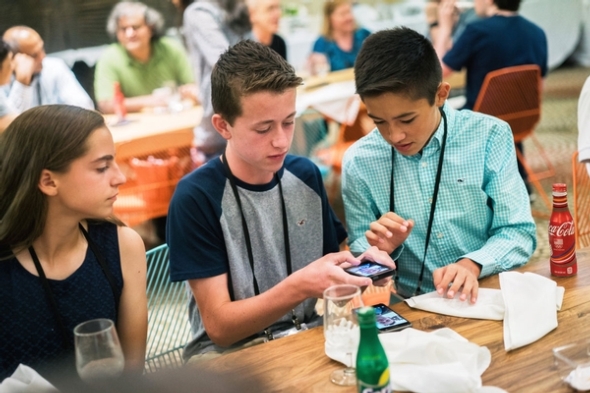
SA-innovators-award

Scientific American Innovators Award winners (from left to right) Julia Bray, Luke Clay and Ashton Cofer
Credit: Andrew Weeks

World-changing ideas may just come from our youngest scientists. This year’s winners of the annual Google Science Fair—including the winners of the Scientific American Innovators Award—were announced this week at Google headquarters in Mountain View, Calif. The event is the largest online science fair in the world, and since its inception in 2011 more than 30,000 teenagers have submitted projects in almost every country.

“Kids are born scientists,” says Scientific American Editor in Chief Mariette DiChristina, who served as head judge at the fair. “They ask great questions and we should foster their efforts to learn the answers firsthand.”

For the past five years Scientific American has partnered with Google to award the Scientific American Innovator Award, which honors an experimental project that addresses a question regarding the natural world. This year’s award went to three eighth graders from Ohio who were particularly disgusted with the amount of Styrofoam (polystyrene foam) trash they saw in their everyday lives—the material accounts for 25 percent of landfill space, and is exceptionally difficult to recycle or reprocess.

The team of Julia Bray, Luke Clay and Ashton Coffer, all age 14, analyzed the chemical structure of Styrofoam and determined that it is composed of over 92 percent carbon. This sparked their idea: They hypothesized that they could use heat to convert the Styrofoam into activated carbon—which could then be used to filter water. After 50 hours of experimental work, the team successfully converted the polystyrene into carbon with over 75 percent efficiency by heating the material to 120 degrees C. They then treated the carbon with a set of chemicals to increase the surface area of the material, and tested it against commercially available water filters. Their results showed that their carbon successfully filtered many of the same compounds that commercials filters remove from water.

“Styro-Filter is just the beginning of an innovation to take dirty waste and make clean water,” Bray explains in her team’s video summary of the project. The team has filed for a provisional patent for its filter-making process.

The winners of the Scientific American Innovators Award share a $15,000 cash prize. The grand prize of the Google Science Fair went to Kiara Nirghin, a 16-year-old from South Africa who used orange peels and avocado skins to devise a superabsorbent material that can absorb and hold 300 times its weight in water. She hopes that the nontoxic material can be used to boost agriculture in water-scarce regions.

“All of the finalists produced inspiring work,” DiChristina says. “It’s thrilling that the judges chose such exciting candidates from all around the globe.”

This article originally appeared at Scientific American on 28 September 2016 and was republished with permission.

Quantum Short 2014 Film Contest Accepting Entries

When the 2008 Bond film came out with the title Quantum of Solace, science fans may have been hoping for a plot that hinged on quantum physics. Bond didn’t deliver, but there are some pretty great quantum-inspired movies out there. And soon there’ll be a few more.

The Centre for Quantum Technologies at the National University of Singapore, in partnership with Scientific American and Nature, is launching its Quantum Shorts 2014 short film competition.

This online contest for films that take inspiration from quantum physics boasts prizes that include cash amounts of up to 2,000 Singapore dollars (around $1,500 U.S. dollars), digital subscriptions to Scientific American and engraved trophies. A team of eminent judges will select the winners in open and student categories. The judges include Mariette DiChristina, Editor in Chief of Scientific American, Artur Ekert, co-inventor of quantum cryptography and Charlotte Stoddart, Head of Multimedia at Nature. There will also be a “people’s choice” prize decided by public vote.

You have until 11:59 p.m. EST on February 1, 2015 to enter films. You can find details on how to enter, inspiring quantum facts and the contest rules on the competition website.

Perhaps you aren’t convinced that quantum physics has the raw materials for making a good movie? Let Mariette DiChristina persuade you. At the conclusion of last year’s Quantum Shorts competition for flash fiction, she wrote, “this stranger-than-fiction discipline has inspired some first-class narrative thrills.” Scientific American joined Quantum Shorts in 2013 as a media partner, and DiChristina was a judge then too.

Continue reading

Childhood dreams become reality after young inventor scoops Science in Action Award

Kenneth Shinozuka: "Struck by the power of technology to change lives."

Kenneth Shinozuka: “Struck by the power of technology to change lives.”

Kenneth Shinozuka was six years old when he first found out his grandfather had Alzheimer’s disease. It was a bracing August morning and the police turned up at the door with his grandfather, dressed in nothing but his pyjamas. They found him two miles away, walking along the freeway. He had been walking through the night. That moment, back in 2005, would change his family forever.

Shocked and concerned by his grandfather’s tendencies to wander in the night, after numerous incidents, the budding inventor set about finding a solution. Shinozuka was by no means your average American six-year-old. Inspired by his parents, both of whom are civil engineering professors, he never tired of dreaming in his small bedroom about creating the next big invention.

Supremely smart and motivated, Shinozuka’s first invention was a device which would send an alert to a carer’s wristwatch when an elderly parent had fallen in the bathroom. Not content with his ‘Smart Bathroom’ idea, at the age of seven, he created a Smart Medicine Box that emits a sound and flashing light to remind patients to take the right medicine at the right time.

This week Shinozuka, now 15, from New York, has been announced as the third annual Scientific American Science in Action Award winner, receiving $50,000 and access to a year mentorship scheme, for his latest acclaimed invention. Scientific American’s Editor-in-Chief, Mariette DiChristina, describes the award’s ethos as “honouring a project that can make a practical difference by addressing an environmental, health or resources challenge.”

Shinozuka had his eureka moment while looking after his grandfather one evening and watching him step out of bed. “The moment his foot landed on the floor, a light bulb flashed in my head,” says Shinozuka. He continues “Why don’t I put a pressure sensor on the heel of his foot? The moment he steps onto the floor, the sensor would detect the pressure caused by his body weight, and the signal could wirelessly trigger an audible alert in my aunt’s smartphone.”

Continue reading

Winner of The Quantum Shorts 2013: The Knight of Infinity

Guest Post from Editor in Chief of Scientific American (part of Nature Publishing Group) Mariette DiChristina.

Timothy Yeo - CQT, National University of Singapore

Timothy Yeo – CQT, National University of Singapore

Quantum mechanics—operating at atom-size scales—is so odd in so many ways that even Einstein despairingly said of it that “God does not play dice with the world.”

Now this stranger-than-fiction discipline has inspired some first-class narrative thrills, including the winner of The Quantum Shorts 2013 competition in the International category, decided by the judges, and also the People’s Choice, decided by public voting: “The Knight of Infinity,” submitted by Brian Crawford. The flash-fiction contest (stories not to exceed 1,000 words), organized by the Centre for Quantum Technologies at the National University of Singapore, drew more than 500 entries in this, its second, year.

As a media partner (I was one of the judges), Scientific American is pleased to share Crawford’s winning entry just below. You can find the rest of the winning entries here as well as other entries here.

Continue reading

Curtis Brainard appointed as new blogs editor at Scientific American

Scientific American (part of Nature Publishing Group) has today announced the appointment of Blogs Editor Curtis Brainard.

Brainard, previously a staff writer at Columbia Journalism Review, will manage and further develop the Scientific American Blog Network. “Science blogs are a vital part of the modern media industry, and it’s an honor to be joining an organization that has done so much for them,” he says.

Continue reading