Guest post by Professor Elizabeth Loftus, winner of the 2016 John Maddox Prize
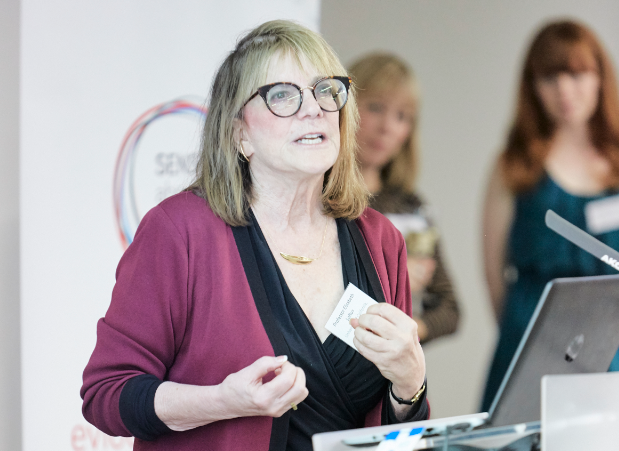
Elizabeth Loftus {credit}The Other Richard{/credit}
I could hardly contain my excitement when I first learned that I would receive the 2016 John Maddox Prize, a prize that recognises the work of people who promote sound, credible science that bears on a matter of public interest and have faced difficult challenges or hostility in the process.
I am humbled that I follow last year’s award winners: Prof Edzard Ernst, who was recognised for his longstanding commitment to solid research about alternative medicines, and Prof Susan Jebb, who tackled misconceptions about sugar in the media and the public; both of whom communicated their findings to a wide audience.
And I love the idea that, forever, my CV will contain the name of the late Sir John Maddox whom all respect for his tireless defence of science.
Early in my scientific career, I developed a deep interest in the study of eyewitness testimony. I would show research witnesses simulated crimes and accidents and explore how the questioning process affected their memories of what they had seen. I conducted hundreds of studies showing how post-event information can become incorporated into a witness’ memory, sometimes adding to the memory and sometimes distorting it. The impairment in memory due to exposure to misinformation became known as the “misinformation effect.”
I would soon find myself involved as an expert in a famous murder case where the accuser claimed to have recovered a repressed memory of murder, but I doubted the authenticity of her memory. It appeared as if she may have developed a “rich false memory,” that is a memory for an entire event that didn’t happen. So I developed a new research paradigm to study such rich false memories. Scores of studies, done by my group, and others, showed how relatively easy it was to plant a childhood memory for something that did not happen, but would have been upsetting or even traumatic if it had happened.
In the years after my first repressed memory murder case, thousands of other repressed memory cases emerged. The memories typically involved claims of severe sexual abuse. People were going into therapy with one sort of problem, like depression or an eating disorder, and coming with another problem. Horrific memories of sexual abuse allegedly perpetrated over years, and repressed into the unconscious until the memory returned. People were suing their family and former neighbors, as well as their doctors, dentists and teachers. Many families were destroyed in the process, and I found myself deep in the midst of these memory wars.
I tried to speak out about these travesties, the dubious nature of repressed memories and the injustice of convicting people of crimes based on these memories without additional evidence. I was met with a great deal of anger from people. The anger came from both the repressed memory patients, convinced of the veracity of their newly “recovered memories”, as well as the therapists who had helped these patients “find” their memories.

Elizabeth Loftus with Sir Philip Campbell, Editor-in-Chief of Nature {credit} The Other Richard{/credit}
I could endure nasty letters and emails. I could handle death threats made to universities that invited me to speak. But I was not quite prepared for the lengthy battle I would face when I investigated a case that was being touted as solid “proof” of repressed memory. It was the case of Jane Doe. Jane Doe had accused her mother of sexual abuse when she was a child caught in the midst of an unpleasant divorce and custody battle. A psychiatrist videotaped the “retrieval” of this memory and showed the tapes to others discussing this new “proof.”
I investigated the case with Mel Guyer, a lawyer and psychologist from the University of Michigan. Our investigation suggested it was quite possible that no abuse ever occurred to Jane Doe. However when we published our findings, without identifying Jane Doe, a number of bad things happened.
We shielded her identity, but Jane Doe sued us anyway, using her real name – Nicole Taus. She filed her case in 2003, asking for $1.3 million dollars for defamation, invasion of privacy and other claims. Over the ensuing years of litigation, a trio of California courts threw out 20 of the 21 allegations that she made against me and other defendants.
After the California Supreme Court effectively finished gutting her case, Taus offered to withdraw her case against me in return for a payment of $7,500. I would have preferred to have a jury vindicate me, but the insurance company decided that the cost of a trial would far exceed $7,500. Insurance companies have a label for this: “nuisance settlement.” The California Supreme Court also ordered the trial judge to determine how much Taus herself would have to pay for attorney fees and costs incurred by the other defendants who had been dropped along the way. These included my co-author, the magazine where we published our essay, and a psychologist-friend whom we had thanked in a footnote for her help with the essay. The trial judge determined that Taus would be responsible for nearly $250,000 in attorney and court fees, and she declared bankruptcy soon after. So, what do I say when people ask me “Who won the case?” No one won, except perhaps the attorneys; they were well compensated for their time.
Are there lessons to learn from enduring a miserable legal process? I learned a great deal about the vulnerability of academics to lawsuits. Scholars are not always afforded the full protection of constitutional guarantees, and this is especially true when the scholars work on problems that matter in people’s lives – and are therefore likely to be sources of controversy or conflict. But these are precisely the kinds of scholarly inquiries in which there is a profound need for our institutions to provide vigilant protection of free speech.
Other institutions can help as well. When organizations like Nature, and the Kohn Foundation and the charity Sense about Science come together to recognise an individual who has faced difficult challenges and huge hostility in the name of science – it can make all the difference in the world.
Elizabeth Loftus was awarded the 2016 John Maddox Prize for courage in promoting science and evidence on a matter of public interest, despite facing difficulty and hostility in doing so. She is a cognitive psychologist at the University of California, Irvine, and is recognised for her leadership in the field of human memory.
The John Maddox Prize, now in its fifth year, is a joint initiative of Nature, The Kohn Foundation and the charity Sense about Science. You can read the full announcement here.