No forest too wide or mountain too high in the fight against global warming

From undersea meetings by Maldives’ ministers to debates in the US Senate, talk of climate change is echoing around every corner of the globe. The message: needs are great and growing fast, while resources remain few and far between.

The task awaiting negotiators headed for Copenhagen this December – to agree a global treaty for saving the planet – is daunting, particularly with hopes of achieving the task in Copenhagen fading rapidly.

But one person eagerly anticipating the conference is Greg Asner, a tropical ecologist with the Carnegie Institution for Science’s global ecology department in Stanford, California. For the past decade Greg and his team have been stationed in the Peruvian Amazon, designing and testing a system that can accurately calculate the amount of carbon locked up in forests and track changes over time. Jeff Tollefson journeyed to the Amazon and reports on Asner’s work in the latest issue of Nature.

Continue reading

Bangkok negotiations: US concedes on funding as accusations fly

At the ongoing pre-Copenhagen climate talks in Bangkok, the US has made a step towards resolving the deal-breaker issue of funds to help developing countries respond to climate change. The Guardian’s all over it, perhaps thirsting for some good news to break up the drumbeat of doubt we’ve heard lately on the climate policy front.

The slight but significant shift is that the US now agrees with developing countries that money for mitigation and adaptation should come through a new, single, independent fund administered at least partly by the UN. Before, the US had argued for sticking with existing funding bodies like the World Bank, an institution disfavoured by the global South for its policy of loaning, rather than aiding, money.

But critical questions on climate funding are still up in the air – not least the numbers to be written on the cheques. And on other issues, the US stands accused of putting on the brakes. As the AP reports, it is increasingly being recast in the familiar role of climate villain.

Details are few on the negotiations, which are sealed off from press. But an anonymous EU source told the Guardian last month that the US team is putting forward a new framework for the Copenhagen deal that would scupper Kyoto-style policy. Instead of working top-down to divide a global emission cut among countries, the US reportedly wants the deal to be a patchwork of national commitments, each with its own rules and timetables.

Add to this the long-running demand for emissions commitments from emerging economies like India and China, and they’ve got the developing world in a righteous fury. Yesterday, China was joined by the head of the G77 (which has grown from the eponymous 77 to a group of 130 developing states ) in a coordinated statement charging that rich nations collectively – not just the US – intend to kill Kyoto.

Continue reading

Must-reads for Copenhagen

At the UN climate conference in Copenhagen this December, talk will turn to scientific, political and economic issues with a global reach and a long history — not easy to pick up from the daily news. We asked select experts on climate change what books we should be reading ahead of the big event.

Here’s a peek at some well-informed desks, bookshelves and bedside tables. Read the full roundup here – and join in our pre-Copenhagen book club by commenting below.

When your last work led to an Oscar and Nobel Prize, anticipation is high on the sequel. And Al Gore’s new book delivers, says Joe Romm, the voice of Climate Progress at the Centre for American Progress. Gore’s Our Choice collects the most effective climate change solutions that policymakers could put in place now.

Tony Juniper, the campaigner and onetime director of Friends of the Earth, picks out Mark Lynas’s Six Degrees (also a favorite of the Royal Society). The book vividly paints the changes expected as the world warms – revealing the practical implications of compromises we could see at Copenhagen.

A lively new book by an ex-oilman and geologist tells some of the insider history behind the UN talks – an eyewitness account of shifting views on climate change within the oil industry. Lord Ron Oxburgh, former chairman of Shell, says Brian Lovell’s Challenged by Carbon is an instant tonic for ‘climate change fatigue’.

Roger Pielke, Jr., a University of Colorado science-policy expert, argues that climate negotiators are failing to learn from history. He recommends the 1998 book Seeing Like a State by James C. Scott, which recites a litany of failed attempts at centralized planning.

Oliver Tickell’s climate policy proposal Kyoto2 is just the thing a truly intelligent species would come up with, according to Mark Lynas, environmentalist and Six Degrees author. But it’s nothing like what’s on the table for December.

Can we ‘solve the climate crisis’? In Why We Disagree About Climate Change, Mike Hulme of the University of East Anglia asserts that “climate change is not ‘a problem’ waiting for ‘a solution’” but rather is an idea whose shape can differ completely depending on one’s political and cultural biases. New York Times reporter and Dot Earth blogger Andrew Revkin recommends the book and sketches out its implications for Copenhagen.

In turn, Mike Hulme points to a book that looks beyond the usual dichotomy of climate change ‘believers’ and ‘sceptics’ to find a more fundamental split in thinking. John Foster’s The Sustainability Mirage explores some crucial social and psychological realities of climate change that you won’t be hearing much about during the conference.

Another good read when you want to lift your head from the trenches, the new book Whole Earth Discipline by Stewart Brand takes an overview of environmental issues in the twenty-first century. Former Nature editor (and sun-eater) Oliver Morton dubs it a lucid big picture put together with experience, wisdom and optimism.

Could you call yourself ready for Copenhagen without taking a look at the IPCC report? Rajendra Pachauri, chairman of the UN’s Intergovernmental Panel on Climate Change, says their 2007 Synthesis Report – a sum-up of the masses of policy-relevant research reviewed by the three working groups – has perhaps been the panel’s most effective report thus far in creating awareness across every section of society.

Here are the book reviews in full. What do you think – are these the right reads to get ready for the conference? What others should be on the list?

Anna Barnett

Image: © iStockphoto / Pertunisas

Cloudy knowledge

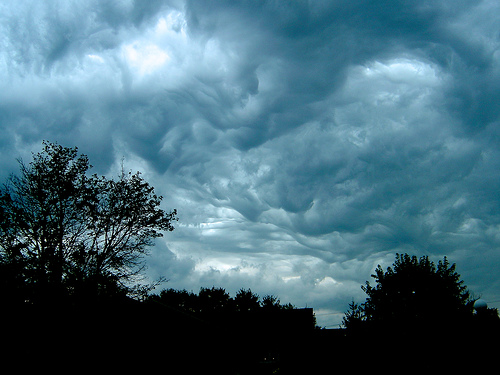
darkclouds.jpgDespite decades of research, relationships between clouds, aerosols and precipitation are poorly understood, concludes a review article in Nature today.
Before a cloud can produce rain or snow, rain drops or ice particles must form. Atmospheric aerosols, tiny particles of mineral or organic origin, serve as the nuclei for condensation.

But the precise effects of aerosols on cloud formation and radiative forcing remain controversial. In their review article, Bjorn Stevens and Graham Feingold propose that the uncertainties reflect a failure to take into account processes that act to buffer the response of clouds and precipitation to aerosol changes. Worse, existing tools and methodologies for untangling these processes are inadequate, they say.

“If we wish to make significant strides in understanding the interplay among the aerosol, clouds and precipitation, we consider it imperative to launch significant new international initiatives, with comprehensive, coordinated and enduring measurements, targeting specific regimes and coupled to state-of-the-art modelling,” the duo concludes.

Among other things, they say, what’s lacking is an array of ground-based remote sensors capable of vertically and temporally resolving the aerosols, clouds, precipitation and the meteorological state.

Quirin Schiermeier

Image: Flickr user laffy4k, Creative Common license

4 Degrees and Beyond: Adaptation to what?

If we are trying to keep global warming to 2 degrees Celsius or less but 4 degrees is possible even within some of our lifetimes, which world do we prepare for? Talks at today’s session on adaptation took on the problem of the multiple futures that decision-makers have to face. Mark Stafford-Smith of CSIRO in Australia talked specifically about long-term decisions – such as planting and managing forests – where the best option depends on which way the climate goes later this century. If you expect strong mitigation that holds down warming, then you try to preserve today’s forests and nurse them through, protecting them from fire and other threats. If a moderately high temperature is in store, forest composition will have to change and you can plant new species to facilitate that. With runaway climate change the best option could be opening up the forests to invading weeds and rapid, radical transformation.

This is no hypothetical choice. During February’s raging wildfires in southeastern Australia, it appears that even the seed stores in the forest floor were destroyed in some burnt areas. Stafford-Smith recommends that conservation managers trying to bring these areas back to life should divide their efforts to follow all three approaches above. Such a hedging strategy may mean two-thirds of forest plans need to be abandoned and altered as the future unfolds, but it’s better then putting all the trees in one basket.

Rob Swart of Wageningen University, The Netherlands, looked at hedging on a much larger scale – the plan Bs we could prepare in case of a true planetary emergency. From geoengineering schemes that risk severe side effects to extreme emissions reductions that would affect the climate only slowly and probably require tight government control, none of the options are attractive. But Swart thinks there should be an international process – separate and parallel to current UN climate policy – for countries to work out ahead of time how they would cooperate on such schemes. If left to a moment of panic, they’re unlikely to be carried out thoughtfully and equitably.

Anna Barnett

4 Degrees and Beyond: To flee the sea, or not to flee?

Immersing yourself in the impacts of extreme climate change can give rise to a certain amount of gallows humor. Conversation among my dinner companions last night turned to whether this week’s 4 Degrees and Beyond conference or March’s Copenhagen Climate Congress provided “more apocalypse for your conference fee”. The far more serious question, of course, is how much upheaval and human suffering would come with the substantial warming that delegates here are contemplating. Some interesting talks today looked at the facets of sea level rise and population displacement.

Stephan Rahmstorf of the Potsdam Institute for Climate Impacts Research had an intriguing update on a 2007 Science paper in which he’d come up with a new method for projecting sea level rise. Rahmstorf throws out any attempt to use complex climate models on this controversial problem and instead starts from scratch, with observed relationships between temperature rises and sea level rises. Now, working with Martin Vermeer of the University of Technology in Helsinki, he’s upgraded the extremely simple equation he used in 2007 to an only slightly less simple equation – one that takes account of the rate of warming and the amount of water that humans sequester in reservoirs. They use this to reconstruct a remarkably faithful record the last millennium’s sea levels.

Turning it to IPCC temperature projections, the team finds that sea level rise by 2100 could range, depending on the emissions scenario, from 0.75 to 1.9 metres, and a 4-degree world would likely see 0.98 to 1.3 metres of rise this century. A caveat: the recent sea-rise data that inspired and calibrated this equation and the past data that it explains don’t include the full effects of melting ice sheets that could lie ahead. That means 0.75 to 1.9 metres may be a conservative estimate.

But if we’re concerned with how creeping seas affect coastal populations, the amount of rise is not the only matter to settle. This was a key argument made by Francois Gemennes of the Institute for Sustainable Development and International Relations in Paris. Gemennes’ talk was based on a study of environmentally induced migration that I covered earlier this year. When it comes to climate refugees, he says, the numbers that are often tossed around – such as 200 million new migrants by 2050 – are based on the assumption that greater climate impacts will push more people around. What they aren’t based on is empirical data about how populations respond to environmental change. But according to the recent EACHFOR project – the first global-scale survey of environmental migrants – the size of impacts isn’t the crucial variable at all: migration largely depends on policies making it possible for people to react to impacts by migrating. In particular, Gemennes argues, the poorest and most vulnerable will not be able to migrate unless they are given resources and exit routes – if we don’t encourage migration as an adaptation strategy, they’ll be trapped in the frying pan (or flooding delta).

The next event of the conference is a panel discussion on “4 degrees of climate change: alarmist or realist?”, which I’ll be tracking over on Twitter. Follow @annabarnett.

Anna Barnett

4 Degrees and Beyond: How soon is it coming?

Unless major breakthroughs in policy, industry and individual behavior turn around our emissions trajectory pronto, this century could well see average global temperatures 4 degrees Celsius or more above their pre-industrial baseline. That’s the starting point for the 4 Degrees and Beyond conference in Oxford this week. Here, 130 scientists and policy experts are taking a detailed look at a world warmed by twice the amount that’s usually considered dangerous.

Putting weight behind the 4-degree premise was new modelling research presented this morning by Richard Betts of the UK Hadley Centre (press release, Guardian). Betts’s team used a complex, coupled ocean-atmosphere model to simulate the IPCC’s extreme-emissions A1FI scenario (the FI stands for fossil fuel intensive) – an emissions trajectory that’s previously been run only on simpler models. It’s time to take this scenario seriously, argues Betts, given that our emissions are running at the upper end of what the IPCC projected a decade ago.

They also tried out weakening climate sinks on land and sea – feedbacks that are increasingly apparent in recent research, Betts says. Depending on the strength of the feedbacks, 4 degrees of average warming could be reached well before 2100 – as early as 2060 in a worst case scenario, and in the 2070s according to the team’s best guess. Regional warming would be far greater, they found – 7 degrees in many areas, up to 10 in western and southern Africa, and 10 or more in the Arctic.

Sessions afterwards started sketching out consequences in detail. Philip Thornton of the University of Edinburgh looked at agriculture in Africa, where projected impacts are predictably devastating, with yields falling over 50% for certain crops and crop failure years growing more frequent in many regions. Adaptations for this amount of change are a big question mark. Intensive agriculture in highlands – among the few spots that will benefit – may be one possibility for preserving the food supply.

Meanwhile in Finland – where you might expect balmier weather to be a boon – intense climate change may also prove a curse to farmers, reports Reimund Rotter of MTT Agrifood Research Finland. The picture there is complicated – the possible responses depend on many variables. A new type of barley that might compensate for losses to rising temperature or drought would only work in certain soil types, for example. But it’s clear that the North as well as the South will have its problems with the radically different 4-degree world.

Anna Barnett

Google Earth launches climate change tours

A newly launched series of Google Earth tours will map out the projected impacts of climate change worldwide and look at mitigation and adaptation options. Here’s a brief intro, narrated in the light Tennessee drawl of Al Gore:

The full length intro is here, with more tours to come. Google is also inviting netizens to talk back about climate change on a new YouTube channel.

While you’re playing with climate science layers on Google Earth, you may want to check out our interactive map of polar ice coring sites where researchers have extracted hundreds of millennia of climatic history.

Anna Barnett

Climate summits underwhelming, say leaders

After a banner week of international summits, a great leap forward on climate policy has yet to materialize, and some players are expressing a growing frustration.

US President Obama and Chinese President Hu Jintao both gave big speeches at a UN meeting in New York on Tuesday, but they didn’t make any bold leadership moves.

Jeff Tollefson has a briefing in Nature News on what went down:

Everybody is looking for signs of progress from the two biggest emitters, who together account [for] roughly 40% of emissions, but neither president offered the kind of commitments needed to re-energize the talks. Obama was in the unenviable position of needing to make bold promises before the US Congress has weighed in on the issue. Nonetheless, he declined to acknowledge, let alone address head on, the challenges he is facing on the domestic front.

For his part, Hu largely underscored existing policies, promising to expand forests, produce 15% of the country’s power using renewable energy and decrease energy intensity per unit of gross domestic product by a “notable margin” between now and 2020. All of these would substantially reduce Chinese emissions compared with baseline forecasts, and China is beginning to win some praise for its energy policies. Nonetheless, cumulative emissions are expected to continue rising, and Hu made no reference to any specific emissions targets or a date by which the country might try to stabilize its emissions.

As Jeff explains, almost everyone agrees with these statements, but they are old hat. And the clock is ticking. Says campaigner Steve Howard, founder of The Climate Group, in a New York Times story on the summit: “It was really great to have the vision, but with just 70 days left to Copenhagen, it is time to put some substance on the table. The two most important countries on this issue are being guarded in their positions.”

Obama’s speech did impress one observer, at least. Fidel Castro praised him as “brave” for acknowledging that the US has been slow to act on climate change.

Following closely was the G20 summit in Pittsburgh, which started yesterday evening and continues today. With financial policy expected to take up much of the agenda, hopes aren’t high for a climate breakthrough there either.

Continue reading

ICESat’s eye on runaway glaciers

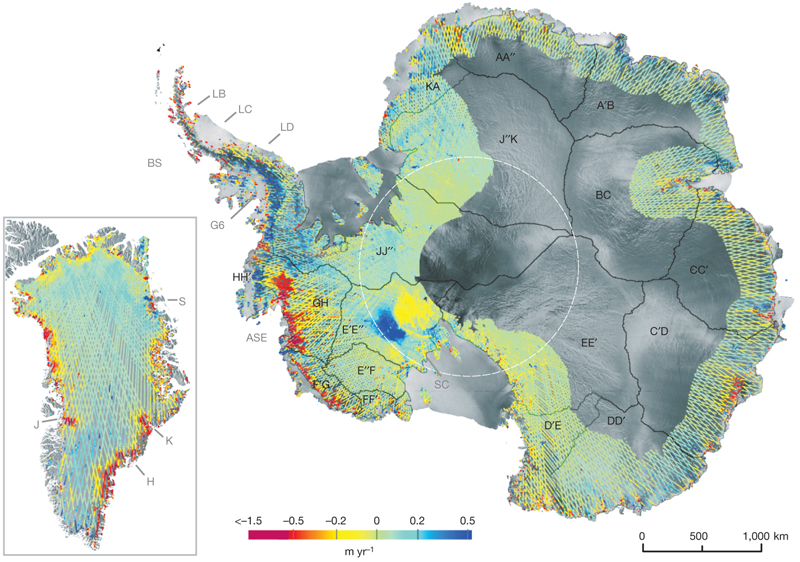
nature08471-f2.2.jpgMany glaciers in Greenland and Antarctica are speeding up their slide into the sea. But this type of ice loss – known as dynamic thinning – is so ill-understood and difficult to predict that the IPCC, in their 2007 assessment report, threw up their hands and refused to guess how much it would contribute to future sea level rise.

Meanwhile, however, scientists have been working with a new tool for studying glacier flow: NASA’s ICESat spacecraft. This satellite uses a laser to measure the changing height of the glaciers with spatial resolution an order of magnitude better than its predecessors.

The results from 2002-2007 are just in, published as a Nature paper (subscription) online this week:

Dynamic thinning of Greenland and Antarctic ice-sheet ocean margins is more sensitive, pervasive, enduring and important than previously realized.

Continue reading