Naturejobs career expo: What a day among classic cars told me about my future career

Lessons can be learned from the cars that crowded the background at the Naturejobs Career Expo in Düsseldorf, says Thais Moraes.

Guest contributor Thais Moraes


On the 26th of November in Düsseldorf, the Naturejobs career expo took place at the perfect venue. The Classic Remise center displays a collection of classic and historical cars that we all admired during the short breaks at the event.20151126_133138-edit

It was my first time at a career fair, and my first impression was that there were only young people there, starting the ignition in their professional lives. Since I already have many years on the road, I didn’t think it was for me. I was completely wrong: after listening to the talks, I was reminded that I don’t need to keep driving in the same direction just because it’s a road I’ve already started down.

The environment could have been just novel and enjoyable, but it also made me think about my future career plans, especially the fears and challenges that arise when you go for something new. There are four things that these machines brought to my mind.

Continue reading

Science communication: Do you struggle with staying impartial?

Catherine Ball, a policy analyst at the House of Lords Science and Technology Select committee, talks about impartiality procedure at the Naturejobs Career Expo London 2015.

Watch more from the Naturejobs career expo here.

Science communication: Writing for scientific and policy audiences

Catherine Ball, a policy analyst at the House of Lords Science and Technology Select committee, explains the difference in styles between writing for a scientific audience and writing for a policy audience at the Naturejobs Career Expo London 2015.

Watch more from the Naturejobs career expo here.

Science communication: What are the differences between working for parliament or a learned society?

Catherine Ball, a policy analyst at the House of Lords Science and Technology Select committee, explains the differences between working for parliament and working for a learned society at the Naturejobs Career Expo London 2015.

Watch more from the Naturejobs career expo here.

Science communication: What is the organisational structure like in a company like Nature?

Anke Sparmann, associate editor at Nature Structural & Molecular Biology, shares her insights on the company structure of Nature at the Naturejobs Career Expo London 2015.

Watch more from the Naturejobs career expo here.

Science communication: Why is the turn-over rate for editors so high?

Anke Sparmann, associate editor at Nature Structural & Molecular Biology, shares her views on the turn-over rate for editors in scientific publishing at the Naturejobs Career Expo London 2015.

Watch more from the Naturejobs career expo here.


Naturejobs: Let’s look over 2015

The Naturejobs blog has flourished this year – we hope you have too.naturejobs-reads

2015 was a great year for science, and it’s been a wonderful year for Naturejobs as well. We’ve hosted three career expos – in London, Boston and Düsseldorf – have published more free content than ever before, be it blog post, podcast or video. We’ve met interesting scientists, visited all manner of fascinating labs, and covered a wide remit of news, views, and everything in between.

We hope you’ve all been entertained by, and have benefited from, the advice and stories we publish here, and we’re hoping to see you all in the 2016 for more careers content that will help you find – and succeed at – that dream job. Here’s a quick rundown of the stories you most enjoyed from 2015. Continue reading

Science communication: How to deal with articles that misrepresent science

Robert Dawson from Cancer Research UK explains how they deliver engaging but accurate content based on their research.

Robert Dawson, communications manager at Cancer Research UK, was one of four speakers on the careers in science communication panel at the 2015 London Naturejobs Career Expo.

Media outlets are giving information in a variety of ways, whether in list formats like those on Buzzfeed, or long feature articles.

But often, with the shorter, and often faster production times of the content, the science can be misleading and incorrect. So, Cancer Research UK works with organisations to do myth-busting: where the media has misrepresented science and needs correcting. The NHS has a section on their website called Behind the Headlines, which does a similar thing.

His advice is to give the audience articles in the form that they want, whether in Facebook posts or Buzzfeed articles, but make sure that the content is accurate.

Further reading:

Science communication: Whose responsibility is it?

Science communication: Sculpting your role

#Scidata15: Make the most of your research: Publish better data

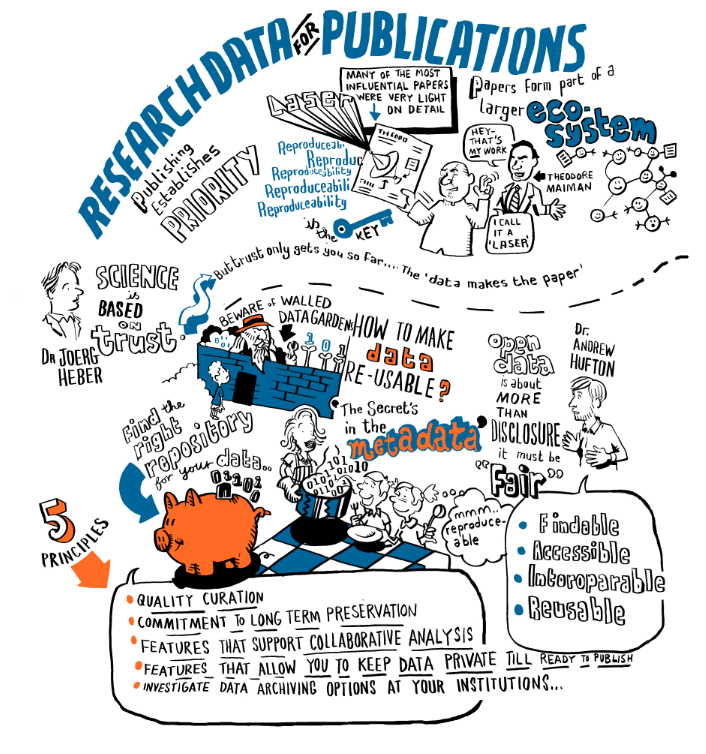
Primary research papers are the currency of academics, but they’re also part of a much wider body of knowledge that is restricted by a lack of transparency.

Guest contributor Lakshini Mendis

naturejobs-blog-Scidata15-ResearchData-for-Publications

{credit}Image credit: SCIENTIFIC DATA/LUDIC GROUP{/credit}

Historically, a great deal of trust has been placed in statements made in research papers for which the underlying data have not been shared. The invention of the laser was described in a paper containing just three data-points, for instance, and Watson and Crick first described the structure of DNA in a paper without any data at all. But with about 1,500 papers retracted since 2012, and 26.6% due to misconduct, scientific papers are now firmly under the microscope.

Improving the availability and readability of original research data would go a long way to improving matters. And as scientific publishers largely determine how research data is disseminated, their involvement will be central to any change. Speaking at Publishing Better Science Through Better Data in late October 2015, Dr Joerg Heber and Dr Andrew Hufton, editors at Nature Communications and Scientific Data respectively, emphasised that to make the most of research data it must be more open.

Overcoming the data-sharing challenge

According to Hufton, the status quo is for researchers to only share data with others directly. As well as being inefficient, data associated with published work disappears at a rate of about 17% a year as a result of researchers failing to properly catalogue findings. There is now, therefore, a move from scientific publishers to make data findable, accessible, interoperable and re-useable – or, to use an acronym as those of a scientific persuasion are so often inclined to do, FAIR. Continue reading

A science masterclass

Young researchers discuss science and careers with Nobel laureates at the 2015 Lindau Nobel meeting.

Image credit: Sam Falconer

Every year, Nobel laureates and young researchers come together in Lindau, Germany. It’s a unique opportunity to glean some advice for a successful career in science. The 2015 meeting cast a spotlight on super-resolution microscopy, as discussed in depth in the Nature Outlook: Science Masterclass, as well as fields as diverse as memory formation and the Higgs boson.

The first meeting was held in 1951, just two years before Francis Crick and James Watson revealed their structure of DNA. Since then, Nobel laureates from all walks of science have graced the small island with their presence, and 2015 was no different.

Elizabeth Blackburn, who shared the 2009 Nobel Prize in Physiology or Medicine with Carol Greider and Jack Szostak for their work on telomeres, was one of only three female laureates to attend the meeting. Other attendees included Richard Roberts (shared the 1993 Nobel Prize in Physiology or Medicine with Phillip Sharp for their discoveries of split genes), Francois Englert (shared the 2013 Nobel Prize in Physics with Peter Higgs for the theoretical discovery of a mechanism that gives mass to subatomic particles), Bruce Beutler (shared one half of the 2011 Nobel Prize in Physiology or Medicine with Jules Hoffmann for their work on the activation of innate immunity) and Susumu Tonegawa (winner of the Nobel Prize in Physiology or Medicine in 1987 for unlocking the genetic secrets behind antibodies’ diverse structures).

This particular Nature Outlook was supplemented with a series of videos highlighting some of the scientists’ work. On the blog, we’ve shown Saul Perlmutter’s work on the expanding universe, Stefan Hell’s work on breaking the diffraction barrier, Robert Wilson’s work on the cosmic microwave background and an insight into Elizabeth Blackburns interest in telomeres.

But of particular interest to the Naturejobs blog are three short videos that discuss certain elements of careers in science. Equal opportunities: Women in science, explores laureate Ada Yonath’s career, and why the gender gap in science persists. Young scientists also came together to discuss whose responsibility it is to disseminate science and finally, what does an early career scientist’s future look like, given the uncertainty in the job market?

Further reading/listening from the Naturejobs blog:

Podcast with Martin Chalfie, Venki Ramakrishnan and Arieh Warshel, on what it takes to be hired into their labs.

Podcast: Academia to industry, and back again, with Eric Betzig

Mentoring: A perspective from Nobel laureates

Mentoring: Before they were laureates

Mentoring: Where do laureates go for advice?

Lessons from a laureate