Fluorescence is a state of mind: Stefan Hell
Reply

Guest contributor Carina Dehner
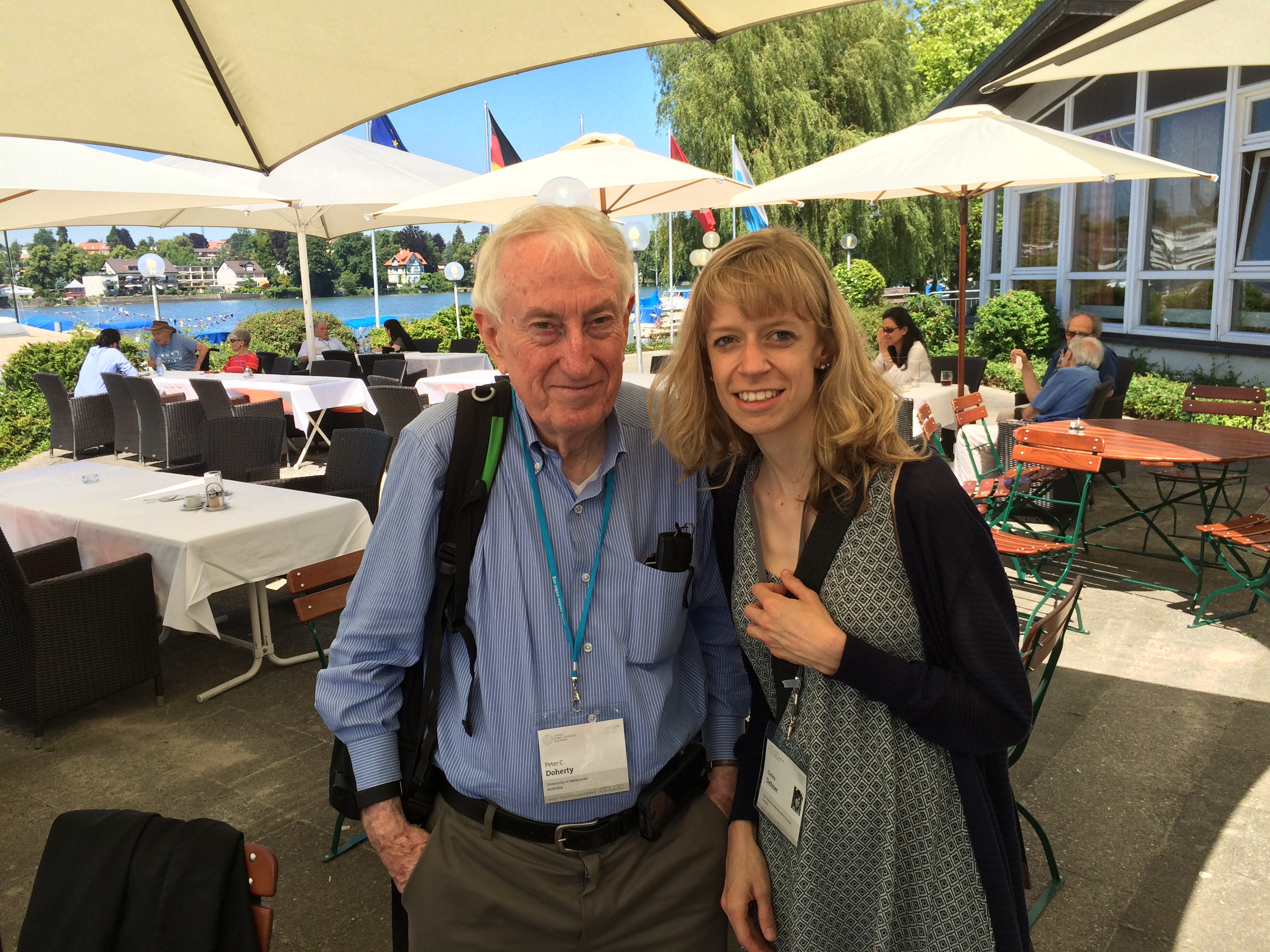
Peter Doherty and Carina Dehner{credit}Image credit Carina Dehner{/credit}
The Nobel Prize is a highly coveted and uniformly respected accolade. Receiving this honor opens almost every single door in the world; seemingly every country will welcome you with open arms. For example, the American immigration system will immediately provide you with a green card–. Furthermore, it conveys life-long prestige which many use to influence policy.
But, what is so special about these laureates? What happened in their lives and education that primed them for their seminal achievements? At the 2015 Lindau Nobel meeting I had the opportunity to interact with Professor Peter C. Doherty, winner of the 1996 Medicine or Physiology Nobel for his research on the immune system. He and Rolf Zinkernagl discovered how the immune system recognizes cells infected by a virus, deepening the understanding of how the immune system distinguishes self from foreign molecules. I was interested in his work as it closely relates to my own research on autoimmune diseases. What I was most excited about, however, was what I could learn from someone who has reached what many consider to be the pinnacle of a scientific career.
Nonlinear paths
Doherty began in Australia as a veterinary doctor, then switched to pathology, where he made his novel findings in immunology research. This meandering path is not unique to Doherty – many scientists often switch research fields, following research questions they find interesting. This type of career path is worth considering because it might stop you from developing tunnel vision and be open for other aspects.
Mentors
Today young scientists are advised to seek a mentor, but it struck me as interesting that Doherty’s never had one. Although he did mention annual meetings with a supervisor in pathology, he never gleaned constructive feedback that helped guide and formulate his thinking. He often left meetings with a simple “good idea” and nothing more. But this obviously did not discourage him.
He doesn’t believe mentors are the be-all-and-end-all. Many senior scientists are extremely busy, and might not be able to focus much attention on your needs as a young researcher. Instead, he suggests speaking to those who are just one or two steps ahead of you in your chosen career path to find out what they’ve experienced. Not only that, but if you want the best learning experience, “it helps to have a mentor who will continue to be enthusiastic about you after you’ve left “the fold”.
Yet he does his best to help his current students. Now, Doherty spends more time away from the bench, reviewing his staff’s papers and working with them to improve their communication skills. “Being able to express him- or herself is one of the most important things in a scientist,” he says.
Science communication
As part of my experience at Lindau, I was given the opportunity to present my research in Doherty’s master class on immunology research. I learned how difficult it can be to convey one’s research to an audience, particularly those not in your field. In asking essential word definitions and mechanisms in immunology – addressed to the audience, he made it obvious how important it is to make one’s own work understandable for any audience. Instead of skipping the details he recommended focusing on the message of the project.
Doherty enjoys communicating ideas that are important to him and encourages young scientists to express their opinions, thoughts and most importantly their work to others. One way he recommends is by submitting written articles to publications like The Conversation. “[It] is a great option for spreading your work – it’s openly accessible and it saves you from wrong journalism – you yourself can set your point of view there,” he says. He believes that the problem lies with well-qualified science journalists losing their jobs, “and the fact that media organizations push a particular (and at times toxic) line.”
So instead he suggests scientists reach out to the public themselves. “The lack of awareness of science and how it works is dangerous, especially when ignorance is a license to deny realities that may be dangerous to us,” he says. “We need everyone to speak up, and younger people are more likely to be adept in the ‘new media’.”
His advice on how to learn to do this is to just get writing. “If you can find someone who is good and will read your stuff, listen to what they tell you,” he says. He had a short list of tips that would be useful for any scientists, whatever their career stage:
Less is more. You don’t have to cover everything. Instead, focus on getting a key message across.
Tell a story, whatever format you use.
Avoid jargon where you can.
Don’t reproduce anything you don’t understand. “If you read an impressive argument or statement that you don’t understand, don’t reproduce it. The originator probably doesn’t understand it either!”
The end goal
When reflecting on the Nobel itself, Doherty believes that “this prize is much more recognition than what you deserve – suddenly things come up you never thought about before.” But there are also advantages of a prize like this. He now has the ability to provide yearly financial support for the training of young scientists, which brings him much joy.
 For many young researchers entering graduate school for a PhD, a career in academic research is the end goal. Yet the pyramidal career structure doesn’t make this easy for everyone to reach. So, when it comes to finding out how you can get your foot in the door, who better to ask than three of the most successful academic research scientists?
One of my best trips this year was to the 65th Lindau Nobel Meeting. It was set on Lindau Island, a beautiful, picturesque little place in Lake Constance in Germany. And whilst I was there enjoying the sights, I also had the opportunity to speak to some very interesting people. The meeting was an opportunity for hundreds of early-career researchers to meet Nobel Prize winners from across the sciences. They networked, presented and had informal conversations about the scientific life.
This month’s podcast is a collection of conversations and thoughts I had at that meeting with three Chemistry Nobel Laureates: the 2008 Laureate Martin Chalfie from the University of Columbia; Venki Ramakrishnan from the Laboratory of Molecular biology, Cambridge, UK, who won the prize in 2009; and Arieh Warshel from the University of Southern California, the 2013 prize winner.
Amongst other things, we discussed what each of them looks for in PhD students that they take on into their laboratories and faculty members that they hire into their departments. The main message from all laureates I spoke to, not just these three, was that without visible, tangible passion and enthusiasm for the science, it’s going to be difficult for you to get a position in a laboratory.
This lead us nicely onto a discussion about how you communicate this in an interview. And so, in the last part of this podcast, Warshel and Ramakrishnan, share their concerns for young scientists in this endeavour: They understand the importance of being a good communicator, but scientists need to know the limits to this. It’s no good over-selling your work if it means neglecting it, or even fabricating it.
The Nobel Prize week began with some very happy, almost unreal coincidences for me.
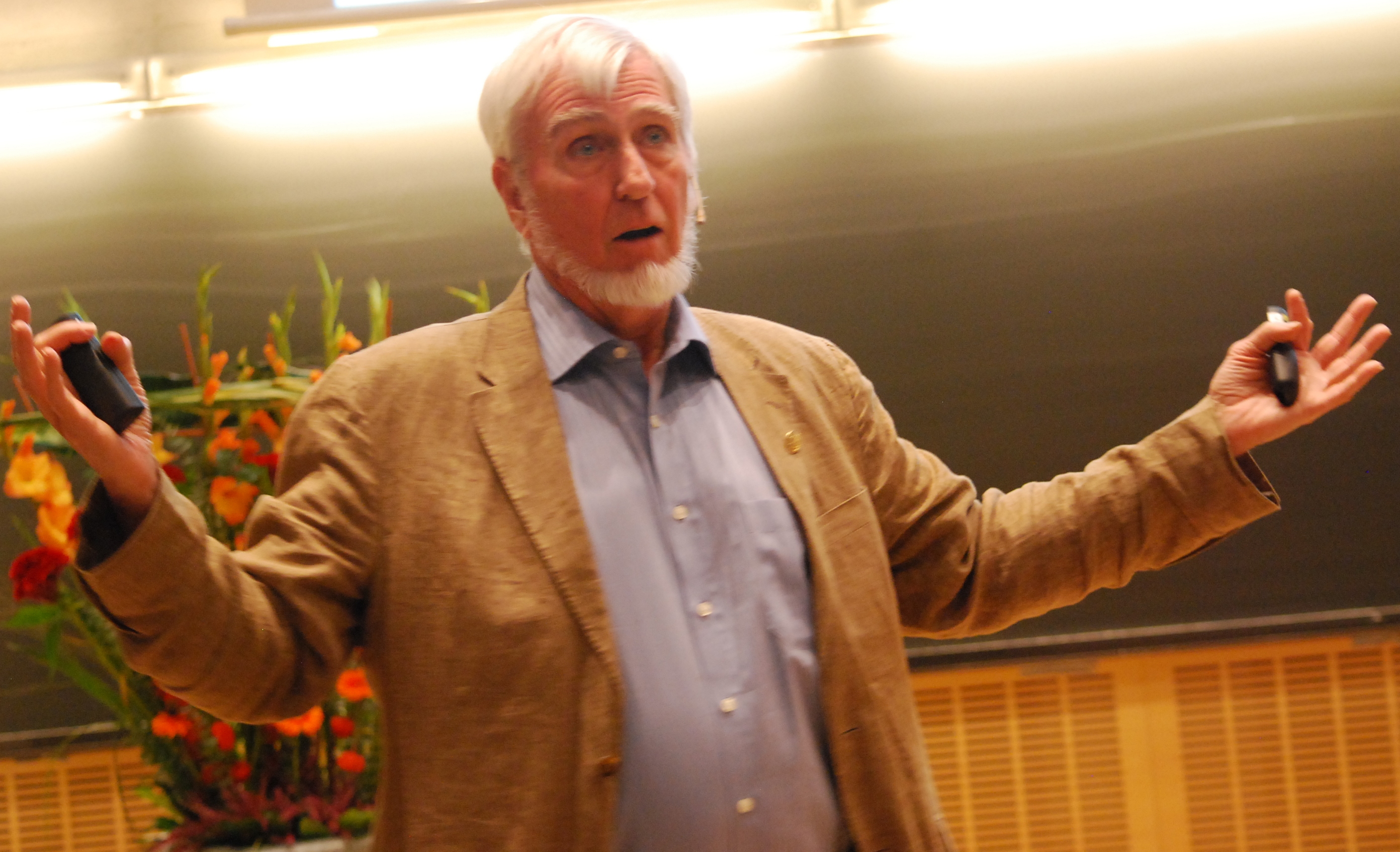
John O’Keefe, who recieved both the Kavli Prize and the Nobel Prize this year. {credit}S. Priyadarshini{/credit}
For one, not even a month back I met all three of the Physiology/Medicine Nobel Laureates for 2014 – John O’Keefe, May-Britt Moser and Edvard Moser – together, awed by their path-breaking work and wondering why they had not got the Nobel yet. What’s more, upon the invitation of the lovable, super-fit Moser couple, I visited their laboratory in Trondheim, the mecca of sciences in Norway, and came back wondering again – really, they haven’t got it yet?
The announcement of the Nobel Prize for Physiology or Medicine yesterday, therefore, felt like déjà vu – as if my attending the Kavli Prize ceremony in Oslo and visiting the Mosers’ lab in Trondheim was a sort of ‘meet the future Nobel winners’ event, star-studded with brilliance in neuroscience, nanoscience and astrophysics. Small wonder that O’Keefe, recipient of the Kavli Prize in Neuroscience, 2014 (along with Brenda Milner and Marcus E. Raichle) mentored the Mosers during their postdocs and beyond. “These two make me very proud”, he had said biting into a venison fillet at the Kavli banquet in Trondheim. “They are doing some exceptional work.”
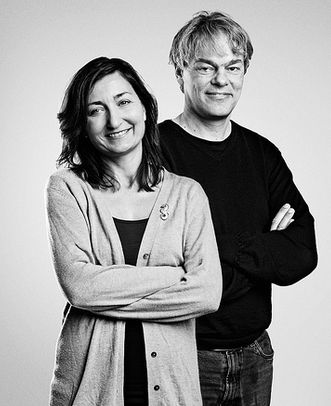
May-Britt and Edvard Moser{credit}Geir Mogen, NTNU{/credit}
Earlier in the day, O’Keefe, a professor of cognitive neuroscience at the University College London, was explaining the workings of our brain – the organ which contains ten times more nerve cells than there are people on this planet. How do these cells interact and perform all the complicated operations? O’Keefe’s work on the hippocampus (the region of the brain that gets its name from its resemblance to a seahorse – ‘hippos’ is horse and ‘kampos’ a sea monster in Greek) got him both the Kavli and the Nobel. In 1971, this affable man with a neat white Lincoln-style chin curtain beard, along with John Dostrovsky discovered that the hippocampus contains special nerve cells that determine an animal’s specific location. He called them ‘place cells’.
The suggestion that the hippocampus holds some kind of ‘cognitive map’ that helps us move – both physically and mentally – from one location to another, was initially controversial. As we know now, the theory has been ultimately pretty influential. “I continue to work on how this cognitive map theory can be expanded to explain the episodic memory deficit in patients whose hippocampus is damaged,” he says. In Alzheimer’s Disease, the first symptoms are usually detected when patients start getting lost in their own familiar neighbourhoods. Getting to know this memory function will help us understand what exactly changes for those with Alzheimer’s, he contends.
It’s a beautiful evening in Trondheim and the chirpy May-Britt Moser is taking us around the labs at the Kavli Institute of Systems Neuroscience at NTNU, the Norwegian University of Science and Technology. “That one is called Happy,” she says, pointing to a rat running around inside an open top rectangular box – the rat’s brains are being monitored on a computer through electrode implants in its head. “We call him ‘Happy’ because he is always so agile,” she explains.
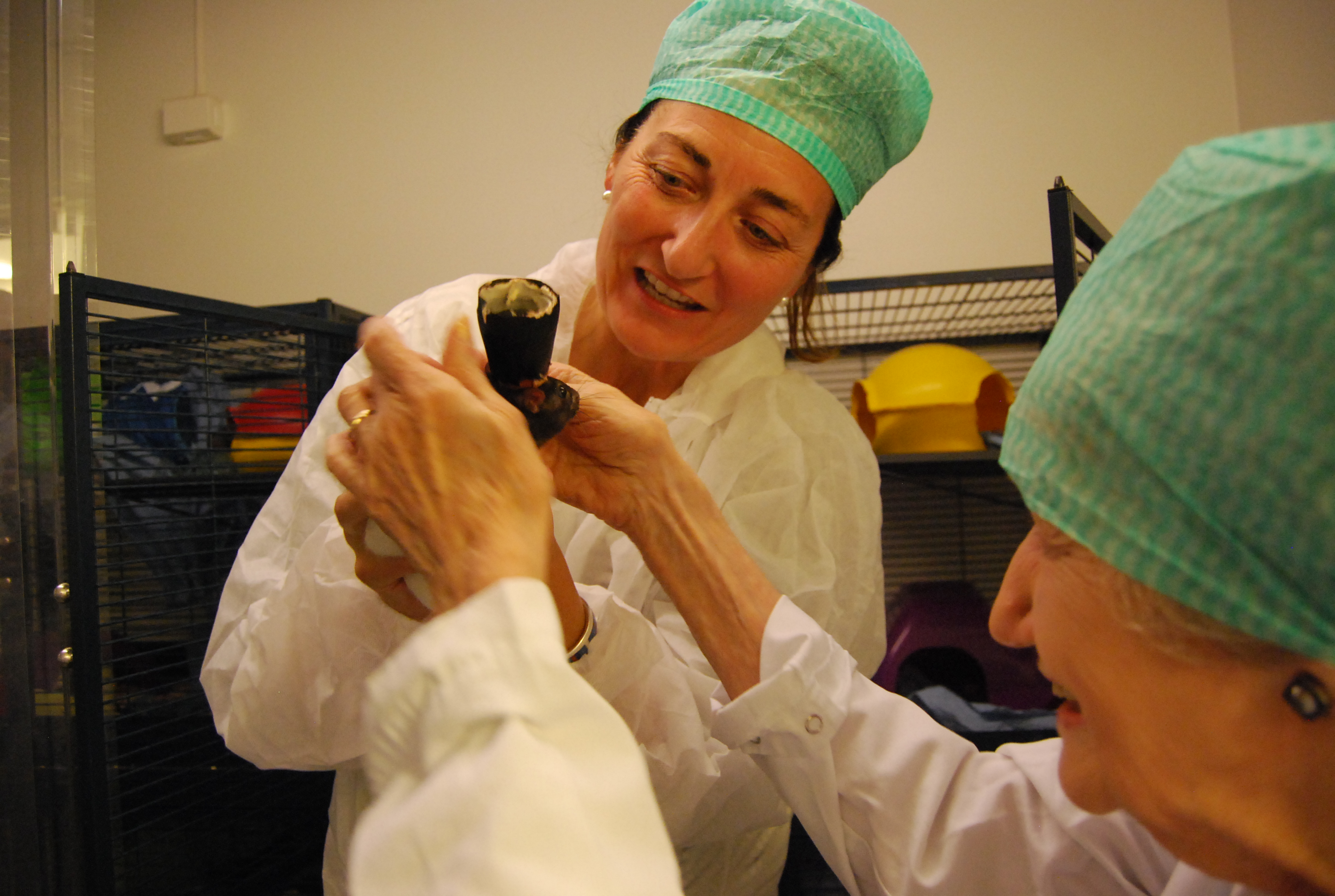
May-Britt Moser in her lab with Brenda Milner{credit}S. Priyadarshini{/credit}
May-Britt and her PhD students know most of the rats in the labs by their names. “Look at this one with a crown, below which we conceal his implant – he looks like a King, doesn’t he?” she says laughing out her characteristic infectious laugh. Accompanying us is Brenda Milner, Kavli Prize awardee in Neuroscience for 2014, who loves the rats and takes one of them out of the cage to stroke it gently and whispers sweet nothings.
Edvard Moser, who shares his life and passions with wife May-Britt ever since they were undergraduate students (and famously got engaged atop Mount Kilimanjaro for their love of volcanoes), explains their research work: “After O’Keefe’s discovery of the place cells, and over the subsequent 30 years a lot was learnt about these cells. But one question that was not addressed at all was where do these’ place’ signals come from, since it is in the middle of the brain far away from the sensory functions. That is what our lab started out to answer around the year 2000.”
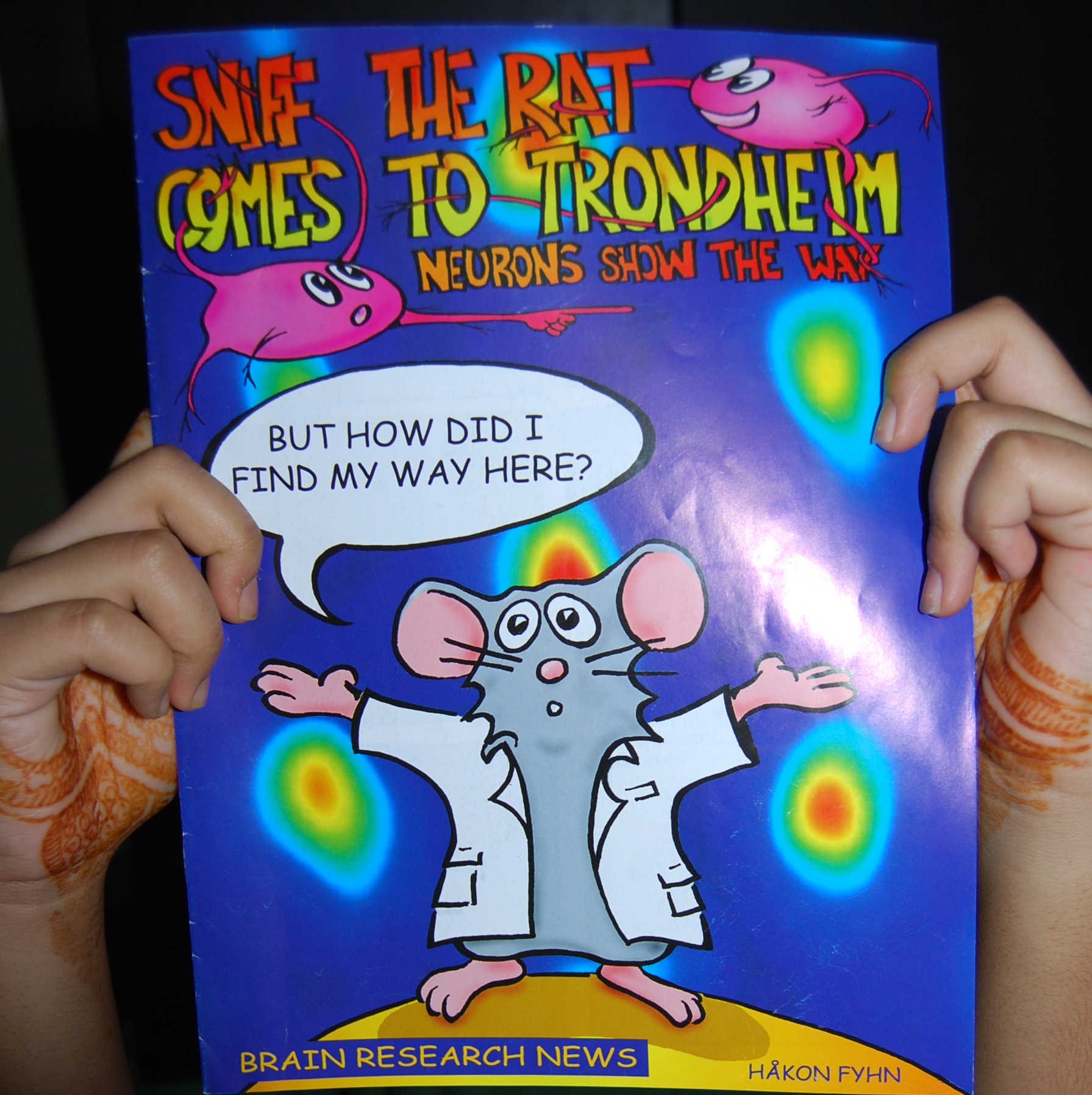
The Mosers lab has made comics like these to explain complex brain operations to children.{credit}S. Priyadarshini{/credit}
One of the first things the Mosers did was to disconnect the area of the hippocampus, where most people thought the place cells were, from the rest of the hippocampus. “The idea was that if we break that intrinsic circuit of the hippocampus, we would know the area of the place cells signal. But it did not happen – we still found place signals,” he says. This led to the idea that there was a different connection – and there was one connection left, another brain area called the entorhinal cortex.
That is when they found the ‘grid cells’. When rats and other mammals move around, these grid cells in the brain send electrical signals at specific points which combine to form a Chinese-checkers-like grid. “The grid cells answer a lot of neural codes for cognitive functions,” he says.
The couple, working in their lab far away from the world’s cutting-edge research hubs, has been churning out some ground breaking work over the years. It has fetched them many international awards and finally the first Nobel for Norway.
As we come out of NTNU, Edvard Moser leaves us with the thought that since the grid pattern is formed inside the brain and not generated from outside, we are just about scratching the surface in our understanding of space and memory. “There will be lot of surprises, and I am not telling you since I don’t know them yet,” he says laughing a hearty laugh.
The Nobel for O’Keefe and the Mosers has certainly not been one of those surprises.
Updated on 8 October, 2014:
Stefan W. Hell, winner of Kavli Prize 2014 in the nanoscience category got the Nobel Prize in Chemistry today along with Eric Betzig and William E. Moerner “for the development of super-resolved fluorescence microscopy”. He accompanied us on the tour to the Mosers lab and I am starting to secretly believe there was some ‘Nobel dust’ in the lab air that day!
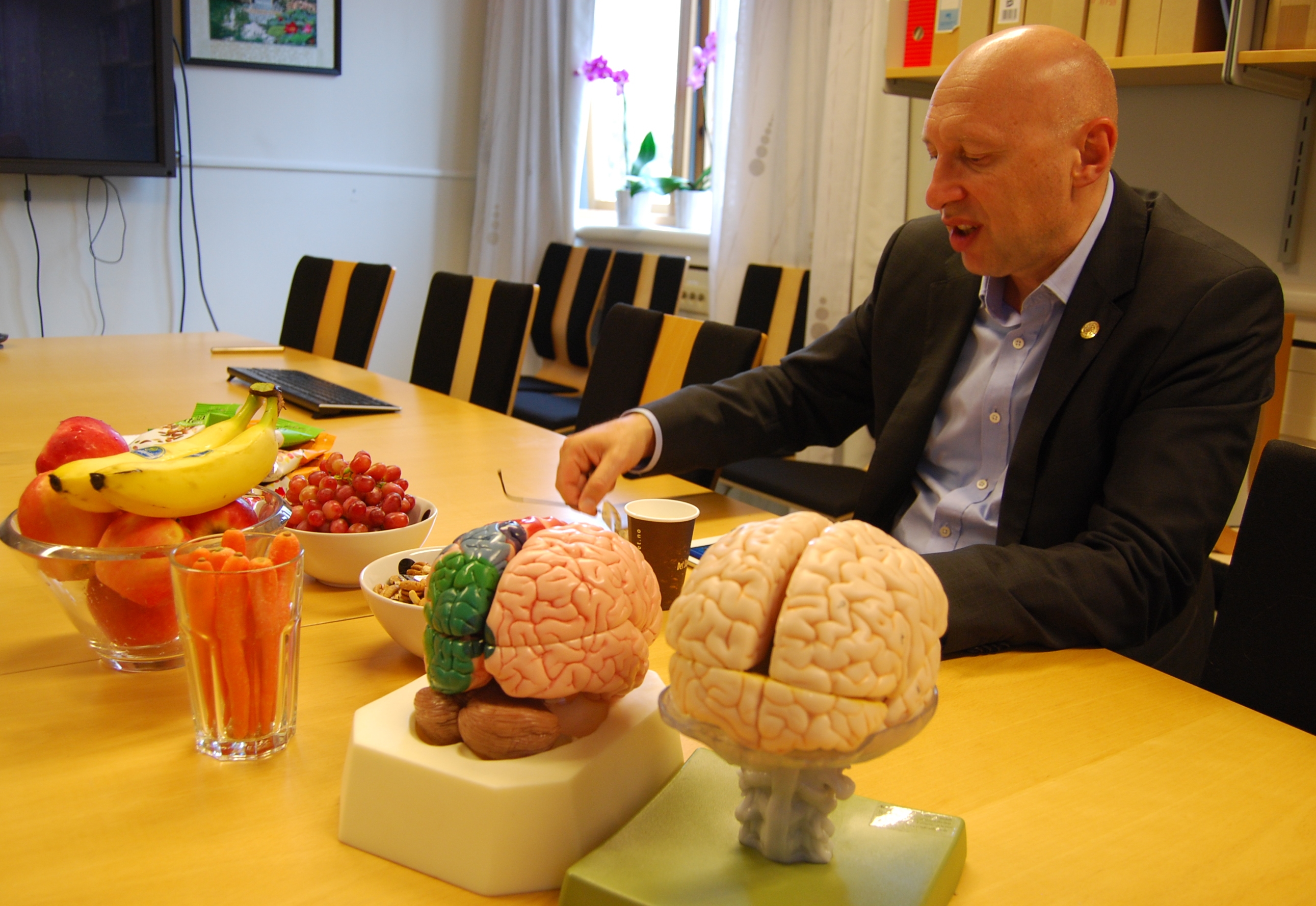
Stefan W. Hell{credit}S. Priyadarshini{/credit}
 Morton A. Meyers, MD is Distinguished University Professor and emeritus chair of the Department of Radiology in the School of Medicine SUNY, Stony Brook. He is the author of the seminal textbook on abdominal radiology (now in its sixth edition) that has been translated into Spanish, Italian, Japanese, Chinese, and Portuguese editions. He is also the founding editor in chief of the international journal Abdominal Imaging. The author of award-winning Happy Accidents: Serendipity in Modern Medical Breakthroughs, he lives in Stonybrook, New York.
 This week’s guest blogger is Manjit Kumar. Manjit’s book, Quantum: Einstein, Bohr and the Great Debate,is about the nature of reality, and was shortlisted for the 2009 BBC Samuel Johnson Prize for Non-fiction. He writes and reviews regularly for a variety of publications, including The Guardian, The Independent, The Times and the New Scientist. He used to edit a journal called Prometheus that covers the arts and sciences, and he was also the consulting science editor at UK Wired.
The first Solvay Conference on Physics, held in Brussels

Left-to right standing – Robert Goldschmidt, Max Planck, Heinrich Rubens, Arnold Sommerfeld, Frederick Lindemann, Maurice de Broglie, Martin Knudsen, Fritz Hasenöhrl, Georges Hostelet, Edouard Herzen, James Hopwood Jeans, Ernest Rutherford, Heike Kamerlingh Onnes, Albert Einstein, Paul Langevin. Seated – Walther Nernst, Marcel Brillouin, Ernest Solvay, Hendrik Lorentz, Emil Warburg, Jean-Baptiste Perrin (reading), Wilhelm Wien (upright), Marie Curie, Henri Poincaré.
In June 1911 Albert Einstein was a professor of physics in Prague when he received a letter and an invitation from a wealthy Belgium industrialist. Ernst Solvay, who had made a substantial fortune by revolutionizing the manufacture of sodium carbonate, offered to pay him one thousand francs if he agreed to attend a ‘Scientific Congress’ to be held in Brussels from 29 October to 4 November. He would be one of a select group of twenty-two physicists from Holland, France, England, Germany, Austria, and Denmark being convened to discuss ‘current questions concerning the molecular and kinetic theories’. Max Planck, Ernest Rutherford, Henri Poincare, Hendrik Lorentz and Marie Curie were among those invited. It was the first international meeting devoted to a specific agenda in contemporary physics: the quantum.
Planck and Einstein were among the eight asked to prepare reports on a particular topic. To be written in French, German, or English they were to be sent out to the participants before the meeting and serve as the starting point for discussion during the planned sessions. Planck would discuss his blackbody radiation theory, while Einstein had been assigned his quantum theory of specific heat. Accorded the honour of giving the final talk, there was no room on the proposed agenda for a discussion of his light-quanta – better known these days as photons.
‘I find the whole undertaking extremely attractive,’ Einstein wrote to Walter Nernst, ‘and there is little doubt in my mind that you are its heart and soul.’ Nernst with his love of motorcars was more flamboyant than the staid Planck, but was just as highly respected – in 1920 he was awarded the Nobel Prize for chemistry for what became known as the third law of thermodynamics. A decade earlier, in 1910 he was convinced that the time was ripe to launch a cooperative effort to try and get to grips with the quantum he saw as nothing more than a ‘rule with most curious, indeed grotesque properties’. Nernst put the idea to Planck who replied that such ‘a conference will be more successful if you wait until more factual material is available’. Planck argued that ‘a conscious need for reform, which would motivate’ scientists to attend the congress was shared by ‘hardly half of the participants’ envisaged by Nernst. Planck was sceptical that the ‘older’ generation would attend or would ‘ever be enthusiastic’. He advised: ‘Let one or even better two years pass by, and then it will be evident that the gap in theory which now starts to split open will widen more and more, and eventually those still remote will be sucked into it. I do not believe that one can hasten such processes significantly, the thing must and will take its course; and if you then initiate such a conference, a hundred times more eyes will be turned to it and, more importantly, it will take place, which I doubt for the present.’
Undeterred by Planck’s response, Nernst convinced Solvay to finance the conference. Interested in physics, and hoping to address the delegates about his own ideas on matter and energy, Solvay spared no expense as he booked the Hotel Metropole. In its luxurious surrounding, with all their needs catered for, Einstein and colleagues spent five days talking about the quantum and, as Lorentz said in his opening remarks, the reasons why the ‘old theories do not have the power to penetrate the darkness that surrounds us on all sides’. However, he continued, that the ‘beautiful hypothesis of the energy elements, which was first formulated by Planck and then extended to many domains by Einstein, Nernst, and others’ had opened unexpected perspectives, and ‘even those who regard it with a certain misgiving must recognize its importance and fruitfulness.’
‘We all agree that the so-called quantum theory of today, although a useful device, is not a theory in the usual sense of the word, in any case not a theory that can be developed coherently at present,’ said Einstein. ‘On the other hand, it has been shown that classical mechanics…cannot be considered a generally useful scheme for the theoretical representation of all physical phenomena.’ Whatever slim hopes he abhorred for progress at what he called ‘the Witches’ Sabbath’, Einstein returned to Prague disappointed at having learnt nothing new. ‘The h-disease looks ever more hopeless,’ he wrote to Lorentz after the conference.
Nevertheless, Einstein had enjoyed getting to know some of the other ‘witches’. Marie Curie, whom he found to be ‘unpretentious’, appreciated ‘the clearness of his mind, the shrewdness with which he marshalled his facts and the depth of his knowledge’. During the congress it was announced that she had been awarded the Nobel Prize for chemistry. She had become the first scientist to win two, having already won the Physics prize in 1903. It was a tremendous achievement that was overshadowed by the scandal that broke around her during the congress. The French press had learned that she was having an affair with a married French physicist. Paul Langevin was another delegate at the congress and the papers were full of stories that the pair had eloped. Einstein, who had seen no signs of a special relationship between the two, dismissed the newspaper reports as rubbish. Despite her ‘sparkling intelligence’, he thought Curie was ‘not attractive enough to represent a danger to anyone’.
The Solvay Congress was the end of the beginning for the quantum. It dawned on physicists that it was here to stay and they were still struggling to learn how to live with it. When the proceedings of the conference were published it brought to the attention of others, not yet aware or engaged in the struggle, what an immense challenge it was to successfully do so. The quantum would be the focus of attention at the fifth Solvay conference in 1927. What happened in the intervening years is, as they say, history.
The Nobel Prize is quite possibly the most anticipated annual event in the scientific community. This year the winners again highlighted the importance of methodological development in scientific progress. Remarkably, the physics, chemistry and medicine prizes all rewarded method and tool developments. This continues, and possibly strengthens, a trend that has become more evident in recent years.
An editorial in the November issue of Nature Methods provides our thoughts on the Nobel Prize and suggests that the addition of a prize dedicated to biology might reduce some of the strain the prize has been experiencing recently and help protect the prize from an erosion of the community support it relies on.
What do you think? Is it ill advised to tamper with something of such stature and history or is it a long overdue change?