{credit}Nature 548, 117–121 (03 August 2017) {/credit}
As my recent Technology Feature made clear, the technology to synthesize large genomes is advancing at a remarkable pace. So too are technologies for wiring genetic circuits to endow those genomes with novel properties. In the 3 August issue of Nature, researchers at Arizona State University in Tempe describe a new technology to do just that.
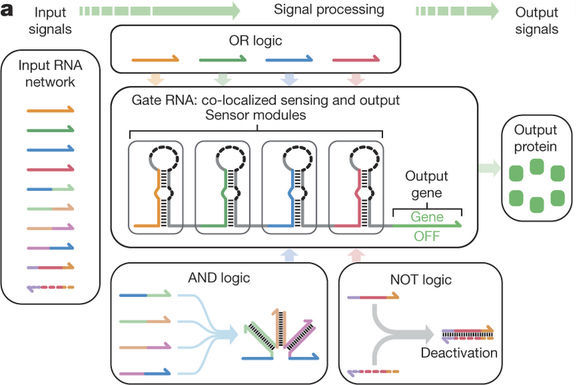
Synthetic biologist Alexander Green of the Biodesign Institute at ASU, and colleagues, describe simple ‘ribocomputing devices‘ that can function as logical AND, OR, and NOT gates — circuit building blocks that control the translation of a reporter gene based on the presence one or more small input RNAs. As those inputs can reflect exposure to different environmental agents or stimuli, the system could serve as a kind of biological sensor.
My most recent Technology Feature, on the technology of genome synthesis, describes advances in the field of large-scale genome hacking. Researchers are rewriting the genomes of organisms from E. coli to yeast, with millions of bases written from scratch. Now, through projects like Genome Project-write, they are turning their attention to even more complex organisms, with concomitantly larger genomes.
How, though, does one actually write a genome? As I note in the article, researchers don’t do that in one step. The molecules are assembled hierarchically, from synthetic oligonucleotides to ever larger pieces, first in a test tube and ultimately in living cells.
That said, it is possible to purchase “gene-sized” pieces of synthetic DNA. But, since DNA today is synthesized mostly using the same error-prone phosphoramidite chemistry researchers have used for decades, the question is: how are those molecules made?
Building a synthetic biology startup is tough – but stay the course and it’ll be the most rewarding struggle of your life, says James Field.
Since the advent of life 3.6 billion years ago, the survival of all species has depended on rapid innovation at the genetic level. As a consequence, our planet has grown rich with evolved technologies.
Traditionally, the dream of harnessing these evolved technologies has been confined to thought experiments and science fiction. Now, the emerging field of synthetic biology is giving engineers the tools required to tap into evolution’s code-base.
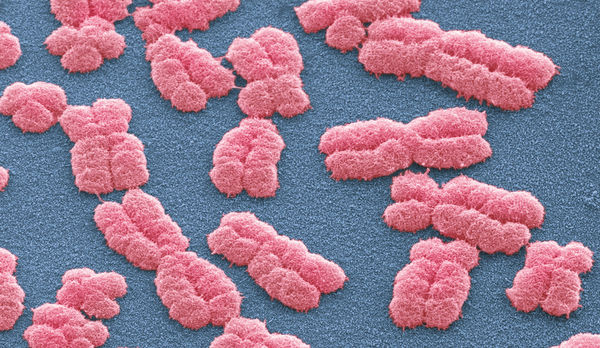
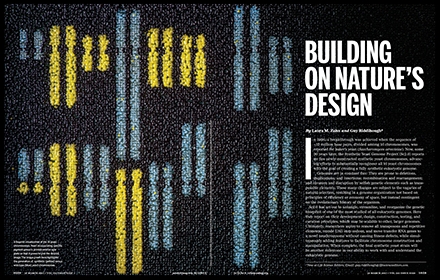
Today, an international research team led by Jef Boeke of New York University Langone Medical Center and Joel Bader at Johns Hopkins University in Baltimore, Maryland, reported in Science a remarkable feat – the complete de novo synthesis and redesign of five yeast chromosomes, a first step towards a completely synthetic model eukaryote. Over at Nature News, Amy Maxmen has done an admirable job covering that achievement, part of a project called Sc2.0. What I’d like to talk about is one of the artistic flourishes used to illustrate it. Continue reading →
Since its launch, Nature Methods has seen many papers that have influenced the Synthetic Biology community. As a supplement to our May Focus on Synthetic Biology we take a nostalgic trip through the highlights of our papers in this area for different aspects of synthetic biology.
Cloning
In 2007 Stephen Elledge and Mamie Li developed SLIC (sequence and ligation-independent cloning) a strategy that uses homologous recombination to assembly many DNA fragments in vitro in a single reaction. Later the same year Mitsuhiro Itaya and colleagues also used homologous recombination in their bottom up assembly to unite larger DNA pieces to genomes of ~ 140kb size.
In 2009 Daniel Gibson and colleagues presented their one-pot enzymatic reaction that successfully assembled genomes 100s of kilobases and has since been dubbed ‘Gibson Assembly’. The method reached fame on Youtube when the Cambridge iGEM team for 2010 created a music video showing how Gibson Assembly saves frustrated scientists:
Gene and genome synthesis
In 2007, to improve error-free DNA synthesis, Duhee Bang and George Church developed circular assembly amplification that eliminated error-containing oligonucleotides from the assembly. A few years later Jay Shendure and colleagues introduced their dial-out PCR to retrieve desired DNA molecules from a library for gene assembly.
In 2010, on the heels of their breakthrough with Mycoplasma mycoides JCVI-syn1.0 – the first chemically synthesized bacterial genome (Gibson D, et al Science 329, 2010) - Gibson et al. published the chemical synthesis of the mouse mitochondrial genome in our pages. They adapted Gibson Assembly to begin at the oligonucleotide level to rapidly make larger fragments that were then combined into the desired genome, exclusively in vitro. Once synthesized a bacterial genome might need to be further modified, but to do so in an organism other than E. coli proved challenging. In 2013 Bogumil Karas et al, showed that whole genomes, as large as 1.8 megabases can be directly transferred from bacteria to yeast where genetic manipulation is routine.
Genome modification
To quickly generate large libraries of promoters in targeted regions of a bacterial chromosome George Church and colleagues presented coselection MAGE (multiplex automated genome engineering) in 2012. The increasingly popular CRISPR system can also rapidly edit genomes with few off-target effects when Cas9 is used as a nickase as William Skarnes and colleagues showed earlier this year.
Circuit design
To ease construction of complex circuits Adam Arkin and colleagues adapted known translational regulators to control transcriptional elongation in 2012. A bit later the same year Jim Collins and colleagues showed that an iterative plug-and-play method makes use of a large repository of genetic components when designing circuits. This year Jeff Tabor and colleagues showed how gene circuit dynamics can be controlled with light. On April 28 Douglas Densmore and his team introduced Raven , software that calculates assembly plans for complex circuits.
Towards the end of 2013 Christopher Voigt and colleagues expanded the designer’s toolbox with over 500 well characterized transcriptional terminators. Robert Landick discussed how these ‘better stop signs’ as he termed them provide insight into the mechanism of termination.
UPDATE: There is now a joint special on Synthetic Biology at nature.com/synbio with articles from Nature, Nature Reviews Microbiology and Nature Methods.
Enjoy reading. The papers mentioned above are listed below in chronological order.
To tie in with the latest Nature Outlook, Lenses on Biology, the Nature Communities team asked five biological scientists at different stages of their education or careers to tell their personal stories in a guest blog post. Each scientist studies, works or has an interest in one of the five research fields featured in Lenses on Biology ― cancer, stem cells, synthetic biology, ocean health and climate change ― and they share what motivates them in their chosen subject. You can read their stories below, and discuss your own motivations here or on the posts in question.