What skills do the University of Toronto department of immunology alumni take away from postgraduate courses?

contributors Yuriy Baglaenko and Eric Gracey

Students from the department of immunology at the University of Toronto recently completed a survey of their 288 alumni, tracking their career choices and progressions through life. In this post, Yuriy Baglaenko and Eric Gracey ask the alumni what they have done after leaving the University of Toronto, and which skills they learned there have come in useful in their careers.

As graduate students, we are both the consumers of education and the producers of knowledge, and the success of universities depends on the research we produce. Many university ranking systems disproportionately value research impact: the Time’s Higher Education University rankings has 30% of the ranking composed of publication citation impact and an additional 30% comprised of research volume, income and reputation. Yet, graduate students are considered trainees and by attending courses and conducting independent research, we are supposed to be preparing for the next chapters of our lives. In a recent survey from the Department of Immunology at the University of Toronto, we asked our 288 alumni to evaluate the effectiveness of that training.

In a previous NatureJobs blog post, we summarized the vocation and location trends uncovered in this survey. In this post, we ask how well graduate training the University of Toronto immunology department prepared our alumni for their chosen careers and pass along some of the comments that emerged.
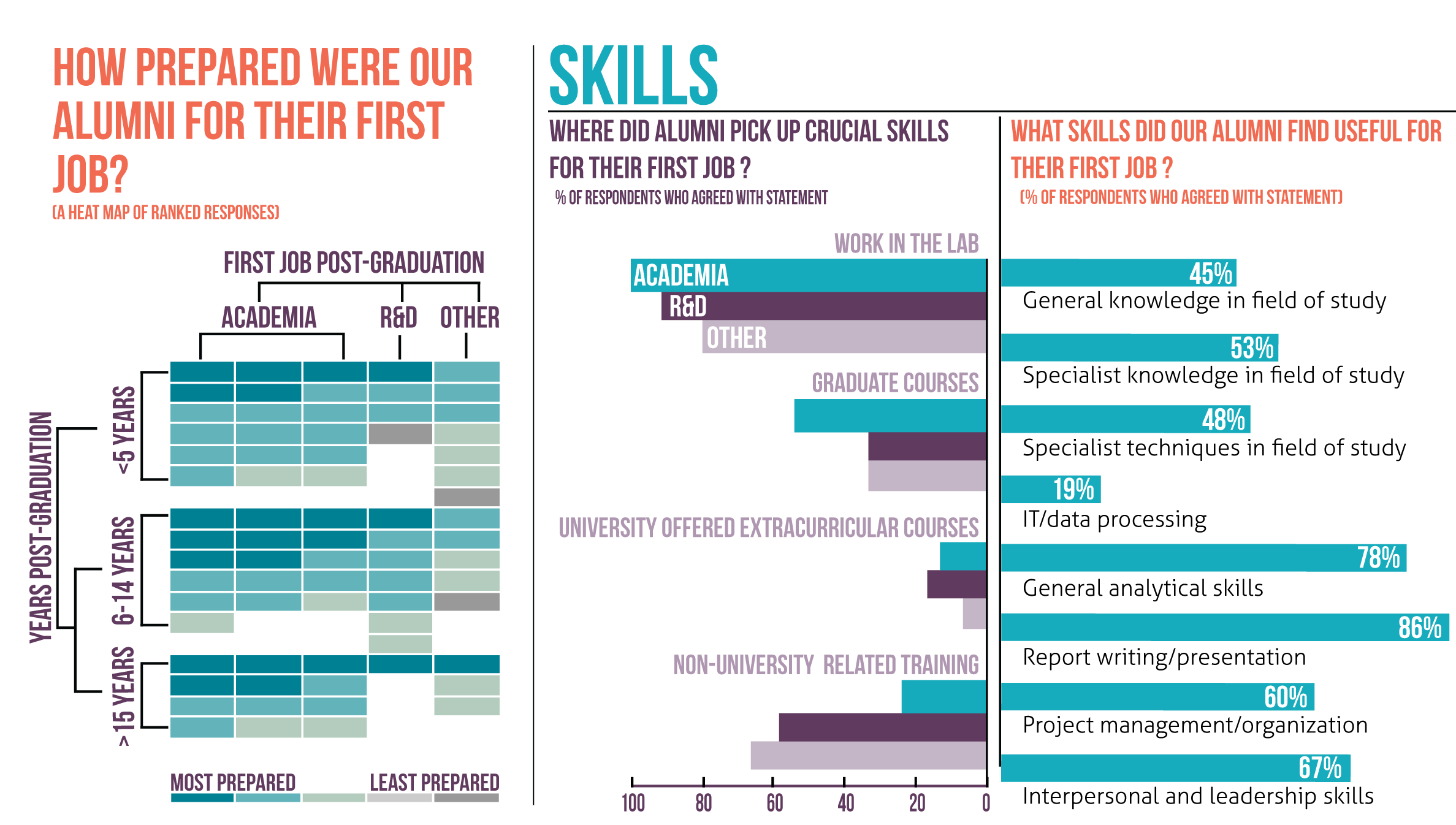
NJB - A student led graduate alumni survey Part 2_v2

{credit}Yi-Min Chun{/credit}

Continue reading

Where do all the alumni go?

Contributors Yuriy Baglaenko and Eric Gracey

Students from the department of immunology at the University of Toronto recently completed a survey of their 288 alumni, tracking their career choices and progressions through life. In this post, Yuriy Baglaenko and Eric Gracey follow the alumni around the globe, to see where they have ended up after leaving the University of Toronto.

The sub-prime mortgage crisis of 2008 had global economic ramifications, still felt to this day. This crisis was particularly close to the heart of business schools, which were criticized for not instilling the proper skills and ethics in their graduates. In response to this disaster, many MBA programs restructured to adapt their training by having continuous dialogues with industry and adding a stronger focus on softer skills.

Recent reports have provided evidence that the scientific system may also be facing an impending crash, with funding levels stagnant, grant success rates diving and an increasing reliance on trainees as producers of knowledge. Will graduate training preemptively change to avoid a scientific meltdown or continue to lag behind a changing world?

Why survey alumni?

Unfortunately, graduate training is rarely evaluated. New courses and technologies might come and go but fundamentally, graduate education has remained unchanged for many years. Only recently have a limited number of academic or industry track PhD programs been introduced to bring training in line with a changing job market. Continue reading