March’s SoNYC: On setting the research record straight – Introduction

It’s time to share some details of the latest Science Online NYC (SoNYC). This month’s event will take place on Tuesday 20th March at Rockefeller University from 7pm EST. You can also watch online via our Livestream channel. The topic for discussion is:  Setting the research record straight

The internet has enabled the faster and more thorough dissemination of published science, meaning that more eyes than ever are available to check the accuracy, veracity and integrity of the research record. With our enhanced ability to spot plagiarism and image manipulation electronically, it appears that the frequency with which we’ve flagged potentially fraudulent or plagiarized papers has gone up. This panel will look at the trends in retractions and how they relate to real or perceived increases in research misconduct. We hope to discuss what steps publications are taking to deal with the sloppy or fraudulent research practices that sometimes result in retractions, and also what research institutions are doing to investigate and deter such practices. Is the system broken, and what can researchers do to help fix it if it is?

Panelists:

– John Krueger of the Office of Research Integrity.

– Ivan Oransky, Executive Editor, Reuters Health and one of the people behind the Retraction Watch blog.

– Liz Williams, Executive Editor, The Journal of Cell Biology.

The event is free to attend and includes the opportunity to meet the panelists and other attendees afterwards. If you’d like to follow the online discussion, keep an eye on the #sonyc hashtag or check back here for our write-up and Storify of the online conversations.  There’s also a SoNYC Twitter account and Facebook page where you can find information and do check out our NYC Science Communication events calendar that lists this event and others.

Preparing for the discussion 

To prepare for the upcoming discussion, we’re running a series of guest posts here on Of Schemes and Memes. In our series we will consider examples of research misconduct, look at what publications are doing to prevent fraudulent research and discuss the role of social media in exposing dishonesty.

If you would like to contribute to this series please do get in touch, or leave a comment in the thread.

What role can peer review play in keeping the research record straight?

Last week various representatives from Nature were in Vancouver, B.C for the The American Association for the Advancement of Science meeting, an annual gathering and one of the most widely recognised global science events. The programme included a mix of plenary talks, smaller discussions and scientific exhibits.

One particular discussion, “Global challenges to peer review of scientific publications” touched on some of the issues relevant to March’s SoNYC and addressed a range of questions.  Can peer review can help to detect fraud? How can technology and certain software programmes be used to help? What about fraudulent images? You can find a Storify summary below, collating this online conversation.  Do let us know if we have missed anything and check out the official conference hashtag, #AAASmtg.
 

Science Online NYC (SoNYC) 9 – Beyond a Trend: Enhancing Science Communication with Social Media

On Thursday evening, we hosted the ninth instalment of the monthly Science Online NYC (SoNYC) discussion series. For this month’s SoNYC we teamed up with the American Museum of Natural History (AMNH) for a special event for Social Media Week.

The topic for debate this month was, “Beyond a Trend: Enhancing Science Communication with Social Media.”

As a communications tool, social media is an undeniably effective way to enhance your message. But within the science realm, top communicators – both academic and professional – strive to use social media for something greater: to engage the public in a conversation about science. Never before has it been so easy for researchers, public information officers, educators, students, and journalists to talk directly to the public about the benefits, limits, and implications of scientific knowledge. Social media not only makes these meaningful conversations possible, but it often also makes them fun and compelling. During this session, hear from scientists, communicators, and educators who use social media tools and the philosophy behind them to find creative, collaborative, and engaging learning opportunities.

Preparing for the event 

In anticipation of the discussion, we ran a series of guest posts here on Of Schemes and Memes, recounting experiences where social media has been a key part of a science education project. To start the discussions, Dr Alan Cann from Leicester University gave us an academic’s viewpoint on how social media can be used as part of the curriculum. Next we heard from Ben Lillie, co-founder of The Story Collider, revealing how social media can also be used to tell a science story. We then took a look at the, “This is what a scientist looks like” initiative, interviewing writer and multimedia specialist, Allie Wilkinson.

This month’s panel:

– American Museum of Natural History educators who are developing a “tool kit” of mobile apps, websites and more to help middle school students collect, share and present data on urban biodiversity

– Ben Lillie, the co-organizer of The Story Collider, which tells science stories by combining verbal narratives with podcasts, Twitter and an online magazine

– Matt Danzico, a BBC journalist who conducted a 365-day blog experiment called “The Time Hack” looking at how we perceive time

– Carl Zimmer, a science journalist whose latest book, Science Ink: Tattoos of the Science Obsessed, is based on feedback he received on his Discover Magazine blog when he asked the question: are scientists hiding tattoos of their science?

– Moderator: Jennifer Kingson, day assignment editor, Science Department, The New York Times


To read what people on Twitter were saying about the event, check out our Storify of tweets at the bottom of this post.

Blog posts about the 9th #sonyc

Do let us know if you blog about the event and we’ll include a round-up of links here.

Social Media as Science Facilitator:  Write up in the Dana Foundation Blog

Live-streaming and video archiving

We live-stream each SoNYC event to give as many people as possible the chance to take part in the debate. Check out this month’s livestream, or take a look at our archives where you can view the previous meetings.

Finding out more

The next SoNYC will be held on March 20th and will be focused on deterring and detecting fraud in scientific publications.  Details will be announced soon – keep an eye on the SoNYC twitter account for more details and/or watch the #sonyc hashtag.

If you have a suggestion for a future panel or would be interested in sponsoring one of the events, please get in touch.

February’s SoNYC: On Science and Social Media – The Museum and the iPad: how the Grant Museum is using social media to make us all curators

As part of Social Media Week, Nature London talked to Jack Ashby, Manager of the Grant Museum of Zoology at UCL, about QRator, the pioneering project the Grant Museum is working on to allow the public to engage with museum collections by contributing their own interpretations.Read on for more from Jack before Thursday, when you can tune into the live stream of “Beyond a Trend: Enhancing Science Communication with Social Media.” The panel, hosted by American Museum of Natural History (AMNH), is the latest in the monthly series organized by Science Online NYC, aka SONYC.


Hello Jack, welcome to the Nature London blog. Can you tell us about the QRator project you’ve introduced to the Grant Museum?

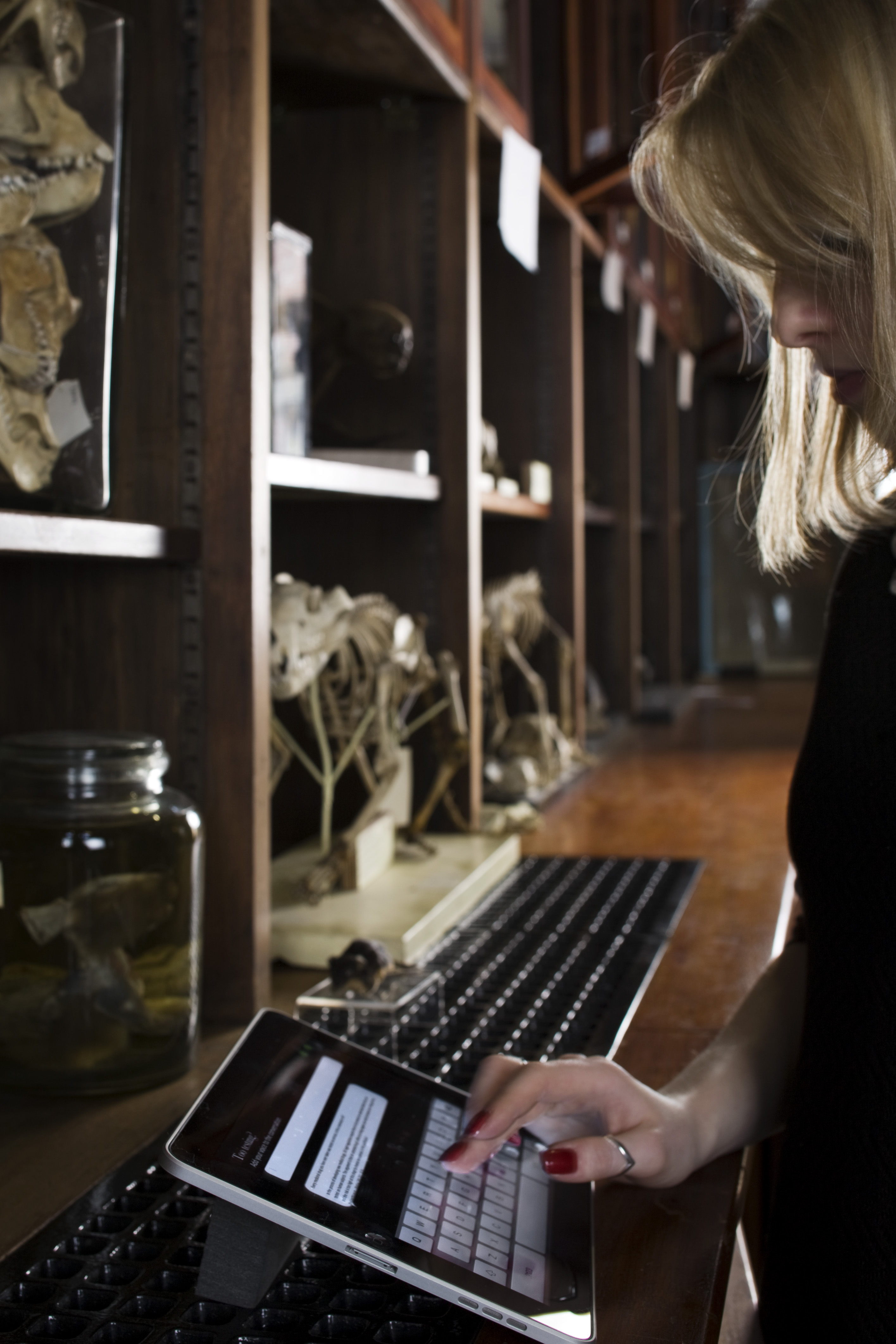
QRator is a project that allows our visitors to get involved in conversations about the way that museums like ours operate and the role of science in society today. In the Museum are ten iPads which each pose a broad question linked to a changing display of specimens. We are really interested in what our visitors think about some of the challenges that managing a natural history collection brings up, and other issues in the life sciences. They change periodically, but at the moment our current questions include “Is it ever acceptable for museums to lie?”, “Is domestication ethical?”, “Should human and animal remains be treated differently in museums like this?” and “What makes an animal British?”

Visitors can respond on the iPads themselves, on their own smart phones by scanning a QR code (hence the name QRator), via Twitter using #GrantQR, or at home on their computers at www.qrator.org. In these ways they can input into our decision making process. Their comments go live immediately on the iPads and online, without being moderated by museum staff.

Not only is QRator a way of empowering visitors but it’s also a research programme – it was developed with a team of academic partners here at the University – the UCL Centre for Advanced Spatial Analysis (CASA) and the UCL Centre for Digital Humanities (UCL DH). Museums are only just beginning to use this kind of technology – it’s a truly ground-breaking project – and having developed the software specifically for us, our partners are researching the way that museum visitors behave around it.

What inspired you to try the iPads in the first place?

The Museum moved into our current venue last year from a small cramped lab down a back-alley in the UCL campus. It had an incredible atmosphere which, following our visitors’ wishes we didn’t want to lose as we moved into our beautiful larger space. At the same time we wanted to be a demonstrably 21stcentury museum, engaging visitors in the ways described above and being innovative with our practices. Working with CASA and UCL DH we decided on iPads as they are discrete enough not to detract from the incredible atmosphere we have here in the way that some computer interactives can, and they are intuitive to use. More importantly, museums had never used them before. To our knowledge, we were only the second museum in the world to employ iPads permanently in displays, and the first to use them for visitor participation.

 How are visitors engaging with them?

There’s been a great response from our visitors – they have left thousands of answers to the questions. One major thing that we didn’t anticipate is that people are also using them as a kind of digital visitors book. As well as getting involved in the conversations, people are letting us know their thoughts on the Museum in general and what they like or dislike about many of our specimens. The jar of moles gets a lot of mentions. This has become a great way for visitors to point things out to each other without us telling them what we think they should see.

Can people who can’t get to the Grant Museum at the moment participate at all?

Absolutely. Everything that is on the iPads is also on www.qrator.org– if you comment online it goes live on the iPad and vice versa.

Are you pleased with how it’s going?

Definitely. It was a big risk – we didn’t know if the hardware could stand up to this kind of use, and allowing visitors to comment without moderating beforehand is something museums very rarely do (though there is an expletives filter), but it’s been a real success. We’ve also had huge amount of interest from colleagues in other museums around the world wanting to know what we’ve learnt from it and whether they can create something similar for their visitors.

What are you hoping to do next with this project?

The big next step is to start putting our visitors’ responses into practice, and for the ones that are more broadly about the life sciences to disseminate what they’ve said more widely. We are constantly exploring what we can do next in this field – broadening the ways that people can respond.

Do you think social media is going to be very important to museums and outreach departments of universities in the future?

There’s no doubt it will be. It would be clichéd to say that more and more people are accessing information through these platforms, but it’s true. Museums are certainly upping their game, and the best examples are those that aren’t all about marketing. Building on the lessons we learnt with QRator at the Grant Museum, The Imperial War Museum is developing its new gallery with what they are calling “social interpretation” – it uses the social media model for visitors to participate digitally with the way their displays are interpreted. It’s a really interesting model and the time is now for museums to be experimenting with this kind of concept.

You can visit the Grant Museum and experience the QRator project for yourself at Rockefeller Building, 21 University Street, London WC1E 6DE. The Museum is open to the public free of charge Monday – Friday 1-5pm. Research and group visits are available by advance booking on weekdays 10am-1pm.

February’s SoNYC: On Science and Social Media – MIT Media Lab’s Joi Ito on science, social networking and “the shape of ideas”

On Monday evening, Joi Ito, Internet pioneer and head of the MIT Media Lab, talked to Nature Boston as part of our coverage of Social Media Week. On Thursday, tune into the live stream of “Beyond a Trend: Enhancing Science Communication with Social Media.” The panel, hosted by American Museum of Natural History (AMNH), is the latest in the monthly series organized by Science Online NYC, aka SoNYC.  

Science, by its nature, is built on a web of traditional social networks. Look at any citation map, C.V. or literature search for a sense of the interactions that drive scientific inquiry. Much of what we know stems from who studied with whom, who worked serendipitouMIT photo by Andy Ryansly in a particular lab and who moved their ideas from one company to another.

“With the so-called social networks we have today, we’ve exploded that,’ says Joi Ito, the Internet pioneer and, now, the director of MIT’s Media Lab.

The burst in electronic interaction is about much more than collaborating over the Internet. Scientists can learn a great deal from social networking about how to generate data, how to test ideas and how think beyond disciplines, Ito said.

In a conversation earlier this week, he offered a hypothetical example of how emerging tools are creating new ways to analyze information generated by online networks. Take data from the history of books, together with trends from search queries and Twitter and connect it all to scientific references, he said.

“Then we get these really rich data sets with which we can understand… the shape of ideas within the context of society.”

He also offered a very concrete example. This spring’s Research Update session – usually open only to the Media Lab’s corporate and philanthropic sponsors — will become a Tweet-up. For the first time, most of the previously private sessions will be live streamed and the lab will solicit input through Twitter.

“The more you get your ideas out there, the more likely you’ll find people to collaborate with,” Ito said.

Ito likes to talk about the Internet as a philosophy of decentralized innovation. In that sense, it is driving a shift in the way scientists collaborate.

“You can see peer review in science and peer review on the Internet converging,” he said.

Traditionally, a researcher will seek confirmation of findings from peers –top experts in a field. The basic ethos of the Internet, Ito said, is that, if you put something online and it survives, it must to be true. Instead of a handful of  experts, “millions of people are going to read it and if you’re wrong,they point it out.”

For researchers accustomed to working with carefully collected data within a clearly defined discipline, that approach may seem chaotic. That’s the point.

“If you have the ability to collect a lot of data and inputs and do an analysis to filter out the noise, then you actually get a really interesting set of answers that has the benefit of having diversity mixed into it,” Ito said. He pointed to Wikipedia as an example.

You also end up with data that tends to be more robust – in the same way the human body is robust. Like the immune system, robust systems tend to be open and a bit messier but they are more adaptable, he said.

“When you have chaotic and fast changing environment, that we do, fitness and robustness are actually important…efficiency and cleanliness less so…But, I’m an Internet guy, so that’s the way I think.”

For more, see the Media Lab’s Social Computing project: The Social Computing group works on models for information processing that work from both angles. We build sociotechnical tools that aim to create substantive human connections as part of the process of data analysis. Our current focus is on developing programming languages for social computation.

February’s SoNYC: On Science and Social Media – #IAmScience and the unexpected tweets

Science Online NYC (SoNYC) is a monthly discussion series held in New York City where invited panellists talk about a particular topic related to how science is carried out and communicated online. For this month’s SoNYC we’ve teamed up with the American Museum of Natural History (AMNH) for a special event for Social Media Week. We’re looking at how social media can be used to communicate science, with the intention of concentrating on how the experiences can have educational value. More details about this month’s SoNYC can be found here.

To complement the event, we’re running a series of guest posts, recounting experiences where social media has been a key part of an education project. To start the discussions, Dr Alan Cann from Leicester University gives us an academic’s viewpoint on how social media can be used as part of the curriculum. In our next instalment, Ben Lille, co-founder of The Story Collider, reveals how social media can also be used to tell a science story.  

I’ve always been what you might call a ‘light’ social media user. A few years ago I started a twitter account, and a year later I had produced seven entire tweets – I was that into it. Years of playing video games had made it clear that your number of followers was how you kept score, but I didn’t know how to play! (Oh yeah, Facebook exists, too.)

So it’s probably unsurprising that I started an organization that features a live experience and longform essays. I’ve always been obsessed with the story of science, the emotional impact on who we are as people: Can knowing about Hubble photos save one from depression? Can new technology change how and who we love? What happens when a neuroscientist’s own father has a stroke?

The Story Collider is an attempt to peer into those questions. Run by Erin Barker, Brian Wecht, and myself, we invite people to tell stories of their personal experience of science, either live on stage — which we recordand podcast— or in essays. Of course, we tweet and post to Facebook, when a new story is published, or an event announced. We’re pretty run-of-the-mill social media users that way. Given my history, I was quite proud of how much we’d done— taking advantage of all the new tools available. We had our content, we tweeted our content, people knew about our content. I figured we were doing it right.

Then, about three weeks ago, a science writer named Kevin Zelnio tweeted this:

And with that, he completely transformed what I thought was possible, and indeed what the point was, of social media.

The tweet came from a discussion of how people had started their science careers, and Kevin’s frustration that the path to a scientist was always depicted in one way: go to college, go directly to grad school. Hope it was a top-tier school, then, “Bam! You’re a scientist.”

But that wasn’t the path Kevin took, and it wasn’t the path most of the people he knew with careers in science took. So he tweeted, and encouraged others to tweet. It struck a chord, and within hours there were hundreds of people tweeting their stories with the hashtag  #IAmScience. I was watching the stream from my office, fascinated, but not sure what to make of it. I tweeted my own and went home.

A couple days later, Erin Barker, the editor and producer of The Story Collider — whose background is in journalism and has no science training — sent me a video produced by Mindy Weisberger with this note:

“Have you seen this? I just watched it and cried and then emailed it to my baby brother. You’re in there!”

I was. The video is a text-animation of some of the tweets, including mine, set to Reckless Kelly’s “Wicked Twisted Road”. It’s simple in concept, easy to make for any video editor, and it brought me to tears a third of the way through.

So here was something that had appeared like magic. It had deeply affected me, a scientist, and Erin, a not-at-all-a-scientist, and it was exactly the kind of thing that we try to create ourselves. Within days, #IAmScience had collected as many stories as we had in a year and a half. Mind you, they’re a lot shorter, and lacking in a certain amount of detail, development, denouement, and other words of the craft, but there they are.

But more importantly than the quantity, is the type of story. These are tales of wrong turns, failed classes, delayed dreams, failed schools, rejection, disabilities, mistaken careers, and as you saw in Kevin’s tweet, much, much more. As science communicators we talk a lot about humanizing science. It doesn’t get much more human than this — but I’ve rarely seen a major science publication touch most of these subjects. And that, of course, is the power of Twitter. Things that would never be published anywhere find a way of bubbling to the surface.

Now, I realized that this is somewhat old-hat and small-peas. Certainly, #IAmScience is no #jan25. But it’s the smallness that’s fascinating: In our normal lives, we tend to be content with thinking of social media as a way to spread our message, to distribute our content, or whatever. It can do vastly more, at scales much smaller than major revolutions — from organizing amateur galaxy hunters to make a major discovery, to organizing small-scale revolutions within the Ivory Tower, to finding stories professional story-hunters missed.

If you want to read the #IAmScience tweets, and the blog posts and more they spawned, there’s a Storyify of the tweets. If you want to hear more about this, and other science and social media topics, come the American Museum of Natural History on Thursday, 6pm, or watch the livestream.

Ben Lillie has a B.A. in physics from Reed College, a Ph.D. in theoretical high-energy physics from Stanford and a certificate in improv comedy from the Upright Citizens Brigade Theater. He left the ivory tower for the wilds of New York’s theater district where he writes, produces, and otherwise brings to light stories about the human side of science. He is Co-founder and director of The Story Collider, where people are invited to share their stories of how science has affected their lives. He is also a Moth StorySLAM champion, and a writer for TED.com.

February’s SoNYC: On Science and Social Media – An Academic’s Viewpoint

Science Online NYC (SoNYC) is a monthly discussion series held in New York City where invited panellists talk about a particular topic related to how science is carried out and communicated online. For this month’s SoNYC we’ve teamed up with the American Museum of Natural History (AMNH) for a special event for Social Media Week. We’re looking at how social media can be used to communicate science, with the intention of concentrating on how the experiences can have educational value. More details of this month’s SoNYC can be found here.

To complement the event, we’re running a series of guest posts, recounting experiences where social media has been a key part of an education project. To start the discussions, Dr Alan Cann from Leicester University gives an academic’s viewpoint on how social media can be used as part of the curriculum. His post considers how the effects of social media usage can be measured and what the future holds for such technology. 

One of the best things about working at a medical school is that we have lots of students and lots of technology, so three years ago we ran a student through our most powerful NMR machine, and this is what we saw:

Attention!
Image Source

Just in case you’ve had a sense of humour bypass, or my Ethics Committee is reading this, we didn’t really – this was one of those Photoshop experiments 😉

Nevertheless, institutional eLearning tools cannot effectively compete with the current generation of social networks for student attention. Yet there are good reasons for educators not to compete online with the attractions of alcohol and sex. In general terms, attention online is in short supply and although we know that Facebook can be a positive tool for education in some circumstances [1], I prefer to sidestep the complications of predominantly social spaces in order to provide some distinction. I try to foster the use of social tools for academic and professional development.

Dissatisfied with the lack of “social” in institutional tools such as virtual learning environments (VLEs), I started down a more outward looking path some years ago. Students log into the university VLE which acts an authentication hub, confirming their identities and providing us with a secure channel for information such as course marks, which, under the terms of the UK Data Protection Act, cannot be trusted to public sites. The university login provides us with an administrative layer but the interaction, and arguably the learning, takes place elsewhere. Although students may download PowerPoint presentations from the VLE, higher thought processes such as analysis and evaluation are associated with actions such as reading current content from RSS feeds on Google Reader and discussing the relevance of shared items to taught courses on Google+. Vital to this approach is the incorporation of student peer networks to amplify staff input [2].

Initially, I focussed on a range of social tools designed to foster student interactions. These included social bookmarking sites such as delicious, social citation tools such as CiteULike and wikis such as WetPaint and Wikispaces. Students were assessed on their use of these sites, but when assessment ceased, we found that very few students continued to use the tools. Some sort of social glue was required to maintain the enthusiasm. Our initial tool-based personal learning environment (PLE) concept rapidly turned into a people-based personal learning network (PLN) approach. As with all effective education, conceptual frameworks, in this case provided by a peer group rather than solely by teaching staff, win out over content alone.

A people-centred approach to peer learning, where academics assume the role of content curator, mentor, and technical support, places communication as a crucial requirement for success. This explains the failure of our initial tool-based approach to encourage students to curate their own information. In comparison with conventional tagging formats, the “just-in-time” attention management of activity stream architecture, where attention is continually refocused by active items returning to the top of the page, provides the reinforcement needed for continued use. Activity streams and the crowd wisdom of a peer network are at the centre of my approach to online learning. All this might seem like dry, academic posturing – but don’t say that to Facebook and Google, who have spent the last three years betting the farm on activity stream architecture.  Starting with the highly influential but now moribund Friendfeed, we were able to demonstrate the effectiveness of this approach in terms of monitoring student engagement [3]. Students engaged in peer to peer discussions around shared resources and personal reflection on their own learning. The patterns of online activity were mapped using graphical tools and were used to inform staff how to guide individual students. Our statistical analysis showed that student contributions to the network could be used to discern student engagement with education in a way which give a far richer picture of online activity than traditional summary statistics such as course or exam marks.

Six months ago, concerned about the sustainability of FriendFeed, I switched our student network to the newly available Google+, and have not looked back. Google+ is conveniently linked to other tools that students use on our course (Google Documents for collaborative writing, Google Reader for RSS feeds), and has fine-grained privacy controls based on the idea of sharing content with user-defined Circles (see: here), which gives users confidence about sharing thoughts and content online. Google+ has proved to be an effective and engaging tool for student feedback [4].  We are currently analysing the structure of student networks on Google+ and looking in depth at usage patterns. If you’re interested in finding our more about this, follow me on Google+ where I post regular updates about my research.

What does the future hold? As connectivity continues to improve, undoubtedly massive open online courses (MOOCs) such as the recent Stanford AI class will keep growing, but the notion that universities will be swept away by organizations such as Udacity and Kahn Academy and abandon qualifications from ancient institutions in favour of free badges and Klout scores is as fanciful now as it was on the barricades of 1968. Eventually our sleeping educational leviathans will rouse themselves and stumble towards the sunlight uplands of enlightenment. Unless Google gets there first of course.

Alan Cann is a senior lecturer in the School of Biological Sciences at the University of Leicester. His interests are science education and exploiting emerging social technologies to enhance the student experience and maximise student and researcher development. He is the author of two highly successful textbooks, has served on the editorial boards of several scientific journals, is creator of MicrobiologyBytes.com, and is Internet Consulting Editor of the Annals of Botany. He has worked as a consultant for numerous educational and scientific institutions, and has published extensively in the area of educational research. More information 


References 

[1] (Junco, R. (2012) The relationship between frequency of Facebook use, participation in Facebook activities, and student engagement (Computers & Education 58(1): 162-171)

[2] (Cann, A.J. & Badge, J. (2011) Reflective Social Portfolios for Feedback and Peer Mentoring. Leicester Research Archive)

[3] (Badge, J.L., Saunders, N.F.W. & Cann, A.J.(2012) Beyond marks: new tools to visualise student engagement via social networks. Research in Learning Technology 20: 16283)

[4] (Cann, A.J. (2012) An efficient and effective system for interactive student feedback using Google+ to enhance an institutional virtual learning environment. Leicester Research Archive)

February’s SoNYC: On Science and Social Media – Introduction

February’s Science Online NYC (SoNYC) co-organised by nature.com, is a super social media week special event at the American Museum of Natural History!  You can join us on Thursday February 16th in person, or online via the social media week livestream to discuss Beyond a Trend: Enhancing Science Communication with Social Media:

As a communications tool, social media is an undeniably effective way to enhance your message. But within the science realm, top communicators – both academic and professional – strive to use social media for something greater: to engage the public in a conversation about science. Never before has it been so easy for researchers, public information officers, educators, students, and journalists to talk directly to the public about the benefits, limits, and implications of scientific knowledge. Social media not only makes these meaningful conversations possible, but it often also makes them fun and compelling. During this session, hear from scientists, communicators, and educators who use social media tools and the philosophy behind them to find creative, collaborative, and engaging learning opportunities.

This month’s panel:

– American Museum of Natural History educators who are developing a “tool kit” of mobile apps, websites and more to help middle school students collect, share and present data on urban biodiversity

– Ben Lillie, the co-organizer of The Story Collider, which tells science stories by combining verbal narratives with podcasts, Twitter and an online magazine

– Matt Danzico, a BBC journalist who conducted a 365-day blog experiment called “The Time Hack” looking at how we perceive time

– Carl Zimmer, a science journalist whose latest book, Science Ink: Tattoos of the Science Obsessed, is based on feedback he received on his Discover Magazine blog when he asked the question: are scientists hiding tattoos of their science?

– Moderator: Jennifer Kingson, day assignment editor, Science Department, The New York Times

Continuing the discussion 

To prepare for the upcoming discussion, we’re running a series of guest posts here on Of Schemes and Memes, recounting experiences where social media has been a key part of an education project.

The advent of social media has seen the birth of wider online initiatives aiming to engage the public with science. For example: the BBC’s So you want to be a scientist, a weekly science show that turns science ideas into real-life experiments, I am a scientist get me out of here (IAS), an X-factor style competition where students talk to scientists online for 2 weeks and vote for their favourite scientist, and Google’s Science Fair, the largest global online science competition. These projects aim to disseminate science effectively to wider audiences and celebrate the curiosity of young scientists. In our upcoming guest posts we will feature anecdotes from the participants of such projects as well as hear from an academic using social media as part of a university course, and consider the future of social media as an aid for learning.

The three scientists sharing their personal experiences are:

Dr Alan Cann from Leicester University. He will be giving an academic’s viewpoint on how social media can be used as part of the curriculum. His post considers how the effects of social media usage can be measured and what the future holds for such technology in the classroom.

– Dr Tom Crick, a senior lecturer in Computer Science, will talk about his experiences with the IAS competition, including a personal take on how he uses social media to aid learning.

– Ben Lillie, co-organizer of The Story Collider and one of the SoNYC panellists, will discuss how he uses social media to organise events and engage people online.

If you are keen to learn more about disseminating science using social media and other discussion forums, check out the write-up of December’s SoNYC and the following presentation by Christie Wilcox:

Science Online NYC (SoNYC) 8 – Thinking Digital: Giving your research more reach (and making sure others can find it)

On Wednesday evening, we hosted the eighth installment of the monthly Science Online NYC (SoNYC) discussion series. The topic for debate this month was, “Thinking Digital: Giving your research more reach (and making sure others can find it)” and the panel featured:

  • Mark Hahnel is the developer of Figshare.
  • Carol Feltes is the head librarian at Rockefeller University.
  • Veronique Kiermer is an Executive Editor and Head of Researcher Services at Nature, and a member of the ORCID steering committee.
  • Cathy Norton is the library scholar at the Biodiversity Heritage Library at Woods Hole’s Marine Biological Laboratory.

As is our usual format, following short introductory talks from the panelists, we invited attendees present in person at Rockefeller University or watching online to take part in a wider discussion.

To read what people on Twitter were saying about the event, check out our Storify of tweets at the bottom of this post.

Blog posts about the 8th #sonyc

Do let us know if you blog about the event and we’ll include a round-up of links here.

Dana Foundation blog.

Live-streaming and video archiving

We live-stream each SoNYC event to give as many people as possible the chance to take part in the debate. Check out our livestream channel where the archives of the meetings can also be found.

Finding out more

The next SoNYC will be held on February 16th and will be a special event at the American Museum of Natural History for social media week.  Details will be announced soon – keep an eye on the SoNYC twitter account for more details and/or watch the #sonyc hashtag.

If you have a suggestion for a future panel or would be interested in sponsoring one of the events, please get in touch.

This month’s Storify

Science Online NYC (SoNYC) 7 – Matching medium and messengers to meet the masses

On Thursday evening, we hosted the seventh installment of the monthly Science Online NYC (SoNYC) discussion series. The topic for debate this month was, “Matching medium and messengers to meet the masses” and the panel featured:

  • Darlene Cavalier is the woman behind the Science Cheerleaders.
  • Jamie Vernon, a science policy analyst.
  • Molly Webster, lead producer for live programming at the World Science Festival.
  • Kevin Zelnio is Assistant Editor and Webmaster for Deep Sea News and a freelance writer.

As is our usual format, following short introductory talks from the panelists, we invited attendees present in person atRockefellerUniversityor watching online to take part in a wider discussion.

To read what people on Twitter were saying about the event, check out our Storify of tweets at the bottom of this post.

Blog posts about the 7th #sonyc

Do let us know if you blog about the event and we’ll include a round-up of links here:

WSF Blog Introduction 

Simon Fischweicher’s summary

Philip Yam’s observations

Live-streaming and video archiving

We live-stream each SoNYC event to give as many people as possible the chance to take part in the debate. Check out our livestream channel where the archives of the meetings can also be found.

Finding out more

The next SoNYC will be held in January and details will be announced in the next few weeks – keep an eye on the SoNYC twitter account for more details and/or watch the #sonyc hashtag.

If you have a suggestion for a future panel or would be interested in sponsoring one of the events, please get in touch.

This month’s Storify


Communities Happenings – 17th November

Welcome to the blogosphere

new blog image.jpg

We would like to wish a warm welcome to a new blog which began on the Scitable blogging network this week. The Promethean Cell will track ongoing issues and research in the regenerative medicine fields and will occasionally be interspersed with anecdotes from a fledgling postdoc’s career. Ada Ao, a postdoctoral research fellow at Vanderbilt University, explains more about her new blog:

Now that I’ve declaimed from my soapbox, what exactly will I blog about? The possibilities are endless. Recent discoveries in the stem cell field are incredibly exciting. This blog will encompass issues like basic biology, opinions and views, and where we may go next in terms of applicable therapeutics. I’m really aiming to put together the “big picture”.

We urge you to check it out and do feel free to send Ada a tweet; she’s @adaaocom on Twitter, with any feedback or suggestions.

On Nature Network we would also like to welcome post-doc student Ivana Gadjanski whose new blog, My Metacognitive Oasis began this week. Her very first post discusses how she Zigs and Zags through her scientific career:

I still remember the feeling I had immediately after obtaining my PhD degree. It was a mixture of relief, accomplishment and somehow emptiness. And one question kept popping in to my mind. What now?

You can follow her story in her blog and please feel free to join in the discussion.

Neuroblogging

Neuroscience 2011 has been this year’s major event for neuroscientists from around the globe. Organised by the Society for Neuroscience (SfN), the event took place from November 12th – 16th, in Washington, DC. To tie in with this, some of the attendees have been sharing their observations from the event in an exclusive series of guest posts on NPG’s Neuroscience blog, Action Potential.

We’ve created two round-ups of the blogging coverage; part 1 here and part 2 In addition, Action Potential’s editor, Noah Gray, has created a Google + circle listing the guest bloggers and you can also follow the hashtag #NPGsfn11 on Twitter to share in the discussion. Do let is know if you have any feedback.

SONYC!

The details of December’s Science Online NYC (#SoNYC) event were announced this week. Please join us on Thursday December 8th, in person at Rockefeller University from 7pm EST, or online via our Livestream channel to discuss, Matching medium and messengers to meet the masses.

Reaching an audience that’s already interested in science is a relatively easy thing to do. Reaching a broader audience, however, can be a serious challenge. Attracting and maintaining an audience outside the core of science enthusiasts requires a carefully crafted match of the medium and messenger. When and how should scientists and science communicators seek to highlight science issues to the general public? Should we be ready to respond and correct public misunderstandings or attempt to influence science policy? What material can be handled through social media, and what requires a more involved form of engagement, such as a science festival?

This month’s panel has experience communicating with everyone from young kids to policymakers, and will discuss what they’ve learned about using different spokespeople and platforms to get their message out. The panel includes:

Darlene Cavalier: The woman behind the Science Cheerleaders

Jamie Vernon: A science policy analyst

Molly Webster: The lead producer for live programming at the World Science Festival.

Kevin Zelnio: The webmaster for the Deep Sea News and a freelance writer.

The event is free to attend with an opportunity to meet the panellists and other attendees afterwards. If you’d like to follow the vocal online discussion (we average around 600 tweets per SoNYC event), keep an eye on the #sonyc hashtag or check back here for our write-up and Storify of the online conversations. Do also keep an eye on the official Twitter account for more details.

Tweetups

Science Tweetups provide an excellent opportunity to meet local scientists and science communicators for an evening of chatting in the pub. For those interested in the next #camscitweet, this will be held next week on Thursday 24th November in the Kingston Arms pub. Join in from 6:30pm and anyone is welcome!

For those on the other side of the Atlantic, keep an eye on the #DCscitweetup and #NYCscitweetup hashtags for information on future events.

Twitter and Google+

This week has seen the launch of another NPG journal account on Twitter, Nature Reviews Molecular Cell Biology who are tweeting as @NatRevMCB

You can also find a full Twitter list of NPG journals and products here.

Last week Google+ launched pages and several NPG journals and products have already created their own. See our circle featuring all the NPG Google+ pages. This circle will be continuously updated as and when accounts are created.

Science Calendars

Yesterday we alerted you to the latest scientific calendar in our series, Science Events in Paris. The calendar is moderated by MyScienceWork, an open access scientific research network.

There’s always an interesting science event taking place and to help with diary planning, we’ve created Google Calendars for some of the other major science cities: London and Cambridge in the UK and NYC, Boston and San Francisco in the US. Below you can find links to all of the Google Calendars we have put together:

Please do let us know if you can see any important omissions.