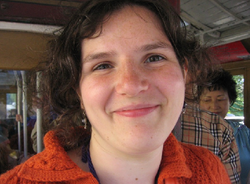
This week’s guest blogger is Nicola Osborne, a Social Media Officer for EDINA, a JISC National Data Centre based at the University of Edinburgh. Nicola began her career investigating “Y2K” for BP but, whilst studying engineering, she became more interested in writing and running review websites. After graduating Nicola joined the Edinburgh University Library then moved on to SUNCAT where she worked with library catalogue data and trialled various social media tools to promote the service. She was appointed to her current innovative role in 2009. Nicola Osborne is a regular speaker on social media, an organiser for the annual Repository Fringe events and regularly blogs on social media events, possibilities and issues for higher and further education.
I have the rather unusual job title of Social Media Officer for EDINA and I’ve been asked to explain what I do, though I should probably start by saying that my work varies hugely from day to day and week to week depending on the projects I’m working with, the events that are coming up, and the new technologies that have appeared lately (right now Google+ and Klout are the hot topics).
The largest part of my role is to work with colleagues across EDINA projects and services to encourage and support the use of social media and related communications technologies. We run services including Digimap, an online mapping and spatial data service including Ordnance Survey data; and JISC MediaHub, a huge resource of images, video and sound; and SUNCAT, the UK Serials Union Catalogue. I help my colleagues think about how we can engage our user communities through social media – whether by including sharing elements or social media-like features in an interface or through sharing training materials on YouTube or providing updates and alerts via blogs and twitter. I also help to manage the in-house blogs platform and authored the EDINA Social Media Guidelines which we have had a fantastic response to since we released them under Creative Commons license in January 2011. Acting as a social media “evangelist” is not only my passion but an official part of my job description so a significant part of my role is speaking, writing and running training events where I enthusiastically share new possibilities and best practice for using social media in the education sector.
At the moment I am also part of the team running the JISC GECO – Geo Engagement and Community Outreach – project. We are working with 12 JISC-funded geo projects across the UK to make connections between the use of geo information and “non-traditional” users, which tends to mean those outside of geography, geosciences or earth sciences. We are using “geo” in a very broad way so we would mean anything geographic, geospatial, geo-referenced, or anything where location and/or physical context is important. We are trying to build new connections between those who have expertise, experience and resources to share, those that are interested in using geo, and those who bring new perspectives on geo and on how geo data or tools could be used.
The diversity of projects and disciplines that interact with geo is so broad that GECO is proving to be a constantly challenging and inspiring project. Those projects we are working with include several elearning projects: GeoSciTeach is creating a phone app for teachers leading science fieldwork; JISC G3 are developing approaches to teach geographic concepts to non geographers; and ELOGeo are developing an e-learning framework for materials on open data, open source and open standards around geospatial information.
Many of our projects are exploring existing data: geoCrimeData project is looking at the relationship between location and crime statistics; U.Geo is investigating material held in the UK Data Archive to identify those with location information and potential for use as georeferenced data; PELAGIOS is applying the extremely modern concept of Linked Open Data to expose, share and combine online resources about the very ancient world; IGIBS is working with researchers in the Dyfi Biosphere (a UNESCO designated area of outstanding diversity of environment, culture, language, etc.) to create a tool that combines research data with authoritative maps and allows that work to become more visible and sharable between researchers; and the Halogen 2 project team are enhancing their existing cross-disciplinary History, Archeology, Linguistics, Onomastics and Genetics database.
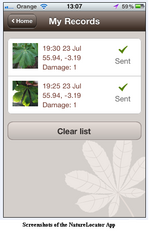
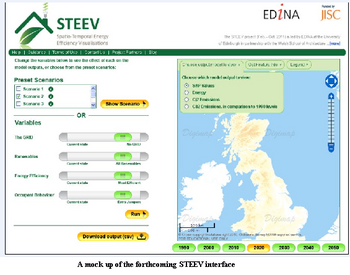
We are also working with the NatureLocator project who have created a curiously addictive phone app that lets you record the location and level of damage to horse chestnut trees which will help track the spread of the leaf minor moth; xEvents, who are creating a tool to build, share and map academic events; STEEV, a project to enable you to time travel through of historical energy efficiency data right through to future predictions. And, last but by no means least, the GEMMA project (which has a particularly fetching gerbil logo) is building a series of mapping applications and tools that can be combined and adapted so that any web user can make a map no matter how much or little that individual knows about mapping.
Most of these projects are reaching out far beyond traditional academic communities and all reach beyond traditional geo communities. Communicating with these audiences can be challenging, particularly for those used to working mainly with other specialists in their field. We are helping the projects find each other and related projects both within and outside of academia, and we are helping them to reach out with the broader community around their work. My main responsibility has been to help the project teams communicate what they are doing through their blogs. Some of the project teams include experienced bloggers but some of our researchers and developers are entirely new to sharing their work in such an informal and public space and we’ve been delighted to support them to become confident and talented bloggers.
In addition to the project blog we directly communicate key developments and announcements about these projects through a central JISC GECO blog and on Twitter as @jiscGECO. We are trying to highlight the connections between all manner of geo ideas, projects, concepts, tools and sites so we tend to share rather quirky finds in these spaces and always welcome comments, suggestions and guest posts. We will be running a number of events over the coming months and we will be amplifying these through liveblogging, tweeting and, where possible, videoing key content. We also have a mailing list to encourage broad discussion around geo – we do a lot of matchmaking between different people and communities and we want to help raise awareness of the ubiquity and importance that geo plays in everyday work and lives.
Our main focus at the moment is the organisation of an Open Source Geo and Health event (Twitter hashtag #GECOhealth ) which we will be running in Edinburgh on Tuesday 9th August. We have worked with the ELOGeo project at Nottingham University, the British Computing Society, Edinburgh Napier University and geo enthusiasts at the Edinburgh College of Art to create a fantastic programme exploring the intersections between geo and many aspects of health practice, theory, trends, policy, and we hope this will trigger some really interesting discussions and relationships that will continue long after the project comes to an end.

 Naturejobs is celebrating Women in Science. Every day this week we’re interviewing an inspirational female scientist. Yesterday, we spoke to Una Ryan, an angel investor and the chair of the Bay Area Bioeconomy Initiative.