The Naturejobs podcast needs you!

Ask a careers expert your job-related questions on the Naturejobs podcast.

 The Naturejobs podcast is making a long-awaited comeback in July 2017 and we’re setting up an expert panel of careers advisers to answer your job-related questions.

25795-03_Podcast-End-User-Banner-300x100 Update3

Each month we plan to feature a hot topic for relevant members of our panel to answer. Do you have a workplace dilemma that you’d like to discuss? Are you struggling to decide what your next career step should be? Do you need help answering tricky interview questions, or tips on how to structure your CV? If you need help answering these questions and others, email your question to naturejobseditor@nature.com.

If we decide to feature your question we’ll be in touch to discuss ways of including it in the podcast, including an opportunity for you, the questioner to feature on the podcast!

In our opening episode of this new #NJPodcast series, Lauren Celano, co-founder and CEO of Propel Careers, will be our expert. Lauren has been working closely with Naturejobs for many years, regularly featuring on the blog and at our Boston Expo.

Her work with Propel Careers has allowed her to help many early career researchers find their feet when pursuing a career in the life sciences.
Continue reading

Job search: Finding your career fit

Tips on how to prepare and conduct an effective job search.

Contributor Ada Yee

Lauren-celano-NJCE15

{credit}Image credit: @DrTanyaSmith{/credit}

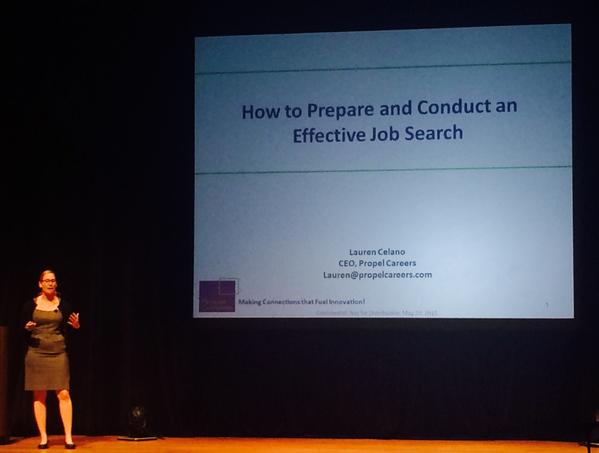
At the Boston Naturejobs Career Expo on 20 May, Lauren Celano, CEO of the career development firm Propel Careers, surveyed her audience: “How many of you are looking for interesting areas?” Most hands went up. “How many know what you want, and just need someone to hire you?” Just a few hands. Celano went on to coach the audience on the job hunt, starting from ground zero: how do you find a job—and then, an employer—that makes sense for you?

Identify the right career path for you

Celano highlighted growing opportunities across many fields, from industry-oriented positions in academia (core facility director, tech transfer, grant management) to non-profits seeking PhDs to do communications, licensing, or advocacy. With all these options, you should think about what suits you, she advised. “Fit really matters!” stressed Celano. “I see people taking a job because the title sounds cool, but maybe isn’t what they’re looking for, and they’re unhappy.” Continue reading

From start to finish: A guide to informational interviewing

Informational interviews, when properly prepared for, are a powerful career and self-development tool.

Contributor Prital Patel

informational-interviews-patel-naturejobs-blog

Lauren Celano, Propel Careers{credit}Image credit: Shawna Lu and Jennifer Gorman{/credit}

In 2014 I attended the Naturejobs Career Expo in Boston as a reporter, covering a talk delivered by Lauren Celano of Propel Careers on how to look your best on paper (here’s part 1 and part 2). I am currently an executive member of the Life Sciences Career Development Society (LSCDS) at the University of Toronto, a platform for assisting graduate students in exploring career options outside of academia. I worked as part of a team to organize a networking reception to give researchers at University of Toronto an opportunity to engage and network with life sciences professionals in non-academic roles. As a prelude to the event, Celano gave a seminar on informational interviewing and effective networking.

“Informational interviews are one of the most powerful tools available to graduate students and academics who wish to figure out what exactly it is they wish to do.”- Lauren Celano

Typically lasting between 15-30 minutes, informational interviews can happen anywhere ranging from coffee shops, Skype or even the telephone. They are an opportunity for job seekers to gather information about jobs and companies that are of interest to them.

As a graduate student, I can attest to the fact that the number of “non-traditional” career options I can pursue are numerous. Whilst the possibilities are exciting, they quickly become overwhelming. As Celano pointed out, narrowing down where your interests lie is crucial for proper time management, especially as it allow you to effectively develop career-specific networks and prepare for job interviews. I’ll admit that reaching out and speaking to strangers over an informational interview seemed very daunting at first. However, Lauren simplified it into a step-by-step process making it easier for me to find a structured approach to take.

Continue reading

Jobs in the USA: Academic CVs and industry resumes

Looking for jobs in the USA? Here are some top tips on academic CVs and industry resumes from Lauren Celano.

Contributor Lauren Celano

Who needs paper?

Who needs paper?{credit}iStockPhoto/Thinkstock{/credit}

Although CVs and resumes both contain information regarding experience, accomplishments, research focus and education, these documents differ in many ways. Understanding these is critical for candidates applying to non-academic positions. Here I highlight a few of the key differences. The details provided below refer to academic CV’s and industry resumes for the USA job market.

Industry resumes: A resume is meant to simply hit the high points and be directed toward the position of interest.

Length: Resumes are typically limited to just one or two pages, and this depends upon an individual’s experience. A candidate with limited work and/or educational experience should try to stick to just one page, and a more experienced candidate can extend to two.

Format: The first page typically starts out with a summary statement(s) that tells the reader who you are, what you do and how it directly relates to the position of interest. It also includes information on experience and positions you have held, which could include undergraduate, graduate, and postdoctoral research along with education.

The second page could contain a skills and techniques section, peer review experience, selected awards, leadership, and papers and presentations. Continue reading

4 ways to identify smaller companies to work for

Lauren Celano offers advice on how to identify and research smaller companies that can offer growth opportunities and a variety of skills.

Contributor Lauren Celano

It’s easy to identify large companies in an area of interest, as they work hard to build strong brand recognition and awareness. But how do you identify the small and stealth-mode companies working in your field? Since these companies can provide tremendous growth opportunities and a chance for you to develop a variety of skills, it is important to include them in your target list during your career search. Below are a few suggestions on how to identify these companies and jump-start your search.

Scientific Conferences & meetings

Scientific conferences and meetings provide a wealth of information regarding research in a particular field and the organizations working in and/or supporting the area. Often, conferences and meetings have a website to profile the meeting and highlight the speakers, poster presenters, exhibitors and sponsors. Continue reading