How to combat implicit bias

The habit of implicit bias can be broken, but it takes awareness and behavioural strategies, says a new study.

Guest contributor Viviane Callier

Gender stereotypes affect our attitudes and behaviours, even if we’re unaware of them. But the habit of implicit bias can be broken: an intervention with faculty at the University of Wisconsin helped to break the bias habit, led to an improved department climate for everyone, and increased faculty hires of women and underrepresented minorities, a new study shows.

Bias, perhaps?

Continue reading

Science Online NYC (SoNYC) 4 – Reaching the niches

On Wednesday evening, we hosted the fourth installment of the monthly Science Online NYC (SoNYC) discussion series. The topic for debate this month was “Reaching the niches: connecting underrepresented groups with science” and the panel featured:

• Khadijah Britton: Founder of BetterBio, a nonprofit focused on helping minority communities connect with science.

Meghan Groome: Director of the NY Academy of Science’s K-12 Education and Science & the City programs.

Dhiraj Murthy: An assistant professor at Bowdoin College, where he studies the use of social media tools within minority communities.

Nancy Parmalee: A graduate student at Columbia University.

Daniel Colón Ramos: Director of CienciaPR, a group dedicated to promoting scientific collaborations and literacy in Puerto Rico.

Bernice Rumala: Co-chair of Rockefeller University’s Achieving Successful and Productive Academic Research Careers (SPARC) initiative.

As is our usual format, following short introductory talks from the panelists, we invited attendees present in person at Rockefeller University or watching online to take part in a wider discussion.

To read what people on Twitter were saying about the event, check out our Storify of tweets at the bottom of this post.

Photos

Have been added to our Facebook page. Do let us know if you’d like us to link to any of yours.

Live-streaming and video archiving

We do also live-stream each SoNYC event to give as many people as possible the chance to take part in the debate. Check out our livestream channel where the archives of the first two meetings are currently hosted.

Of Schemes and Memes blog posts around the themes of the 4th #sonyc

To complement this SoNYC discussion, on Of Schemes and Memes we have been delving into the world of minority scientists. Our first installment from Jeanne Garbarino, a Postdoc at Rockefeller University, considered some of the underrepresented groups within science. In our second installment, Mónica I. Feliú-Mójer discussed her role as the vice-director of Ciencia Puerto Rico, a non-profit, grassroots organization that promotes science, research and scientific literacy in Puerto Rico. Our third post was from Subhra Priyadarshini, editor of Nature Publishing Group’s India portal who talked about life for scientists in India. In our forth post we heard from Satoshi Uchiyama, a Japanese researcher working abroad, as he details his career hurdles and visa issues. In our last post, we heard from Amanda Adeleye, a medical student who reveals that the glamorous world of cheerleading can mix with science.

Other blog posts about #sonyc 4

Making Science Relevant

Do let us know if you blog about the event and we’ll include a round-up of links here.

Finding out more

The next event will be held in September and will focus on Enhanced eBooks & BookApps: the Promise and Perils. Keep an eye on the SoNYC twitter account for more details and/or watch the #sonyc hashtag.

If you have a suggestion for a future panel or would be interested in sponsoring one of the events, please get in touch.

This month’s Storify

The life of a Science Cheerleader

To complement this week’s SoNYC discussion, on Of Schemes and Memes we have been delving into the world of minority scientists. Our first installment from Jeanne Garbarino, a Postdoc at Rockefeller University, considered some of the underrepresented groups within science. In our second installment, Mónica I. Feliú-Mójer discussed her role as the vice-director of Ciencia Puerto Rico, a non-profit, grassroots organization that promotes science, research and scientific literacy in Puerto Rico. Our third post was from Subhra Priyadarshini, editor of Nature Publishing Group’s India portal who talked about life for scientists in India. In our forth post we heard from Satoshi Uchiyama, a Japanese researcher working abroad, as he details his career hurdles and visa issues. In our next post, Amanda Adeleye, a medical student discusses how the glamorous world of cheerleading can mix with science.

DSCN0493_2.jpeg

Marie Curie, the first person to be honored with two Nobel prizes both in chemistry and physics once said, “be less curious about people and more curious about ideas.” Rather than perseverating on what stereotyped roles women ought to follow, whether as mothers, writers, dancers, artists or nurturers, we ought to focus on what we, as women, are able to do. In fact, the options are limitless.

During college, I double majored in biology and classics – the study of ancient Greek and Roman texts and philosophy – and simultaneously was an NFL cheerleader for the St. Louis Rams. I have been asked to write about this experience as well as my current thoughts on being a Science Cheerleader. Overall, cheerleading has been an incredibly rewarding experience, as has completing bench research on breast cancer, graduating college, and working my way through medical school. Each activity is a part of me, a part of my identity but in no way completes me. I am often asked what its like to have been in both worlds, what is generally considered the very glamorous world of cheerleading, and the world of science. Truthfully, I could not imagine it any other way, and more importantly, why it would be any other way.

DSCN0508.jpeg

The woman standing with me is none other than astronaut Tracy Caldwell Dyson at NASA’s headquarters in Washington, D.C. as part of the White House’s celebration of Women in History Month!

Luckily, movements like Science Cheerleader are excellent ways to bridge this unspoken divide between women and science. According to the National Science Foundation in 2009, while women made up 48.9% of the biological and life science work force, and 33.1% of the physicians, we were a mere 10.7% of engineering workforce. Without burdening you with statistics, there does exist a persistent gender gap in the science, technology, engineering and mathematics (STEM) fields. The question is “why?” Some would argue that women are discouraged from these fields throughout elementary school and secondary school and that there several negative reinforcing messages to young women regarding these careers. Specifically, there are those out there who feel that activities like cheerleading focus on looks, dancing and popularity at the expense of “being smart.” There are some who wonder how can you be smart and a cheerleader. I think the subliminal question is “how can you be smart and a woman?” While you would be hard pressed to find a politically correct individual who would admit to these prejudices, they exist and are often perceived by our young women. However, my feeling is that these prejudices do not come from a place of malice but rather ignorance.

Science Cheerleader is a wonderful and multifaceted way to spread knowledge and battle some of the ignorance that exists about women in science. First, it brings to the forefront this contrast between cheerleaders and scientists (that really should not be a contrast at all). In my time as a science cheerleader, I have met incredible women who are NASA engineers, or women attaining PhDs in chemistry and psychology, or science teachers themselves. Importantly, the guests that interact with Science Cheerleaders have the opportunity to meet these amazing women as well. Second, and very close to my heart, is the way that Science Cheerleaders are able to reach out to girls and young women at such an impressionable time in their lives. They may initially be attracted by the shiny pom-poms, big smiles, big boots and fun music, but they stay because they learn and they get excited about science. It’s a small way to remind people that science is for all citizens of the world and that it does not have to be some activity relegated to textbooks at the back of the library that no one goes to read. Rather, science can be a present and beautiful force in our everyday lives. Third, as my life drifts farther and farther into the world of medicine, Science Cheerleader has been a wonderful opportunity for me to continue to dance, cheer, make friends and make a difference. Ultimately, beyond admiring Marie Curie for all of her work, I believe she was wise to appreciate early on that it is not particularly important who we are, but it’s what we do, the power in our minds that we use to imagine, create and discover.

References

Bureau of Labor Statistics. Current Population Survey. Accessed 8/22/11

The life of a Japanese Researcher abroad

To supplement this month’s SoNYC discussion, on Of Schemes and Memes we have been delving into the world of minority scientists. Our first installment from Jeanne Garbarino, a Postdoc at Rockefeller University, considered some of the underrepresented groups within science. In our second instalment, Mónica I. Feliú-Mójer discussed her role as the vice-director of Ciencia Puerto Rico, a non-profit, grassroots organization that promotes science, research and scientific literacy in Puerto Rico. Our third post was from Subhra Priyadarshini, editor of Nature Publishing Group’s India portal who talked about life for scientists in India. In our latest post we will hear from Satoshi Uchiyama, a Japanese researcher working abroad, as he details his career to date.


japan.jpg

Working away from your homeland as a scientific researcher means you may face many barriers such as culture changes, language barriers, and visa issues. Satoshi Uchiyama, originally from Japan, is a researcher in the field of microbiology, now working at the University of Zurich. In his guest post he details his career story including the move from Japan to the other side of the world, all in the name of science.

I finished my medical school and my residency as a paediatrician in Japan. After this, I worked for 3 more years in general paediatrics and neonatology. At this point, I decided that I wanted to focus my efforts on infectious disease and live in the United States. I obtained funding from a Japanese foundation and moved over to San Diego to start my carrier as a researcher at the University of California, San Diego. At this point I had no idea what I wanted to do in the future: research or clinical medicine? I came to the conclusion that I liked the excitement of working as a scientist more and that I didn’t want to go back to my original position working as a physician.

Looking back, I was fortunate that everything worked out well for me. Changing jobs and location causes a lot of stress for people, especially when you relocate to a different country. When I relocated to the US, I moved with my wife and thankfully she had experienced living in other countries before, which made the move much easier for us. However, one of the best things about my change was my new lab PI. He was a great researcher and a thoughtful person; he cared about me and my family. With this emotional support network, I could concentrate on my scientific research without any obstacles.

Now onto my visa situation, something a lot of foreign researchers struggle with. (Please keep in mind that I am not a visa specialist and this information is for Japanese citizens.) I had a J Visa to work as a science researcher in the US. For Japanese people the J visa can be extended up to 5 years and cannot be extended after that time. If you want to continue working in US, for instance, the choice will be to find a lab that supports an H visa, or alternatively to get a green card. If you want to apply for another J visa, you have to live outside the US for 2 more years before you can reapply. (I am not explaining about the “2 years rules” but you can read more about it here.)

I came to the conclusion that at the end of my 4th year in US, it was a good time to think about my future. My J Visa was only good for another year and I finally passed my PhD degree from my university in Japan. I had a difficult decision to make, decisions most foreign researchers have to face at some point in their career. My options: should I continue my career as a researcher, or should I go back to my original job as a paediatrician? Should I find a lab or a company in the US that would support the H visa? Or should I go back to Japan?

For me the decision was easy and things worked out well. It transpired that one of my Swiss co-workers at UCSD got an independent position back at the University of Zurich. I asked her if they required any researchers there and she offered me a postdoc position. So I decided to move to Switzerland.

Switzerland was far from Japan and San Diego, but despite this and the culture shock the move was relatively stress free. The only concern I had was the language barrier, an issue foreign scientists sometimes face. Zurich is a German speaking part of Switzerland, and I don’t speak German. It turned out that most people in Zurich speak English and in my new lab they work in English. To date, my family, including my daughter, who was born in US, have settled down nicely and we are all happy, very happy. Zurich is an expensive city to live in, but life as a postdoc here is great – my income is almost twice what a postdoc gets in US.

Visas (working permissions) are not as complicated here in Switzerland as they are in the US – they are just harder to get for non-EU citizens. However, if you have strong support from your lab, they can be obtained relatively easily and extended for as long as the lab keeps on supporting you.

So what does my future hold? I have decided that I will continue working as a researcher for as long as I can. I would love to stay in Switzerland or in Europe, if I get the chance to, or I may even consider going back to US or Japan. All I know is that despite the hurdles I have faced with visas, language barriers and culture changes, I will continue to work hard for my lab, enjoying every day as a research scientist.

Being a Scientist in India

To supplement this month’s SoNYC discussion, on Of Schemes and Memes we have been delving into the world of minority scientists. Our first installment from Jeanne Garbarino, a Postdoc at Rockefeller University, considered some of the underrepresented groups within science. In our second instalment, Mónica I. Feliú-Mójer discussed her role as the vice-director of Ciencia Puerto Rico, a non-profit, grassroots organization that promotes science, research and scientific literacy in Puerto Rico. In our next post we will hear from Subhra Priyadarshini, an award winning science journalist and the editor of Nature Publishing Group’s India portal Nature India and manager of the Nature India blog, Indigenus. She talks about life for scientists in India.


pic.JPG

Subhra has been chasing deadlines to cover politics and sports, fashion and films, crime and natural disasters in the mainstream Indian media for around 15 years. She finally chose to come back to her first love – science – in 2007 launching the India portal of NPG one year later. She has been a correspondent with major Indian dailies and briefly worked for the Observer in London. Subhra received the BBC World Service Trust award for her coverage of the ‘vanishing islands of Sunderbans’ in the Bay of Bengal in 2006. She is a regular contributor to BBC Radio’s Hindi science programme ‘Vigyan aur Vikas’ (Science and Development). She has been on the panel of many international conferences on science communication and won acclaim in India for her coverage of the Orissa super cyclone in 1999 and the Indian Ocean tsunami in 2004.

These are boom times for Indian science. The national spending on science and technology has gone up in the last five years and is inching towards two per cent of India’s GDP. Hordes of new institutes are coming up in the nook and corner of the country — 30 new central universities, 5 new Indian Institutes of Science Education and Research, 8 new Indian Institutes of Technology and 20 new Indian Institutes of Information Technology are in various stages of conception and completion.

However, many people are of the view that simply increasing the number of institutes will not lead to better scientific prowess. The education system needs a complete rethink in order to attract more students to science and produce world class scientists.

According to a government estimate, India has registered an annual growth rate of more than 12% in scientific publications in Science Citation Indexed journals during the last five years which compares well to a global average of 4%. India’s global ranking in the number of publications also saw relative improvement — from 15th position in 2000 to 10th in 2009.

Given the background, it should look like it is really hunky-dory for scientists working in India. Though good science and research are happening in some brilliant pockets of India, things are not as cheerful in a majority of labs. The lion’s share of scientific R&D in India is government controlled. The pet peeves of a lot of scientists stem from the bureaucratic handling of science — poor pay and personal development opportunities, lack of amenities and stifling work environments where new ideas are not allowed to flow freely.

India is also accused of doing a lot of ‘copycat science’ duplicating work already done in western countries. The Prime Minister of India Manmohan Singh actually urged scientists at the largest meeting of scientists – the Indian Science Congress in January 2011 – to think out of the box and ahead of the times. India hasn’t seen a home-grown Nobel Laureate since Sir Chandrasekhara Venkata Raman, who got the prize for physics in 1930, and that is something the government rues time and again at scientific meetings.

A lot of brilliant scientists work in labs away from their country and the government has launched new schemes to bring them back home. New programmes and incentives have also been announced for post-docs to carry out their PhD work in Indian labs. At the moment the fad is to fetch a PhD from a good foreign lab or under a Nobel Laureate mentor – that gives them an edge in the job market.

Also, the ‘publish or perish’ principle of scientific success results in a lot of junior scientists complaining that their seniors take credit for their work and fail to acknowledge their scientific contribution. A lot of angry voices in the Nature India forum complain about corruption and one-upmanship in Indian labs. While a handful of such cases have been taken seriously and scientists/administrators found guilty removed from their positions, there is no empirical data to prove that this might be a widespread phenomenon.

Like elsewhere, women scientists in India have their set of problems – mostly stemming from societal pressures that force them to multi-task – not allowing them and their research to grow at par with their male colleagues. The government, however, has launched some schemes that would go a distance and bringing women back to the labs. More on the issues women scientists face in India can be found in these Nature India forum discussions here and here..

CienciaPR.org: Addressing the underrepresentation of Latinos in STEM through social networking

To accompany this month’s SoNYC conversation, on Of Schemes and Memes we have been exploring the world of the minority scientist. Our first installment from Jeanne Garbarino, a Postdoc at Rockefeller University, considered some of the underrepresented groups within science. In our next post, we will be hearing from Mónica I. Feliú-Mójer, the vice-director of Ciencia Puerto Rico, a non-profit, grassroots organization that promotes science, research and scientific literacy in Puerto Rico.

monica.jpg

Mónica I. Feliú-Mójer is a Ph.D. candidate in Neuroscience at the Department of Molecular Biology at the Massachusetts General Hospital and the Program in Neuroscience at Harvard Medical School. She is the vice-director of Ciencia Puerto Rico. CienciaPR is a volunteer-based organization, and the activities described here are spearheaded by a dedicated team of Latino scientists that donate their time and effort to CienciaPR and its initiatives.

Although Latinos comprise 16% of the total population in the United States, they remain largely underrepresented in Science, Technology, Engineering and Mathematics (STEM) degrees and careers.

This underrepresentation of Latinos in science is problematic on several levels. The attrition of Latinos among the ranks of scientists limits our ability as a society to benefit from the full range of talent and minds. The scientific enterprise is enriched by the variety of thoughts, experiences and ideas contributed by diversity. A lack of diversity among the research workforce is detrimental for innovation and can also have the effect of decreasing the diversity of research topics, particularly those that pertain to Latinos.

Many barriers have been found to contribute to the disproportionately low numbers of Latinos in science, including educational gaps, financial pressures, family and cultural dynamics, and insufficient guidance and mentoring.

The lack of mentors that can advice Latino students about the pathways towards STEM degrees and careers is a key contributing factor to the attrition of Latino students in the scientific training pipeline. A good mentor and role model is an invaluable source of experience and insights, someone to identify with, who knows how it is and what it takes to develop into and perform successfully as a scientist or engineer. Often, Latino youth have limited access to role models in their communities to engage, mentor and empower them to go into science.

Today, social networking platforms have emerged as powerful tools to address the lack of mentors among Latino students, because they enable the far-reaching personalized mentoring relationships needed to succeed in the scientific enterprise.

Social networking websites can help democratize access to knowledge and provide new opportunities for fellowship and mentorship by linking groups from resource-limited geographical regions with others in resource-rich centers. Science is a global activity and, with the Latino scientific community dispersed over a wide geographic area, a virtual space that brings individuals of that scientific diaspora together represents a powerful and innovative way to address the challenges faced by Latinos in science and technology.

This is precisely the type of community the non-profit grassroots organization Ciencia Puerto Rico has established. Our volunteer-run website, CienciaPR.org, brings together the geographically dispersed Puerto Rican scientific community under a virtual collaborative space, and uses their collective knowledge-wealth and expertise to engage the public in science; to serve as role models and mentors for the next generations of scientists; and to promote the development of science endeavors in the Puerto Rican archipelago.

By encouraging user participation and the exchange of knowledge and ideas, social networks foster a sense of community and facilitate the creation of user-driven initiatives. For instance, CienciaPR.org provides people with common interests – science, research and Puerto Rico – with the tools, information and resources to help them forge collaborations and mentoring relationships. The ideas and shared interests of the members of Ciencia Puerto Rico’s online community have fueled our organization’s most successful initiatives.

In an effort to increase scientific literacy among lay audiences, members of Ciencia Puerto Rico write and publish scientific articles in El Nuevo Día, the Spanish-language newspaper with the highest circulation in Puerto Rico and the United States. Our users also create science podcasts in Spanish, available on iTunes and transmitted in radio stations in Puerto Rico. The publication of the book ¡Ciencia Boricua!, a collection of essays written by members of Ciencia Puerto Rico’s community in simple everyday language, provides culturally relevant and accessible examples of science to inspire young Puerto Ricans.

While the issues faced by Latinos in science and technology need to be addressed at the government, private, community and individual levels, social networking platforms, such as CienciaPR.org, are powerful instruments to help establish creative strategies to effectively tackle the issues of scientific literacy, cultural relevance and access for minority populations.

On STEM and SoNYC: Connecting underrepresented groups with science

Science Online NYC (SoNYC) is a monthly discussion series held in New York City where invited panellists talk about a particular topic related to how science is carried out and communicated online. On August 24th the focus will be on niche groups; whether that’s scientists from developing countries, science mums or the ways we reach out to make science interesting to the younger generations.

To complement the conversation, this month on Of Schemes and Memes we will be exploring the world of the minority scientist by hosting a series of guest posts. Our first installment is by Jeanne Garbarino, a Postdoc at Rockefeller University. Jeanne, co-organiser of SoNYC, regularly discusses being a mother and a scientist in her blog The Mother Geek, where this post is mirrored.

Last week the United States government passed legislation – with only a few hours to spare – that would help prevent our country from going into default. However, despite these measures, America was not able to salvage our AAA credit rating. So, as our markets keep spiraling into the great unknown that is fiscal instability and it’s associated state of chronic joblessness, can we squint our eyes and see light at the end of this long, convoluted tunnel? Now, I’m no economist but I would say that science, technology, math, and engineering – collectively known as STEM – can offer more than a glimmer of hope for our future.
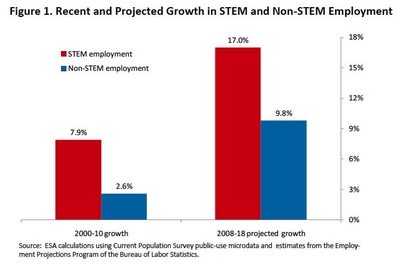
Figure 1 STEM post.JPG

A recent report (PDF) published by the U.S. Department of Commerce has provided evidence that, even in the face of economic distress, the U.S. exhibited a 7.9% increase in STEM-related employment compared to only 2.6% for non-STEM jobs over a ten-year period spanning from 2000-2010. Furthermore, the authors of this report predict that STEM employment opportunities will increase by 17% from 2010-2018 whereas non-STEM positions is only predicted to increase by 9.8% (Figure 1).

Figure 2 STEM post.JPGGood news, right? Well, if the demographics remain steady, these opportunities will mostly help white males, as these are the people who currently make up over 50% of the STEM workforce (Figure 2). As can be seen from this data collected by the National Science Foundation (NSF), women and minorities are sorely underrepresented in STEM occupations (included under the scientist category are life scientists, computer/information scientists, mathematicians, physical scientists, psychologists, and social scientists).

Given the desire (need?) to achieve economic vitality, should we not limit the amount of people in the talent pool? I have written the specific perspective that women bring to the discussion and the underrepresentation of minorities in STEM is a widely addressed topic. But, are we making any progress?

These issues have inspired the organizers of Science Online NYC to focus on local programs and tactics that help make science more available to anyone who is interested. On August 24th, we will hold our fourth SoNYC discussion series – Reaching the Niches: Connecting underrepresented groups with science, featuring an all-star panel of science advocates. The description for this event is as follows:

How do we reach and connect groups that are underrepresented in science? Women, minorities, and researchers in developing economies often face challenges when integrating into the scientific community. It can also be difficult for researchers with a niche interest to find and support each other. Groups such as teens often fail to view science as interesting or significant in its own right and have poor access to reliable, engaging scientific content. Our panel will take a look at how minority networks form and develop both online and off, and discuss targeted efforts to reach communities that are underrepresented or disinterested in science.

Khadijah Britton is the founder of BetterBio, a nonprofit focused on helping minority communities connect with science.

Meghan Groome is director of the NY Academy of Science’s K-12 Education and Science & the City programs.

Dhiraj Murthy is an assistant professor at Bowdoin College, where he studies the use of social media tools within minority communities.

Nancy Parmalee, a graduate student at Columbia University, will talk about how forming online communities have advanced her research.

Daniel Colón Ramos is the director of CienciaPR, a group dedicated to promoting scientific collaborations and literacy in Puerto Rico.

Bernice Rumala is co-chair of Rockefeller University’s Achieving Successful and Productive Academic Research Careers (SPARC) initiative.

If you are in the NYC area and are interested in attending this free event, please sign up via our Eventbrite page. If you can’t make it, do not fret – we will be Livestreaming the event here. Looking forward to the discussions!

If you would like to contribute to our series focusing on minorities in science, feel free to get in touch.

Announcing the fourth Science Online NYC! (SoNYC)

After a break in July for the summer, it’s time to share some details of the latest Science Online NYC. SoNYC is a monthly discussion series for anyone based in, or around, New York who’s interested in how science is carried out and communicated online. Each month we invite a panel of experts in a particular area to tell us in 5-10 minutes what the latest developments are in their field or to whet our appetites for a debate with a provocative thesis. We then open up the conversation to the in-person audience as well as those watching via our Livestream channel and commenting on Twitter and enjoy a lively discussion and the chance to make new friends afterwards.

The topic for discussion in August is:

Reaching the niches: connecting underrepresented groups with science

How do we reach and connect groups that are underrepresented in science? Women, minorities, and researchers in developing economies often face challenges when integrating into the scientific community. It can also be difficult for researchers with a niche interest to find and support each other. Groups such as teens often fail to view science as interesting or significant in its own right and have poor access to reliable, engaging scientific content. Our panel will take a look at how minority networks form and develop both online and off, and discuss targeted efforts to reach communities that are underrepresented or disinterested in science.

The Panel:

• Khadijah Britton is the founder of BetterBio, a nonprofit focused on helping minority communities connect with science.

• Meghan Groome is director of the NY Academy of Science’s K-12 Education and Science & the City programs.

• Dhiraj Murthy is an assistant professor at Bowdoin College, where he studies the use of social media tools within minority communities.

• Nancy Parmalee, a graduate student at Columbia University, will talk about how forming online communities have advanced her research.

The event will take place on Wednesday 24th August from 7pm at Rockefeller University (Weiss 305 – location 25 on this map), later adjourning to the Faculty and Students Club on-campus bar.

You can find us online at the following places: Twitter: @S_O_NYC hashtag: #sonyc Facebook: SoNYC page

Please let us know if you’re planning to come by signing up via our Eventbrite page as it helps to ensure we have the right sized room and enough for everyone to drink.

Themed blog posts

In order to prepare everyone for the upcoming dialogue, here on Of Schemes and Memes we will be exploring the world of the minority scientist or the scientist/science communicator that wants to reach out to other minorities. If you would like your project or your personal experiences to be featured, please do get in touch.

If you have any questions about this month’s event or would like to be added to our mailing list, do send Lou an email (l.woodley@nature.com).

Hope to see you in August!