From the archives (1995): Guidelines for interpreting and reporting linkage results

NG1995In 1995, Nature Genetics published a report by Eric Lander and Leonid Kruglyak, recommending clear statistical guidelines for reporting linkage results for complex traits. The paper had an immediate impact, setting the bar for what could or could not be called “significant” in the literature. Although originally focused on human genetic linkage studies, the guidelines set forth by Lander & Kruglyak influenced fields from model organism genetics to plant genetics, and eventually genome-wide association studies (GWAS).

The mid-1990’s was a very exciting time in genetics. The human genome project had recently been announced and advances like microsatellite linkage maps of the human genome and multiplex sequencing technology were now available. Mapping genes underlying complex phenotypes was now a real possibility, and human geneticists were busy prospecting for genetic gold. However, as Lander & Kruglyak cautioned in their paper, the lack of clear guidelines could foster a spate a false positive reports that would, if left unchecked, discredit a the nascent field (for example, see this 1993 paper in Nature Genetics finding no evidence for a previously-reported linkage region for manic depressive illness).

On the other hand, setting too high a bar for reporting significance would mean missing many true signals where they exist, an equally dangerous proposition for a new field. As explained in the paper, “striking the right balance requires both a mathematical understanding of how positive results will occur just by chance and a value judgment about the relative costs of false positives and false negatives.” The paper then outlines the mathematical and statistical arguments in favor of the standards we now all know and love.
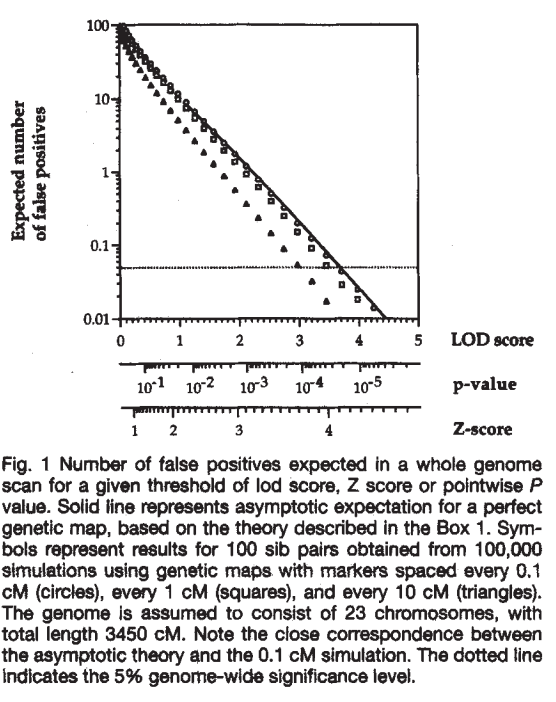
Capture

{credit}Lander & Kruglyak, Nature Genetics 1995{/credit}

I spoke with Leonid Kruglyak, co-author of this landmark paper, to get a sense of the context in which this paper came about, and the impact it had on the field at the time of publication. He first explained that it was finally possible to conduct genome-wide linkage studies with hundreds of individuals, allowing linkage mapping methods to be applied to complex traits (for example, this genome-wide screen for schizophrenia susceptibility genes published in the same issue). However, unlike Mendelian genes, there was no clue as to “how many signals there should be, or what their expected sizes were.” Thus, the need for a statistical framework.

This need was recognized as well by the Journal. As Prof Kruglyak recalls, Kevin Davies (founding editor of Nature Genetics) originally commissioned this work as a News & Views article, but it then evolved into a more extensive piece as its implications became clear. However, as he remembers, there was still a very strict deadline for the paper as it had to make the next issue (and these were still the days of hard-copy submissions). At the time, Prof Kruglyak was a young postdoc, so it fell to him to rush to the main FedEx office in downtown Boston before closing time, to make sure the manuscript got to the printer on time.

Prior to submitting the final text, Lander & Kruglyak produced some of the “original preprints”, sending a copy of the paper by snail mail or email to “everyone we knew in statistical genetics”, for comments and suggestions. After all, these guidelines would affect quite a lot of people and “signals that people would like to be results might not be real results anymore”.
Presentation1

{credit}Curtis, Nature Genetics 1996{/credit}

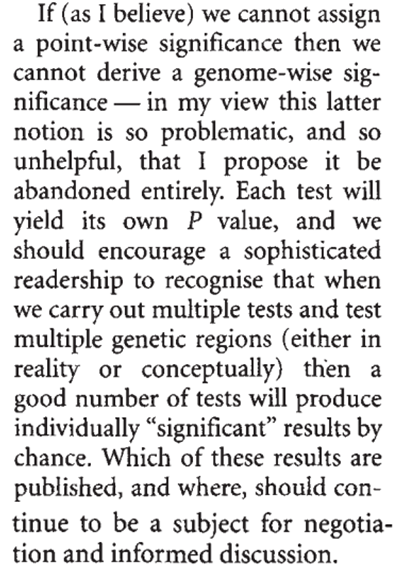
Following publication, “the reactions came in essentially two flavors,” Prof Kruglyak recalls. There were those who thanked the authors, saying that someone really needed to do this. Others were less enthused. “They said, ‘you’re standing in the way of progress and making it harder to publish.’” In fact, Nature Genetics published two letters to the editor arguing that the proposed genome-wide significance threshold was too strict, or that at the very least additional discussion was warranted before these guidelines were adopted (see the letters here and here, and the authors’ reply here). Personally, I agree with the overall sentiment of Lander & Kruglyak as summed up in this portion of their reply: “The correspondents (all trained statisticians) argue that there is no need for guidelines because everyone should be able to interpret the genomewide significance of pointwise P values on their own. In our view, this is naïve. Most geneticists are not statisticians, and rules of thumb can be extremely helpful in promoting sensible discussion.”

The legacy of this paper is clear to anyone familiar with GWAS. “The GWAS community learned a lot from that whole experience [of false positive linkage reports],” says Prof Kruglyak. “There were many serious statistical geneticists involved [in the GWAS field] from the beginning, with a lot of carryover from the linkage era to the GWAS era.”

“Guidelines are not just ‘external gatekeepers’”, he noted.  They are not just there to tell you what you can and can’t publish. “You know what they say, the easiest person to fool is yourself.” These guidelines were developed to help researchers understand their own findings better and decide which are worth following up. “You can often make up a plausible story, but how strong is the evidence?”


Thinking of a PhD? This is the Australian story

Advice for prospective PhD candidates focuses on career prospects in R&D, but more thought should be given to personal aspirations in life and work.

Research is fuelled by the energy of post-graduate students. PhD students contribute 57% of total university research output, according to a 2013 discussion paper from The Group of Eight Universities in Australia. In 2011 Nature published “The PhD factory,” which described the ongoing crisis caused by the oversupply of trained researchers and the inability of academia and industry to soak up the overflow.

CSIRO_ScienceImage_3881_Five_Antennas_at_Narrabri_-_restoration1

Five of the Australia Telescope Compact Array antennas at Narrabri, New South Wales

Fast forward to 2016, and the PhD factories are just as productive, if not even more so. In the 2011 article, Dr Anne Carpenter at Harvard/MIT’s Broad Institute fought the system by hiring permanent staff scientists instead of the usual mix of postdocs and graduate students. She struggled to justify her high staff cost to grant-review panels. Continue reading

Seeking out stronger science: An incomplete, non-systematic list of resources

Our reporter Monya Baker runs through some of the statistical tools she found when writing her latest story.

As I reported in a Nature feature published this week, I found more online courses that were being developed than were actually in place. Resources to help scientists do more robust research are set to expand quickly. For example, the National Institute of General Medical Sciences has a competitive program that awards funds to institutions to enhance graduate student training; of 15 such supplements awarded in 2015, a dozen involved data analysis, statistics, or experimental rigor. You can find more here, and that is only a fraction of what is available. Some courses are still being developed and piloted to select students; others are being offered only to those in a particular department or training grant. If you find one that interests you, it can’t hurt to ask.

data-science-industry

{credit}PW Illustration/Getty{/credit}

Continue reading

The elephant in the lab

Young researchers should take the time to educate themselves on STEM career-related  statistics.

Contributor Robert Aboukhalil

Like many PhD students in their fourth year, there are two things constantly on my mind: one is my research, and the other is my post-graduation plan. I am currently a graduate student in the Cold Spring Harbor Laboratory (CSHL) PhD programme, which is designed to be 4-5 years long. The course puts a strong emphasis on developing post-graduation plans early on, so I started researching career options in my 2nd year.

I came across some statistics from the National Science Foundation (NSF) that painted a dire picture of career prospects in academia. Coincidentally, I joined CSHL’s Bioscience Enterprise Club around the same time to learn about alternative careers, and was taken aback by the abundance of career options available for PhDs: research in industry, publishing, science writing, teaching, public policy, finance, consulting, patent law, biotech startups, and more.

An elephant in a room.

An elephant in a room. {credit}Bit Boy/ Flikr — CC-BY-SA-2.0 — https://bit.ly/2gKKEfF{/credit}

Researching career options early on has given me ample time to identify rewarding career paths, and to get involved in extra-curricular activities. Having done the research, I plan on applying the data science skills that I have developed over the course of my PhD to a career in industry.

As I get closer to graduation, I find myself much more prepared for what’s to come and strongly believe that considering career options early on is crucial for any PhD student. Therefore, I would urge all graduate schools to insist that their students do the same, especially in the current academic climate. For those who haven’t been introduced to the stats, I’ve put together a short summary for you.

Continue reading

What makes a Nature Genetics paper?

largecoverIn the editorial published in the current issue of Nature Genetics, we draw attention to the development and implementation of community standards for biomedical publications. We also note that we will be discussing our own standards—interactively with the community, we hope—on this blog.

The goal is two-fold. First, we’d like to better communicate to researchers what we’re looking for in specific sub-fields (eg: genomic associations, cancer studies, epigenetics, evolutionary genetics, data analysis, etc) to more clearly answer the question “what makes a Nature Genetics paper?” Second, we want you to help us update what a Nature Genetics paper should be. Are there criteria we should be applying that we’re not? Don’t be shy. Obviously, we love to hear what we’re doing right, but it’s much more helpful to learn what we’re doing wrong.

So, to start off, I’m asking you: What makes a Nature Genetics paper? What should make a Nature Genetics paper? Send me your questions about our editorial processes or your comments/suggestions either in the comments to this post, by email (brooke.laflamme [at] us.nature.com) or on Twitter (@Brooke_LaFlamme). We will post contributions without name attribution unless you specify that you want to be named. For reasons of editorial responsibility we will need to record your name and affiliation offline. Questions and comments will be answered by staff on our editorial team in future posts.


Bring on the box plots

Box plots are excellent for visualizing important core statistics of sample data. We hope that a new online plotting tool BoxPlotR will help encourage their wider use in basic biological research.

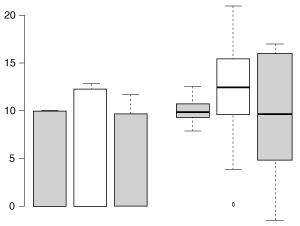
The same three samples plotted by bar chart (left) and box plot (right).

The same three samples plotted by bar chart with s.e.m. error bars (left) and Tukey-style box plot (right). The box plot more clearly represents the underlying data.

A bar chart is often a person’s first choice of plot type when they want to compare values. This is appropriate when the values arise from counting. But when the value is a mean or median of data points taken from a sample, a bar chart is usually inappropriate. As discussed in our March Editorial and the accompanying Points of View and Points of Significance columns, a “mean-and-error” scatter-type plot or a box plot are more appropriate for sampled data. In summary, we strongly recommend that box plots be used when you have at least five data points, but for samples with 3-5 data points mean-and-error plots are more appropriate.

Box plots are heavily used in biomedical research in which statisticians have historically had considerable input into study design and analysis. But although similar types and quantities of sample data also appear in basic research (such as that published in Nature journals) box plots are much less common than bar charts in these manuscripts. Last year in Nature Methods for example, ~80% of sampled data was plotted using bar charts.

Discussions we had with the community suggested that an impediment to using box plots instead of bar charts to graph sample data was due to limited support for box plots in plotting programs commonly used by researchers. It also became apparent that some software that did support the box plot was deficient in communicating to users what the different elements of the plot represented. As a result, strangely labeled box plots were showing up in published papers. At NPG we thought it would be useful to provide authors with a simple online tool they could use to generate basic box plots of their data for publication.

The origin of BoxPlotR
At the VizBi 2013 conference in Cambridge Massachusetts I mentioned NPG’s desire for such a tool at a breakout session chaired by Martin Krzywinski in which the participants, including a young researcher named Jan Wildenhain, discussed what the community needed to create better figures. I also happened to mention our interest in this to Michaela Spitzer while visiting her poster from the Juri Rappsilber and Mike Tyers labs showing how the R-package ‘shiny’ by RStudio can be used to easily convert R code (a popular scripting language for statistics) into a visual application for exploring data.

Later at the conference Jan approached me and said he was intrigued by our desire for someone to design a webtool to create box plots and that he was interested in working on such a project. I happily told him to get in touch with me after the conference so we could discuss it further.

Three weeks after the conference concluded I still hadn’t heard from Jan and was beginning to worry that he had decided not to pursue this. Then… a few days later, I received an email from Jan. Much to my surprise he provided a link to a highly functional tool that he and Michaela, through their own initiative, had gone ahead and created using shiny and R. What followed was a productive and rewarding period of discussion and development during which time Michaela incorporated additional functionality and made selected design changes. The tool appeared so well designed and functional that I encouraged them to submit it to Nature Methods for publication as a Correspondence. After incorporating additional functionality and changes based on comments brought up during peer review BoxplotR was ready for publication.

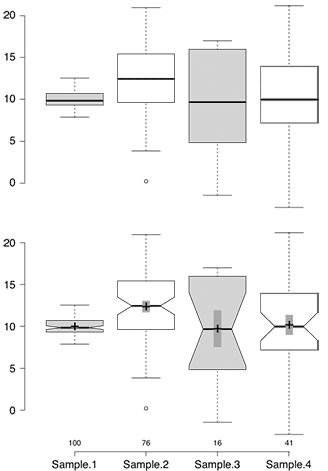
Sample BoxPlotR plots

Sample BoxPlotR plots. Top: Simple Tukey-style box plot. Bottom: Tukey-style box plot with notches, means (crosses), 83% confidence intervals (gray bars; representative of p=0.05 significance) and n values.

Launch of BoxPlotR
To accompany the publication and launch of BoxPlotR we thought it would be useful to provide some information and practical advice about box plots to our readers. Nils Gehlenberg, a former author of several Points of View articles with Bang Wong, agreed to resurrect that popular column for our February issue with an article on bar charts and box plots. Similarly, Martin Krzywinski and Naomi Altman agreed to delay our planned Points of Significance article on the two-sample and paired t-test and instead devote an article to box plots.

Seeing how the community responded to our interest in creating an online box plot tool and then working with them on this project has been a great experience. This never would have been possible without the initiative and talent of Jan and Michaela or the support they received from their PIs Mike and Juri. We hope both our authors and others find BoxPlotR useful and we encourage feedback. General comments can be made here on our blog or by emailing the journal. For specific bug reports and feature requests please see the contact information at https://boxplot.tyerslab.com.

Let’s give statistics the attention it deserves

This month we launch a new column ‘Points of Significance’ devoted to statistics, a topic of profound importance for biological research, but one that often doesn’t receive the attention it deserves.

For the past three years Nature Methods has been publishing the Points of View column, one page a month dedicated to practical advice for researchers on how to create accessible and accurate visualizations of their data. The response to the column articles has been fantastic and most recently we organized them by topic here on our blog.

Unfortunately, a truth about data visualization is that no matter how good the visualization, if the experiment wasn’t appropriately designed and the data wasn’t analyzed correctly, the resulting visual depiction of the data will be inherently flawed. Nature Methods and the other Nature journals recently made changes to improve data and methods reporting as part of a reproducibility initiative. We feel this is an important first step in improving experimental reproducibility and repeatability, but unfortunately by the time work is submitted for publication it can be difficult to correct shortcomings in experiemntal design and analysis.

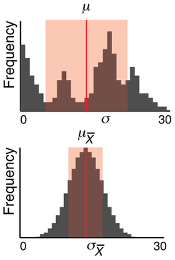
A population distribution and a distribution of sample means.

A population distribution and a distribution of sample means.

In our September issue readers will find a new column, Points of Significance, that we hope will be as useful as the column that preceded it, perhaps more so. Martin Krzywinski, who has been writing the visualization column, is now joined by Naomi Altman, Professor of Statistics at The Pennsylvania State University. Among other things, Naomi will be responsible for ensuring that the information and advice we provide about statistics in every Points of Significance article is accurate.

The column has been expanded from one to two pages and will often have an Excel spreadsheet associated with it. This expansion will help us better communicate information that is less well served by display items. However, as illustrated by the figures in the first article of the column and the accompanying spreadsheet, visual displays will continue to play a vital role due to their strength in providing easily interpretable examples that can often be more readily grasped than mathematical or narrative descriptions.

We will strive to present the material so that each article in the column builds on prior ones. In this spirit the first article discusses populations and sampling, a foundation for nearly all topics to follow. The accompanying spreadsheet allows readers to play around with sampling and see for themselves how often values obtained from samples deviate substantially from the real population. It can be disconcerting to see just how often ‘bad luck’ can give a ‘wrong’ result in one set of measurements while in another set of measurements the ‘right’ result is obtained but statistical measures would suggest that the former is more likely to be ‘correct’ than the latter. This excellently highlights how statistics is unable to tell you if you are right. But this doesn’t suggest statistics has limited value. Instead, readers of scientific articles reporting statistical results need a healthy grasp of the limitations of statistical analysis and users of statistics can always learn ways to improve the power of their analysis.

The “aura of exactitude” that often surrounds statistics is one of the main notions that the Points of Significance column will attempt to dispel, while providing useful pointers on using and evaluating statistical measures. We expect that readers will find the upcoming October Points of Significance article on error bars and confidence intervals with its practical tips on interpreting these graphical elements to be particularly useful almost every time they read a manuscript containing these popular visual representations of uncertainty.

We hope readers enjoy Points of Significance. It is appropriate that the column is debuting during the International Year of Statistics. To allow readership by a wider audience each article will be free to access for a period of one month after it is published.

Update: All Points of Significance articles are now free access and have been collected together on a dedicated page in the nature.com “Statistics for biologists” resource.

For more on statistics, and particularly statistics training, don’t miss this September’s Editorial.

. . . . . . . .

Update: Below is a continuously updated list of the Points of Significance articles.

Importance of being uncertain – September 2013
How samples are used to estimate population statistics and what this means in terms of uncertainty.
Error Bars – October 2013
The use of error bars to represent uncertainty and advice on how to interpret them.
Significance, P values and t-tests – November 2013
Introduction to the concept of statistical significance and the one-sample t-test.
Power and sample size – December 2013
Using statistical power to optimize study design and sample numbers.
Visualizing samples with box plots – February 2014
Introduction to box plots and their use to illustrate the spread and differences of samples.
Comparing samples—part I – March 2014
How to use the two-sample t-test to compare either uncorrelated or correlated samples.
Comparing samples—part II – April 2014
Adjustment and reinterpretation of P values when large numbers of tests are performed.
Nonparametric tests – May 2014
Use of nonparametric tests to robustly compare skewed or ranked data.
Designing comparative experiments – June 2014
The first of a series of columns that tackle experimental design shows how a paired design achieves sensitivity and specificity requirements despite biological and technical variability.
Analysis of variance and blocking – July 2014
Introduction to ANOVA and the importance of blocking in good experimental design to mitigate experimental error and the impact of factors not under study.
Replication – September 2014
Technical replication reveals technical variation while biological replication is required for biological inference.
Nested designs – October 2014
Use the relative noise contribution of each layer in nested experimental designs to optimally allocate experimental resources using ANOVA.
Two-factor designs – December 2014
It is common in biological systems for multiple experimental factors to produce interacting effects on a system. A study design that allows these interactions can increase sensitivity.
Sources of variation – January 2015
To generalize experimental conclusions to a population, it is critical to sample its variation while using experimental control, randomization, blocking and replication to collect replicable and meaningful results.
Split plot design – March 2015
When some experimental factors are harder to vary than others, a split plot design can be efficient for exploring the main (average) effects and interactions of the factors.
Bayes’ theorem – April 2015
Use Bayes’ theorem to combine prior knowledge with observations of a system and make predictions about it.
Bayesian statistics – May 2015
Unlike classical frequentist statistics, Bayesian statistics allows direct inference of the probability that a model is correct and it provides the ability to update this probability as new data is collected.
Sampling distributions and the bootstrap – June 2015
Use the bootstrap method to simulate new samples and assess the precision and bias of sample estimates.
Bayesian networks – September 2015
Model interactions between causes and effects in large networks of causal influences using Bayesian networks, which combine network analysis with Bayesian statistics.
Association, correlation and causation – October 2015
Pairwise dependencies can be characterized using correlation but be aware that correlation only implies association, not causation. Conversely, causation implies association, not correlation.
Simple linear regression – November 2015
Linear regression is a flexible way to predict the values of one variable using the values of the other to find a ‘best line’ through the data points.

Facts and figures – treat with caution

David.bmp

Dr David Barlow is Consultant in Genitourinary Medicine at St Thomas’ and Guy’s Hospitals, London. He has been the lead author for the chapter on gonorrhoea in the last three editions of the Oxford Textbook of Medicine. Between 1986 and 1993, at St Thomas’, he ran the largest linked HIV sero-survey in the United Kingdom. The third edition of his book Sexually Transmitted Infections- The Facts, Oxford University Press, with original cartoons by the late Geoffrey Dickinson, was published in March 2011.

There is something slightly uncomfortable about authoring a book whose cover proclaims: “XXX – The Facts”, with a sub-heading “All the information you need, straight from the experts”. Such is the house style of the OUP for its medical ‘Facts’ series, currently some 35 strong, but going forth and multiplying as you read.

Anyway, it got me thinking about how, in my specialty, when ‘facts’ become ‘figures’, caution is called for. I had an interest in heterosexual transmission of HIV in the 1980s and 1990s which put me in conflict with the official number-crunchers and I’m afraid I’m still suspicious when presented with totals. At the final proof stage of my ‘Facts’ book, I checked the Health Protection Agency’s website for the numbers of UK STIs reported for 2008. Unmentionable diseases including syphilis, gonorrhoea, warts and herpes remained as I had written. Total chlamydial infections, however, had changed from 126,882 (accessed July 2010) to 217,570 (accessed January 2011). A small adjustment might be reasonable. But 70%? This was a DB Type 4 numerical error.

DB’s numerical errors: Types 1-5

Type 1 Somebody has a vested interest: “If we tell these clap-doctors that laboratory culture of the gonococcus is only 70% sensitive, they’ll shut their lab’ and buy our ‘totally sensitive’ NAAT.”

Type 2 The totals may be correct but are misleading (1): “It is Government/Department (of Health) policy to pretend that there is a rapidly increasing HIV epidemic in heterosexuals who are transmitting within the UK.”

Type 3 The totals may be correct but are misleading (2): There is a genuine, probably innocent, misinterpretation of the figures (see horseradish sauce, below)

Type 4 The totals may be correct but are misleading (3): The explanation is perfectly reasonable and logical, but the calculation is opaque/we are keeping it to ourselves/forgot to tell you/have you read the small print?

Type 5 The totals are incorrect: Woops!

At the beginning of June, I awoke to BBC headlines about a doubling of UK-acquired HIV between 2001 and 2010. This drew me to the HPA’s website where I found a press release (June 6): ‘Last year there were 3,800 people diagnosed with HIV who acquired the infection in the UK, not aboard [sic], and this number has doubled over the past decade.’ From the same site: ‘… HIV diagnoses among heterosexuals who most likely acquired in the UK have risen in recent years from 210 in 1999 to 1,150 in 2010’. I shall return to these later but if you really have nothing better to do, why not see whether you can confirm the figures quoted above by accessing the HPA’s ‘New HIV Diagnosis,’ Table 5 here. And your next task (5 marks) is to re-word the press release…

Exactly thirty years ago, on 5th June 1981, the sleuths at the Centers for Disease Control published their crafty bit of epidemiology entitled ‘Pneumocystis pneumonia – Los Angeles’. The CDC had picked up an increase, from the West Coast, in requests for pentamidine. This was the drug used to treat PCP, a rare lung infection found in renal transplant patients whose immunity had been weakened (deliberately) to reduce rejection.

These new cases were different. The men were immuno-compromised but none were undergoing transplantation and all were gay. Thus were HIV and AIDS (although not so named for a year or two) introduced to an awe-struck, and soon fear-stricken, public.

Britain had its first AIDS case in 1981 and in August 1982 the Communicable Disease Surveillance Centre (the UK’s CDC) published the first of their monthly updates in the Communicable Disease Report, the CDR. The risk categories were divided into homosexual, haemophiliac, blood transfusion, intravenous drug users and heterosexuals [without other risk]. It was with these heterosexual cases that the distinction between ‘the truth’ and ‘the whole truth’ became lost during late 1986.

The May 1986 CDR tables broke down the heterosexual AIDS cases into: 3 with USA/Caribbean connection, 3 simply ‘heterosexual contact’ (of whom two “…had recently returned from Uganda and Mozambique.”), and 12 associated with sub-Saharan Africa. In October this connection became a footnote: “associated with sub-Saharan Africa” and by November, the categories had become: ‘contact UK’ and ‘contact abroad’. The December, separate, HIV figures were reported, without footnote, simply as ‘heterosexuals’ ( Type 2 numerical error ). Africa had disappeared from the tables.

By one of those coincidences loved by cynics and conspiracy theorists, the UK-wide leaflet drop about AIDS occurred in January 1987, the very next month, to be followed, in February, by the ’_Don’t die of ignorance_’ campaign. The national press then published increasingly doom-laden descriptions, largely unchallenged, of the burgeoning UK AIDS epidemic in heterosexuals.

What actually mattered was the number of cases being transmitted in Great Britain. Was the disease spreading? What was the risk from a bonk?

The change in wording of the heterosexual categories in the late 1980s allowed speculation that the ‘infected abroad’ category was largely made up of British nationals who had gone overseas and returned with HIV/AIDS. This was the CDR’s interpretation when they gave advice to travellers in 1991 ( Type 3 numerical error ).

We published an alternative view in the Lancet (CDR did not print correspondence, commentary or criticism) and the CDSC, unusually given the chance to reply in the same edition, graciously and politely acknowledged our figures from St Thomas’ but said that they were not representative. Neither my first nor last experience as an outlier.

Have you ever made horseradish sauce? Epidemiologists and cookery-writers run similar risks. Counting and cooking need to be in their respective repertoires but, for both, the craft improves with hands-on experience: contact with patients, or trying out the recipe. If your cookbook doesn’t mention wearing goggles with the wind behind you while you grate this vicious root (and most don’t), the author has never made the sauce. Epidemiologists don’t need the formula for horseradish peroxidase either, but they may miss an open goal if they don’t see patients.

Four other hospitals in or near London (I confess to prompting) reported that most of their (no other risk) HIV-positive heterosexuals were, like ours, from Africa, (Outliers 5, Regression Lines 0). It was not until later in the 1990s that the CDSC accepted the UK heterosexual HIV/AIDS epidemic to be largely imported, with little evidence of significant transmission between heterosexuals from, or in, this country.

So, how did you get on with the HPA’s table 5? You found the 210 for 1999 easily enough, I’m sure. But the 1,150 (and 3,800) for 2010? Well, a helpful person in the HPA’s epidemiology section told me they reached this figure by extrapolating the, as yet, uncategorized (‘not reported’ – penultimate row Table 5) cases in the same proportion as the different categories where the region of infection was actually known ( Type 4 ).

“But you didn’t apply that correction to the 210 in 1999”.

“Ah, no. We didn’t!” ( Type 5 ).

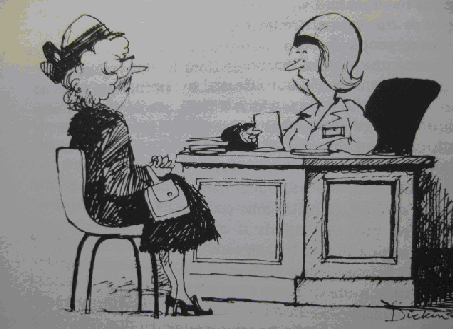
And, finally, the Type 1 numerical error? Specificity is also important in diagnostic tests (the 55 year-old Granny who went to her GP for a smear test, was screened for chlamydia, and came out with gonorrhoea. Yes truly!). The Nucleic Acid Amplification Tests for gonorrhoea may give you false positives.

Why didn’t you tell me about this before, Mother?

box.bmp

So, am I advising less sex?

What, and put myself out of a job? Give over!

References

Barlow D (2004) HIV/AIDS in ethnic minorities in the United Kingdom.

In Ethnicity and HIV: prevention and care in Europe and the USA, Eds, Erwin, Smith and Peters. 21-46

Barlow D, Daker-White G and Band B (1997) Assortative mixing in a heterosexual clinic population – a limiting factor in HIV spread? AIDS; 11:1039-44

All The Old Showstoppers

Now is the time of the month when I have to look at “the numbers” to see how things are going on Nature Protocols and Protocol Exchange. Since I was doing that anyway I thought I’d share some with you. The thing that most intrigues me is what brings people to the sites; what questions are they trying to answer? Well here are the top 20 search terms that resulted in people coming to Nature Protocols and Protocol Exchange in the last month (linked to the Protocols I imagine they found helpful).

Nature Protocols

  1. nature protocols
  2. nature protocol
  3. multiplex pcr
  4. “clonogenic assay “:https://www.nature.com/nprot/journal/v1/n5/abs/nprot.2006.339.html
  5. overlap extension pcr
  6. blue native page
  7. inverse pcr
  8. rolling circle amplification
  9. pyrosequencing
  10. pulsed field gel electrophoresis
  11. site directed mutagenesis
  12. scratch assay
  13. circular dichroism
  14. srb assay
  15. overlap pcr
  16. touchdown pcr
  17. trail making test
  18. cell culture
  19. chromatin immunoprecipitation
  20. qpcr

Not so informative really apart from showing that a lot of people need help with their PCR. I’m also surprised that there is so much interest in circular dichroism. But those looking for information are very persistent as the page I assume they are coming to (Using Circular Dichroism Spectra to Estimate Protein Secondary Structure) was on the third page of Google’s search results.

How about the Protocol Exchange:

  1. itraq
  2. transwell migration assay
  3. barnes maze
  4. kaiser test
  5. nature protocols
  6. neurosphere
  7. neurosphere assay
  8. slic cloning
  9. fluorescent in situ hybridization protocol
  10. dpph assay protocol
  11. immunofluorescence protocol
  12. chip assay
  13. nature protocol exchange
  14. transient transfection
  15. transwell assay
  16. in utero electroporation
  17. neurospheres
  18. protocol exchange
  19. purify protein complex
  20. fluorescence in situ hybridization protocol

That’s a much more diverse list of searches. But there certainly is a desire to know about iTRAQ (which stands for isobaric peptide Tags for Relative and Absolute Quantification if you were in any doubt), and the Protocol Quantitative analysis of protein expression using iTRAQ and mass spectrometry by Ry Y Tweedie-Cullen & Magdalena Livingstone-Zatchej will hopefully have satisfied them.