Electrifying: Tesla on television

Posted on behalf of Liesbeth Venema

teslaseries_poster_medtAn eccentric genius in an impeccable suit and a level-headed young sidekick who have to use their wits to combat a time-travelling automaton and save the Earth. No, this is not the plot of the latest Doctor Who. It is Nikola Tesla and the End of the World, a fun and highly original four-episode science fiction series created by Ian Strang nominated at the 2015 Raindance film festival best British Series category (and available free to view online).

What is the greatest innovation the world has ever seen? According to physicist Sophie Clarke (played by Gillian MacGregor), the doctor in this fictional duo, it is the transmission of energy. This is a topic the real-life nineteenth-century engineer-inventor Tesla thought a great deal about, and in a way that often leaped far ahead of his time. Tesla shaped the modern world with inventions such as the alternating current system for large-scale electric power distribution, radio transmission and fluorescent light bulbs.

Several of these exist only as sketches for patents, and more than a few conspiracy theories about their intended purposes do the rounds. It doesn’t help that Tesla himself made outrageous claims such as being able to receive extraterrestial signals. He indulged in ambitious visions of human advancement and tried to build a power station — the infamous Wardenclyffe tower in New York —  that would provide the world with free wireless communication and energy by making use of the Earth’s electromagnetic field. The project was doomed, leaving Tesla penniless and with his reputation shattered. Recent years have seen a renewed interest and re-appreciation of his work. For example, a new documentary, Tower to the People, hymns the concepts and humanitarian vision behind the Wardenclyffe project.

Doubly ahead of his time

For an SF series like Strang’s, it is a stroke of genius to transport to the present a charismatic inventor decades ahead of his contemporaries and pair him up with a down-to-earth physics lecturer. The action starts when Clarke stumbles upon a detailed sketch for a wireless power transmitter with Tesla’s signature and does the only reasonable thing a clear-thinking experimental physicist would do: tries to build it.

Tesla (Paul O'Neill) and Dr Clarke (Gillian MacGregor) find their way round the London Underground.

Tesla (Paul O’Neill) and Dr Clarke (Gillian MacGregor) find their way round the London Underground.{credit}Ian Strang{/credit}

Clarke’s first test, sensibly carried out outside at a safe distance from any power cables, doesn’t go as expected. The machine’s mechanical components become unexpectedly electrified: discharge currents flow, bulbs light up, an energy beam shoots out and finally, a rift in time and space appears through which a rather dashing Tesla (Paul O’Neill) materialises.  And with him, a whole bunch of misguided conceptions about technology, humanity and social norms.

This Tesla is full of initiative and wants to see immediately what great social advances his inventions have wrought. Inevitably, modern life disappoints him. He decides the world needs to be enlightened with his ideas — which for him, means he has to enlist the support of industrialists: “Bring me to Richard Branson!”

Clarke’s answer to Tesla’s rash plans is to go to her London university to do proper tests. But her motto — “There’s value in understanding how things actually work” — falls on deaf ears. The two must, however, overcome their differences as it soon turns out something went horribly wrong. The time machine conveyed a villainous figure to the present who also intends to deploy Tesla’s inventions — but to destroy the human race. Soon, lightning bolts are striking all over London and, as a warm-up, the Bank of England is blown up.

Dr Clarke and the 'time machine'.

Dr Clarke and the ‘time machine’.{credit}Ian Strang{/credit}

Only in the fourth episode do we see this mysterious figure – and an answer to the burning question of why he has a bad French accent (no spoilers, you’ll have to see for yourself). Fortunately, by the end Tesla has learned to value Clarke’s common sense and has accepted her as his equal.

Strang has taken a great physics geek idea and run wild with it. There are some wonderful exchanges between Tesla and Clarke: in one striking scene, the mismatched duo walks back to London along a deserted path on an icy afternoon, arguing about whether or not Tesla waves are possible. Unavoidably, a few action scenes feel a bit amateurish, but a huge amount of attention has gone into details such as the original musical score by Canadian songwriter Connie Kaldor.

One quibble: though Clarke disproves many stereotypes and doesn’t overplay the geek-card, she could do with a bit more personality. Throughout she remains unreasonably unfazed. She announces that “something is wrong with the weather and I am pretty sure we have something to do with it” as if saying she may have accidentally knocked over a shelf in Ikea’s furniture showroom.

But her character will surely develop in further episodes, which I absolutely hope will be filmed. (Strang promises to do so if there is sufficient interest.) For now, we have to trust that Clarke isn’t going to sit still knowing there is an evil force lurking in the future waiting to destroy the world as we know it, using Tesla’s invention of free energy transmission. “I’d better get on that,” she assures us.

Liesbeth Venema is senior physics editor at Nature. She tweets at @LCVenema.

For Nature’s full coverage of science in culture, visit www.nature.com/news/booksandarts.

NI Photo Contest 2015: Finalist #1

Festival time, and also that time of the year to roll out the finalists of the Nature India photo contest!

In it’s second edition this year, the photo contest has received an overwhelming response — hundreds of entries from around the world. Conceived with the idea of appreciating the art in all things science, the theme for 2015 was ‘Patterns’ — geometric, natural, abstract, under the microscope, in/on the human body or in space.

The quality and novelty of some of the entries this year has been exceptional. Amateur and professional photographers, scientists and non-scientists, mobile cameras to high-end DSLRs — everything seems to have come together in looking for patterns across landscapes, demographics and cultures.

The Nature India editorial and design team is sure having a tough time selecting just three winners, who stand a chance of seeing their entries grace the cover page of one of our forthcoming print publications. The winner and two runners-up will receive a copy of the just released Nature India Special Annual Volume and a bag of goodies (which includes Collector’s issues of the first ever print copy of Nature from November 1869 and the first ever issue of Scientific American from August 1845, a beautiful NPG moleskine diary, a pen with a pen drive and some other keepsakes) from the Nature Publishing Group.

As a run up to the final announcement, we will be rolling out the top 15 finalists of the photo competition (in no particular order of merit) over the next few days on the Indigenus blog as well as our social media platforms (Twitter and Facebook). The final results will be announced in November 2015.

So brace up as we announce the Nature India photo contest 2015 finalist number one:

Kumar MP, Bengaluru, India

Photo Caption: ‘Life wrapped in legs’


#Natureindphoto15-1

{credit}Kumar MP{/credit}

Kumar describes his picture thus:

Kumar MP

Kumar MP

“As I spent my childhood in the Western Ghats of India, crawling creatures piqued my interest. I spent time playing with them and would be amused to see them coil as if holding their body with their legs to protect themselves. This picture showing the intricate pattern on a crawly’s body was taken at the Indian Institute of Science campus in Bengaluru, India.”

Congratulations Kumar for making it to the top 15!

Nature India’s final decision to chose the winner will be partly influenced by the engagement and reception he/she receives here at the Indigenus blog, on Twitter and on Facebook. To give all finalists a fair chance, we will take into consideration the social media engagement of each picture only during the first seven days of its announcement.

So watch out for our other finalists and feel free to promote, share and like your favourite entries with the hashtag #NatureIndphoto.

The story behind the story: Staff meeting, as seen by the spam filter

This week sees the welcome return to Futures of Alex Shvartsman with his story Staff meeting, as seen by the spam filter. Alex’s previous tales have touched on subjects as diverse as coffee, time travel, alien invasions, big business and more. You can read more of his work and find out what he is up to by visiting his website or following him on Twitter. Here he reveals how spam inspired his latest tale — as ever, it pays to read the story first.

Writing Staff meeting, as seen by the spam filter

I find spam fascinating.

Not the kind that comes in a can, but the torrent of information flung at you across all media — be it in the form of an e-mail from a Nigerian prince, a commercial on a loop blaring from the loudspeaker set up outside a cell-phone shop, or an unwanted thick envelope of coupons arriving via snail mail.

If art is the product of creative skill and imagination designed to produce emotion, then spam is art, because annoyance and frustration are emotions. But it is also a con, a confidence scam designed to prey upon the most gullible and naive among us, inflicted upon the populace via what hackers refer to as a ‘brute force’ method: send the ad to enough people and a few are bound to show interest.

The arms race between the e-mail spammers and the software engineers is real and ongoing. The ‘white hats’ teach software to recognize the unwanted solicitations, while the ‘black hats’ are busy coming up with yet another euphemism for erectile dysfunction that they hope might sneak past the spam filter.  It may be a stretch, but given this race it was possible to imagine the filter software becoming gradually smarter and one day evolving into an artificial intelligence.

And when it does, what will it think of the torrent of spam it was created to detect?

This is actually my second spam-inspired story at Nature Futures. If you enjoyed it, check out The tell-tale ear as well!

Career decisions: Too complex for the rational brain?

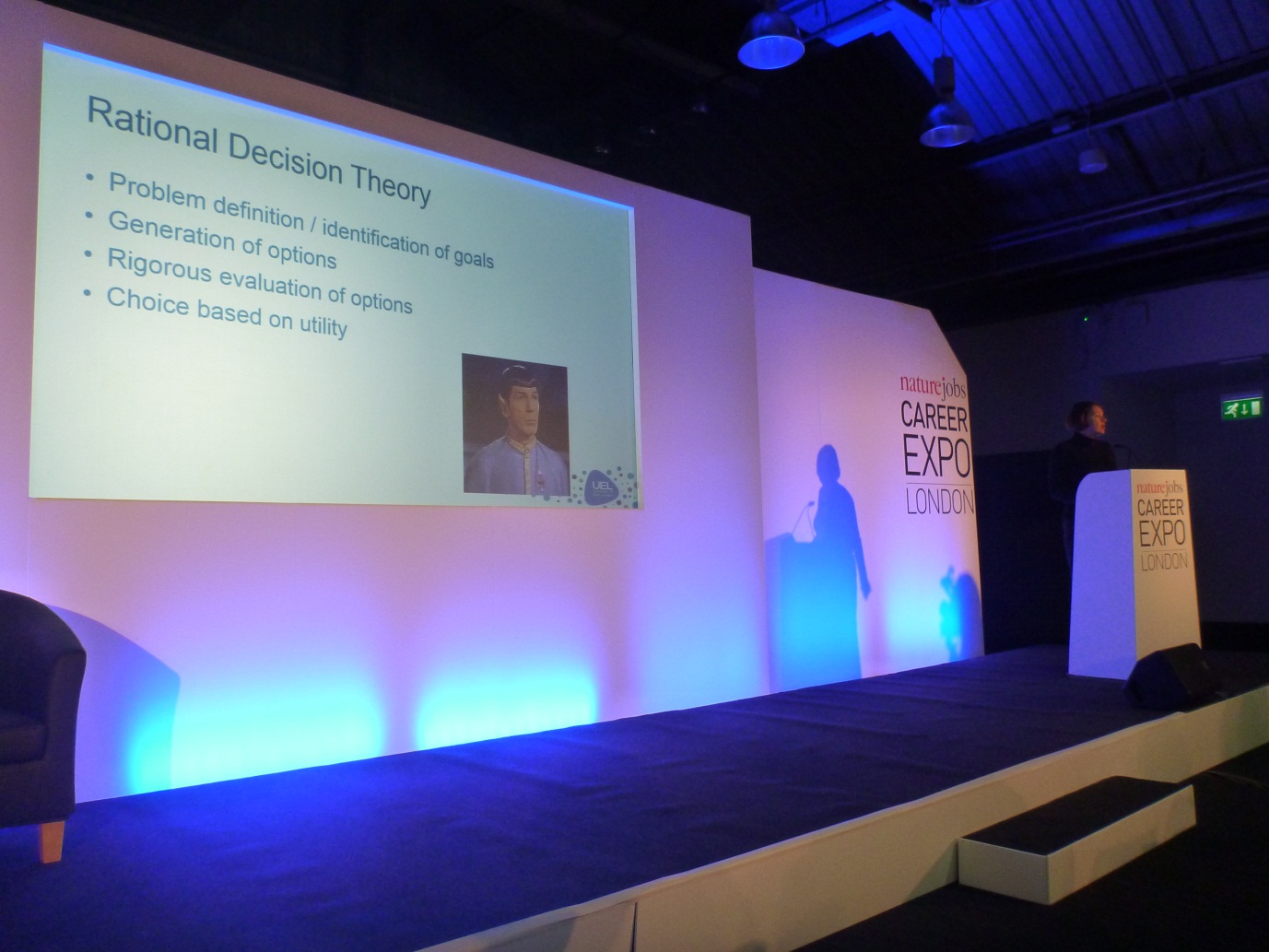
Combining our rational thought process and gut instinct may give us the best of both worlds, says Julia Yates at the 2015 Naturejobs Career Expo in London.

Guest contributor Catherine Seed

Yates-NJCE15-naturejobs-blog

{credit}Image credit: Catherine Seed{/credit}

Deciding on our next career move is a struggle over which many of us have lost sleep. Whether we stay within academia or decide to start looking beyond the ivory tower, there are many paths to choose from. Conventional wisdom stresses the importance of logically thinking through the decision and weighing the available options before we decide. After all, career decisions are life changing: it is important to take time and care in making them, isn’t it? Well, maybe not. This rational approach may leave us unhappier in the long term, argues Julia Yates, a psychologist and career coach at the University of East London, UK.

While the idea of keeping career options open has traction, the reality is that there are more options than we can properly evaluate. “Actually, our brains can cope with about six,” Yates said. She noted that the UK Office of National Statistics recently catalogued some 37,000 available job titles, far more than can be rationally assimilated at once. Continue reading

Size Matters for Adjuvants

Seder NBT cover image

Source: Ethan Tyler, Division of Medical Arts, NIH.

Vaccine designs that elicit a robust immune response against a pathogen without causing unneeded inflammation are in high demand. To ‘tune’ vaccines and achieve this balance, the adjuvant and its mode of delivery are critical. In a paper by Robert Seder and colleagues, the authors explore the use of different types of polymers to deliver Toll-like receptor agonists, a type of powerful adjuvant, and find that polymer-adjuvants best suited for vaccine design are those that form particles. The paper also examines factors that influence why some polymers work better than others.

The above image relates to the Seder and colleagues paper, available now at this link.

Irene Jarchum

Science communication: Sculpting your role

The field of science communication is highly varied, so don’t be afraid to find what works for you, says the panel of experts in science communication at the 2015 Naturejobs Career Expo in London.

Guest contributor Catherine Seed

science-communication-NJCE15-panel-naturejobs-blog

Left to right: Robert Dawson, Catherine Ball, Anke Sparmann and Belinda Quick{credit}Image credit: Catherine Seed{/credit}

Science communication is rapidly becoming a core requirement for scientists, and has long been a highly sought-after career in its own right.

There is a huge breadth and diversity in the field of science communication, agreed the panel members, yet the use of ‘science communication’ as an umbrella term often obscures this variety.  Panellists agreed that the key to developing a successful science communication career is in finding how you prefer to communicate, and determining which avenues of communication match your style. With options ranging from news reporting to working for academic institutions or societies, or in simply starting your own blog, the options are countless. The process, they said, requires much experimentation; test different forms of communication to discover what works best for you.

The objectives of organisations shape the form of communication that they use, said Robert Dawson, head of news at the BBSRC. He stressed the importance of familiarising yourself with different media outlets, universities, research institutions, and companies and their communication style.  In his own role, he communicates to scientists, journalists and other members of the media. “Science PR is about balancing the need to encourage the public to be enthusiastic about your organisation and about science, with the need to produce accurate and balanced coverage,” he said. Continue reading

Robots I have known

Posted on behalf of Celeste Biever

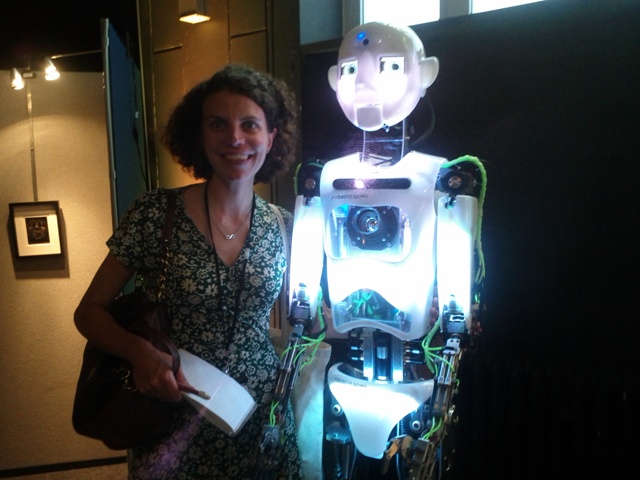
Bonding with RoboThespian at London's Science Museum.

Bonding with RoboThespian at London’s Science Museum.

You remember your first robot – at least, if you are as fixated on them as I am. A recent review of three books that explore the implications of artificial intelligence took me back to 2006 — and the machine that lit my obsession. It wasn’t pretty or even cute, though many automatons are. It was creepy: a four-legged metal crawler that could figure out how to limp if one of its legs was shortened.

At the time, I was a technology reporter for New Scientist with an assignment to write a news story about the quadruped. In order to limp, the robot first had to detect that something had changed. To do this, it maintained a software version of itself, which it constantly compared with the position of its real physical body. When the two no longer matched, it knew it had to modify its gait to cope with its new shape.

It seemed neat, even potentially useful, but not the stuff of philosophy — until a computational biologist I spoke to cast the machine in a new light. Because the robot built a model of itself that was distinct from its real physical body, he suggested that its creators had – perhaps inadvertently – given it a sense of self. With at least the semblance of an inner experience, he said, the robot provided a glimmer of what consciousness could look like in a machine. That was it. My world shifted, I understood the power of robots and I was hooked.

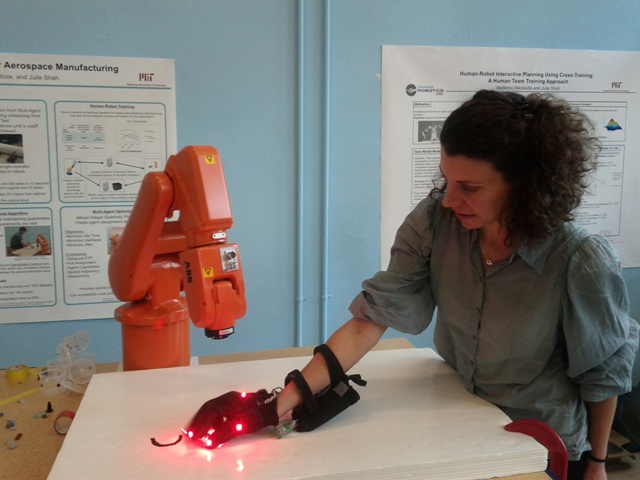
Trading places with Abbie the robot arm at Massachusetts Institute of Technology.

Trading places with robot arm Abbie at Massachusetts Institute of Technology.

Until then, I had regarded them as either gimmicks that disappointed or cold, destructive Terminators. The crawler represented a third option: a way to figure out how humans work.

My next discovery was Nico, a metal skeleton that could recognise its reflection in a mirror. Dressed in a sweatshirt and baseball cap, he did this in a similar way to the crawler: he compared what he saw in the mirror to the movement commands he had just sent to his body, and looked for a match.

Nico didn’t really recognise himself. He just reproduced the behaviour – or so many biologists I spoke to insisted. But the Turing test challenges us to consider what the difference would be between behaviour that seems human and that of a real human. And undeniably, Nico classified his own reflection differently from the sight of anyone else.

Nico set me on a roll. Weekly news meetings became a sport in which I competed with biology reporters to discover beings that chipped away at what it means to be human. Scrub jays are birds clever enough to move their food stores to trick potential pilferers, but I discovered a furry robot that passed a test for theory of mind and a wheeled rover that deceived its opponent to play hide-and-seek.

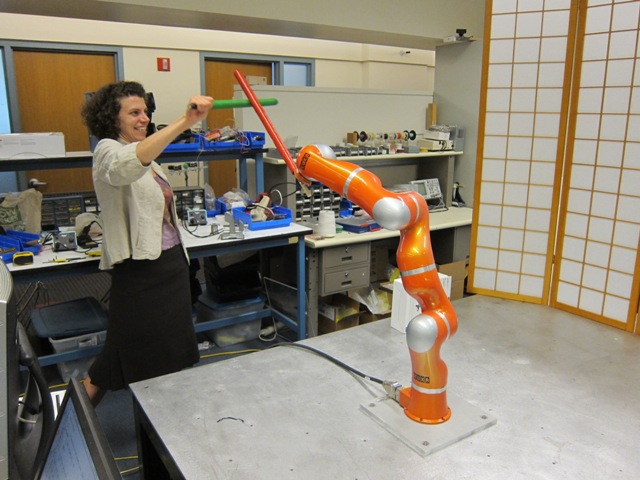
Sparring with Jedibot at Stanford University in California.

Sparring with Jedibot at Stanford University in California.

These synthetic creatures had a crucial selling point: people had programmed them and so understood how they worked, making them the ultimate tool for discovering whether simple rules can produce complex behaviours. Unlike animals, with robots you know exactly what your psychological ingredients are.

My passion led me to shake hands with a knee-high pearly white humanoid as it stepped off the red carpet at the Robot Film Festival (in TriBeCa, New York, in 2011 – I was a judge). I fenced with an orange robot arm, Jedibot. And I mentally ‘traded places’ with another orange robot arm, Abbie, as we worked together to insert screws into a tabletop. The point was to see if the switch improved our ability to collaborate, a psychological trick that is known to work with human-only teams.

Throughout these adventures, my feelings towards robots have often dramatically differed from many others’. Elon Musk and Stephen Hawking, for instance, are among those who have recently warned that the creation of artificial intelligence is risky because of the potential to create Terminator-style killing machines. There’s also the fear, fashionable right now, that robots are on the brink of making human jobs redundant, leaving us with nothing useful left to do.

Perhaps I should be more afraid. But I can’t help but think of one further entry in my robot diary: there is a piece of software that falls for the same optical illusion as people. Trained to estimate the lightness of a pixel based on examples of images it had seen, the program classified grey regions of an image as darker when placed on a white background and lighter when on a black one. This highlights the main reason I don’t fear robots: if you believe that we humans are just complex machines — and I do — aren’t we on some level just one big happy family?

Celeste Biever is Nature’s chief news editor. She tweets at @celestebiever.


For Nature’s full coverage of science in culture, visit www.nature.com/news/booksandarts.

Career paths: How to decide which path to take

Rui Pires Martins, researcher development advisor at Queen Mary University of London, encourages scientists to self-reflect in order to make future career decisions.

Guest contributor Rui Pires Martins

Career-path-decisions-naturejobs-blog-small

{credit}iStock{/credit}

I love cities, especially large, diverse ones. Moving from Toronto to Detroit for my PhD studies in 2000 made me appreciate the importance of the place I live in beyond just ‘somewhere near work’. I took the post knowing very little of the complex socioeconomic history that led to the city’s decline. After almost seven years of tough-love, it became apparent that Motown wasn’t really able to provide “city” at the level that I craved.

Even as starved for “urbania” as I was, my next move in 2007 was more guided by the reputation of the The Gurdon Institute, and of its scientists, than location (Cambridge, UK). The logistics of studying a stage of embryonic development that happened in the early morning hours would soon start to impact my work-life balance. So while my fellowship was a tremendous opportunity for my development, when I began to search for my next post, I set my sights on London. I also focused my search on groups working with embryonic stem cells, thinking I’d have more control over my working hours. In 2009, I took a position as a postdoctoral research assistant at QMUL, where I would work for just over four years.

Location: check. Work-life balance: fingers crossed. Continue reading

Data sharing: Contribute to the community

Data sharing can make a significant contribution to the scientific community, but it comes with challenges, says Caroline Weight.

Guest contributor Caroline Weight

We have all heard of it. We are all worried about it. We hear whispers of it in the corridors. We are advised to be careful what we say to ‘others’. We constantly check the literature. It matters to us. After all, it is our careers on the line.

‘Scooped’.

The process of publication is vigorous, competitive and tricky. It’s not uncommon for five years to pass between writing the grant application and publishing the work. Big labs with state-of-the-art facilities stand a better chance of getting their work out there first, given the extra manpower and often more-established protocols. This race for ownership of the data makes it difficult to share information and present new findings at meetings or conferences. Even at manuscript submission, there is often a chance to actively inhibit particular referees in case of conflicts of interest or personal competitors, to retain the novel concepts and data until they have been made public. Not until the publication has been accepted and is in print can you heave a sigh of relief and move on to the next project. Yet, sharing of data is essential to the progression of science in the modern world. Continue reading

A New Science of Learning, Accessible to All

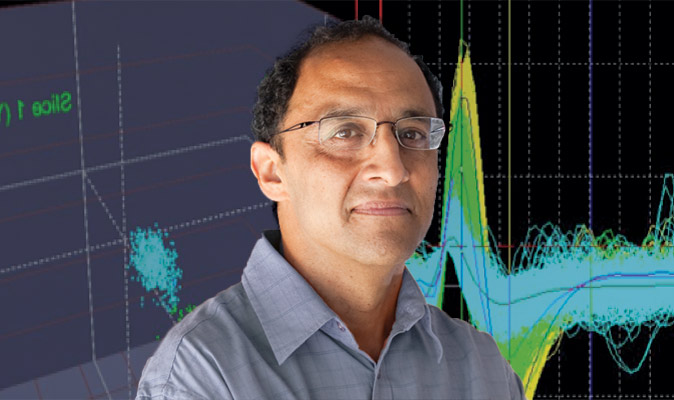
web_pankajGuest post by Professor Pankaj Sah, Director, Queensland Brain Institute and Editor-in-Chief, npj Science of Learning

In partnership with Nature Publishing Group, the Queensland Brain Institute is launching an open access journal dedicated to the science of learning – npj Science of Learning. We want to create a forum through which neuroscientists, psychologists and educators interact to produce a deeper understanding of how we learn. Just as important as this interdisciplinary approach is the open access model we are adopting. Education affects us all, and we want the findings, discussions and debates within the journal to be accessible to everybody, academic or not.

Education and the neuroscience of learning may seem like they dovetail perfectly. After all, learning takes place in the brain and is the foundation of education. As we understand more about how the brain learns, surely this knowledge can inform educational practice? In theory yes, but there is a large conceptual gap between knowing the neural processes that underlie learning and using this to benefit classroom practices. This is where cognitive psychology comes in, as an essential stepping stone between the neuroscience of learning and practical implementation. Ultimately, we think that it is this collaborative approach from researchers in different disciplines—neuroscience, cognitive psychology and education—that will improve educational practice and long-term educational outcomes.

We also think that open access is the right move for academic publishing in general, and even more so for npj Science of Learning. Although the prohibitively high costs of academic journal subscriptions have prevented even the most exclusive, well-funded research institutions from maintaining comprehensively stocked libraries, the impact on middle-tier or lower-tier institutions—particularly from developing countries—is much greater. This unbalanced impact on socioeconomically underdeveloped countries is especially relevant in the field of education.

Education is associated with enhanced health and wellbeing and a more productive economy, and it is exactly these factors that are high priorities for disadvantaged countries. Yet if a paywall prevents people from poorer countries from having access to the cutting edge discourse on learning and education, they cannot learn from or contribute to the debate. It just doesn’t make sense for the most impacted people to be sidelined from the discussion, and we’re happy that by making our content open access, everybody can contribute and everybody can benefit.

Another reason we think that the open access format is ideal for a journal on the science of learning is that the interested parties are not just academics. Teachers and policymakers are two notable examples. Their ideas and opinions currently drive education practice and assessment, and we feel that this thinking should be shaped by the research – it is no use finding ways to improve classroom learning if those practices cannot or will not be implemented. Traditionally, however, these groups have not had direct and easy access to academic research. Open access overcomes this issue and should allow informed debate of the issues at hand by all parties. Parents are another group who are heavily invested in education, yet they too are currently removed from the policies and research that will shape the futures of their children and grandchildren.

This wide array of interested parties does pose a problem of sorts, as does the interdisciplinary nature of the journal: how can we ensure that everybody can understand the specialised research findings that are at the heart of the journal? To address this concern, npj Science of Learning will further break down the barriers to collaborative advance by providing jargon-free summaries of all the research we publish. We want all parties to be able to contribute to the discussion on learning and education, and that requires making the research accessible not just financially, but also intellectually.

We are looking forward immensely to seeing how the collaborative framework enabled by our journal will influence education through a new science of learning. By ensuring that research, discussion and policy perspectives are accessible to all, we think that open access is the ideal platform for our journal dedicated to improving learning and education.

Professor Pankaj Sah is renowned for his work in understanding the physiology of excitatory synapses and synaptic plasticity in the amygdala, an area of the brain involved in emotional processing. He is currently Deputy Director (Research) and Director of the Science of Learning Research Centre at The Queensland Brain Institute (QBI). Previously he was group leader at the John Curtin School of Medical Research at the Australian National University and moved to The University of Queensland as a founding member of QBI in 2003.

His laboratory continues to study the amygdala using a combination of molecular tools, electrophysiology, anatomical reconstruction and calcium imaging. More recently his laboratory has begun research work on humans doing electrophysiological recordings in patients undergoing electrode implantation for deep brain stimulation for the treatment of movement disorders in Parkinson’s disease, essential tremor and Tourette’s syndrome. He has published over 90 papers in international peer reviewed journals.