Career paths: What do you need to think about before taking your next step?

Before choosing a new career path, take the time to get to know yourself, and you may be surprised at how well things fall into place.

 Naturejobs journalism competition winner Mary Gearing

Any career, scientific or otherwise, is the product of choices. In my own path in science, the first set of choices was clear: major in biology, conduct undergraduate research, enroll in a PhD program. This was a comforting, well-trodden path, but it left me unprepared to make the next big decision: my post-PhD direction. Now, as I near the end of my graduate studies, I’ve realized that this decision is much simpler than I thought. The most important tool for a career change is self-awareness – the willingness to analyze yourself as thoroughly as you would any key experiment.

Continue reading

Highlights from the Naturejobs Career Expo

We run a quick summary of yesterday’s #NJCE16

What are the best ways to make yourself into the most appealing job candidate? How do you perfect your CV – or resume? And what should you do before, during and after a job interview?

These questions and many more were answered Wednesday at our Naturejobs Career Expo in Boston, Massachusetts. We had speakers from academia, industry, government and non-profits, who presented crucial information on navigating your career during a day of conference sessions and workshops. We’ll post lots more about these secrets in days and weeks to come, but here’s a sneak preview.

Continue reading

So you want to be a Nature journalist? Join us at the Naturejobs Career Expo!

The Naturejobs Career Expo Journalism Competition is back!
5583_2016_800x400a

We’re thrilled to announce this year’s Naturejobs journalism competition, taking place in both San Francisco and Boston. This is a great opportunity for new and upcoming science journalists to work with a Nature editor, attend the Naturejobs Career Expo, and have their voice published on the Naturejobs blog. Winners will also be provided with a $100 Amazon voucher and a year’s personal subscription to Nature.

We’re looking for 10 new science writers, based in – or able to travel to – San Francisco and Boston, to cover our ever-popular career expos. The conferences will explore careers in academia and industry, the career paths of prominent scientists, and how to develop the all-important practical and soft skills you need to progress in your career.

Winners of the journalism competition will have the opportunity to visit and report on at least two sessions at the career expo, will be able to work with Springer Nature editors on their pieces, and have their winning entries and reports published on the Naturejobs blog.


All you need to do to be considered for the Naturejobs Career Expo Journalism Competition is to send us:

1) A cover letter explaining why you want to be considered and what would make you a good journalist.

2) Your CV.

3) A 600 word answer to one of the following topics:

  • Career paths: What do you need to think about before taking your next step?
  • Balance: Can scientists really have work/life balance?
  • Interviews: What’s the worst question to be asked, and how do you answer it?
  • Events: What are the best networking practises at a conference?
  • Attitude: How important is confidence in science?
  • Mobility: How far should you travel for your research?
  • Transferable skills: What are scientists good at (other than science)?


The prizes are:

1) The five winning and five runner-up entries will be posted on the Naturejobs blog before the event.

2) The reports of the Expo will be published on the Naturejobs blog after the event.

3) Winners will work with, and meet, Springer Nature editors.

4) The five winners will receive a one year personal subscription to Nature .

5) The five winners will also get a $100 Amazon voucher.


The things you need to know BEFORE entering the competition:

1) We cannot offer travel grants or cover travel expenses to the event of any kind. Instead we offer some great prizes, along with the opportunity of having your pieces published on the Naturejobs blog.

2) The competition entries and content created will be used on the Naturejobs blog and in marketing materials for the Naturejobs Career Expo.

3) The deadline for sending in your competition entries is 7th April 2016 at 9pm GMT.

4) You can send your competition entries to the Naturejobs editor at naturejobseditor [at] nature.com.


Good luck, and we’re looking forward to seeing your entries!


Links

Naturejobs Career Expo San Francisco

Naturejobs Career Expo Boston

Why you should come to the Naturejobs Career Expo in London on 19 September 2014

Naturejobs-podcast

The Naturejobs team hosted their first Naturejobs Career Expo in the USA on May 20th 2014. Their chosen spot: Boston, MA, a state known for its biotechnology hubs and world renowned institutions: Harvard University and Massachusetts Institute of Technology.

In between welcoming the delegates and hosting panels, I put on my reporting hat and found out what the organisers, delegates, speakers and exhibitors had to say about the event.

The conference hosts sessions with experts and careers advisers from industry and academia, providing practical advice on transferable skills, career paths and CV writing. “The Naturejobs Career Expo is an extension of what we offer online,” says Nils Moeller, global head of sales and advertising at Naturejobs. The Naturejobs Career Expo also offers a career exhibition, where employers showcase their companies and offer advice (and potential job opportunities) to visiting delegates. Listen to the podcast to find out more.

You can read all about the Boston Expo conference sessions from the reports written by the Naturejobs Career Expo competition winners by looking in the #NJCEBoston category archive on the blog.

You can register for free for the 2014 London Naturejobs Career Expo, which will be on September 19th at the Business Design Centre in Islington. We’re also running the Naturejobs Career Expo journalism competition for our London event, but the deadline for entries is tomorrow (August 1st), so get them in quick!

How to get to the top in industry

Contributor Scott Chimileski

Industry-careers

David Proia, Erin Whalen, Vikas Goyal and Lauren Celano

The Career Paths in Industry Panel at the 2014 Naturejobs Career Expo featured three professionals from Boston area companies that have risen to top positions in the scientific industry. David Proia is the director of Cancer Biology at Synta Pharmaceuticals, Erin Whalen is a senior research investigator at Novaritis Institutes for Biomedical Research (NIBR) and Vikas Goyal is a senior associate at SR One. Proia, Whalen and Goyal each have their own career path story, however they agree that working hard and showing initiative are key to advancement in the business world.

Proia always had a passion for cancer research, but he held several jobs completely outside of the oncology field before becoming a cancer biologist. Looking back on his career, he pointed out that gaining experience in broader areas of biology allowed him to learn about industry and leadership in general. His first jobs exposed him to a variety of managers and helped him to realise what management styles work for him. After working in a protein purification lab, another job as a contract scientist at AstraZeneca ultimately gave him the experience to enter the oncology field as a scientist at Synta Pharmaceuticals.

At Synta, Proia progressively advanced from scientist through many positions to become Director of Cancer Biology. He believes the key to his success at Synta has been his initiative. For young scientists, he suggested taking temporary or contract jobs to help build a toolset and a network in a particular field. Further, he suggested that once you have the job you seek, go above and beyond rather than doing the minimum that it takes to complete a task or project. For example, he recommended taking the next step whenever you can by designing follow-up experiments before they are required. “Simply give everything you have to your manager.” Continue reading

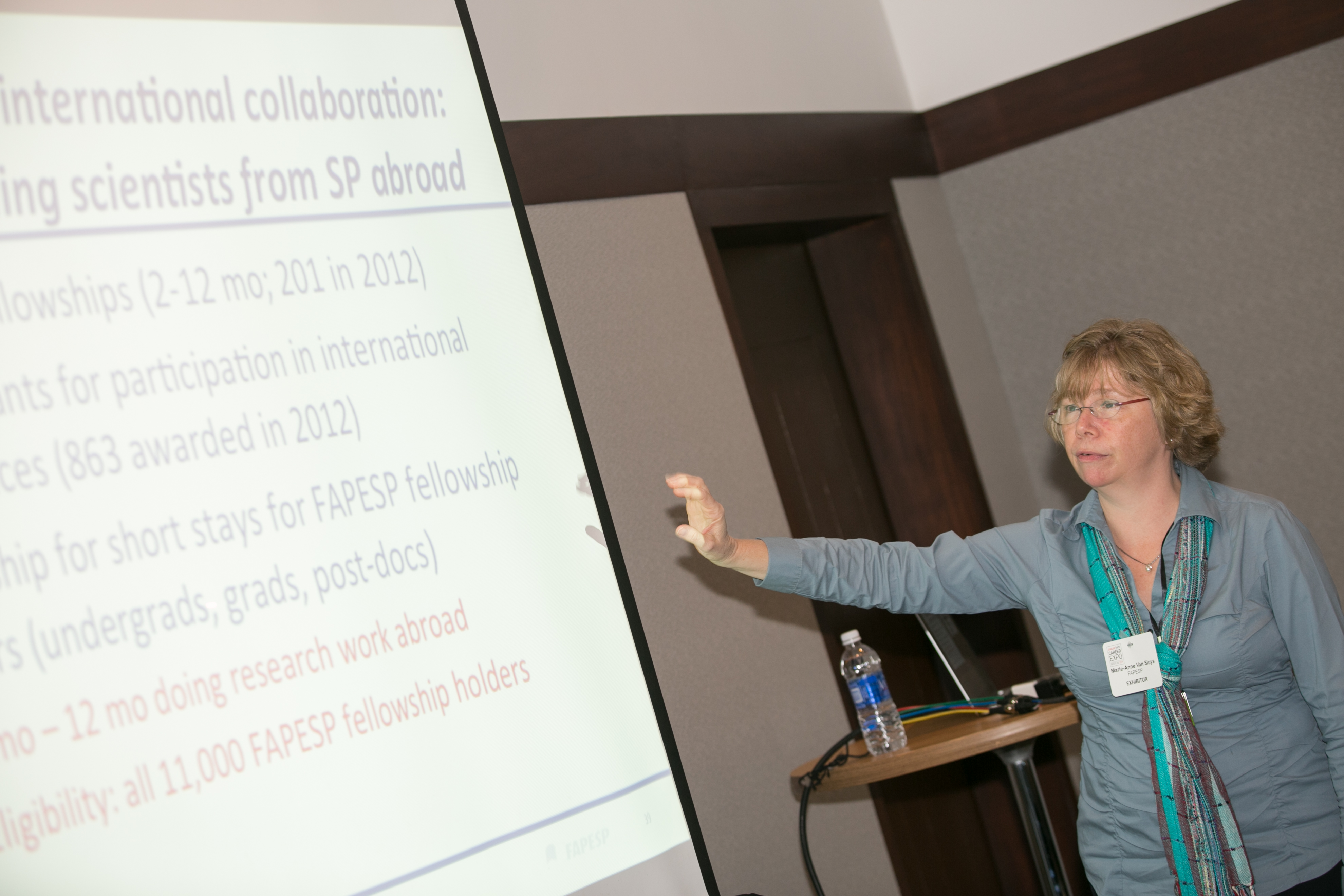
Research opportunities in São Paulo

Contributors: Lynn Kimlicka, Prital Patel and Saheli Sadanand

Research Opportunities in Sao PauloMost of us currently associate Brazil with football, the Amazon rainforest, and Carnival. Add extensive, well-funded research opportunities to the list.

Brazil has a growing economy, with the seventh largest gross domestic product (GDP) in the world. In addition, it has a growing bioenergy industry and robust agribusiness. With the resources to perform cutting-edge science, Brazil is now looking to strengthen its scientific research community.

International work experience is becoming an expected entry line on researchers’ CVs if they hope to climb the academic ladder or gain a tenured position. Multitudes of organisations now aid scientists in seizing such global opportunities. São Paulo Research Foundation (FAPESP), Brazil’s largest publicly funded, regional grant funding institution, is one such example. Continue reading

Destination: Science communication

Contributor Saheli Sadanand

science communication

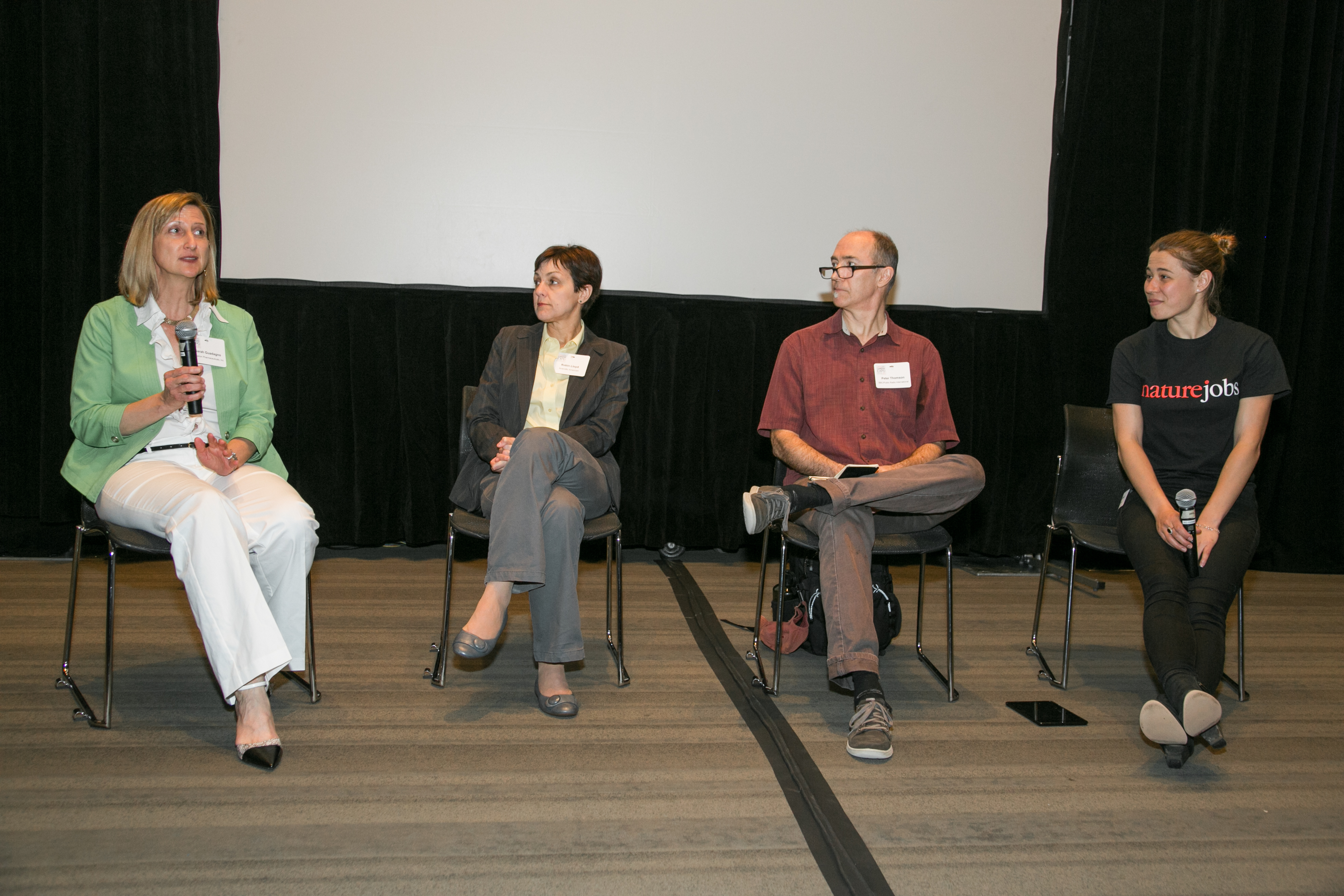
Sarah Guadagno, Robin Lloyd, Peter Thomson, Julie Gould

What is science communication? Turns out that it can be a number of things, as revealed by an afternoon panel at the Naturejobs Career Expo. Peter Thomson, Robin Lloyd and Sarah Guadagno — all of whom have made careers in different forms of science communications – described the paths that brought them to their current positions, and held forth on the challenges and rewarding features of their work.

Peter Thomson is the founding producer of “Living on Earth,” an award-winning environmental news program that has aired on the US public radio network (NPR) since 1991. He now serves as the environment editor for the Public Radio International program, “The World.” “There is something about the human voice that is so elemental. It’s the way we’ve always told stories,” Mr. Thomson said in describing the appeal of radio communication. “Radio is the most intimate medium.” Mr. Thomson pointed out that environment reporting involves more than just a science component; he and his team of journalists must address other perspectives in their pieces.

Robin Lloyd came to her position as online news editor for Scientific American via a circuitous route. She got her Ph.D. in sociology at the University of California, Santa Barbara and after a few years in a tenure-track position, she realised research was not her passion. She then worked in a variety of different jobs (including a stint as a barista!) before becoming a locum editor at Scientific American. Her appointment ultimately evolved into a permanent position at the journal. Her job, as she puts it, is “to take the material that comes in from the writer and turn it into something compelling that the audience really wants to read.” In addition to planning and editing stories for publication, she manages the Scientific American home page. She emphasised that her job involves more than just presenting new and trendy scientific discoveries. Continue reading

Contact Singapore: Translational and clinical science career opportunities in Singapore

Contributor Aliyah Weinstein

Research in Singapore

This article originally incorrectly stated Swaine Chen’s position as a tenure-track assistant professor there. In fact, he is a tenure-track assistant professor with NUS and an Adjunct Senior Research Scientist with GIS. The text has now been corrected.

Imagine going to the lab every day in a country with a tropical climate, whose main working language is English and whose government strongly supports scientific research. Singapore is ranked first in the world for ease of doing business, and in 2012 was voted as Asia’s Most Livable City. 

Of particular interest to academic researchers: from 2011-2015, the government there has pledged S$16.1 billion (US$12.8 billion) to boost Singaporean research initiatives, and build more basic and clinical research space there.

That’s according to Contact Singapore an alliance of the Singapore Economic Development Board and the Ministry of Manpower and host of a session at the NatureJobs Career Expo Boston that was designed to draw the attention of attendees to Singapore’s research institutions.

Singapore has three medical schools:  the National University Health System (NUHS); SingHealth/Duke-NUS, affiliated with Duke University in North Carolina; and the Lee Kong Chian School of Medicine, affiliated with Imperial College in the UK. Additionally, the Genome Institute of Singapore (GIS) is a research institute with government backing. Each institute has broad but individual research interests, and are accepting applications from interested researchers to fill their expanding laboratory space. Continue reading

How to look your best on paper: Part 2

Contributor Prital Patel

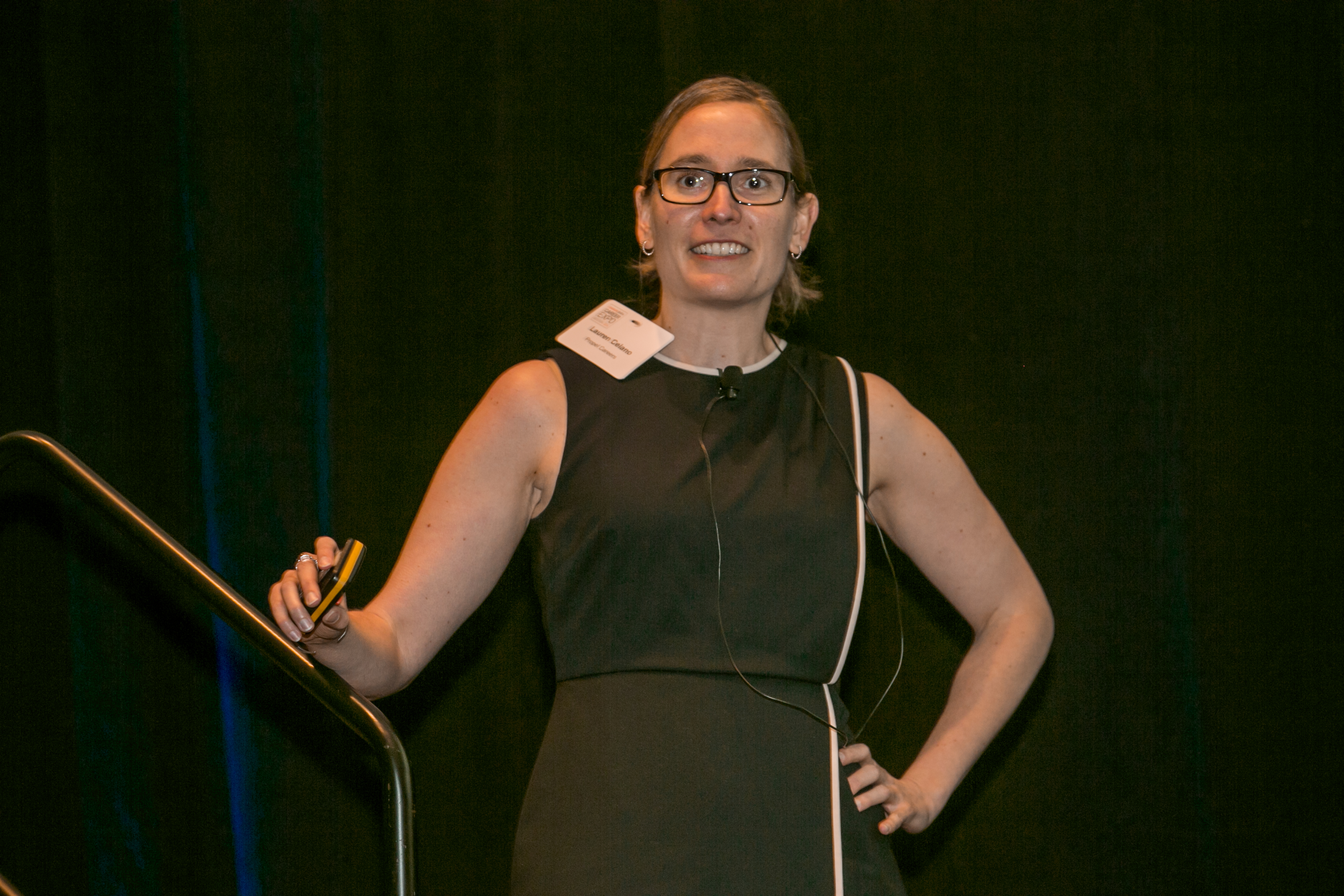
CelanoDuring the first half of the Naturejobs Career Expo conference talk, “How to look your best on paper”, Lauren Celano spoke about the skills that should be highlighted in your resume for various career paths. In the second half of the talk, Celano elaborated on the differences between CVs and resumes, how to chose the right one for your application and how to compile your experiences in the best way.

Curriculum Vitae versus Resume

A Curriculum Vitae (CV) documents your academic career including publications, awards, honors, affiliations, presentations and teaching experiences in reverse chronological order. They tend to be at least two pages in length. CVs are common in Europe, Asia, Africa and the Middle East for most job applications. In the United States and Canada, CVs are primarily used for academic and research positions or fellowship applications. For non-academic positions, a resume is generally preferred. Resumes are concise documents summarizing your qualifications, education and work experiences. They tend to be no more than two pages.

The key goal for each of these documents is to ensure that they are succinct. Don’t minimize any of your accomplishments; instead highlight the things you’ve done that are most relevant. Continue reading

How to look your best on paper: part 1

Contributor Prital Patel

Lauren Celano Driven by her passion to foster entrepreneurship and instill leadership in life science trainees, Lauren Celano along with Dr. Omar Amirana, established Propel Careers. Propel Careers acts as a liaison between companies and individuals with relevant skills. At the Naturejobs Career Expo, Lauren Celano spoke about tips and tricks on how to look your best on paper.

“You want to tell a story. All of you have done very important things, to be where you are. You don’t want to minimize what you have done, but instead you want to highlight the right details appropriately, so people can see that you are the right fit for the position,” says Celano.

When creating a resume or CV, assume that the decision on whether you get an interview or not will be based on a ten second glance at your document. In order to maximize the visibility of relevant experiences, it is a good idea to customise it for every job application. This is especially important because it makes it easier for hiring managers to immediately recognise whether or not you have the skills necessary for that job.

“Think about how you are branding yourself when you are applying to different places,” says Celano. As a young trainee, find some time to reflect on where your interests lie. This allows you to develop skills along the way that will aid in producing relevant experiences when you are ready to enter the job market. Ideally, your resume should demonstrate long-standing interests in a particular field of interest rather than applying to a non-academic position as a default option. Here is a list of various roles and the skills and experiences that you want to be able to highlight:

Business Development:Emphasising activities undertaken to expand your business skills can be beneficial when applying to business development positions. Ideally, internships at tech-transfer offices and start-ups, as well as practical experience in conceptualising business development plans should be highlighted. Enrolling into relevant business courses can expand your knowledge base while also demonstrating your interests positively to potential employers. Continue reading